




Potassium deficiency in cannabis can cause yellow leaf edges, rusty spots, burnt tips, curling leaves, and slower flower development. However, these symptoms can also resemble nutrient burn, heat stress, and other deficiencies, making accurate diagnosis important before changing the feeding schedule.
The problem may be caused by too little potassium, but it often develops when incorrect pH, salt buildup, poor watering practices, or unhealthy roots prevent the plant from absorbing nutrients properly. Simply adding more fertilizer can therefore make the issue worse.
This guide explains how to recognize potassium deficiency at each stage, distinguish it from similar problems, identify the underlying cause, and help the plant recover. It also covers the routine checks that can prevent the deficiency from returning.
Key Takeaways
- Potassium deficiency usually begins on older leaves, with pale or yellow margins that later develop rusty spots, burnt tips, and crispy edges.
- Several issues can look similar, so diagnose the problem by checking where symptoms started, how they progressed, and which parts of the plant are affected.
- Incorrect root-zone pH, salt buildup, nutrient imbalances, and root stress can cause potassium lockout even when enough potassium is present.
- Correct the underlying problem before increasing nutrients, and make one adjustment at a time to avoid creating further imbalances.
- Damaged leaves will not recover, so look for symptoms that stop spreading and healthy new growth as signs that the plant is improving.
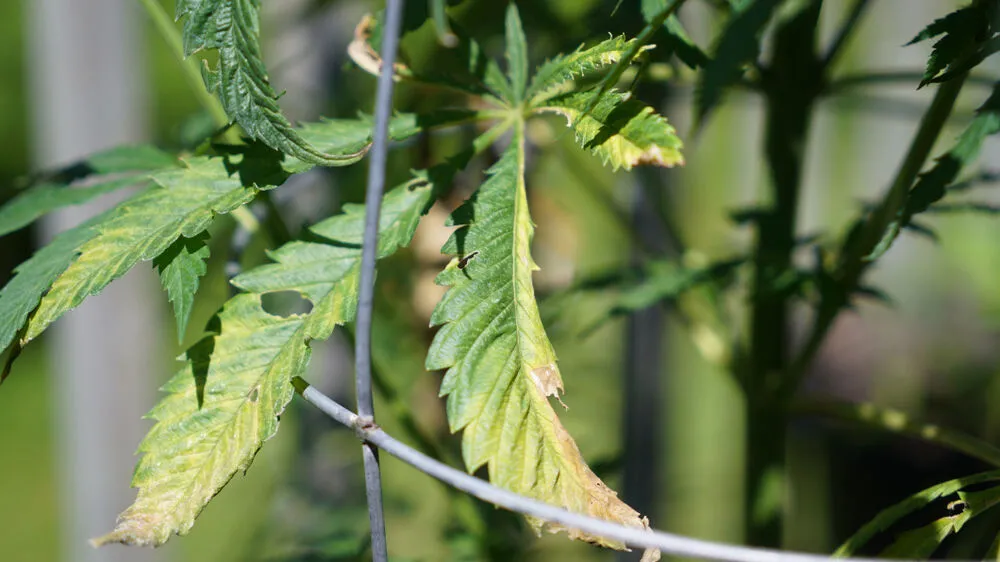
What is Potassium Deficiency in Cannabis and Why Does It Matter?
Potassium deficiency in cannabis occurs when a plant cannot access enough usable potassium to support healthy growth. Potassium is one of the three primary macronutrients required by cannabis plants. Understanding the correct NPK ratio for each growth stage helps ensure your plants receive enough potassium throughout their lifecycle. It helps regulate water movement, supports photosynthesis, transports sugars and nutrients, strengthens plant tissue, and Potassium plays an important role in producing the dense flowers expected from modern high-yield cannabis seeds.
Without enough available potassium, cannabis plants become less efficient at carrying out these essential functions. Growth slows, leaves become damaged, and flower production can suffer.
True Potassium Deficiency vs. Potassium Lockout
A true potassium deficiency occurs when the cannabis growing medium or nutrient solution doesn't contain enough potassium. Using the best nutrients for cannabis can help prevent this from happening.
Potassium lockout is different. The nutrient is present, but the roots cannot absorb it because of issues such as incorrect pH, salt buildup, overwatering, or poor root health. Learning how to prevent nutrient lockout in cannabis can help avoid this problem. In these cases, adding more potassium rarely solves the problem and can sometimes make it worse.
Nutrient Imbalances
Potassium deficiency symptoms can also develop when other nutrients interfere with uptake. Excessive levels of calcium, magnesium, or sodium may reduce the plant's ability to absorb potassium, even when enough is available. This is why it's important to maintain a balanced feeding program rather than increasing a single nutrient without diagnosing the cause.
Why Symptoms Appear on Older Leaves First
Potassium is a mobile nutrient, meaning the plant can relocate it from older leaves to support new growth when supplies become limited. As a result, the oldest leaves usually develop symptoms first, with yellowing around the edges followed by brown spots, burnt tips, and crispy margins. If the underlying problem isn't corrected, symptoms gradually spread upward through the plant.
Grower Tip: One of the first things I check when I suspect potassium deficiency is the root-zone pH rather than the nutrient bottle. In my experience, many plants showing potassium deficiency symptoms are actually suffering from nutrient lockout, and correcting the root-zone conditions often restores normal uptake.
How to Identify Potassium Deficiency in Cannabis
Potassium deficiency in cannabis usually develops in stages. The earliest signs tend to appear on older leaves near the bottom of the plant before the damage gradually spreads upward. However, no single symptom confirms the problem on its own. The most reliable identification comes from looking at the location, pattern, and progression of several symptoms together.
Early Symptoms of Potassium Deficiency
Early potassium deficiency is easy to overlook because the leaves may still appear mostly healthy. At this stage, the first changes usually develop around the outer edges of older leaves.
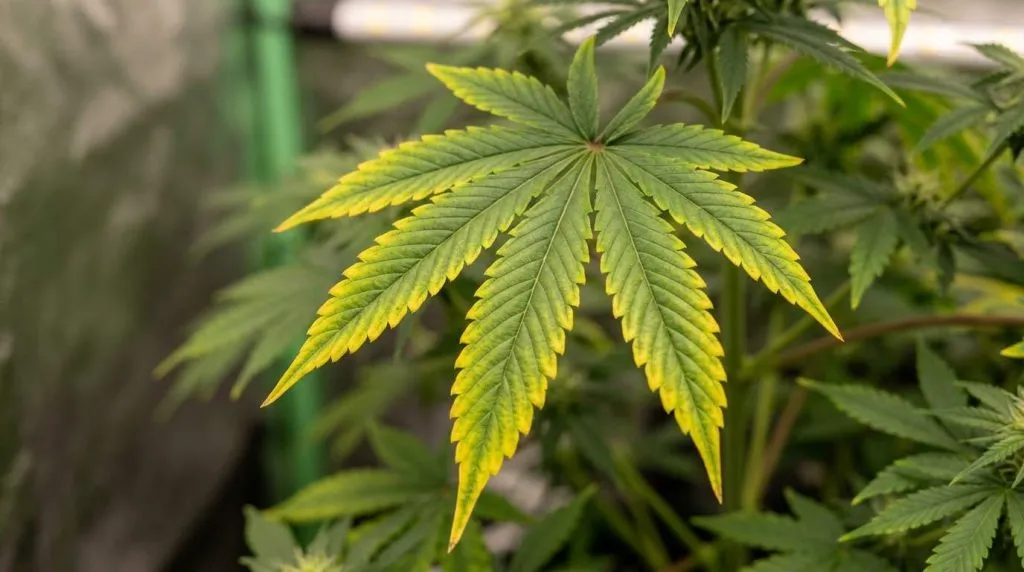
Yellowing Around the Leaf Edges
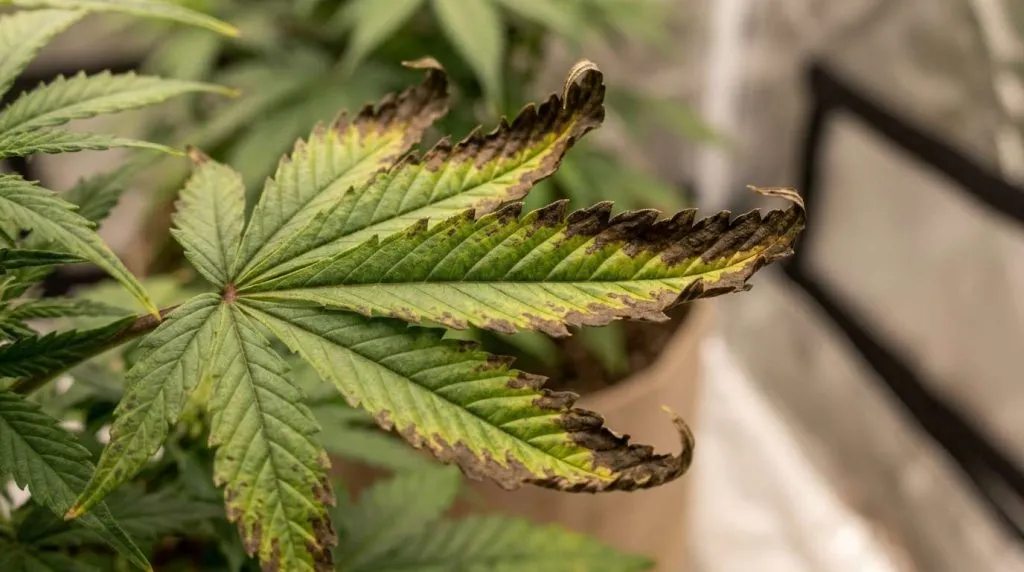
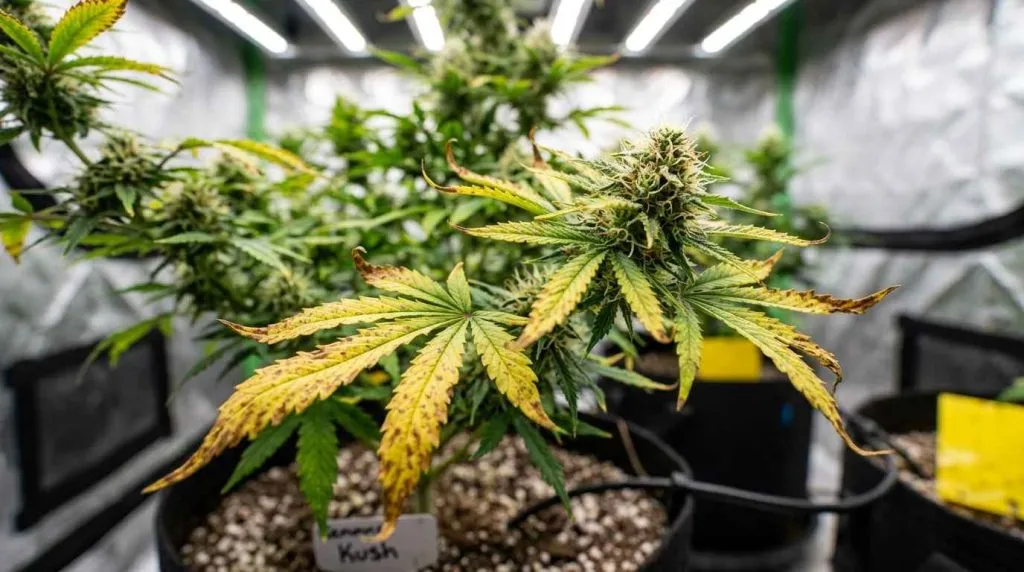
One of the first visible signs is yellowing along the tips and outer margins of older leaves. The center of the leaf may remain green while the edges gradually lose color.
This marginal yellowing is different from nitrogen deficiency, which usually causes the entire leaf to fade more evenly. With potassium deficiency, the discoloration normally begins around the outside of the leaf and slowly works inward.
Pale Leaf Margins
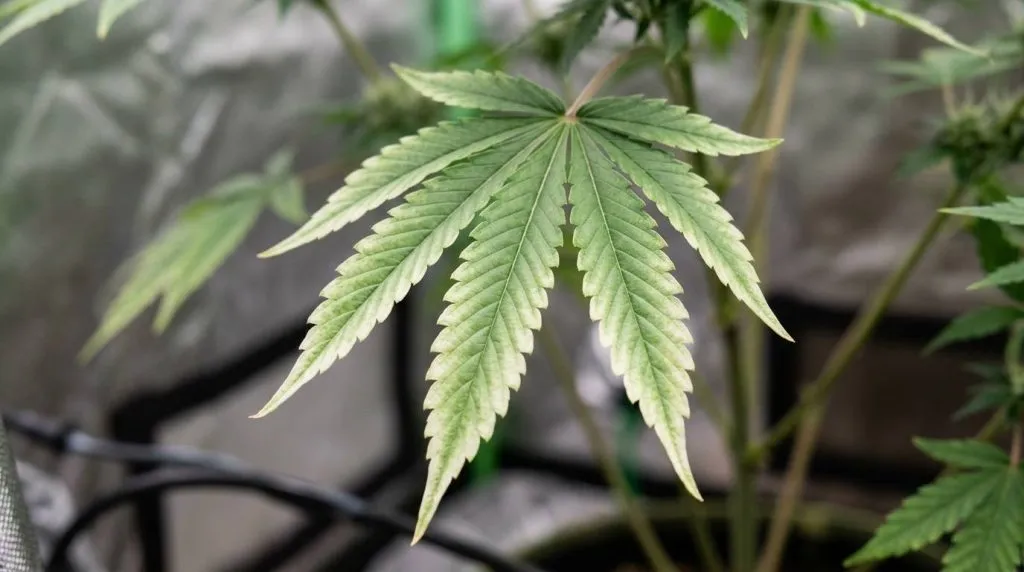
Before the edges turn fully yellow or brown, they may develop a pale, washed-out appearance. The leaf margins can look lighter than the tissue closer to the veins, even though there is no dead or crispy tissue yet.
This subtle fading is often one of the earliest warning signs and may appear on several lower leaves at the same time.
Older Leaves Are Affected First
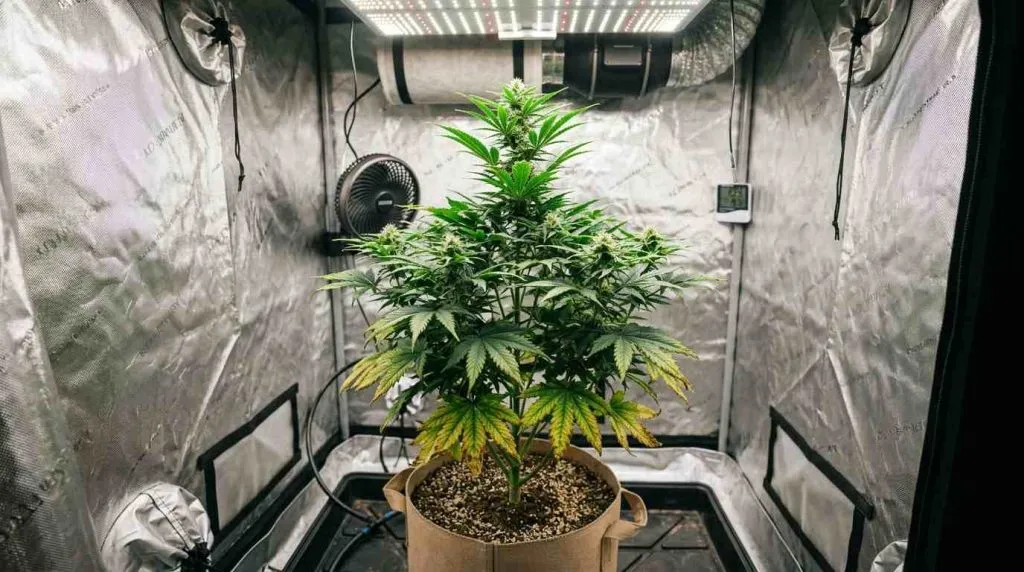
Potassium is a mobile nutrient, meaning the plant can move it from older tissue to support new leaves and growing tips. When available potassium becomes limited, the plant draws from its lower leaves first.
For this reason, early potassium deficiency normally begins in the lower canopy rather than at the top of the plant. Symptoms that start only on fresh growth may point to a different nutrient or root-zone problem.
Progressing Symptoms of Potassium Deficiency
If the underlying issue is not corrected, the pale and yellow areas begin to deteriorate. The leaf edges become increasingly dry, damaged, and discolored.
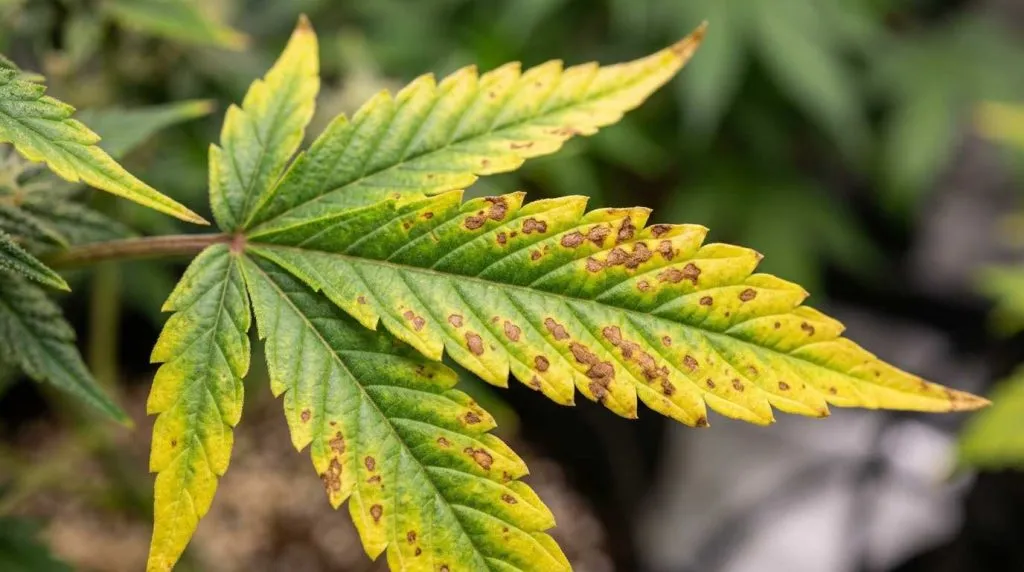
Brown or Rust-Colored Spots
Small brown, tan, or rust-colored spots may begin to form around the leaf margins or within previously yellow areas. These spots are sections of damaged tissue and often become larger as the deficiency progresses.
Unlike pest damage, which may create holes, trails, or irregular feeding marks, potassium-related spotting is usually dry and closely associated with yellowing or scorched-looking edges.
Burnt Leaf Tips
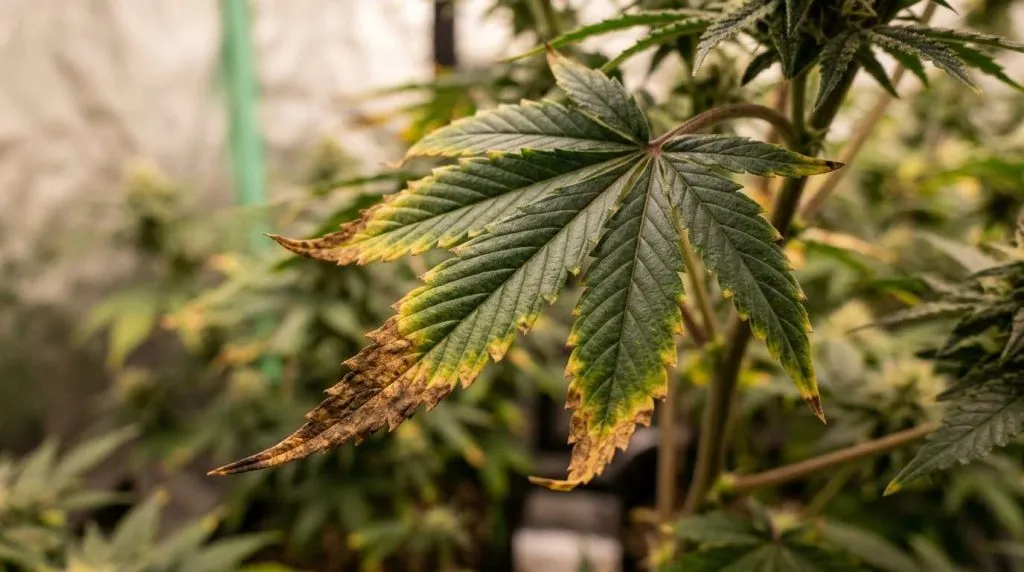
The tips of affected leaves may turn brown and appear burnt. This can look similar to nutrient burn, making it important to examine the rest of the leaf.
With potassium deficiency, burnt tips are commonly accompanied by yellow margins, brown spotting, and damage beginning on older leaves. Nutrient burn is more likely to produce sharply browned tips across many leaves, often alongside dark green foliage.
Crispy Leaf Margins
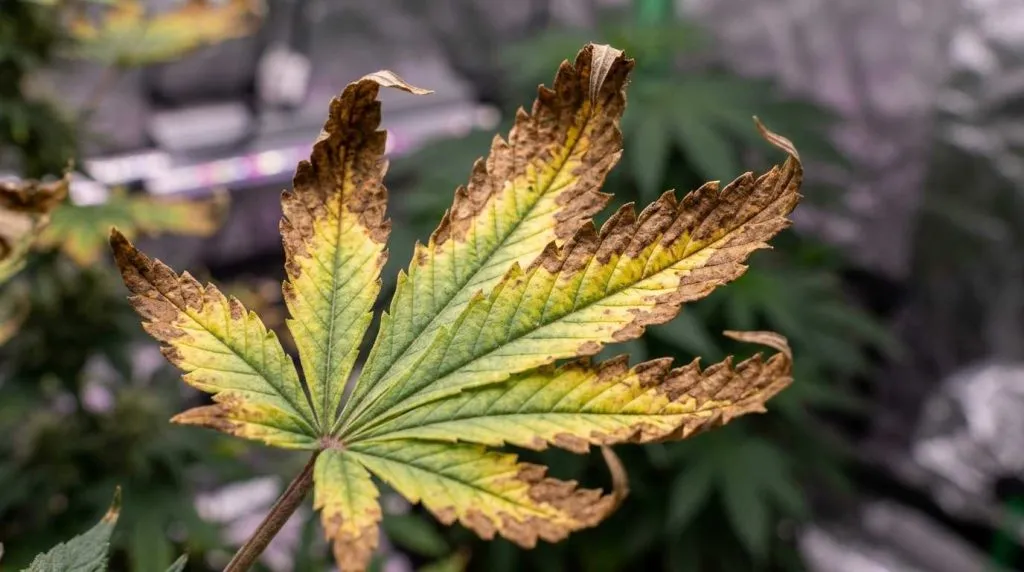
As damaged tissue loses moisture, the outer edges of the leaf become dry and brittle. The margins may feel rough or crispy and can crumble when handled.
This usually indicates that the deficiency has progressed beyond its earliest stage. Once tissue becomes brown and crispy, it will not return to green after the plant recovers.
Curling or Twisting Leaf Edges
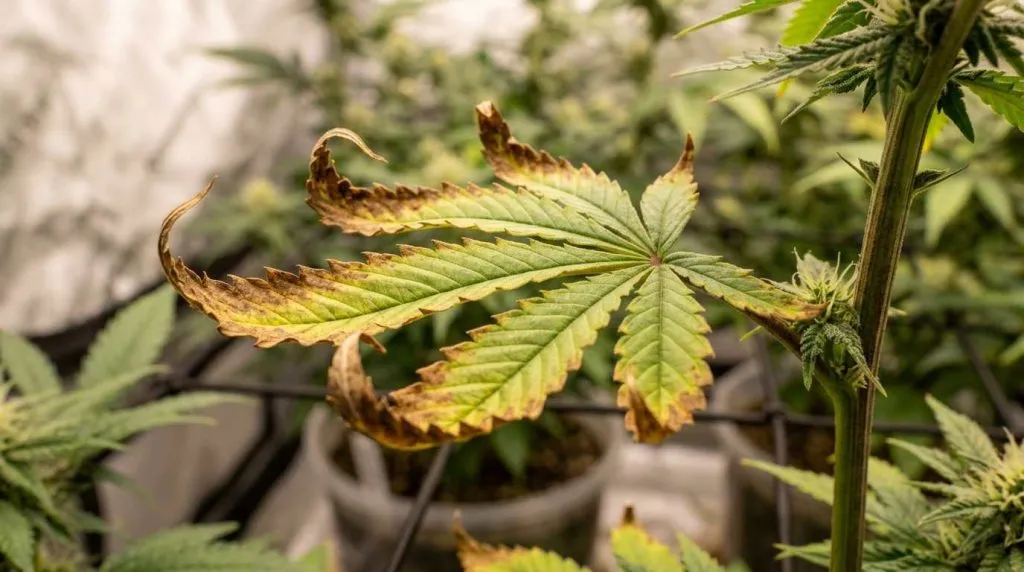
Affected leaf margins may begin to curl upward, bend, or twist around damaged areas. The curling leaves is often uneven and follows the yellow or brown edges rather than affecting the entire leaf in the same way.
Potassium helps plants regulate water movement, so a shortage can make it harder for leaf tissue to maintain normal moisture balance. However, curling can also result from heat, excessive light, overfeeding, or watering problems, so it should always be assessed alongside the other symptoms.
Advanced Symptoms of Potassium Deficiency
Advanced potassium deficiency affects more than the appearance of individual leaves. At this stage, the plant may lose functioning foliage, grow more slowly, and struggle to develop flowers properly.
Dead Leaf Tissue
Severely damaged areas eventually become necrotic, meaning the tissue has died. These sections may appear dark brown, gray, or almost black and will feel dry and brittle.
Dead tissue cannot recover. Treatment should focus on stopping the damage from spreading and protecting the remaining healthy growth.
Leaves Drying and Dropping
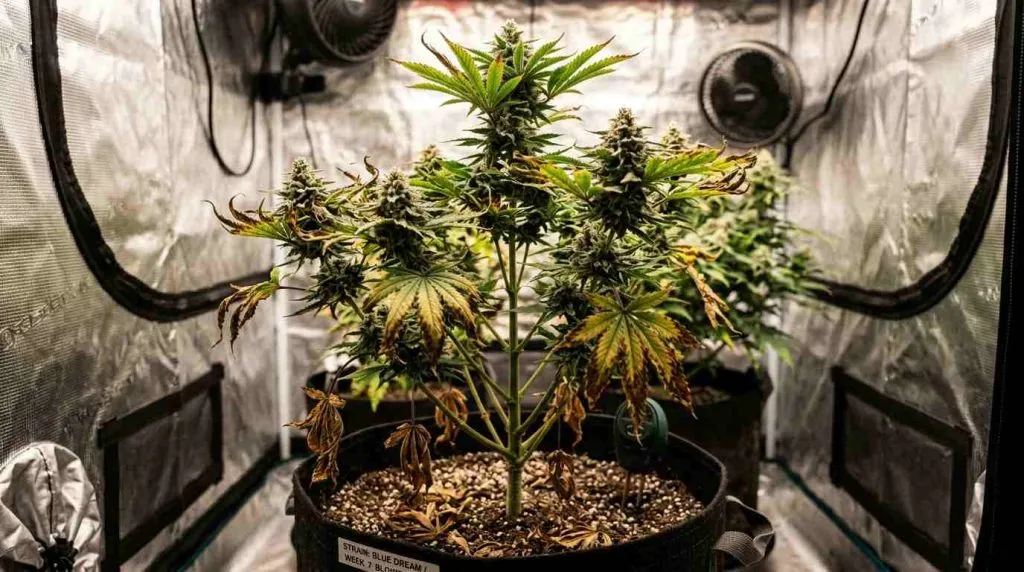
Older leaves may become so damaged that they dry out completely and fall from the plant. Some leaves may also detach easily when touched because the plant has already begun shedding the weakened tissue.
Losing a few badly damaged lower leaves is less concerning than seeing the symptoms continue to move upward after corrective action.
Slower Plant Growth
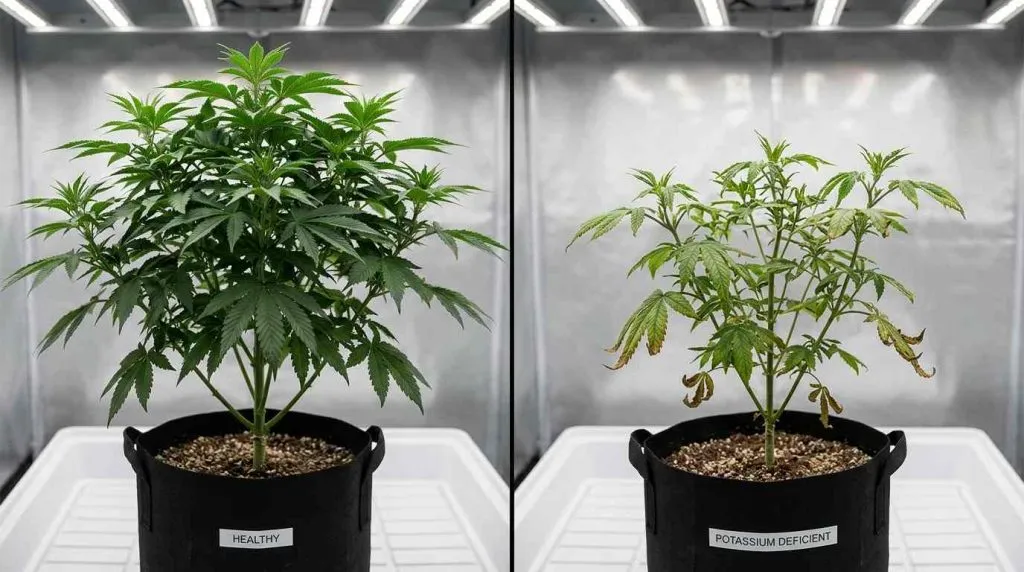
Potassium supports water regulation, photosynthesis, and the movement of sugars through the plant. When the deficiency becomes severe, these processes become less efficient and overall growth may slow.
You may notice smaller new leaves, reduced vertical growth, weaker branching, or a plant that appears to have stopped developing compared with healthy plants of the same age.
Poor Flower Development
During flowering, advanced potassium deficiency can reduce the plant’s ability to move sugars and energy toward developing buds. Flowers may swell more slowly, remain smaller, or develop a looser structure than expected.
Poor bud development alone does not confirm potassium deficiency, but it becomes more significant when combined with older leaves showing yellow margins, rust-colored spots, crispy edges, and necrotic tissue.
| Symptom | What it looks like | Typical stage |
| Yellow leaf edges | Yellowing begins around the outer margins | Early |
| Pale margins | Leaf edges look faded or washed out | Early |
| Older leaves affected first | Lower canopy shows symptoms before new growth | Early |
| Brown or rusty spots | Dry lesions form near yellow margins | Progressing |
| Burnt leaf tips | Tips turn brown and appear scorched | Progressing |
| Crispy leaf margins | Outer edges become dry and brittle | Progressing |
| Curling or twisting | Damaged edges bend, curl, or twist | Progressing |
| Dead tissue | Brown, gray, or black necrotic areas develop | Advanced |
| Leaf drop | Severely damaged older leaves dry and fall | Advanced |
| Slower growth | New growth and branching become less productive | Advanced |
| Poor flower development | Buds swell slowly or remain smaller and less dense | Advanced |
Grower Tip: Do not identify potassium deficiency from burnt tips or yellow leaves alone. Look for a combination of symptoms beginning on older leaves, especially marginal yellowing followed by rusty spots, crispy edges, and damage that progresses inward.
How to Diagnose Potassium Deficiency
Potassium deficiency can look similar to nutrient burn, nitrogen or magnesium deficiency, and environmental stress. Before adjusting the feeding schedule, check where the symptoms began, how the damage developed, and whether root-zone conditions could be limiting uptake.
Check Where the Damage Started
Potassium is a mobile nutrient, so symptoms usually begin on older leaves in the lower or middle canopy. Damage appearing only on fresh growth or leaves nearest the light is more likely to have another cause.
A typical progression is:
- Leaf margins become pale or yellow.
- Brown or rusty spots appear near the edges.
- Tips and margins become dry and crispy.
- Damaged edges curl or twist.
- Symptoms gradually spread upward.
Compare Similar Problems
| Problem | Typical signs | Main difference |
| Potassium deficiency | Yellow margins, rusty spots, burnt edges and curling on older leaves | Damage begins around the leaf edges and moves inward |
| Nutrient burn | Brown tips and dark green or clawed leaves | Tips may burn without widespread marginal yellowing |
| Nitrogen deficiency | Older leaves fade and turn yellow | The whole leaf usually yellows more evenly |
| Magnesium deficiency | Yellowing between green veins | Discoloration develops between the veins |
| Light stress | Bleaching or crispy patches near the canopy top | Damage is strongest closest to the light |
| Heat stress | Upward curling or canoe-shaped leaves | Usually affects exposed leaves during high temperatures |
Check the Root Zone
Potassium may be present but unavailable because of poor root-zone conditions. Check:
- pH: approximately 6.0–7.0 in soil and 5.5–6.5 in coco or hydroponics.
- EC: low readings may suggest underfeeding, while high runoff EC can indicate salt buildup.
- Feeding history: consider recent nutrient changes, flushing, underfeeding, or excessive calcium and magnesium.
- Watering: constantly wet media can reduce root oxygen, while repeated wilting can cause dry, curled margins.
- Root health: unhealthy roots may appear brown, slimy, damaged, or smell sour.
- Salt buildup: look for high runoff EC or white deposits around the growing medium and containers.
Monitor Before Making Major Changes
Avoid changing the pH, nutrient strength, watering schedule, and growing medium at the same time. Make one measured adjustment and monitor the plant over the following days.
Existing yellow or brown tissue will not recover. Improvement is shown when the damage stops spreading and healthy growth continues.
Grower Tip: Burnt tips alone do not confirm potassium deficiency. Look for several symptoms appearing together, especially yellow margins, rusty spots, and damage beginning on older leaves.
What Causes Potassium Deficiency?
Potassium deficiency can develop because the plant is not receiving enough potassium or because root-zone conditions are preventing it from absorbing what is already available. Identifying the cause is important, as adding more nutrients will not correct a pH, salt buildup, or root-health problem.
Insufficient Potassium
A genuine deficiency occurs when the feeding program does not supply enough potassium to meet the plant’s needs. This may happen when growers use depleted soil or choose a growing medium that isn't suitable. Choosing the best soil for cannabis can reduce the risk of deficiencies., apply nutrients too lightly, or continue using a vegetative fertilizer during flowering.
Cannabis typically requires more potassium as flowers develop, especially when growing high THC cannabis seeds with large, resin-rich flowers, so symptoms may appear after the transition to bloom if the feeding schedule is not adjusted.
Incorrect Root-Zone pH
When root-zone pH moves outside the suitable range, potassium becomes harder for the plant to absorb. This is known as nutrient lockout and can occur even when the growing medium contains sufficient potassium.
As a general guide, aim for:
- Soil: pH 6.0–7.0.
- Coco or hydroponics: pH 5.5–6.5.
Always follow the recommendations provided for your growing medium and nutrient line.
Excess Nutrients and Salt Buildup
Repeatedly applying strong nutrient solutions can cause mineral salts to accumulate around the roots. High salt levels make it more difficult for the plant to absorb water and nutrients, including potassium.
Common warning signs include high runoff EC, white deposits around pots or growing media, dark foliage, and burnt leaf tips.
Nutrient Imbalances
Excessive amounts of other minerals can compete with potassium uptake. High levels of calcium, magnesium, sodium, or ammonium may contribute to an imbalance, particularly when several supplements are combined.
In this situation, adding more potassium may increase the overall nutrient concentration without correcting the underlying competition.
Root Stress
Unhealthy roots cannot absorb nutrients efficiently. Common causes of root stress include:
- Overwatering: reduces oxygen around the roots.
- Poor drainage: keeps the growing medium saturated for too long.
- Root damage: may occur during transplanting or through root disease.
- Compacted media: restricts airflow, drainage, and root development.
Check root-zone conditions before assuming the feeding program is too weak.
Hydroponic Causes
Hydroponic systems require close monitoring because nutrient availability can change quickly. Common causes include:
- Incorrect reservoir pH: prevents normal potassium uptake.
- High EC: indicates an overly concentrated nutrient solution or salt accumulation.
- Old nutrient solution: may become unbalanced as plants absorb nutrients at different rates.
- Poor reservoir maintenance: warm temperatures, low oxygen, contamination, or infrequent changes can damage roots and interfere with absorption.
Grower Tip: If potassium deficiency appears despite regular feeding, investigate pH, EC, watering, and root health before increasing nutrient strength. The plant may be experiencing lockout rather than a genuine shortage.
How to Fix and Prevent Potassium Deficiency
Once you've identified potassium deficiency, resist the temptation to add more fertilizer straight away. In many cases, the plant already has access to enough potassium, but poor root-zone conditions are preventing it from absorbing the nutrient. Taking a systematic approach will help you solve the problem without creating new ones.
Step 1: Confirm the Cause
Before making any adjustments, ask yourself:
- Have the symptoms started on older leaves?
- Have you checked the root-zone pH?
- Has the feeding schedule recently changed?
- Could overwatering, poor drainage, or root damage be affecting nutrient uptake?
Answering these questions will help determine whether you're dealing with a genuine potassium deficiency or nutrient lockout.
Step 2: Check the Root Zone
Healthy roots are essential for nutrient uptake. Start by checking the root-zone pH, as incorrect pH is one of the most common causes of potassium lockout.
If you're growing in coco or hydroponics, measure the EC as well. A high EC may indicate salt buildup, while a very low EC could suggest the plant isn't receiving enough nutrients.
Also inspect the growing medium. If it remains constantly wet, drains poorly, or smells sour, the roots may not be functioning properly.
Step 3: Correct the Problem
Once you've identified the cause, make the appropriate adjustment.
- If pH is outside the recommended range: Correct it gradually so potassium becomes available again.
- If salt buildup is present: Flush the growing medium using pH-balanced water or a suitable flushing solution before returning to a balanced feeding schedule.
- If nutrients are insufficient: Increase feeding gradually using a complete fertilizer suitable for your growing medium and growth stage.
- If root health is poor: Improve drainage, avoid overwatering, and correct any issues restricting healthy root development.
Avoid changing several factors at once. Making one adjustment at a time makes it much easier to identify what solved the problem.
Step 4: Monitor Recovery
Potassium deficiency will not disappear overnight. Existing yellow, brown, or crispy leaves will remain damaged because dead tissue cannot recover.
Instead, monitor the plant for healthy new growth and check that the symptoms have stopped spreading to additional leaves. This is the clearest sign that the problem has been resolved.
Step 5: Prevent Potassium Deficiency Returning
Good growing habits are the best way to prevent future deficiencies. Build the following routine into every grow:
- Use a complete nutrient designed for your growing medium. If you're unsure which to choose, compare the best nutrients for soil, coco, and hydro.
- Check and adjust the root-zone pH regularly.
- Measure EC where appropriate, especially in coco and hydroponic systems.
- Avoid overfeeding, which can lead to salt buildup and nutrient lockout.
- Water correctly and allow the growing medium to drain well between irrigations where appropriate.
- Increase nutrient strength gradually as the plant transitions from vegetative growth into flowering.
- Keep a simple grow diary recording pH, EC, feeding, watering, and any changes in plant health.
By monitoring these factors throughout the grow, you'll often spot small problems before they develop into visible nutrient deficiencies.
Grower Tip: The healthiest cannabis plants come from consistency, not constant adjustments. Regularly checking pH, EC, and watering practices will prevent far more potassium deficiencies than trying to correct them after symptoms appear.
Conclusion
Potassium deficiency in cannabis is easiest to correct when it is identified early. Look for yellowing around the edges of older leaves, followed by brown spots, burnt tips, crispy margins, and curling as the problem develops.
Before adding more nutrients, check the root-zone pH, EC, watering habits, feeding history, and root health. Many apparent deficiencies are caused by nutrient lockout rather than a genuine lack of potassium.
Make one adjustment at a time and judge recovery by healthy new growth and damage no longer spreading. Existing leaves will remain marked, but stable root-zone conditions and balanced nutrition should allow the plant to continue developing normally.
Frequently Asked Questions
What Does Potassium Deficiency Look Like in Cannabis?
Potassium deficiency usually begins on older leaves. The outer edges become pale or yellow before developing brown spots, burnt tips, crispy margins, and curling. In advanced cases, damaged tissue dies and affected leaves may fall from the plant.
Does Potassium Deficiency Affect New or Old Leaves First?
Potassium deficiency normally affects older leaves first because potassium is a mobile nutrient. The plant moves available potassium from lower foliage to support newer growth. If symptoms begin only on fresh leaves, another nutrient or environmental problem may be responsible.
Can Incorrect pH Cause Potassium Deficiency?
Yes. Incorrect root-zone pH can prevent the roots from absorbing potassium even when the nutrient is present. This is known as potassium lockout. Check and correct the pH before increasing the nutrient strength.
How Long Does a Cannabis Plant Take to Recover?
You may notice the symptoms stop spreading within several days once the underlying cause has been corrected. Recovery time depends on the severity of the problem, the plant’s growth stage, and root health. Existing yellow or brown tissue will not repair itself.
Should I Remove Leaves Damaged by Potassium Deficiency?
Do not immediately remove every affected leaf. Partially green leaves can still contribute to photosynthesis, and their progression can help you monitor the plant. Remove leaves that are fully dead, brittle, or blocking airflow, but avoid stripping large amounts of foliage at once.


