




Magnesium deficiency in cannabis is one of the most common nutrient problems growers encounter, yet it is also one of the easiest to misdiagnose. While yellow leaves are often the first warning sign, several issues, including nitrogen deficiency, calcium deficiency, nutrient lockout, and poor watering practices, can produce similar symptoms. Knowing what to look for can help you identify the problem before it affects plant growth and flower production.
In this guide, you'll learn how to recognize the early signs of magnesium deficiency, understand why cannabis plants need magnesium, diagnose the underlying cause, and apply the correct solution. We'll also explain how to distinguish magnesium deficiency from other nutrient problems, prevent it from returning, and maintain healthy plants throughout every stage of growth. Whether you're growing in soil, coco, or hydroponics, this guide will help you confidently identify and correct magnesium deficiency in cannabis before it becomes a serious issue.
Key Takeaways
- Magnesium deficiency usually begins on older, lower fan leaves because magnesium is a mobile nutrient that the plant moves to support new growth.
- The most recognizable symptom is yellowing between the leaf veins, followed by rusty or brown spots, dry tissue, and brittle or curling leaves as the deficiency progresses.
- Incorrect root-zone pH is one of the most common causes of magnesium deficiency symptoms, even when enough magnesium is present in the growing medium or nutrient solution.
- Always diagnose the cause before adding supplements. Check pH, EC, watering practices, root health, and your nutrient program to determine whether the problem is a true deficiency or nutrient lockout.
- Successful treatment is measured by healthy new growth, not by damaged leaves turning green again. Once the underlying cause is corrected, symptoms should stop spreading and the plant can continue developing normally.
- What is Magnesium Deficiency in Cannabis?
- Why Do Cannabis Plants Need Magnesium?
- How to Identify Magnesium Deficiency in Cannabis Plants
- How to Diagnose Magnesium Deficiency in Cannabis
- Magnesium vs. Calcium, Nitrogen, and Potassium Deficiency
- What Causes Magnesium Deficiency in Cannabis?
- How to Fix and Prevent Magnesium Deficiency in Cannabis
- How Long Does Magnesium Deficiency Take to Recover?
- Conclusion
- Frequently Asked Questions
What is Magnesium Deficiency in Cannabis?
Magnesium deficiency in cannabis occurs when a plant cannot access enough usable magnesium to support healthy growth. This does not always mean the growing medium or nutrient solution contains too little magnesium. In many cases, magnesium is already present, but unsuitable root-zone conditions prevent the roots from absorbing it effectively.
Magnesium is classified as a secondary macronutrient and is required throughout the plant's entire lifecycle. Although cannabis needs less magnesium than nitrogen, phosphorus, and potassium, it remains essential for healthy photosynthesis, energy production, and plant development.
There are three main reasons cannabis plants develop magnesium deficiency symptoms:
| Type | Description |
| True deficiency | The best soil for cannabis plants should provide balanced nutrition, reliable drainage, and root-zone conditions that keep magnesium available. |
| Nutrient lockout | Magnesium is available but cannot be absorbed because of incorrect pH or excessive salt buildup. |
| Poor nutrient uptake | Magnesium is present, but damaged or stressed roots cannot absorb it efficiently. |
Understanding which situation you're dealing with is important because the treatment is different for each one. Adding more magnesium can solve a genuine deficiency, but it will not correct nutrient lockout or unhealthy roots. In fact, adding unnecessary supplements can increase the nutrient concentration and create further imbalances.
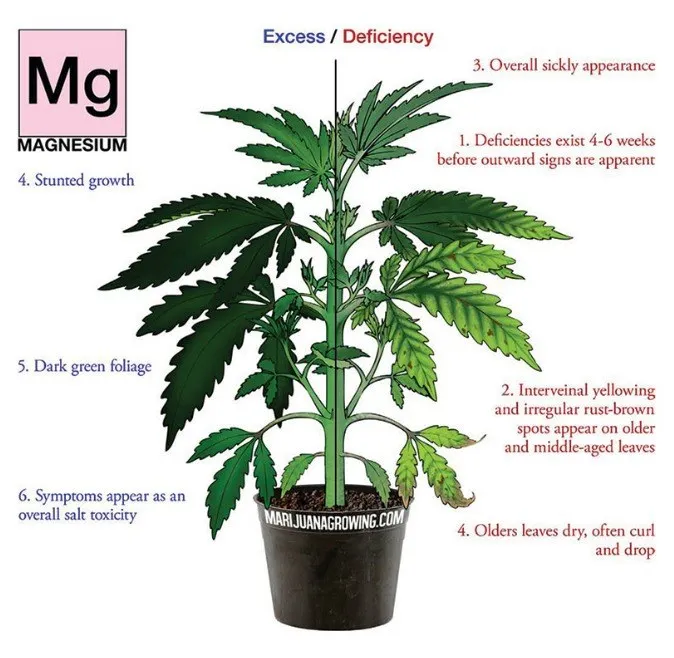
Magnesium is also a mobile nutrient, meaning the plant can move it from older leaves to support new growth when supplies become limited. This is why magnesium deficiency almost always appears on the older, lower fan leaves first before progressing upward.
Grower's Tip: Before reaching for Cal-Mag or another magnesium supplement, check your root-zone pH. Incorrect pH is one of the most common causes of magnesium deficiency symptoms, even when plenty of magnesium is already present.
Why Do Cannabis Plants Need Magnesium?
Magnesium plays an essential role in keeping cannabis plants healthy from seedling through harvest. While many growers recognize it as the nutrient that prevents yellow leaves, its role extends far beyond leaf color. Magnesium helps cannabis plants produce energy, support healthy growth, and make efficient use of light and nutrients throughout every stage of development.
Magnesium and Chlorophyll Production
One of magnesium's most important functions is its role in chlorophyll production. Chlorophyll is the green pigment that allows cannabis plants to absorb light and convert it into energy through photosynthesis.
The sugars produced during photosynthesis fuel virtually every aspect of plant growth, including root development, stem production, leaf expansion, and flower formation. Without enough magnesium, chlorophyll production declines, reducing the plant's ability to generate the energy needed for healthy growth.
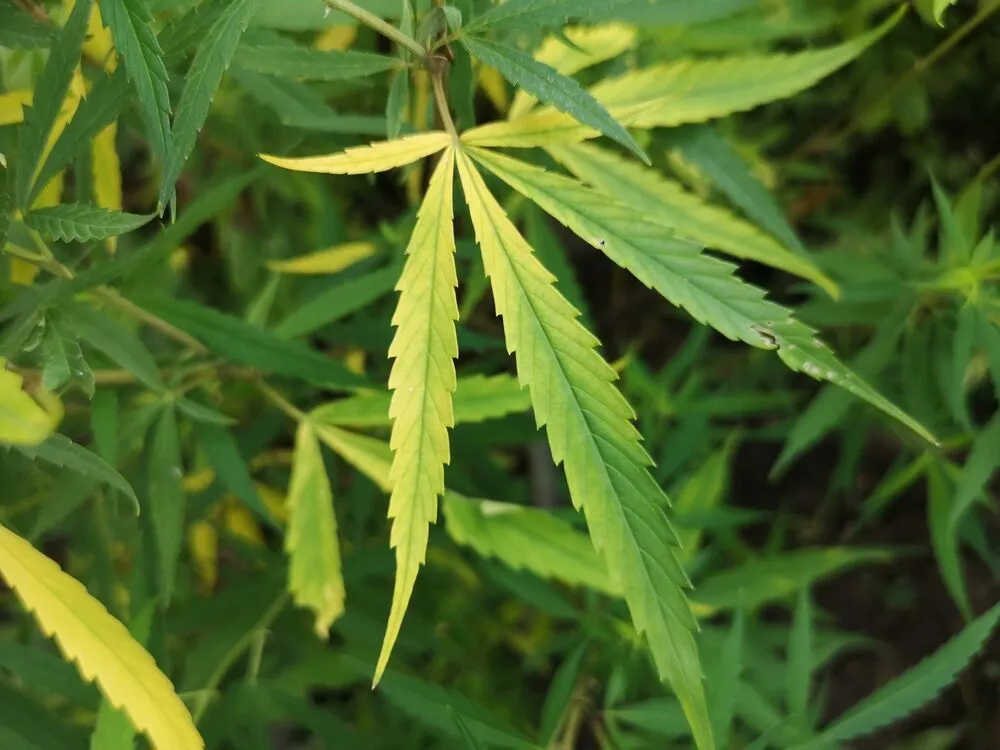
This is why magnesium deficiency typically causes interveinal chlorosis, where the tissue between the leaf veins turns yellow while the veins remain noticeably greener.
| Healthy Leaf | Magnesium-Deficient Leaf |
| Uniform green color | Yellowing between the veins |
| Efficient photosynthesis | Reduced photosynthesis |
| Healthy chlorophyll production | Reduced chlorophyll production |
| Flexible leaf tissue | Dry or brittle leaf tissue |
Because magnesium is mobile, cannabis prioritizes new growth by moving magnesium from older leaves. This natural survival response explains why lower fan leaves usually show symptoms first.
Grower's Tip: Don't expect damaged leaves to turn green again after treatment. Instead, monitor new growth and check that symptoms stop spreading to additional leaves.
Magnesium, Enzyme Activity and Plant Metabolism
Magnesium also supports hundreds of enzyme-driven processes that keep cannabis plants growing efficiently. These enzymes help convert light into usable energy, produce carbohydrates, build proteins, and transport sugars from the leaves to actively growing roots and flowers.
A simple way to think about magnesium is as one of the workers keeping the plant's internal factory running. Even if the plant receives plenty of water, light, and nutrients, production slows when those workers are missing. Growth often begins to slow before obvious yellowing appears, which is why healthy plants rely on a consistent supply of magnesium throughout their lifecycle.
Magnesium During Vegetative Growth and Flowering
During the vegetative stage, magnesium helps cannabis plants build a healthy canopy capable of capturing as much light as possible. Strong, green leaves produce the energy needed to develop roots, branches, and vigorous new growth.
As plants transition into flowering, they continue relying on photosynthesis while directing more energy toward flower production, which is why the correct cannabis NPK ratio for each growth stage matters. Magnesium deficiency often becomes noticeable during this stage, flowering itself does not cause magnesium deficiency. Instead, increased nutrient demand often exposes existing issues, particularly in fast-growing autoflower cannabis seeds.
Many beginner growers assume yellowing leaves during flowering automatically mean the plant needs more nutrients, but natural fading and knowing when to stop feeding cannabis nutrients should also be considered. However, experienced growers know the first step is always to identify why the deficiency has developed before adjusting the feeding program.
Grower's Tip: If yellowing begins between the veins of older fan leaves while the newest growth remains healthy, check your pH and root-zone conditions before increasing nutrient strength. Correcting the underlying cause is usually more effective than simply adding more fertilizer.
How to Identify Magnesium Deficiency in Cannabis Plants
Correctly identifying magnesium deficiency in cannabis is essential before changing your feeding program. While yellow leaves are often the first symptom growers notice, several other problems can produce similar signs, including nitrogen deficiency, calcium deficiency, light stress, and watering issues.
Instead of focusing on a single symptom, experienced growers look at where the symptoms begin, how they develop, and which leaves are affected. This approach makes magnesium deficiency much easier to distinguish from other nutrient problems.
Where Magnesium Deficiency Appears First
Magnesium is a mobile nutrient, so cannabis plants move it from older leaves to support new growth when supplies become limited. As a result, magnesium deficiency almost always begins on the older, lower fan leaves before progressing upward.
The newest growth usually remains healthy during the early stages, making leaf position one of the easiest ways to identify the problem.
Grower's Tip: Always inspect the entire plant, not just the most damaged leaf. Where the symptoms begin is often just as important as the symptoms themselves.
Symptoms Through Each Stage of Deficiency
Magnesium deficiency develops gradually rather than overnight.
| Stage | Symptoms |
| Early | Pale green tissue develops between the veins of older leaves. |
| Developing | Yellowing becomes more obvious while the veins remain greener. |
| Moderate | Rust-colored or brown spots begin appearing. |
| Advanced | Leaves become dry, brittle, and may eventually die and fall away. |
Symptoms at Different Growth Stages
| Growth Stage | Typical Symptoms |
| Seedling | Rare. Usually caused by severe pH or nutrient issues. |
| Vegetative | Pale tissue develops between the veins of older leaves. Growth may slow slightly. |
| Early Flower | Yellowing becomes more noticeable as nutrient demand increases. Rust spots may begin appearing. |
| Mid to Late Flower | Symptoms spread upward, and older leaves may become brittle and drop. |
Early Signs of Magnesium Deficiency
The first visible symptom is usually interveinal chlorosis, where the tissue between the veins turns pale green or yellow while the veins remain darker.
Early symptoms include:
- Pale green tissue between the veins
- Older fan leaves losing color first
- Green veins remaining visible
- Slightly slower growth
- Dull-looking foliage
Catching the deficiency at this stage gives growers the best chance of preventing permanent leaf damage.
Yellowing Leaves
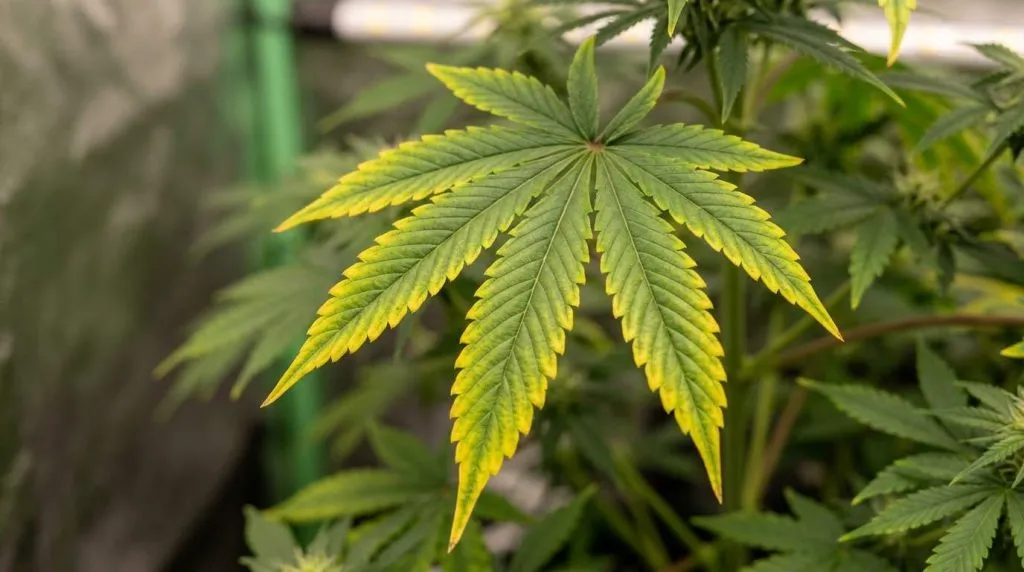
Yellow leaves alone do not confirm magnesium deficiency.
With magnesium deficiency, the yellowing develops between the veins. Nitrogen deficiency, by comparison, usually causes more even yellowing across the entire leaf.
| Problem | Where It Begins | Yellowing Pattern |
| Magnesium deficiency | Older leaves | Yellowing between green veins |
| Nitrogen deficiency | Older leaves | Uniform yellowing |
| Calcium deficiency | New growth | Irregular spotting and distorted leaves |
| Light stress | Upper canopy | Bleaching closest to the light |
Rusty or Brown Spots
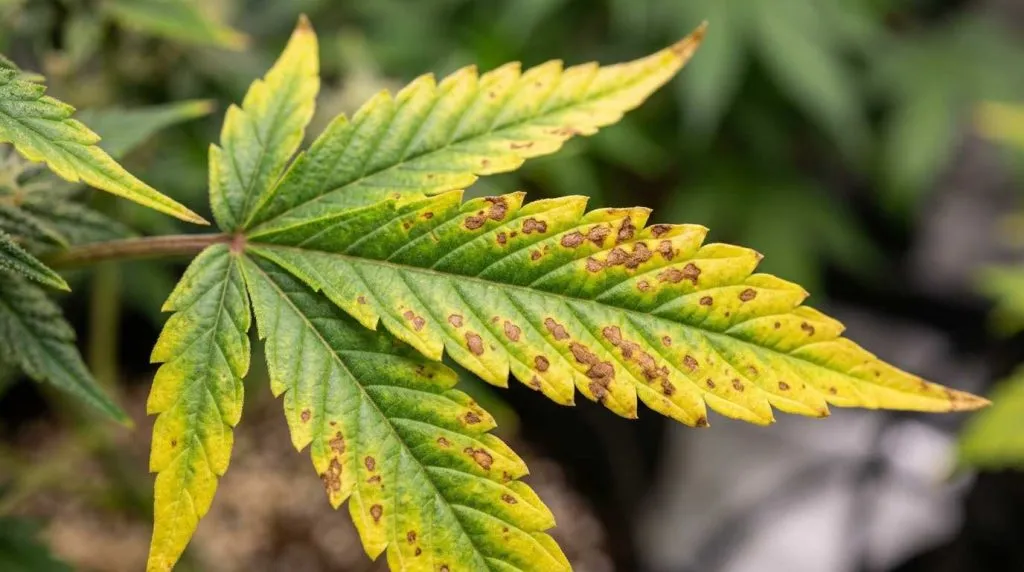
As the deficiency progresses, rusty or brown spots often develop on the yellowing tissue. These spots form as sections of the leaf begin to die.
Brown spots alone do not confirm magnesium deficiency because they can also result from calcium deficiency, potassium deficiency, pests, or fungal diseases. They should always be considered alongside the location and pattern of the yellowing.
Curling, Dry and Brittle Leaves
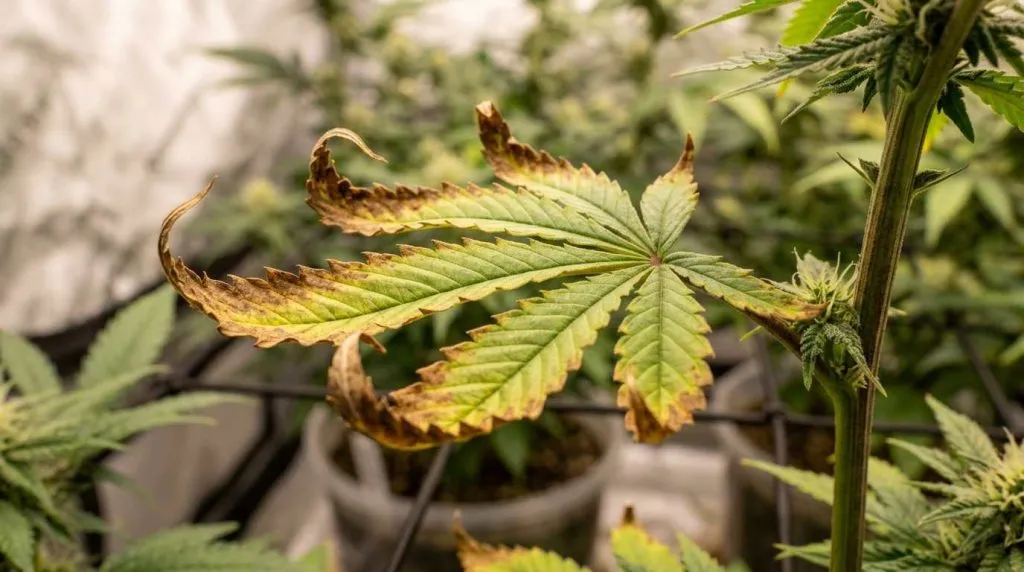
In advanced cases, affected leaves become dry, brittle, or papery, and the edges may curl upward.
These symptoms can also be caused by heat stress, underwatering, overwatering, or nutrient burn, so they should never be used as the only diagnostic sign.
Advanced Magnesium Deficiency Symptoms
If left untreated, magnesium deficiency continues spreading through the lower canopy and eventually reaches the middle of the plant.
Common advanced symptoms include:
- Extensive interveinal yellowing
- Rust-colored or brown patches
- Dry, brittle foliage
- Curling leaf edges
- Older leaves dying and dropping
- Reduced plant vigor and slower flower development
Damaged leaves rarely return to green after treatment. Instead, recovery is shown by healthy new growth and symptoms no longer spreading.
How to Diagnose Magnesium Deficiency in Cannabis
Diagnosing magnesium deficiency in cannabis requires more than spotting one yellow leaf. Look at where the symptoms began, how the discoloration is developing, and what has changed in the root zone or feeding program.
Check Where the Symptoms Started
Magnesium is a mobile nutrient, so deficiency symptoms usually begin on older, lower fan leaves. New growth often remains healthy at first. If symptoms begin on young growth and include mottling or small necrotic spots, investigate manganese deficiency in cannabis instead.
Examine the Yellowing Pattern
Look for yellowing between the veins while the veins remain greener. This pattern is called interveinal chlorosis and is one of the clearest signs of magnesium deficiency. Uniform yellowing across the entire leaf is more commonly associated with nitrogen deficiency.
Look for Supporting Symptoms
As the problem progresses, affected leaves may develop rusty or brown spots, dry tissue, brittle edges, and upward curling. These symptoms should support the diagnosis rather than be used alone, since heat stress, pests, and other nutrient problems can produce similar damage.
Measure Root-Zone pH
Check the pH of the nutrient solution, reservoir, and runoff where appropriate. Magnesium uptake can be restricted when pH moves outside the suitable range. Aim for approximately 6.0 to 7.0 in soil and 5.5 to 6.5 in coco or hydroponic systems.
Review EC, Feeding and Water Quality
Check whether EC is unusually high, whether feeding strength recently increased, and whether several supplements are being combined. Also consider very soft or reverse-osmosis water, which may contain little calcium or magnesium.
Rule Out Similar Cannabis Problems
Compare the symptom pattern before treating. Nitrogen deficiency causes more even yellowing, calcium deficiency affects new growth, potassium deficiency often damages leaf edges, and light stress usually appears near the top of the canopy.
Grower Tip: Confirm the symptom pattern and root-zone conditions before adding Cal-Mag. Treating the wrong problem can increase EC and make nutrient uptake worse.
Magnesium vs. Calcium, Nitrogen, and Potassium Deficiency
Magnesium deficiency in cannabis is commonly confused with calcium, nitrogen, and potassium deficiencies because all four can cause yellowing, brown spots, or damaged leaves. The easiest way to separate them is to examine where the symptoms first appeared and how the damage is distributed across each leaf.
| Deficiency | Where Symptoms Appear First | Main Symptoms |
| Magnesium | Older, lower leaves | Yellowing between greener veins, followed by rusty spots, brittle tissue, and curling |
| Calcium | New leaves and growing tips | Distorted new growth, irregular brown spots, weak stems, and damaged root tips |
| Nitrogen | Older, lower leaves | Even yellowing across the entire leaf, usually beginning at the tip and spreading inward |
| Potassium | Older leaves | Yellow or burnt leaf edges, brown margins, weak stems, and curling near the edges |
Both magnesium and nitrogen are mobile nutrients, so their deficiencies normally begin on older leaves. The key difference is the yellowing pattern. Magnesium deficiency causes interveinal chlorosis, while nitrogen deficiency produces more uniform yellowing across the leaf.
Calcium deficiency usually affects new growth because calcium is not easily moved from older leaves. Potassium deficiency can begin on older foliage like magnesium deficiency, but the damage is normally concentrated around the tips and edges rather than between the veins.
Grower Tip: Do not diagnose a deficiency from brown spots alone. Check the age of the affected leaves and the pattern that appeared before the spots developed.
What Causes Magnesium Deficiency in Cannabis?
Magnesium deficiency in cannabis is not always caused by a lack of magnesium in the growing medium or nutrient solution. More often, the nutrient is present but the plant cannot absorb or use it efficiently. Identifying the underlying cause is essential because adding more magnesium will not solve problems such as nutrient lockout or poor root health.
Incorrect Root-Zone pH
Incorrect root-zone pH is one of the most common causes of magnesium deficiency in cannabis. When pH moves outside the suitable range, magnesium becomes less available, even if it is present in the feed.
As a general guide, maintain a pH of 6.0-7.0 in soil and 5.5-6.5 in coco or hydroponic systems. Check the nutrient solution before feeding and monitor your reservoir or runoff regularly to identify trends before symptoms appear.
Insufficient Magnesium in the Nutrient Program
A true deficiency occurs when the nutrient program simply does not supply enough magnesium. This may result from using an incomplete fertilizer, feeding below the recommended strength, or using nutrients designed for a different growing medium.
Before adding supplements or homemade cannabis fertilizer, check whether your base nutrient already contains enough magnesium. Many complete fertilizers provide sufficient amounts when used correctly, but the best nutrients for cannabis plants will depend on whether you are growing in soil, coco, or hydro.
Coco Coir That Has Not Been Properly Buffered
Coco coir can increase the risk of magnesium deficiency if it has not been properly buffered. The growing medium naturally binds calcium and magnesium, making them less available to the roots during the early stages of growth.
Using pre-buffered coco and a nutrient program formulated specifically for coco helps reduce this risk. Avoid assuming every coco grow requires additional Cal-Mag, as many coco nutrients already contain adequate levels.
Soft Water and Reverse-Osmosis Water
Soft water and reverse-osmosis water contain very few dissolved minerals, including calcium and magnesium. Depending on your nutrient program, additional supplementation may be required. In contrast, hard water may already contain significant amounts of these minerals, so adding Cal-Mag without checking your water quality can create nutrient imbalances.
Nutrient Buildup and High EC
High EC or salt buildup can prevent roots from absorbing magnesium efficiently. This often occurs when nutrients are mixed too strongly, several supplements are used together, or fertilizer residue accumulates in the growing medium.
Excess calcium or potassium can also compete with magnesium uptake, creating deficiency symptoms even when magnesium is present.
Overwatering and Poor Root Health
Healthy roots need oxygen as well as moisture, making proper watering especially important when growing indoor cannabis seeds in containers. Overwatering, compacted growing media, poor drainage, root disease, or cold root temperatures can all reduce the plant's ability to absorb magnesium. If the entire plant appears unhealthy, always inspect the root zone before increasing nutrient strength.
Excessive Nutrient Correction
Adding multiple magnesium products in an attempt to fix the problem can often make it worse. Raising EC unnecessarily may increase nutrient lockout and create further imbalances between magnesium, calcium, and potassium.
Grower's Tip: Before adding Cal-Mag or Epsom salt, check your pH, EC, feeding history, and root health. In many cases, correcting the root-zone conditions restores magnesium uptake without increasing nutrient strength.
How to Fix and Prevent Magnesium Deficiency in Cannabis
Fixing magnesium deficiency in cannabis is not simply a case of adding Cal-Mag or Epsom salt. The correct treatment also depends on the cannabis growing medium, since soil, coco, and hydro systems manage water and nutrients differently.
Use the following step-by-step process to correct the issue and reduce the risk of it returning.
Step 1: Confirm That Magnesium Is the Problem
Check that the symptoms match magnesium deficiency before changing the feeding program.
Look for:
- Yellowing between the veins of older, lower leaves
- Veins remaining greener than the surrounding tissue
- Rusty or brown spots developing after the yellowing
- Dry, brittle, or upward-curling leaves
- New growth remaining relatively healthy during the early stages
If symptoms begin on new growth, appear mainly along leaf edges, or affect the entire leaf evenly, another deficiency may be responsible.
Step 2: Check Root-Zone pH
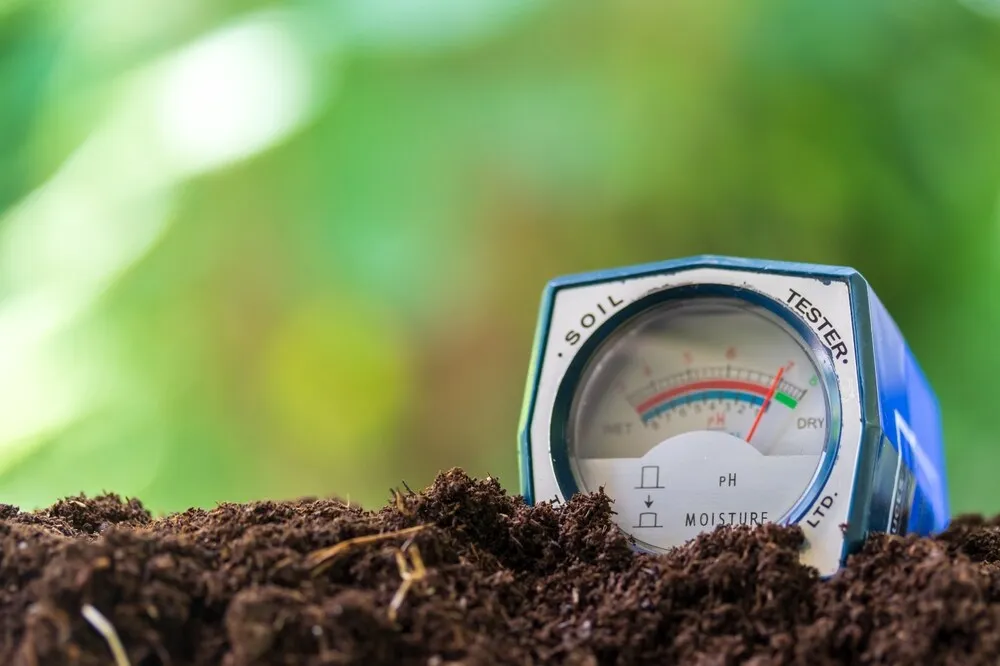
Incorrect pH is one of the most common reasons cannabis plants cannot absorb magnesium.
Measure the pH of the water or nutrient solution before feeding. In hydroponics, test the reservoir. Soil and coco growers can also use runoff readings to identify ongoing trends.
Aim for approximately:
| Growing Medium | Recommended pH Range |
| Soil | 6.0 to 7.0 |
| Coco | 5.5 to 6.5 |
| Hydroponics | 5.5 to 6.5 |
If the pH is outside the suitable range, correct it gradually. Do not add more magnesium until the root-zone pH has been brought back under control.
Step 3: Check EC and Salt Buildup
Next, review the EC and recent feeding history.
High EC can restrict water and nutrient uptake even when enough magnesium is present. Salt buildup is more likely if:
- Nutrients have been mixed too strongly
- Several supplements are being used together
- Fertilizer residue has accumulated in the medium
- Coco has not produced sufficient runoff
- A hydroponic reservoir has not been refreshed
If EC is much higher than expected, reduce nutrient strength or flush the medium only where salt buildup is clearly present. Do not automatically flush an underfed plant, as this can remove more nutrients and make the deficiency worse.
Step 4: Inspect Root Health and Watering Practices
Healthy roots need oxygen as well as moisture.
Check for:
- Constantly wet growing media
- Poor drainage
- Compacted soil or coco
- Cold root-zone temperatures
- Brown, slimy, or unhealthy roots
- Plants that are severely root-bound
If the root zone is waterlogged, allow the medium to dry appropriately before watering again. Improve drainage and reduce watering frequency where necessary.
Step 5: Review the Existing Nutrient Program
Read the label on the base nutrient before adding a separate magnesium product. Many complete cannabis fertilizers already contain magnesium.
Ask:
- Is the nutrient designed for soil, coco, or hydro?
- Is it being used at the intended strength?
- Does it already contain calcium and magnesium?
- Has another supplement recently been added?
- Is the water naturally hard, soft, or reverse osmosis?
This prevents unnecessary nutrient stacking.
Step 6: Add Magnesium Only When Required
If pH, EC, and root health are suitable but the symptoms still indicate a genuine shortage, add magnesium using a product appropriate for the growing system.
Possible options include:
- A complete base nutrient containing magnesium
- A magnesium-only supplement
- A Cal-Mag product
- Magnesium sulfate, commonly known as Epsom salt
Follow the product label and begin conservatively. Avoid combining several magnesium-containing products at once, as this can raise EC and interfere with calcium or potassium uptake.
Step 7: Treat According to the Growing Medium
| Growing Medium | Step-by-Step Treatment |
| Soil | Check pH, allow proper dry-back, confirm the base fertilizer contains magnesium, and supplement only if a true shortage is present. Avoid heavy flushing unless salt buildup has been confirmed. |
| Coco | Confirm the coco was buffered, maintain suitable pH and EC, use a coco-specific nutrient, and review the mineral content of the water before adding Cal-Mag. |
| Hydroponics | Test reservoir pH and EC, inspect roots, correct water temperature if necessary, replace an unstable nutrient solution, and add magnesium at a measured rate. |
Step 8: Monitor the Plant’s Recovery
Previously damaged leaves may remain yellow or spotted, so do not judge treatment by whether old foliage returns to green.
Look for:
- Symptoms no longer spreading
- Healthy new growth
- Stable pH and EC
- Improved growth rate
- No new rust spots on unaffected leaves
Take photographs before treatment and compare them every few days. This makes it easier to see whether the plant is stabilizing.
Step 9: Prevent Magnesium Deficiency From Returning
Once the plant has recovered, focus on maintaining stable conditions.
- Check pH regularly rather than waiting for symptoms.
- Monitor EC in coco and hydro.
- Use nutrients designed for the growing medium.
- Understand the mineral content of the water supply.
- Use properly buffered coco.
- Avoid combining unnecessary supplements.
- Maintain good drainage and appropriate watering intervals.
- Inspect older fan leaves during vegetative growth and early flowering.
- Record feeding changes, pH, and EC in a grow log.
Grower Tip: Make one correction at a time. If you change pH, nutrient strength, supplements, and watering on the same day, it becomes difficult to identify which adjustment solved the problem.
How Long Does Magnesium Deficiency Take to Recover?
A cannabis plant may begin stabilizing within several days after the underlying cause has been corrected, but the exact recovery time depends on the severity of the deficiency and the condition of the roots.
Do not expect damaged leaves to repair themselves. Recovery is shown by healthy growth and symptoms no longer spreading. If the plant continues to decline after pH, EC, and root conditions have been corrected, review the diagnosis before applying more magnesium.
Conclusion
Magnesium deficiency in cannabis is most successfully treated when it's identified early and the underlying cause is corrected. While yellowing between the veins of older leaves, rusty spots, and brittle foliage are classic symptoms, they do not always mean the plant needs more magnesium. In many cases, the problem lies with incorrect root-zone pH, high EC, salt buildup, poor watering practices, or unhealthy roots preventing nutrient uptake.
Rather than immediately reaching for Cal-Mag or another supplement, take a systematic approach. Check the symptom pattern, measure your pH and EC, review your feeding program, and assess root health before making any adjustments. Once the root zone is stable, healthy new growth should appear and the symptoms should stop spreading. Although damaged leaves may not recover, correcting the problem early will help the plant continue growing and producing healthy flowers for the rest of its lifecycle.
Frequently Asked Questions
What Is the First Sign of Magnesium Deficiency in Cannabis?
The first sign is usually pale green or yellow tissue developing between the veins of older, lower fan leaves. The veins often remain noticeably greener, creating a striped or marbled appearance known as interveinal chlorosis.
Can Magnesium Deficiency Cause Brown Spots on Cannabis Leaves?
Yes. Rusty, tan, or brown spots can appear as magnesium deficiency progresses and damaged tissue begins to die. Brown spots alone do not confirm the problem, so check whether they developed after interveinal yellowing on older leaves.
Does Magnesium Deficiency Cause Cannabis Leaves to Curl?
It can. Affected leaves may become dry, brittle, and curl upward as the deficiency becomes more advanced. Curling can also be caused by heat stress, watering problems, nutrient burn, or root damage, so it should not be used as the only diagnostic sign.
Can Cannabis Plants Recover From Magnesium Deficiency?
Yes, cannabis plants can recover if the underlying cause is corrected before the damage becomes severe. Existing yellow or brown areas may not return to green, so judge recovery by healthy new growth and symptoms no longer spreading.
Should You Use Cal-Mag or Epsom Salt for Magnesium Deficiency?
Only use a supplement after checking pH, EC, root health, and the existing nutrient program. Cal-Mag may be useful when both calcium and magnesium are needed, while Epsom salt supplies magnesium sulfate. Follow a verified product rate and avoid combining multiple magnesium sources.


