




Nitrogen deficiency in cannabis is a common nutrient issue during vegetative growth, when plants require high nitrogen to build leaves, stems, and branches. If left untreated, it can slow growth, reduce canopy development, and limit flower production.
However, yellow leaves do not always indicate nitrogen deficiency. Similar symptoms can result from incorrect root-zone pH, nutrient lockout, overwatering, or poor root health. Adding more fertilizer without proper diagnosis may worsen the problem or delay recovery.
This guide shows how to identify nitrogen deficiency in cannabis, diagnose its root cause, and correct it safely. You will learn key symptoms, how to distinguish it from other nutrient issues, and practical steps growers use to restore healthy growth and prevent recurrence. Early detection and correct diagnosis are essential for preventing long-term plant stress and ensuring consistent yields. Proper environmental control and feeding practices help maintain stable nitrogen levels throughout growth cycles and stages.
Key Takeaways
- Nitrogen deficiency starts on lower leaves as nitrogen moves to new growth, causing pale then yellow foliage in plants.
- Yellow leaves aren't always nitrogen deficiency. pH issues, lockout, overwatering, or salt buildup can look similar, so diagnose first before adjusting nutrients.
- Healthy roots are essential for nitrogen uptake. Correct pH, EC, and watering are as important as feeding nitrogen for growth.
- Fix deficiencies gradually. Restore root-zone health first, then raise nitrogen slowly while monitoring plants to avoid new imbalances carefully.
- Old yellow leaves won't recover. Look for healthy new growth and stopped yellowing as signs of improvement overall health.
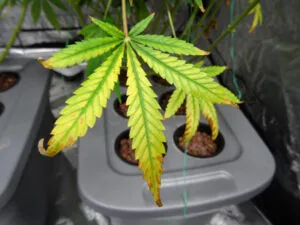
- What is Nitrogen Deficiency in Cannabis?
- How to Identify Nitrogen Deficiency in Cannabis Plants
- How to Diagnose Nitrogen Deficiency in Cannabis
- Nitrogen vs Magnesium, Potassium and Sulfur Deficiency
- What Causes Nitrogen Deficiency in Cannabis?
- How to Fix and Prevent Nitrogen Deficiency in Cannabis
- How Long Does Nitrogen Deficiency Take to Recover?
- Is Yellowing During Flowering Always Nitrogen Deficiency?
- Should You Remove Nitrogen-Deficient Leaves?
- Nitrogen Deficiency in Autoflowering Cannabis
- Conclusion
- Frequently Asked Questions
What is Nitrogen Deficiency in Cannabis?
Nitrogen deficiency in cannabis occurs when a plant cannot access enough nitrogen to support healthy growth. While this may result from an insufficient nitrogen supply, it can also happen when nitrogen is present but cannot be absorbed because of problems such as incorrect root-zone pH, poor root health or nutrient lockout.
Nitrogen is a mobile nutrient, meaning the plant can move it from older leaves to support new growth when supplies become limited. As a result, the earliest symptoms usually appear on the lower leaves before progressing upwards if the problem isn't corrected.
The first signs are often a gradual loss of green colour, followed by yellowing, slower growth and reduced plant vigour. As the deficiency becomes more severe, affected leaves may dry out, die and eventually fall away.
Fortunately, nitrogen deficiency is usually straightforward to correct once the underlying cause has been identified. The key is diagnosing the problem accurately before adjusting your feeding programme, as several other issues can produce similar symptoms.
Grower Tip: Don't react to a single yellow leaf. Look for a consistent pattern developing across several older leaves before assuming your plant has a nitrogen deficiency.
Why Do Cannabis Plants Need Nitrogen?
Nitrogen is one of the three primary macronutrients found in cannabis fertilisers alongside phosphorus and potassium. It is required throughout the plant's life and supports many of the processes responsible for healthy growth.
Cannabis plants use nitrogen to produce chlorophyll, amino acids, proteins and enzymes that drive photosynthesis, cell development and new tissue formation. Nitrogen demand is highest during vegetative growth when plants are rapidly producing leaves, stems and branches, but it remains an important nutrient throughout flowering to maintain healthy foliage and continued development.
Nitrogen and Chlorophyll Production
Nitrogen is an essential component of chlorophyll, the green pigment that allows cannabis plants to capture light for photosynthesis. During this process, light energy is converted into the energy needed to produce new growth.
When nitrogen becomes limited, chlorophyll production declines and older leaves gradually lose their healthy green colour. They often become pale green before turning yellow as the plant redirects available nitrogen to support younger growth.
This is why one of the earliest and most recognisable symptoms of nitrogen deficiency in cannabis is yellowing lower leaves.
Grower Tip: Learn what healthy foliage looks like for the strain you're growing. Some cultivars naturally produce lighter green leaves than others, so it's more useful to watch for changes over time than compare your plant with someone else's.
Nitrogen, Amino Acids and Protein Formation
Nitrogen is also needed to produce amino acids, the building blocks of proteins that support almost every aspect of plant growth. These proteins help form new cells, build stems and leaves, transport nutrients and produce the enzymes required for normal plant development.
Without enough nitrogen, cannabis plants struggle to produce new tissue efficiently. Growth slows, leaves become smaller and the overall canopy may remain sparse compared with a healthy plant receiving balanced nutrition.
This reduced growth is often most noticeable during the vegetative stage when plants should be rapidly increasing in size. If development begins slowing at the same time that older leaves are turning pale or yellow, nitrogen deficiency becomes a more likely explanation.
Nitrogen During Vegetative Growth and Flowering
Cannabis plants require the greatest amount of nitrogen during the vegetative stage of cannabis growth. Choosing quality autoflower seeds or feminized seeds with stable growth characteristics makes it much easier to maintain consistent nutrition throughout this stage. At this stage, they are building the leaves, stems and branches that will support flower production later in the grow. An adequate nitrogen supply helps establish a healthy canopy capable of capturing as much light as possible.
Once the cannabis flowering stage begins, nitrogen demand gradually decreases as the plant shifts its energy toward flower development. However, nitrogen is still required throughout flowering to maintain healthy leaves and support ongoing growth. Eliminating it too early can encourage premature yellowing and reduce the plant's ability to photosynthesise effectively.
As harvest approaches, it is normal for some older leaves to fade as the plant naturally reallocates mobile nutrients. This gradual yellowing is different from a true nitrogen deficiency, which usually develops earlier and progresses more rapidly through the lower canopy.
Grower Tip: Healthy cannabis plants rarely stay exactly the same colour from seed to harvest. Understanding when natural fading is expected will help you avoid correcting a problem that doesn't actually exist.
How to Identify Nitrogen Deficiency in Cannabis Plants
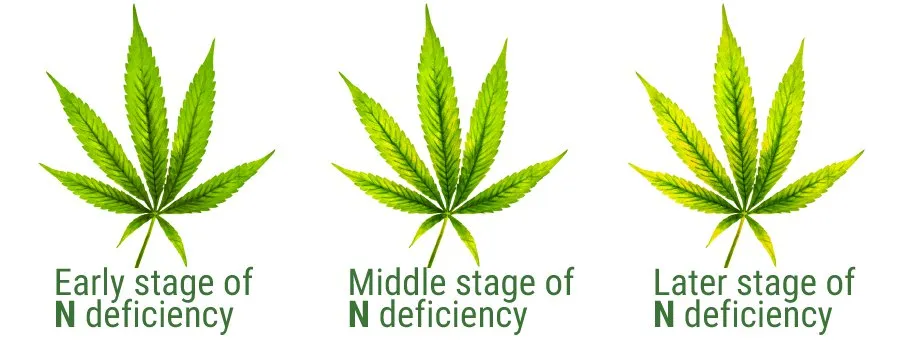
Nitrogen deficiency in cannabis rarely appears overnight. Instead, it develops gradually as the plant begins conserving nitrogen by moving it from older leaves to support new growth. Understanding this progression is one of the easiest ways to distinguish a genuine nitrogen deficiency from problems such as overwatering, nutrient lockout, or natural leaf aging.
When diagnosing a cannabis plant, avoid focusing on a single symptom. Instead, look at the entire plant and ask yourself three questions:
- Where did the symptoms start?
- How have they progressed over time?
- Is the plant still growing normally?
The answers will usually tell you far more than one yellow leaf ever could.
| Stage | Common Symptoms | What the Plant Is Doing |
| Early | Pale green lower leaves | Redistributing nitrogen to new growth |
| Developing | Yellow lower leaves, slower growth | Nitrogen reserves becoming depleted |
| Moderate | Drooping leaves, wilting, leaf loss | Reduced photosynthesis and declining vigor |
| Advanced | Yellowing spreading upward, stunted growth | Nitrogen reserves exhausted and growth affected |
Where Symptoms First Appear
The location of the first symptoms is one of the most reliable ways to identify nitrogen deficiency in cannabis.
Nitrogen is classified as a mobile nutrient, meaning the plant can relocate it from older tissues to areas of active growth whenever supplies become limited. Instead of allowing new shoots to suffer, the plant sacrifices its oldest fan leaves first.
Because of this, nitrogen deficiency almost always begins on the lowest leaves before gradually moving upward through the canopy. The newest growth often remains healthy during the early stages because it continues receiving the limited nitrogen still available.
If symptoms begin on the newest leaves or growing tips, nitrogen deficiency becomes much less likely, and another nutrient deficiency or environmental issue should be investigated instead.
Grower Tip: Before changing your feeding schedule, spend a minute looking at the entire plant from the bottom upward. Where the symptoms started is often the biggest clue to identifying the problem correctly.
Pale Green and Yellow Leaves
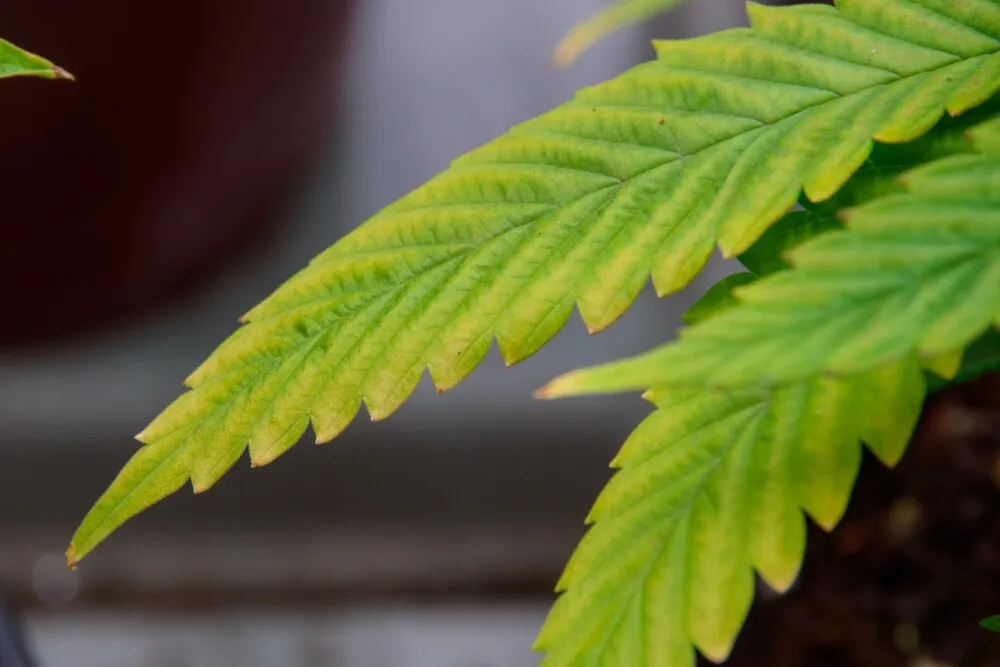
For most growers, the first visible symptom of nitrogen deficiency is a gradual change in leaf color rather than dramatic yellowing.
Healthy lower fan leaves slowly lose their deep green appearance and become noticeably lighter. As chlorophyll production declines, these leaves transition from pale green to yellow over several days. This change usually affects the entire leaf fairly evenly instead of producing isolated spots or sharply defined discoloration.
As the deficiency progresses, additional lower leaves begin following the same pattern until a distinct band of yellow foliage develops around the base of the plant. The upper canopy often remains green because the plant continues directing available nitrogen toward new growth.
This gradual progression is an important diagnostic feature. Nitrogen deficiency rarely causes random yellow leaves throughout the plant. Instead, the symptoms develop in an orderly pattern that slowly moves upward if the underlying problem isn't corrected.
Growers should also consider the plant's stage of growth. Yellow lower leaves during vegetative growth or early flowering deserve investigation, whereas a gradual fade on older fan leaves close to harvest is often part of the plant's natural aging process.
Grower Tip: If you're unsure whether the color is changing, take photographs every three or four days under the same lighting. Comparing images often reveals gradual yellowing that isn't obvious when you're looking at the plant every day.
Drooping, Wilting and Leaf Loss
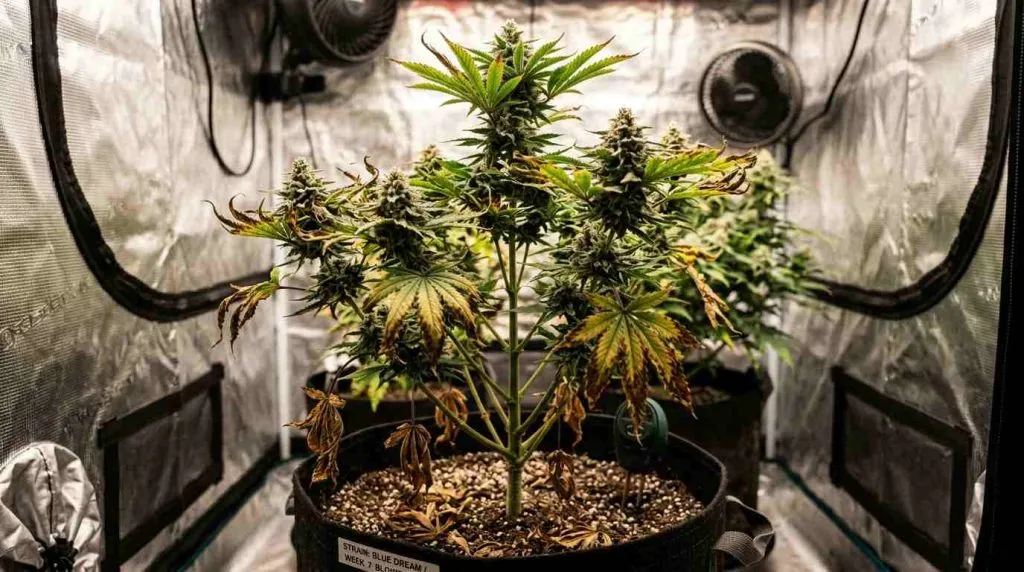
As nitrogen deficiency becomes more severe, affected leaves begin losing more than just their color. Their ability to support photosynthesis declines, causing the leaf tissue to weaken and deteriorate.
The progression usually follows a predictable sequence. Pale green leaves become yellow, yellow leaves begin hanging lower than healthy foliage, and eventually they become dry, brittle and detach from the stem.
Not every drooping leaf indicates nitrogen deficiency, however.
If only the older yellow leaves are drooping while the rest of the plant remains healthy, nitrogen deficiency becomes a stronger possibility. If the entire plant suddenly wilts, investigate the common causes of drooping cannabis leaves before increasing nitrogen.
Understanding this difference prevents one of the most common beginner mistakes adding more fertilizer to a plant that actually has unhealthy roots.
Leaves that have already become completely dry have finished their job and will not recover. Partially green leaves, however, may still contribute to photosynthesis while the plant begins recovering.
Grower Tip: Don't diagnose nitrogen deficiency from drooping leaves alone. Always consider leaf color, where the symptoms started and whether the entire plant or only the oldest leaves are affected.
Slower Growth and Smaller Leaves
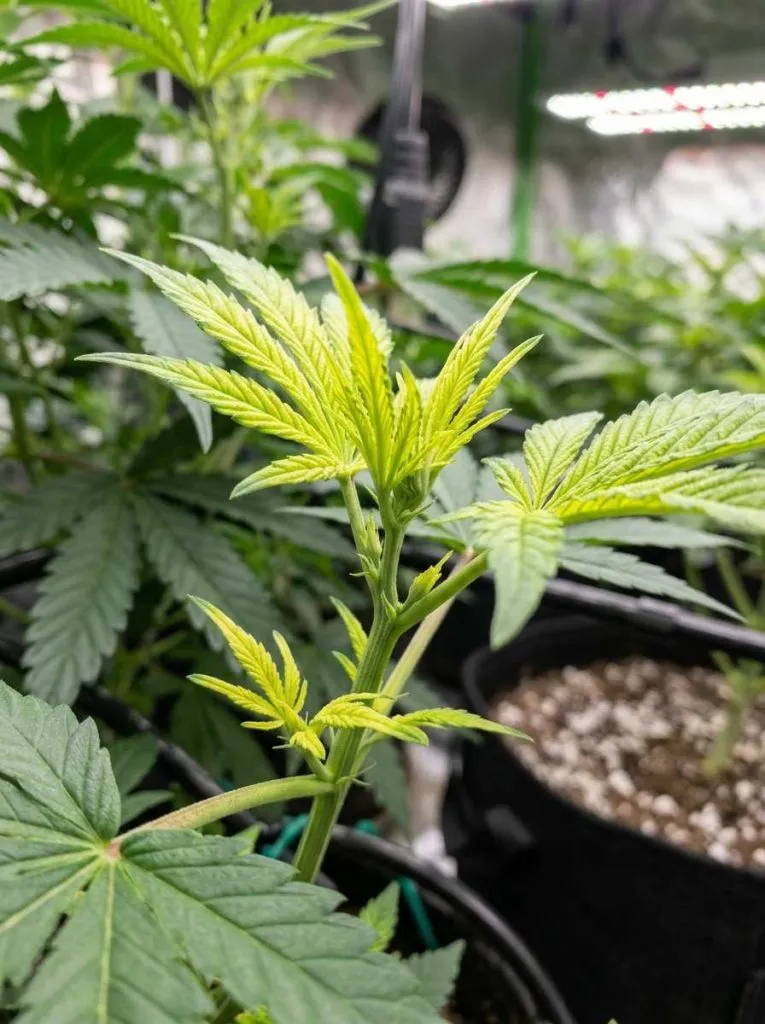
Nitrogen deficiency affects the entire plant, not just its leaves.
Because nitrogen is required to produce amino acids, proteins and new plant tissue, a shortage slows the plant's ability to build stems, branches and foliage. Growth that was once vigorous gradually becomes less productive, and new leaves may emerge noticeably smaller than earlier sets.
This is often easiest to recognize during vegetative growth when cannabis should be producing rapid, healthy development. Plants may stop filling out, side branches remain short and the canopy appears less dense than expected.
Flowering plants can continue producing buds, but reduced foliage limits photosynthesis and restricts the energy available for flower development.
Growth should always be judged over time. A plant that has stopped stretching for several days while lower leaves continue yellowing presents a much stronger case for nitrogen deficiency than a healthy plant with one or two aging leaves.
Grower Tip: Compare this week's growth with last week's, not with another grower's plant. Every cultivar grows differently, but a noticeable slowdown compared with its own previous growth is often an important warning sign.
Advanced Symptoms
If nitrogen deficiency remains unresolved, symptoms continue spreading through the canopy as the plant exhausts its remaining nitrogen reserves.
Yellowing gradually moves beyond the lowest leaves into the middle of the plant, while healthy foliage becomes increasingly limited. The canopy often appears thin because many older fan leaves have died and dropped naturally.
At this stage, growers commonly notice:
- Yellowing spreading upward through the canopy
- Extensive lower leaf loss
- Weak branch development
- Poor overall vigor
- Reduced canopy density
- Smaller flowers and lower yield potential if symptoms continue during flowering
By this point, correcting the underlying problem can prevent further decline, but damaged leaves rarely regain their original green color. Instead, recovery should be judged by healthy new growth, improved vigor and the absence of additional yellowing.
It's also important to consider the plant's growth stage. A severe nitrogen deficiency during vegetative growth can permanently reduce plant size, while one that develops early in flowering may reduce flower production. In contrast, a gradual fade during the final weeks before harvest is often a normal part of the plant's life cycle and doesn't necessarily require additional nitrogen.
Grower Tip: Experienced growers don't judge recovery by old leaves. They watch the newest growth. If fresh leaves remain healthy and the yellowing has stopped spreading, you're moving in the right direction.
How to Diagnose Nitrogen Deficiency in Cannabis
Identifying yellow leaves is only the first step. Diagnosing nitrogen deficiency means confirming that nitrogen is the most likely cause before changing your feeding program. This is important because several nutrient deficiencies, watering problems, and root-zone issues can produce similar symptoms.
When diagnosing a cannabis plant, compare multiple cannabis leaf symptoms instead of focusing on a single symptom. Instead, they work through a series of observations, gradually ruling out other possibilities until the evidence points toward nitrogen deficiency.
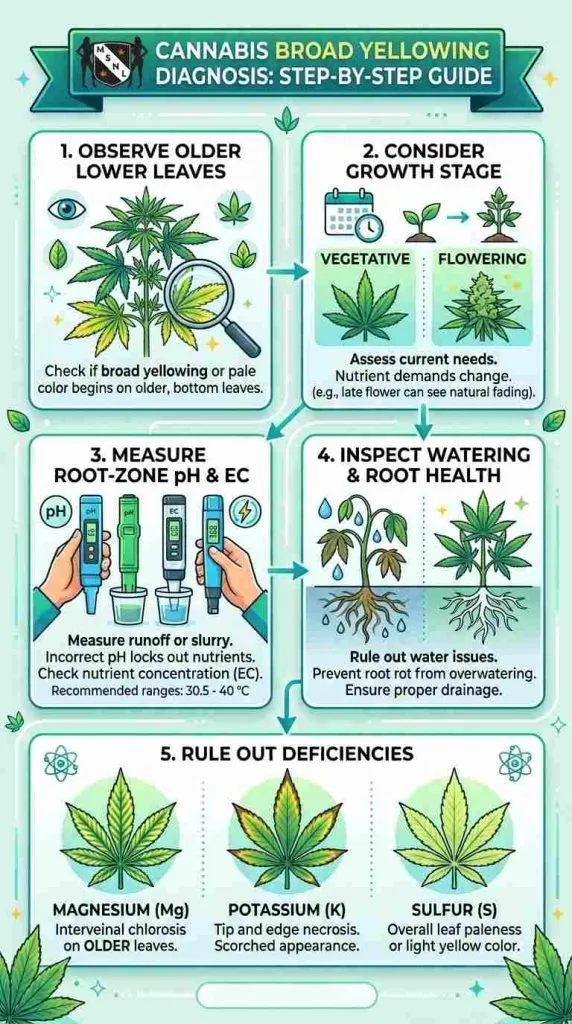
Use the following six-step process before adjusting your nutrients.
Step 1: Examine the Location and Pattern of Yellowing
The first question to ask is where did the symptoms begin?
Nitrogen is a mobile nutrient, allowing cannabis plants to move it from older leaves into new growth whenever supplies become limited. Because of this, nitrogen deficiency almost always starts on the oldest fan leaves at the bottom of the plant.
Once you've identified the first affected leaves, examine how the discoloration is developing.
Nitrogen deficiency usually produces:
- Pale green leaves that gradually become yellow.
- Fairly even yellowing across the leaf surface.
- Several lower leaves following the same pattern.
- Symptoms slowly progressing upward through the canopy.
If yellowing begins in the newest leaves, remains mostly between the veins, or is concentrated around the leaf edges, another nutrient deficiency is more likely.
This first step immediately eliminates many other potential problems.
Step 2: Consider the Plant's Growth Stage
Next, consider when the symptoms appeared.
Nitrogen deficiency is much more concerning during vegetative growth and early flowering than it is close to harvest.
Ask yourself:
- Is the plant still in vegetative growth?
- Has flowering only recently begun?
- Is harvest only a couple of weeks away?
If several lower leaves begin yellowing during vigorous vegetative growth, nitrogen deficiency becomes a stronger possibility.
If the same symptoms appear during the final weeks of flowering while buds continue developing normally, the plant may simply be undergoing a natural fade as it reaches maturity.
The growth stage provides valuable context and helps prevent unnecessary feeding during late flower.
Step 3: Check Root-Zone pH
Before adding more nitrogen, confirm that the plant can actually absorb the nutrients already available.
Nitrogen deficiency symptoms can develop even when sufficient nitrogen is present if the root-zone pH has drifted outside the ideal range. This reduces nutrient availability and creates what's commonly known as nutrient lockout.
As a general guide:
- Soil: pH 6.0–6.5
- Coco and hydroponics: pH 5.5–6.2
Measure the nutrient solution before feeding and, where appropriate, compare it with runoff or root-zone readings. Large differences may indicate an imbalance developing around the roots.
Correcting the pH often restores nutrient uptake without immediately increasing fertilizer strength.
Step 4: Review EC, Feeding and Watering Practices
Now review what has changed over the last week or two.
Ask yourself:
- Have you recently reduced nutrient strength?
- Did you switch to bloom nutrients earlier than planned?
- Have you been feeding plain water more frequently?
- Has the growing medium remained wet for several days?
- Have EC readings changed significantly?
A low EC may indicate underfeeding, while a very high EC may suggest salt buildup that's preventing the roots from absorbing nutrients efficiently.
Watering practices are equally important. Constantly saturated media limits oxygen around the roots, while repeated cycles of excessive drying can damage fine feeder roots. Both situations reduce nutrient uptake and may produce symptoms that resemble nitrogen deficiency.
Rather than looking at one feeding in isolation, review the plant's recent history. Nitrogen deficiency often develops because of several small changes rather than one major mistake.
Keeping a simple grow journal with pH, EC, feed strength, and watering dates makes diagnosing nutrient problems much easier than relying on memory.
Step 5: Rule Out Similar Cannabis Problems
Before deciding that nitrogen is responsible, compare the symptoms with other common cannabis deficiencies and environmental problems.
Ask yourself:
- Are the oldest leaves affected first?
- Is the whole leaf yellowing or only the tissue between the veins?
- Are the leaf edges burning?
- Is the entire plant drooping?
- Has the foliage become extremely dark green?
Your answers provide valuable clues.
- Yellowing between green veins is more consistent with magnesium deficiency.
- Brown or scorched leaf edges are more commonly associated with potassium deficiency in cannabis.
- Pale new growth usually points toward sulfur deficiency rather than nitrogen.
- If the entire plant is drooping while the leaves remain green, watering practices or root health are more likely to be responsible.
- Very dark green leaves with downward-clawed tips suggest excess nitrogen rather than a deficiency.
Experienced growers eliminate these possibilities before changing the nutrient program.
Step 6: Complete a 5-Minute Nitrogen Deficiency Check
Before increasing nitrogen, work through this quick checklist.
- Did the symptoms begin on the oldest lower leaves?
- Are several leaves following the same yellowing pattern?
- Is the newest growth still greener than the lower canopy?
- Has plant growth slowed recently?
- Is the root-zone pH within the correct range?
- Have recent feeding or watering changes reduced nitrogen availability?
If you answered yes to most of these questions, nitrogen deficiency is a strong possibility. If several answers are no, continue investigating before adjusting your nutrient program. Correct diagnosis is far more effective than simply adding more fertilizer.
Nitrogen vs Magnesium, Potassium and Sulfur Deficiency
Several nutrient deficiencies produce yellow cannabis leaves, but they affect different parts of the plant and create distinct symptom patterns. Learning these differences can help you avoid treating the wrong problem.
| Problem | Where symptoms begin | Leaf appearance | Most useful diagnostic clue |
| Nitrogen deficiency | Oldest lower leaves | Broad, even yellowing | Progresses upward through the canopy |
| Magnesium deficiency | Older or middle leaves | Yellowing between green veins, often with rusty spots | Distinct interveinal chlorosis |
| Potassium deficiency | Older leaves | Yellow or brown leaf tips and margins | Damage starts around the leaf edges |
| Sulfur deficiency | New upper leaves | Pale green or yellow new growth | Symptoms begin at the top of the plant |
| Nitrogen toxicity | Entire plant | Very dark green leaves with downward clawing | Excessive nitrogen rather than a shortage |
Don't diagnose from color alone. Experienced growers first identify where the symptoms started, then examine how they developed before deciding which nutrient is responsible.
What Causes Nitrogen Deficiency in Cannabis?
Nitrogen deficiency doesn't always mean your plant isn't receiving enough fertilizer. In many cases, nitrogen is present in the growing medium, but the roots are unable to absorb it efficiently. Understanding the underlying cause is important because adding more nutrients won't solve problems caused by poor root health, incorrect pH, or salt buildup.
The table below summarizes the most common causes.
| Cause | Why it happens | Typical result |
| Insufficient nitrogen | The plant isn't receiving enough nitrogen for its stage of growth. | Gradual yellowing and slower growth. |
| Incorrect root-zone pH | Nitrogen becomes less available to the roots. | Nutrient lockout despite adequate feeding. |
| Depleted or reused growing media | The growing medium has exhausted its nutrient reserves. | Progressive deficiency as the plant matures. |
| Unsuitable nutrients for the growth stage | Nitrogen levels no longer match the plant's requirements. | Premature yellowing, particularly after switching to bloom nutrients too early. |
| Nutrient build-up and high EC | Excess fertilizer salts interfere with nutrient uptake. | Deficiency symptoms despite high nutrient levels. |
| Overwatering and poor root health | Oxygen-starved roots struggle to absorb nutrients. | Yellowing, slow growth, and reduced vigor. |
| Cold or damaged roots | Root activity declines because of stress or low temperatures. | Temporary nutrient uptake problems. |
Insufficient Nitrogen
The most straightforward cause is simply not supplying enough nitrogen. Cannabis has its highest nitrogen demand during vegetative growth, when it's rapidly producing leaves, stems, and branches. Underfeeding, using plain water too frequently in inert media, or allowing a large plant to outgrow its feeding schedule can all result in a genuine nitrogen shortage.
Incorrect Root-Zone pH
Even when nitrogen is present, roots can't absorb it efficiently if the root-zone pH moves outside the recommended range. This is one of the most common causes of apparent nitrogen deficiency and is often mistaken for underfeeding. Always check pH before increasing nutrient strength.
Depleted or Reused Growing Media
Soil and organic growing media contain a finite nutrient reserve. Over time, those nutrients are consumed or washed from the medium. Reusing soil without refreshing or re-amending it can leave the next crop with insufficient nitrogen, especially during vigorous vegetative growth.
Unsuitable Nutrients for the Growth Stage
Cannabis requires more nitrogen during vegetative growth than it does during flowering. Switching to a bloom nutrient too early or reducing nitrogen too aggressively can cause the lower canopy to fade while the plant is still actively producing leaves and stems.
Nutrient Build-Up and High EC
A high EC doesn't always mean the plant is well-fed. Excess fertilizer salts can make it harder for roots to absorb water and nutrients, producing deficiency symptoms even though plenty of nitrogen is present. This is why high EC and yellow leaves often occur together.
Overwatering and Poor Root Health
Healthy roots need oxygen as well as water. Following good cannabis watering practices helps maintain healthy root function and nutrient uptake. Constantly saturated growing media reduce oxygen around the roots, limiting nutrient uptake. Overwatered plants frequently develop yellowing leaves that resemble nitrogen deficiency, even when the feeding program is correct.
Cold or Damaged Roots
Cold temperatures, transplant shock, root-bound plants, pests, and diseases such as cannabis root rot can all reduce nutrient uptake. When roots are stressed, nitrogen absorption slows, causing deficiency symptoms without necessarily indicating a lack of nitrogen in the growing medium.
Grower Tip: Before increasing nitrogen, ask yourself why the plant can't access it. The solution is often restoring healthy root-zone conditions rather than adding more fertilizer.
How to Fix and Prevent Nitrogen Deficiency in Cannabis
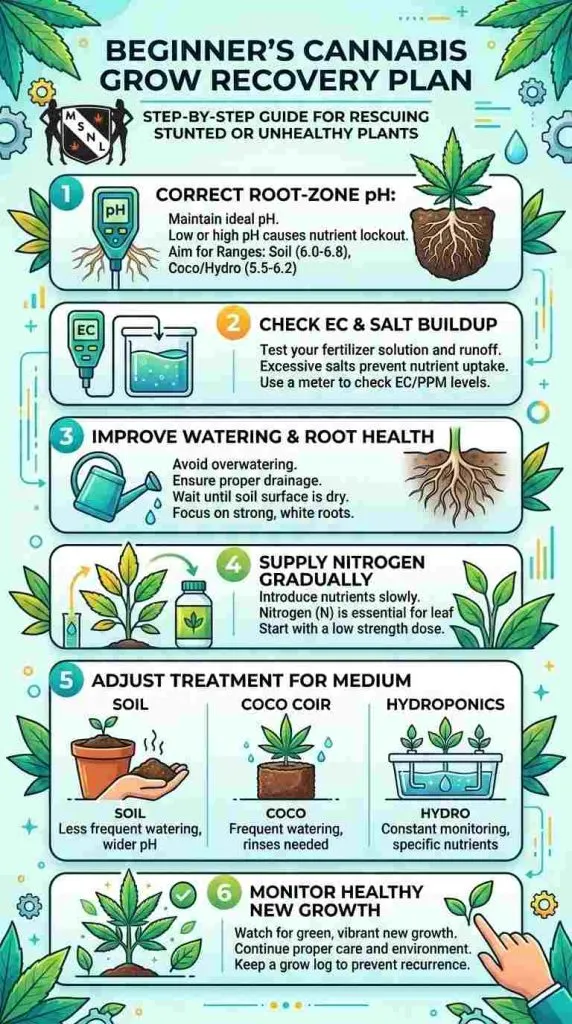
Once you are reasonably confident that nitrogen deficiency is the problem, avoid reaching straight for a stronger feed. The safest approach is to work through the root zone first, correct any uptake problems, and only then increase nitrogen if the plant still needs it.
Experienced growers make one change at a time and give the plant a chance to respond. This makes it easier to see what solved the problem and reduces the risk of replacing a deficiency with nutrient burn or nitrogen toxicity.
Step 1: Confirm That Nitrogen Is the Problem
Review where the symptoms started and how they progressed. Nitrogen deficiency usually begins on older lower leaves, causes broad yellowing, and gradually moves upward.
Before treating it, rule out the most common lookalikes:
- Yellowing between greener veins may indicate magnesium deficiency.
- Burnt leaf margins may indicate potassium deficiency.
- Pale new growth may indicate sulfur deficiency.
- Whole-plant drooping may point to watering or root problems.
- Dark green, clawed leaves suggest excess nitrogen.
Do not adjust the feeding program because of one yellow leaf. Look for a clear pattern across several older leaves.
Step 2: Check and Correct Root-Zone pH
Before adding nitrogen, confirm that the roots can absorb the nutrients already present.
| Growing medium | General working pH range |
| Soil | 6.0–6.5 |
| Coco | 5.8–6.2 |
| Hydroponics | 5.5–6.2 |
Measure the pH of the nutrient solution before feeding. If you suspect a root-zone imbalance, check runoff or use a suitable root-zone testing method for the medium.
Correct pH gradually rather than forcing a large change in one irrigation. Once the pH is back within range, wait and observe the plant before increasing nutrient strength.
Grower Tip: If the feed already contains nitrogen, unsuitable pH may be the real problem. Correcting nutrient availability is often more effective than adding more fertilizer.
Step 3: Check EC and Salt Build-Up
EC helps you determine whether the root zone is underfed or overloaded with fertilizer salts.
- A low EC may support a genuine nutrient shortage.
- A high EC may indicate salt buildup that is restricting water and nutrient uptake.
Compare the input solution with runoff or reservoir readings where appropriate. If the root-zone EC is much higher than expected, deal with the accumulation using the method recommended for your medium and nutrient line before adding more nitrogen.
Prevent future buildup by avoiding unnecessarily strong feeds, monitoring EC regularly, and following appropriate runoff or reservoir-management practices.
Step 4: Improve Watering and Root Health
Healthy roots need moisture and oxygen. Constantly saturated media can make a well-fed plant look deficient because oxygen-starved roots cannot absorb nutrients efficiently.
Do not water solely by the calendar. Check the weight of the container and the moisture level of the medium first. A pot that still feels heavy usually does not need more water.
If the plant has been overwatered:
- Allow the medium to dry appropriately.
- Improve drainage and airflow around the container.
- Resume watering only when the root zone is ready.
- Avoid increasing nutrients until the plant begins recovering.
In hydroponics, check reservoir oxygenation, cleanliness, and root condition. Healthy roots are generally firm and light-colored, while dark, slimy, or unpleasant-smelling roots suggest a separate root problem.
Step 5: Supply Nitrogen Gradually
If pH, EC, watering, and root health are all suitable, the plant may genuinely need more nitrogen.
Return to a complete nutrient designed for the growing medium and current growth stage. Avoid combining several nitrogen-rich products or making a large increase in one feeding.
A safer method is to:
- Make one modest adjustment.
- Feed according to the product instructions.
- Observe the plant for several days.
- Increase again only if symptoms continue and the root zone remains healthy.
This measured approach prevents a common beginner mistake: correcting nitrogen deficiency so aggressively that the plant develops dark green leaves, clawing, or nutrient burn.
Step 6: Adjust the Treatment for the Growing Medium
| Medium | What to check first | Practical correction | Common mistake to avoid |
| Soil | Root-zone pH and nutrient depletion | Resume a balanced feed or replenish depleted fertility | Adding concentrated nitrogen before checking pH |
| Coco | Input and runoff pH and EC | Restore a consistent, medium-appropriate feeding schedule | Treating coco like fertilized soil and using plain water too often |
| Hydroponics | Reservoir pH, EC, temperature, and oxygenation | Replace or rebalance the solution if required | Making repeated adjustments without allowing readings to stabilize |
Soil usually changes more slowly than coco or hydroponics, so allow extra time before making another correction. Coco and hydro systems can respond quickly, but inaccurate measurements can also create problems quickly.
Step 7: Use a Stage-Appropriate Feeding Program
Nitrogen demand is highest during vegetative growth and gradually decreases during flowering.
Do not switch to a low-nitrogen bloom formula before the plant has finished stretching and building foliage. Equally, avoid continuing a heavy vegetative feed deep into flowering.
Use the feeding chart as a starting point and understand the correct NPK ratio for each growth stage before making adjustments, then adjust according to plant size, growth rate, medium, and response. Preventing deficiency is easier when changes between vegetative and flowering nutrients are gradual rather than abrupt.
Step 8: Monitor Recovery and Prevent a Repeat
Do not expect fully yellow leaves to turn green again. Instead, look for:
- Healthy green new growth
- Yellowing no longer moving upward
- Normal growth rate returning
- No new signs of nutrient burn or toxicity
Keep a simple record of pH, EC, nutrient strength, watering dates, and plant response. This helps you spot gradual changes before they become serious and makes future diagnosis much faster.
Grower Tip: After making a correction, resist the urge to keep changing the feed every day. Give the plant time to respond and judge progress from new growth, not old damage.
How Long Does Nitrogen Deficiency Take to Recover?
Once the underlying cause is corrected, healthier new growth may become noticeable within approximately 5–10 days. Coco and hydroponic plants may respond sooner than soil-grown plants, although recovery depends on root health, severity, and growth stage.
Existing yellow leaves usually remain damaged. Recovery is better judged by whether yellowing has stopped spreading and new leaves are developing normally. A severe deficiency may permanently limit plant size even after healthy growth resumes.
Is Yellowing During Flowering Always Nitrogen Deficiency?
No. Gradual yellowing of older fan leaves can be normal during the final weeks of flowering as the plant matures and reallocates mobile nutrients.
Yellowing is more concerning when it begins early in flowering, spreads quickly, reaches productive upper leaves, or appears alongside stalled growth and poor flower development.
Before increasing nitrogen, consider how close the plant is to harvest. Treating a normal late-flower fade as a deficiency can leave the plant with excess nitrogen when its requirements are naturally declining.
Should You Remove Nitrogen-Deficient Leaves?
Do not remove affected leaves simply because they have started yellowing. Leaves that still contain green tissue can continue contributing to photosynthesis while the plant recovers.
Remove leaves only when they are completely yellow, dry, brittle, diseased, or detach easily. Avoid stripping several leaves from a stressed plant at once.
Focus first on correcting the underlying cause. Leaf removal does not fix nitrogen deficiency.
Nitrogen Deficiency in Autoflowering Cannabis
Nitrogen deficiency affects autoflowering cannabis in the same basic way, but the shorter life cycle gives growers less time to correct it.
A deficiency during early vegetative growth can reduce the plant’s final size before flowering begins. Check lower leaves regularly and respond promptly, but avoid aggressive nutrient increases. Autoflowers can be sensitive to sudden changes in feed strength, particularly when young.
Correct pH, EC, watering, and root conditions first. If extra nitrogen is genuinely needed, make a small adjustment and monitor new growth over the following days.
Prevention depends on stable root-zone conditions and a feeding program suited to the plant’s rapid transition from vegetative growth into flowering.
Conclusion
Nitrogen deficiency in cannabis is easiest to correct when caught early and the underlying cause is addressed rather than reacting to yellow leaves alone. Broad yellowing starting on older lower leaves and moving upward is the most common sign, often with slowed growth. Before adding nitrogen, check growth stage, pH, EC, watering routine, and root health. Lockout, salt buildup, or poor roots can also block uptake. Once stable, reintroduce nitrogen gradually with a balanced feed and avoid multiple changes at once. Damaged leaves will not recover, so judge success by new growth and halted yellowing. Monitor pH and EC regularly.
Frequently Asked Questions
What is the first sign of nitrogen deficiency in cannabis?
The first sign is usually a gradual loss of green color in the oldest fan leaves near the bottom of the plant. These leaves become pale green before turning broadly yellow. If the deficiency continues, the discoloration progresses upward and plant growth may begin to slow.
What is the fastest way to fix nitrogen deficiency in cannabis?
First check root-zone pH, EC, watering conditions, and root health. If these are within suitable ranges and the plant is genuinely underfed, gradually resume or increase a balanced nutrient containing nitrogen. Avoid applying a large dose, as overcorrecting can cause nutrient burn or nitrogen toxicity.
Can yellow cannabis leaves turn green again?
Leaves that are only slightly pale may improve, but fully yellow leaves rarely return to healthy green. Use new growth to judge recovery. The treatment is working when fresh leaves develop normally and yellowing stops progressing through the canopy.
Can overwatering cause nitrogen deficiency symptoms?
Yes. Constantly wet growing media contain less oxygen, which reduces root activity and nutrient uptake. This can cause yellow leaves, drooping, and slow growth even when enough nitrogen is present. Allow the medium to dry appropriately and restore healthy root conditions before increasing fertilizer strength.
Is nitrogen deficiency normal during flowering?
A rapid loss of lower leaves during early flowering may indicate nitrogen deficiency. However, gradual fading of older fan leaves during the final weeks before harvest can be a normal part of plant maturation. Consider the timing, speed of progression, and condition of the upper canopy before adding more nitrogen.


