




Sulfur deficiency in cannabis usually appears as pale or yellow new growth at the top of the plant. Because sulfur is relatively immobile, the youngest leaves are affected first, while older fan leaves often remain green during the early stages. If the problem continues, new leaves may stay small, stems can become thin, and overall growth may slow.
A true lack of sulfur is uncommon when plants receive a complete nutrient program. In many cases, sulfur is already present but unavailable because of incorrect pH, overwatering, poor root health, salt buildup, or an unbalanced feeding routine. Adding more nutrients without checking these factors can make the problem worse.
This guide explains how to identify sulfur deficiency, distinguish it from nitrogen, iron, and magnesium deficiencies, find the underlying cause, and correct it safely. You will also learn what recovery looks like and how to prevent the same symptoms from returning.
Key Takeaways
- Sulfur deficiency typically starts in the newest growth, while older leaves often stay green in early stages.
- Uniform yellowing in young leaves (including veins) helps distinguish sulfur deficiency from iron deficiency.
- True sulfur deficiency is rare; issues like pH imbalance, root stress, overwatering, or nutrient lockout are more common causes.
- Always check pH, EC, drainage, root health, water quality, and nutrient mix before adding sulfur.
- Focus on fixing the root cause first; recovery is shown by healthy new growth and stopping symptom spread, not by damaged leaves recovering.
What Is Sulfur Deficiency?
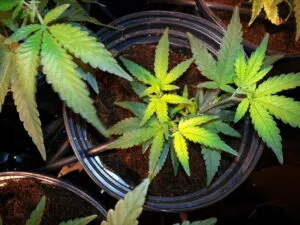
Sulfur deficiency occurs when a cannabis plant cannot access enough sulfur to support normal growth. This is usually not because sulfur is completely absent from the medium, but because the plant is unable to absorb it properly. Common causes include incorrect pH, damaged or stressed roots, overwatering, or an unbalanced nutrient program. These same issues can also cause other cannabis nutrient deficiencies, so diagnosis should never rely on leaf color alone.
Cannabis only requires sulfur in small amounts, but it is still essential for healthy development. When uptake is limited, the plant struggles to build new tissue efficiently. Growth may slow, young leaves can lose their color, and flowering plants may fail to reach their full potential.
Sulfur is relatively immobile within the plant, meaning it cannot be easily moved from older leaves to new growth. Identifying the problem early is particularly important when growing autoflower cannabis seeds, as they have less time to recover before flowering progresses. Because of this, deficiency symptoms tend to appear first in the newest leaves at the top of the plant.
Why Sulfur Is Essential
Sulfur plays a key role in plant metabolism. It is part of important amino acids such as cysteine and methionine, which are used to build proteins. These proteins support cell formation, enzyme activity, root development, and overall growth.
It also contributes to chlorophyll production. Chlorophyll is responsible for capturing light energy during photosynthesis. When sulfur is lacking, chlorophyll levels can drop, causing new growth to appear pale green or yellow.
In addition, sulfur is involved in the production of enzymes, vitamins, and aromatic compounds. While genetics and environment have the biggest influence on aroma and flavor, sulfur still supports the biological processes behind terpene and compound formation.
Healthy cannabis plants do not require high levels of sulfur. They need a consistent, balanced supply. Excess sulfur will not improve growth and may create additional nutrient issues, so deficiencies should always be confirmed before supplementing.
Effects on Growth and Flowering
The first visible sign of sulfur deficiency is usually a loss of color in new growth. Young leaves may appear pale while older leaves remain green. If the issue continues, yellowing can spread, stems may become thinner or more rigid, and overall growth can slow.
Plants may also produce smaller leaves and shorter internodes due to reduced protein synthesis. In more advanced cases, leaves can develop pink or purple tones, especially on stems or petioles. However, these colors can also result from genetics, temperature changes, or other nutrient imbalances, so they are not a reliable diagnostic sign on their own.
During flowering, an unresolved deficiency can reduce bud development and slow overall flower formation. Plants may lose vigor earlier than expected, and yields can suffer if the problem persists. Mild deficiencies caught early are usually reversible, but existing damaged leaves will not fully recover. Healthy new growth is the best sign that conditions have improved.
Is Sulfur Deficiency Common?
True sulfur deficiency is relatively rare in cannabis cultivation. Most quality soils and nutrient lines already contain sufficient sulfur for plant needs.
More often, symptoms that resemble sulfur deficiency are caused by other issues. Incorrect pH is one of the most common reasons, as it can cause nutrient lockout in cannabis, preventing sulfur uptake even when enough is present in the growing medium. Iron deficiencies, nitrogen deficiencies, and magnesium deficiencies can also produce similar yellowing patterns, making diagnosis more difficult.
For this reason, experienced growers avoid relying on leaf color alone. Before adding sulfur, it is important to check pH levels, recent feeding history, root health, and environmental conditions. In many cases, correcting the underlying issue is more effective than adding additional nutrients.
How to Identify Sulfur Deficiency
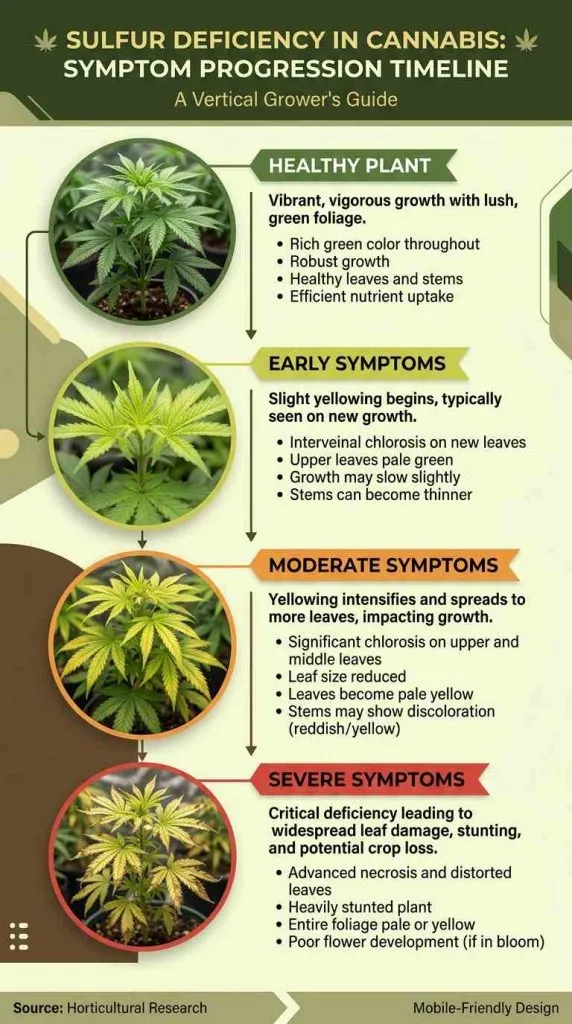
Sulfur deficiency is best identified by observing where symptoms begin and how they develop over time. Because sulfur is relatively immobile within cannabis plants, early signs almost always appear in the newest growth at the top of the canopy. Older fan leaves typically remain green in the initial stages, which helps distinguish sulfur issues from other nutrient problems.
However, leaf color alone is not a reliable diagnostic tool. Yellowing can result from multiple causes, including nitrogen or magnesium deficiency, pH imbalance, root stress, or natural senescence in late flowering. A more accurate diagnosis requires evaluating symptom location, progression pattern, and overall plant growth behavior.
Early Symptoms to Watch For
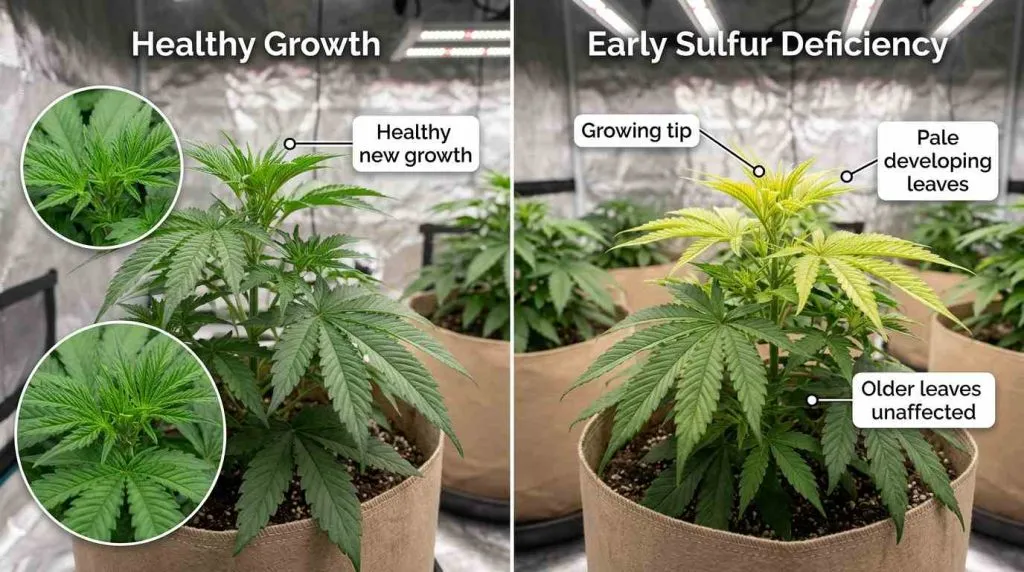
The first sign of sulfur deficiency is a subtle loss of color in new growth. Young leaves may emerge pale green or slightly yellow while older leaves remain unaffected.
At this stage, symptoms are easy to overlook. Newly formed leaves are often lighter by nature, but they should deepen in color as they mature. Sulfur deficiency becomes more likely when multiple new leaves remain pale and fail to green up over time.
Other early indicators include:
- Slower opening of new leaves
- Reduced leaf size at the top of the plant
- Weak or thin growing tips
- Minimal or no tissue damage (no necrosis yet)
Because symptoms begin at the top rather than the bottom, early detection is possible if growers regularly inspect new growth.
Moderate Symptoms as the Deficiency Progresses
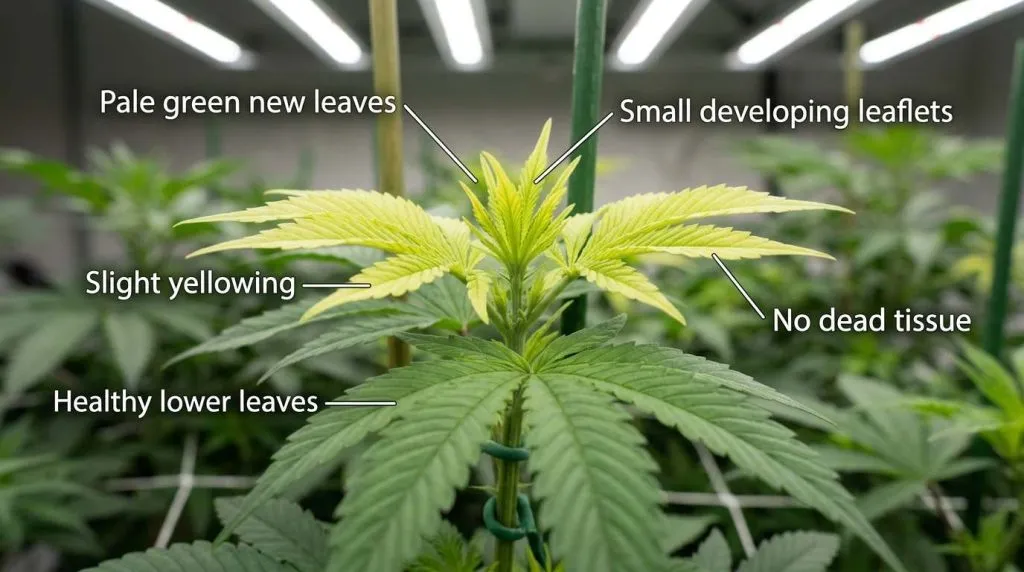
If sulfur availability remains limited, symptoms become more pronounced and spread across the upper canopy. Pale leaves turn distinctly yellow, and new growth continues to emerge underdeveloped.
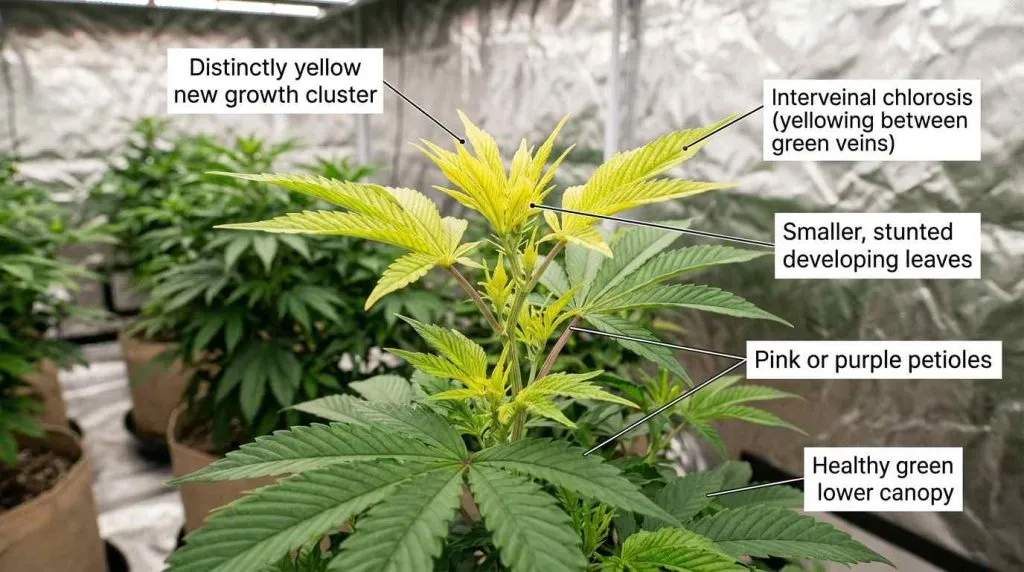
Interveinal chlorosis may appear, where tissue between veins yellows first. Unlike iron deficiency, where veins often remain clearly green, sulfur deficiency typically leads to more uniform fading as the condition worsens.
Growth impacts become more noticeable:
- Reduced internode spacing
- Smaller, weaker new leaves
- Thinner upper stems
- Slower canopy development
Some plants may also show red, pink, or purple coloration on stems or petioles. While this can support a diagnosis, it is not definitive on its own.
At this stage, multiple new leaves are affected, making the issue easier to identify visually.
Severe Symptoms and Impact on Yield
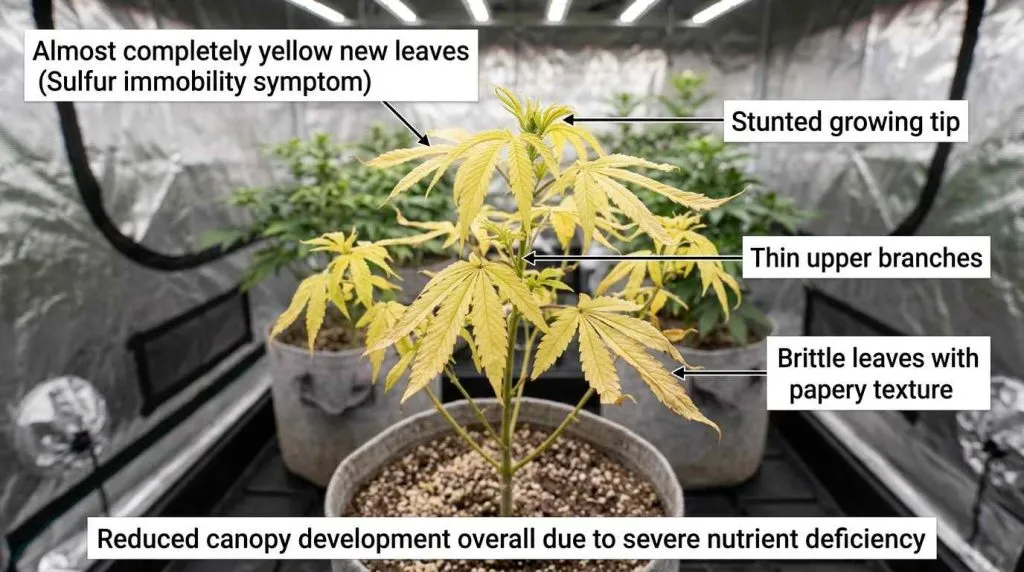
Severe sulfur deficiency significantly disrupts plant development. New leaves may emerge almost entirely yellow, and growing tips can become distorted or stunted. Leaf edges may curl, dry, or become brittle.
As the condition worsens:
- Canopy density decreases
- Branch development slows
- Stems remain thin and underdeveloped
- Vertical growth may stall
During flowering, prolonged deficiency can reduce bud development and overall yield potential. Reduced chlorophyll limits photosynthesis, decreasing the plant’s energy supply for flower production.
| Severity Level | Key Symptoms | Growth Impact |
| Early | Pale new leaves | Minimal impact |
| Moderate | Yellowing spreads, slow growth | Reduced vigor |
| Severe | Stunted growth, leaf damage | Lower yield potential |
Recovery is measured by new growth, not damaged leaves. Existing yellow leaves rarely regain full color.
Yellow Leaves, Interveinal Chlorosis, and Color Changes
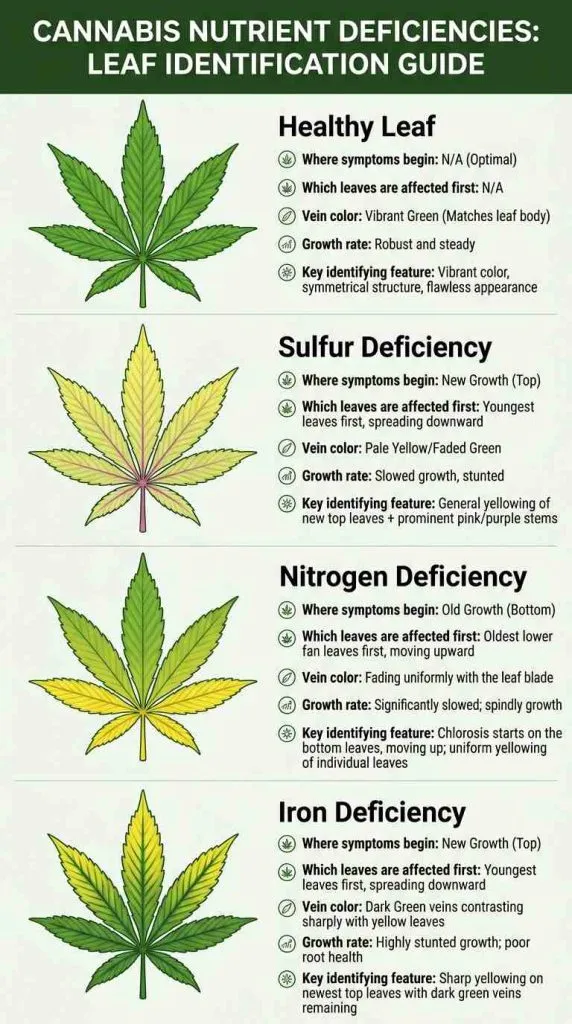
Yellowing is a common cannabis symptom, but its location and pattern are more important than color alone.
- Sulfur deficiency: Starts in new growth at the top
- Nitrogen deficiency: Starts in older lower leaves
- Magnesium deficiency: Starts in older leaves with interveinal yellowing
- Iron deficiency: Affects new leaves with green veins and yellow tissue
Interveinal chlorosis (yellowing between veins) can occur in both sulfur and iron deficiencies, making careful observation essential.
Purple or pink coloration on stems or petioles may appear in sulfur deficiency but is not diagnostic. Genetics, temperature stress, and lighting conditions can also cause similar pigmentation.
How to Diagnose in the Correct Order
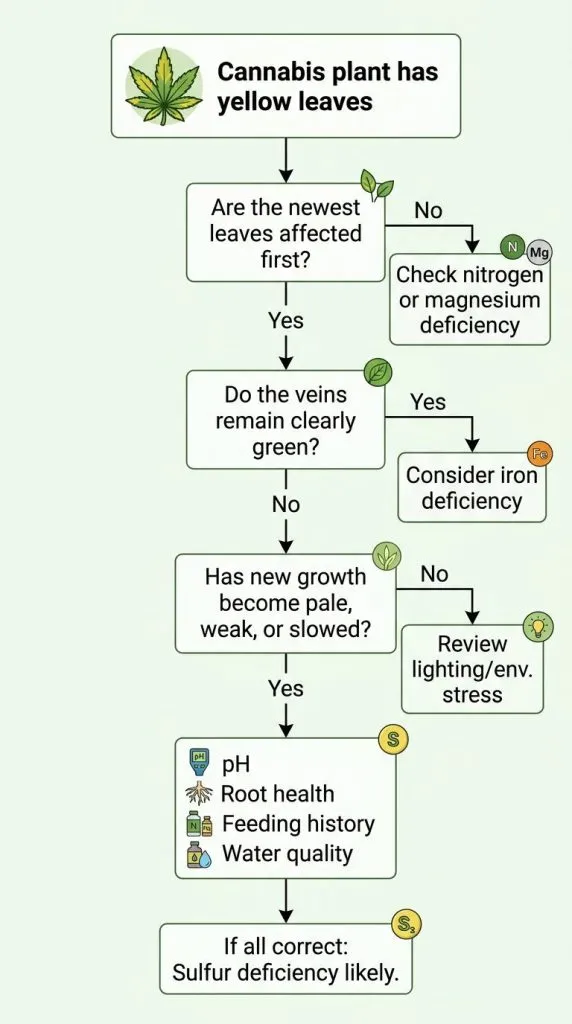
A structured approach improves accuracy and reduces misdiagnosis.
Step 1: Identify Where Symptoms Begin
- New growth affected first → sulfur or iron likely
- Old growth affected first → nitrogen or magnesium likely
Step 2: Check Leaf Pattern
- Entire leaf pale (including veins) → sulfur more likely
- Green veins with yellow tissue → iron more likely
- Older leaves with interveinal yellowing → magnesium likely
Step 3: Evaluate Growth Rate
Sulfur deficiency often slows development. Look for:
- Small or delayed new leaves
- Weak growing tips
- Reduced internode spacing
If growth remains strong, the issue may be environmental rather than nutritional.
Step 4: Look for Supporting Signs
- Stem or petiole discoloration
- Brittle or distorted new growth
- Reduced canopy density
These signs support diagnosis but are not conclusive alone.
Step 5: Review Recent Changes
Before adjusting nutrients, check for:
- pH fluctuations
- Overwatering or poor drainage
- Recent flushing
- Nutrient changes
- RO or very soft water use
- Root stress or low temperatures
- Salt buildup (high EC)
Review recent changes in your care routine. If plants are also growing slowly with dark foliage or purpling, compare the symptoms with phosphorus deficiency before changing your nutrient program.
Sulfur Deficiency Compared With Similar Issues
Sulfur vs Nitrogen
| Feature | Sulfur | Nitrogen |
| First affected leaves | New growth | Old growth |
| Progression | Top-down | Bottom-up |
| Growth impact | Early slowdown | Leaf drop over time |
Sulfur vs Iron
Both affect new growth, but:
- Iron deficiency keeps veins green longer
- Sulfur deficiency leads to more uniform yellowing
- Sulfur more often slows overall growth
Sulfur vs Magnesium
| Feature | Sulfur | Magnesium |
| Affected leaves | New | Old |
| Pattern | General yellowing | Interveinal chlorosis |
| Spotting | Rare | Common (rust spots) |
What Causes Sulfur Deficiency?
True sulfur deficiency is relatively rare in cannabis when plants are grown in fresh soil or given a complete nutrient program. In most cases, sulfur is present in the medium but unavailable due to uptake issues.
Before adding supplements, it is important to identify the underlying cause. Extra sulfur will not fix poor root health, incorrect pH, or salt buildup, and may worsen nutrient imbalances.
Incorrect pH and Nutrient Lockout
One of the most common causes of sulfur deficiency symptoms is incorrect root-zone pH. When pH moves outside the optimal range, sulfur and other nutrients become chemically unavailable even if they are present in the medium.
This condition is known as nutrient lockout. The plant shows deficiency symptoms not because the nutrient is missing, but because the roots cannot absorb it.
| Growing System | Ideal pH Range |
| Soil | 6.0–7.0 |
| Hydro/Soilless | 5.5–6.5 |
Salt buildup from repeated feeding can also disrupt pH and electrical conductivity (EC), further limiting nutrient uptake. Checking pH and EC in both the feed solution and runoff is essential before assuming a sulfur deficiency.
Insufficient Sulfur in the Medium
A true lack of sulfur can occur when the growing medium or nutrient program does not supply enough. This is more likely in depleted soil, poorly amended mixes, or incomplete fertilizer systems lacking secondary nutrients.
Reused soil may gradually lose sulfur over multiple cycles, especially without added compost or mineral amendments. In hydroponics, deficiencies can appear when nutrient solutions are too weak or improperly formulated.
Light feeding can also contribute during rapid growth phases. However, growers should not increase nutrient strength based solely on yellowing leaves. Always confirm pH, root health, and feeding history first, as uptake issues are far more common than actual sulfur shortages.
| Possible Cause | Description |
| Depleted soil | Nutrients exhausted over multiple grows |
| Incomplete fertilizer | Missing secondary nutrients like sulfur |
| Weak nutrient solution | Insufficient EC in hydroponic systems |
| Poor amendments | Lack of compost or mineral inputs |
Root Problems, Overwatering, and Poor Drainage
Healthy roots are essential for sulfur uptake. Even a balanced nutrient solution will fail if the root system is damaged or oxygen-starved.
Overwatering is a frequent cause of nutrient issues. When the medium stays saturated, oxygen levels drop, root function slows, and disease risk increases.
Poor drainage and compacted soil create the same conditions and can eventually contribute to cannabis root rot if the roots remain oxygen deprived. Plants may remain wet for too long, grow slowly, and show multiple deficiency symptoms at once. Cold root zones can also reduce nutrient absorption even when above-ground conditions appear normal.
| Symptom | Possible Root Issue |
| Slow drying medium | Poor drainage or overwatering |
| Drooping in wet soil | Oxygen deprivation |
| Stunted growth | Root restriction or damage |
| Unpleasant odors | Root rot or anaerobic conditions |
| Brown/slimy roots | Advanced root disease |
| Multiple deficiencies | General root failure |
Improving drainage and allowing proper dry-back cycles is often more effective than adding nutrients.
Water Quality and Nutrient Imbalances
Water quality strongly affects sulfur availability. Reverse osmosis and very soft water contain few minerals, meaning the nutrient program must supply all essential elements.
While complete fertilizers usually provide enough sulfur, deficiencies can occur if formulations are incomplete or improperly mixed. Hard water can also create issues by raising alkalinity and making pH harder to control.
Nutrient imbalances may further restrict uptake. Excess of one mineral can interfere with another, while overfeeding increases salt levels around the roots. This can mimic a deficiency even when sulfur is present.
| Factor | Potential Impact |
| RO / soft water | Requires full nutrient supplementation |
| Hard water | pH instability and mineral competition |
| High EC / overfeeding | Salt buildup and nutrient lockout |
| Incomplete nutrients | Direct sulfur shortage |
| pH drift | Reduced nutrient availability |
Key factors to review include:
- Water mineral content
- Fertilizer completeness
- Feed strength and EC
- Recent nutrient changes
- Salt buildup
- Root-zone and runoff pH
Restoring balance in the root zone and stabilizing feeding practices is usually more effective than adding extra sulfur.
How to Confirm It's Sulfur Deficiency
There is no single symptom that definitively confirms sulfur deficiency. A reliable diagnosis comes from observing multiple symptoms together, ruling out similar nutrient issues, checking root-zone conditions, and evaluating how the plant responds after corrections are made.
Sulfur deficiency is more likely when yellowing starts in the newest growth, although zinc deficiency can also affect developing leaves and should be ruled out if symptoms do not match. Before adding sulfur, it is important to rule out more common issues such as nitrogen, iron, and magnesium deficiencies, as well as check pH, root health, water quality, and recent feeding practices.
Step-by-Step Checklist Before Adding Sulfur
Follow these steps in order to confirm whether sulfur deficiency is likely and avoid misdiagnosis.
Step 1: Identify where symptoms began.
Look closely at the plant and determine the first area affected.
- If symptoms start in new growth → sulfur or iron deficiency is more likely
- If symptoms start in older leaves → nitrogen or magnesium deficiency is more likely
Step 2: Examine the yellowing pattern.
Check how the discoloration appears on the leaves.
- Uniform yellowing across new leaves → points toward sulfur deficiency
- Green veins with yellow tissue → points toward iron deficiency
- Interveinal yellowing on older leaves → points toward magnesium deficiency
Step 3: Compare symptoms with known deficiencies.
Use the comparison tables below to narrow down the cause.
Sulfur Deficiency vs Nitrogen Deficiency
Sulfur and nitrogen deficiencies both cause yellowing, but they affect different parts of the plant.
Sulfur is not easily moved within the plant, so symptoms appear first in the youngest leaves at the top. Nitrogen is mobile, so the plant moves it from older leaves to support new growth. This causes older fan leaves at the bottom to yellow first.
| Feature | Sulfur Deficiency | Nitrogen Deficiency |
| First leaves affected | New growth | Older fan leaves |
| Progression pattern | Top to bottom | Bottom to top |
| Growth impact | Early slowdown | Often delayed |
| Frequency | Less common | Very common |
Sulfur Deficiency vs Iron and Magnesium Deficiencies
Iron deficiency is often confused with sulfur deficiency because both affect new growth first. Iron deficiency typically causes strong interveinal chlorosis, where veins stay green while surrounding tissue turns yellow. Sulfur deficiency may begin similarly but usually becomes more uniform as it progresses, with the entire leaf turning pale.
Magnesium deficiency is different because it starts in older leaves. It often produces interveinal yellowing followed by rust-colored spots as it worsens. This pattern is uncommon in sulfur deficiency.
| Feature | Sulfur | Iron | Magnesium |
| First affected leaves | New | New | Old |
| Veins stay green | Sometimes | Yes | Yes |
| Yellowing pattern | Uniform | Interveinal | Interveinal |
| Rust spots | Rare | No | Common |
| Growth slowdown | Common | Moderate | Later stage |
Step 4: Measure root-zone pH.
Check whether the pH is within the correct range for your growing medium. If pH is too high or too low, sulfur may be present but unavailable to the plant, causing lockout symptoms that mimic deficiency.
Step 5: Inspect roots and growing medium.
Carefully evaluate the root environment.
- Look for overwatering or waterlogged conditions
- Check for poor drainage or compacted media
- Inspect for root damage, rot, or foul odors
- Confirm roots appear healthy and white/tan rather than dark or mushy
Root stress can block nutrient uptake even when nutrients are present. While inspecting the root zone, also look for symptoms that could indicate calcium deficiency, as poor root health can affect the uptake of several nutrients simultaneously.
Step 6: Review feeding and water history.
Analyze recent changes in your care routine.
- Have you recently flushed the medium?
- Did you change nutrient brands or strength?
- Are you using reverse osmosis or very soft water?
- Is there evidence of salt buildup or high EC?
- Does your fertilizer include secondary nutrients like sulfur?
These factors often explain symptoms that look like deficiencies.
Step 7: Observe plant response after corrections.
After fixing any identified issues, monitor new growth closely.
- Healthy new leaves should emerge greener
- Symptoms should stop spreading upward
- Existing yellow leaves will not recover
Greener new growth and the end of symptom progression provide the strongest practical evidence that the underlying availability problem has been corrected. If the plant is truly sulfur deficient, correcting availability will result in improved color and vigor in newly formed leaves, even if older damage remains visible.
Sulfur supports the synthesis of sulfur-containing amino acids and proteins involved in nitrogen metabolism, which is one reason deficiencies can produce broadly similar chlorosis and growth problems. Perhaps it is for this reason that sulfur deficiencies often look like nitrogen deficiencies. However, a sulfur deficiency will have some defining characteristics that are not present with a nitrogen deficiency.
How to Fix and Prevent Sulfur Deficiency
When I see pale new growth, I do not reach for a sulfur supplement straight away. In most grows, sulfur is already present in the feed or medium, and the real issue is that the roots cannot access it.
Work through the steps in order. Make one correction at a time and observe new growth before changing anything else. Multiple fixes at once can hide the real cause and create overfeeding problems.
Starting with cannabis seeds for beginners can make nutrient management easier, particularly when the genetics are known for stable growth and straightforward feeding requirements.
Step 1: Check and Correct pH
Measure the pH of your feed solution. In hydro or soilless systems, also check runoff or reservoir levels.
| System | Target pH |
| Soil | 6.0–7.0 |
| Hydro | 5.5–6.5 |
If pH is out of range, sulfur may be present but locked out. Adjust gradually over several feeds rather than making a large correction. Do not add sulfur yet—wait for the plant to respond.
Step 2: Check for Overwatering and Root Stress
Inspect the medium. If it stays wet for days, smells sour, or feels compacted, roots may be oxygen-starved.
Signs include:
- Drooping in wet soil
- Slow drying between waterings
- Water pooling under pots
- Soft or brown roots
- Multiple symptoms at once
- Stalled growth
If waterlogged, let the medium dry and improve drainage. Roots must function properly before nutrients can be absorbed.
Step 3: Check EC and Salt Buildup
Compare feed EC with runoff. High runoff EC suggests salt accumulation, which can block sulfur uptake.
If EC is high:
- Stop increasing feed strength
- Flush or reset if appropriate
- Ensure good drainage
- Resume feeding at lower strength
Avoid unnecessary flushing, which can strip useful nutrients and worsen deficiencies.
Step 4: Review Nutrients
Most complete fertilizers already contain sulfur (usually as sulfate). Deficiency is more likely when:
- Soil is depleted or reused
- Nutrients lack secondary elements
- Feed is too weak
- RO water is used without full supplementation
- Homemade soil lacks amendments
If sulfur is already included, adding more is rarely helpful. Return to a balanced feed.
Step 5: Add Sulfur Only if Needed
Only supplement after ruling out pH, root, and EC issues. Start with the lowest recommended dose.
Sources include:
- Complete base nutrients
- Magnesium sulfate
- Calcium sulfate
- Compost or organic amendments
Choose based on what else the plant needs. Magnesium sulfate adds both Mg and S; calcium sulfate adds Ca. Avoid stacking supplements unnecessarily.
Step 6: Monitor Recovery
Keep feeding stable and watch new growth. Old leaves may not recover.
Look for:
- Stopping of yellow spread
- Greener new leaves
- Normal tip growth
- Improved leaf size
- Stronger overall growth
Improvement may take several days to two weeks depending on severity and root health.
If new growth stays yellow, reassess for iron issues, pH drift, or root disease.
Step 7: Prevent It Returning
Stability matters more than additives.
- Maintain correct pH
- Use complete nutrients
- Avoid overwatering
- Ensure good drainage
- Monitor EC regularly
- Replace or re-amend old soil
- Account for RO water needs
- Watch new growth early
Keep simple notes on pH, EC, and watering. Most issues trace back to recent changes in feeding or moisture.
Always fix the root environment first, add sulfur only when confirmed necessary, and judge recovery by new growth.
Conclusion
Sulfur deficiency is uncommon in cannabis, but it can slow growth and reduce yield when left untreated. The clearest warning sign is pale or yellow new growth at the top of the plant, especially when the veins lose color and development begins to stall.
Do not assume the plant simply needs more sulfur. Check pH, root health, moisture levels, EC, water quality, and your feeding program before adding supplements. In many cases, correcting nutrient lockout or root stress is enough to restore sulfur uptake.
Make one adjustment at a time and judge recovery by the newest leaves. Existing damage may remain visible, but greener new growth and normal development show that the plant is recovering. Keeping the root zone stable, using complete nutrients, and watching the upper canopy closely will help prevent the problem from returning.
Frequently Asked Questions
What does sulfur deficiency look like in cannabis plants?
Sulfur deficiency usually begins in the newest growth at the top of the plant. Young leaves turn pale green or yellow, often including the veins, while older leaves remain green during the early stages. Growth may also become slower, with smaller leaves and weaker growing tips.
How can I tell sulfur deficiency from nitrogen deficiency?
Sulfur deficiency affects new growth first because sulfur is relatively immobile within the plant. Nitrogen deficiency starts on older lower leaves because nitrogen can be moved into developing growth. New yellow leaves suggest sulfur or iron issues, while yellowing from the bottom upward points more strongly toward nitrogen deficiency.
Can incorrect pH cause sulfur deficiency?
Yes. Incorrect root-zone pH can make sulfur unavailable even when it is present in the soil or nutrient solution. Aim for a pH of approximately 6.0–7.0 in soil and 5.5–6.5 in hydroponic or soilless systems.
What is the fastest way to correct sulfur deficiency?
Start by checking pH, EC, moisture levels, drainage, and root health. Correct any lockout or root problems before adding sulfur. If the nutrient program genuinely lacks sulfur, introduce a suitable sulfur-containing fertilizer or amendment at the lowest recommended strength.
How long does a cannabis plant take to recover from sulfur deficiency?
Mild cases may stop worsening within several days, with greener new growth appearing over the following week. More serious cases involving root damage or nutrient lockout may take one to two weeks or longer. Existing yellow leaves may not recover, so judge progress by healthy new growth.


