




Phosphorus deficiency in cannabis slows root growth, limits vegetative development, and reduces flower production. Early signs appear on older leaves, which darken before developing bronze or reddish-brown patches. As it worsens, leaves stiffen, curl downward, and die.
However, deficiency often reflects uptake problems rather than lack of phosphorus. It may already be present but unavailable due to incorrect pH, cold temperatures, overwatering, poor drainage, salt buildup, or root damage. Adding bloom boosters without diagnosis can worsen imbalance.
Diagnosis should focus on overall symptom patterns, not a single sign. Purple stems alone are unreliable, as genetics, cold, and light exposure can cause similar coloration.
This guide explains how to identify phosphorus deficiency, confirm causes, restore uptake, and prevent recurrence in soil, coco, and hydroponic systems. It also covers prevention strategies for maintaining stable nutrient availability throughout the entire growth cycle in all cultivation environments for consistent plant health and yield performance.
Key Takeaways
- Phosphorus deficiency in cannabis typically starts on older leaves, as the plant reallocates nutrients to support new growth and flowering.
- Visible symptoms include darkening foliage, bronze or brown spotting, stiff leaves, downward curling, and slowed overall development.
- Purple stems are not a reliable indicator of phosphorus deficiency, as they can also result from genetics, temperature stress, or lighting conditions.
- Most cases are caused by nutrient lockout rather than true deficiency, often due to incorrect pH, cold roots, overwatering, poor drainage, or salt buildup.
- Correct diagnosis and recovery depend on fixing root-zone conditions first, maintaining proper pH, and ensuring healthy new growth rather than expecting damaged leaves to recover.
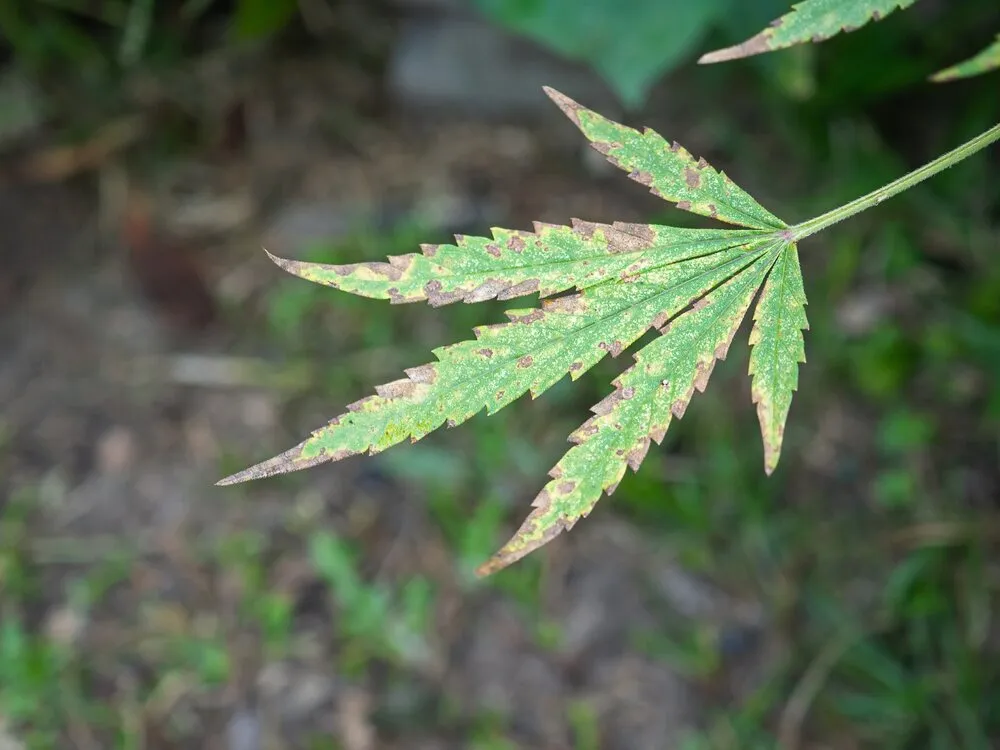
What is Phosphorus Deficiency in Cannabis?
Phosphorus deficiency in cannabis occurs when a plant cannot access enough phosphorus to support normal growth. This does not always mean the growing medium contains too little phosphorus. In many cases, the problem is caused by nutrient lockout, where phosphorus is present but cannot be absorbed by the roots. In many cases, the nutrient is present but unavailable due to incorrect root-zone pH, cold or waterlogged conditions, or salt buildup that blocks uptake.
Phosphorus is a mobile nutrient, meaning the plant can move it from older leaves to newer growth when supplies are limited. As a result, the first symptoms usually appear on mature, lower leaves. These leaves may darken, develop bronze or reddish-brown patches, feel stiff, or begin curling downward.
As the deficiency progresses, overall growth slows and affected leaf tissue may become dry or necrotic. During flowering, an unresolved deficiency can reduce flower development because the plant lacks the energy required for normal reproductive growth.
It is important not to diagnose phosphorus deficiency based on a single symptom. For example, purple stems can be caused by genetics, low temperatures, strong light, or general stress. A proper diagnosis should consider leaf position, symptom pattern, and root-zone conditions.
Why Cannabis Plants Need Phosphorus
Phosphorus is one of the three primary macronutrients in cannabis NPK fertilizers. While cannabis uses less phosphorus than nitrogen or potassium in many situations, it still requires a steady supply throughout its life cycle.
Phosphorus supports key plant functions:
| Plant function | Importance for cannabis growth |
| Energy transfer | Helps store and move energy for growth |
| Root development | Supports strong, expanding root systems |
| Photosynthesis | Aids conversion of light into usable energy |
| Cell division | Enables new roots, leaves, stems, and flowers |
| Flower development | Supports normal bud formation and reproduction |
| Genetic processes | Involved in DNA, RNA, and new cell production |
In practice, a plant lacking available phosphorus often loses vigour. Root growth may slow, vegetative development weakens, and flowering plants may produce fewer or smaller flowers.
Grower tip: Avoid immediately using strong bloom boosters when you see dark or purple leaves. First check pH, root temperature, watering habits, and nutrient strength. Adding more phosphorus will not fix a lockout and may worsen imbalances.
When Phosphorus Demand Is Highest
Cannabis requires phosphorus throughout all stages, but demand changes over time.
Seedlings need only small amounts because they rely partly on stored seed reserves. Overfeeding at this stage can easily cause stress.
During vegetative growth, phosphorus supports root expansion, energy transfer, and new tissue formation. Nitrogen remains the dominant nutrient, but phosphorus must still be available for healthy development.
Demand increases during the transition to flowering. Phosphorus becomes important for the energy-intensive process of flower formation, while potassium also plays a larger role in water regulation and flower quality.
This does not mean cannabis needs extremely high phosphorus levels in bloom. Excess phosphorus does not automatically increase yield. A balanced feeding programme is usually more effective than heavy bloom additives.
| Growth stage | Phosphorus need | Main focus |
| Seedling | Low | Avoid overfeeding |
| Vegetative growth | Moderate | Root and structural development |
| Transition to flower | Increasing | Maintain steady nutrient supply |
| Flowering | Consistent | Support normal bud formation |
| Late flowering | Stable/low | Follow plant response |
When phosphorus deficiency appears during flowering, the cause should be corrected quickly. However, growers should always confirm whether the issue is true deficiency or a root-zone uptake problem, which is far more common in beginner grows.
How to Identify Phosphorus Deficiency in Cannabis
Phosphorus deficiency in cannabis usually appears first on older fan leaves near the bottom or middle of the plant. Phosphorus is a mobile nutrient, so the plant can move its remaining supply from mature leaves into newer growth. This leaves the oldest foliage showing damage first.
Early symptoms include unusually dark leaves, slower growth, and small bronze or reddish-brown marks. As the problem develops, affected leaves may become stiff, curl downward, and develop larger areas of dry, dead tissue.
Use the overall symptom pattern rather than relying on one sign alone.
| Diagnostic feature | Typical phosphorus deficiency symptom |
| Where it begins | Older leaves in the lower or middle canopy |
| Leaf color | Dull, dark green, blue-green, or grey-green |
| Leaf damage | Bronze, rusty, reddish-brown, or dark brown patches |
| Leaf shape | Tips and edges may curl downward |
| Leaf texture | Thick, stiff, dry, or brittle |
| Plant growth | Slower shoots, branches, roots, and flowers |
Purple stems alone do not confirm phosphorus deficiency. Some strains naturally produce red or purple pigmentation, while cold temperatures, strong light, and general stress can create similar coloring.
Early Signs on Older Leaves
The first signs can be easy to miss because the upper canopy may still look healthy. Start by inspecting mature fan leaves near the bottom of the plant.
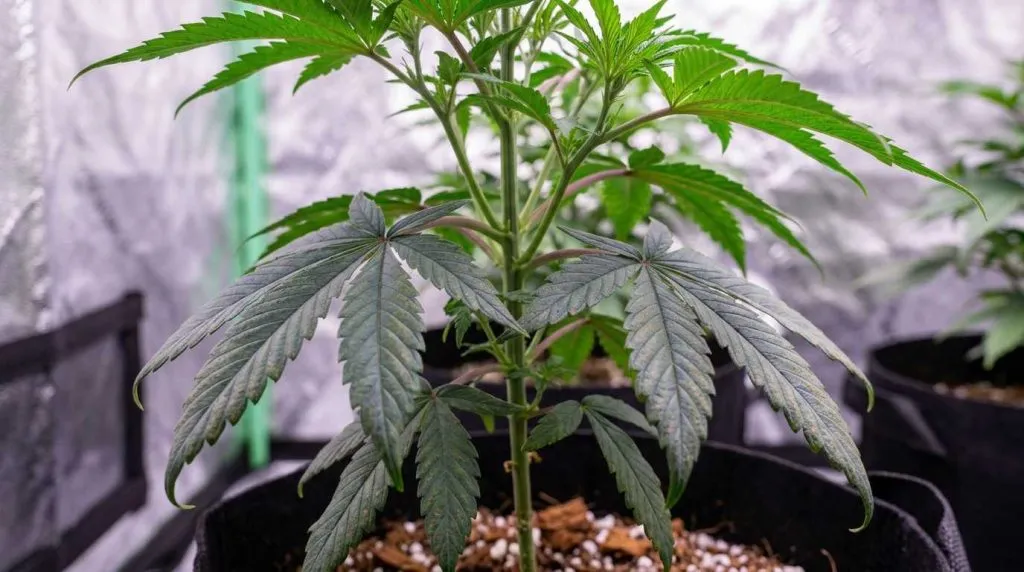
Look for:
- Older leaves becoming darker than nearby foliage
- A dull or slightly blue-green appearance
- Small rusty, bronze, or reddish-brown spots
- Leaves becoming thicker or less flexible
- Slower growth or reduced side-branch development often accompanies other cannabis leaf symptoms.
Dark leaves do not always mean the plant is healthy. A phosphorus-deficient leaf often looks dull and rigid rather than evenly colored and flexible.
A single damaged leaf is not enough to diagnose a nutrient problem. It may have been bruised, splashed, shaded, or damaged during training. Phosphorus deficiency normally creates a similar pattern across several older leaves.
Grower tip: Compare an affected lower leaf with a healthy leaf from higher on the plant. Differences in color, texture, and flexibility are often easier to see side by side.
Dark Leaves, Brown Patches and Downward Curling
As the deficiency progresses, small rusty spots can spread into larger bronze, purple-brown, or dark brown patches. These damaged areas eventually become dry because the leaf tissue has died.
The leaf may also feel thick or stiff, with its edges and tips hooking downward. This differs from the soft, limp drooping commonly caused by underwatering.
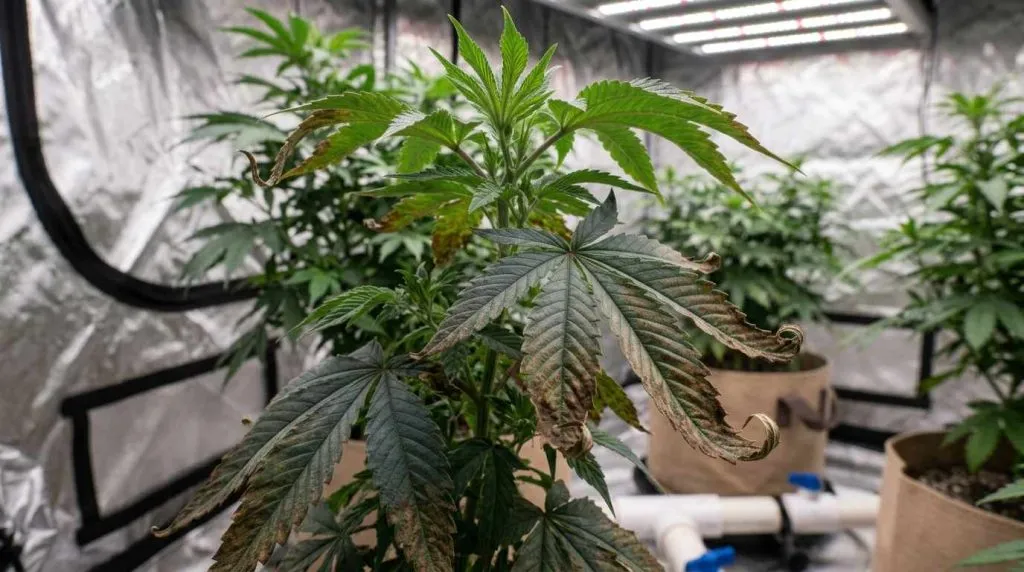
| What you see | What it may suggest |
| Dark leaves without spotting | Normal color or excess nitrogen may be more likely |
| Dark leaves with bronze or brown spots | More consistent with phosphorus deficiency |
| Burnt-looking leaf edges | Potassium deficiency may be more likely |
| Purple stems with healthy foliage | Often genetic or environmental |
| Dark, stiff leaves curling down | Possible advanced phosphorus deficiency |
Phosphorus deficiency does not normally cause the bright, even yellowing associated with nitrogen deficiency. Potassium deficiency more commonly damages the leaf margins, while magnesium deficiency usually creates yellowing between green veins.
How Symptoms Progress Through the Plant
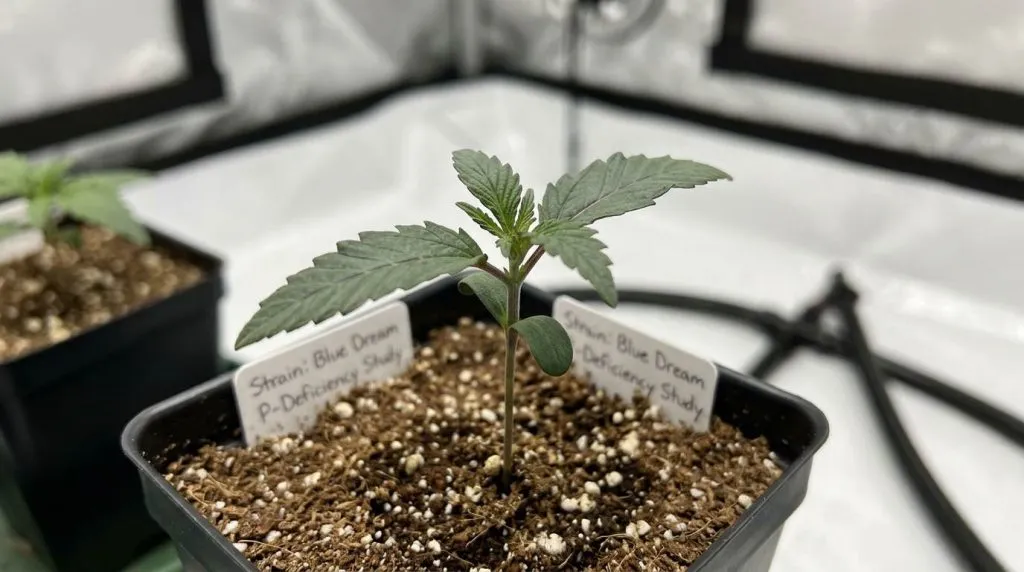
Phosphorus deficiency usually develops gradually.
| Stage | What you may notice |
| Early | Older leaves darken and growth begins to slow |
| Developing | Rusty, bronze, or reddish-brown spots appear |
| Moderate | Spots expand and leaves become stiff or curled |
| Advanced | Large areas turn brown, dry out, and die |
| Severe | Damage spreads higher and plant development stalls |
If the cause is not corrected, affected leaves may die and fall away. Symptoms can then move higher as the plant continues redirecting phosphorus towards its newest growth.
Damaged tissue will not return to normal. Judge recovery by whether the spots stop spreading and healthy leaves remain unaffected.
Grower tip: Photograph the same leaves every two or three days under similar lighting. This makes it easier to see whether the problem is progressing or stabilising.
Phosphorus Deficiency During the Vegetative Stage
During vegetative growth, phosphorus deficiency often appears as dark lower leaves combined with slower plant development.
New shoots may emerge more slowly, side branches can remain short, and the plant may stop expanding at its previous rate. The growing medium may also take longer to dry if cold, saturated, or damaged roots are absorbing water inefficiently.
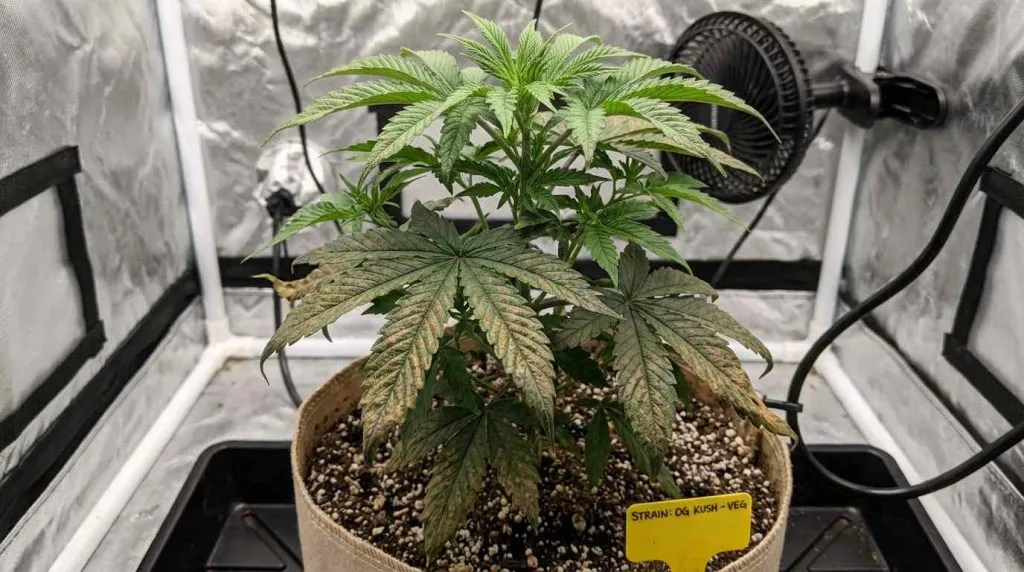
Before adding more phosphorus, check:
- Root-zone pH
- Root temperature
- Watering frequency
- Drainage and aeration
- Feed strength and salt buildup
Growers starting with beginner cannabis seeds should check the root zone before increasing fertilizer strength, as poor phosphorus uptake is often caused by unsuitable growing conditions rather than a genuine shortage.
Phosphorus Deficiency During Flowering
Phosphorus deficiency can become more noticeable during the cannabis flowering stage. Older fan leaves may darken, develop spreading brown patches, curl downward, and die earlier than expected.
Flower development can also slow if the problem continues. Bud sites may appear smaller or develop unevenly, while branch growth and stretching become limited.
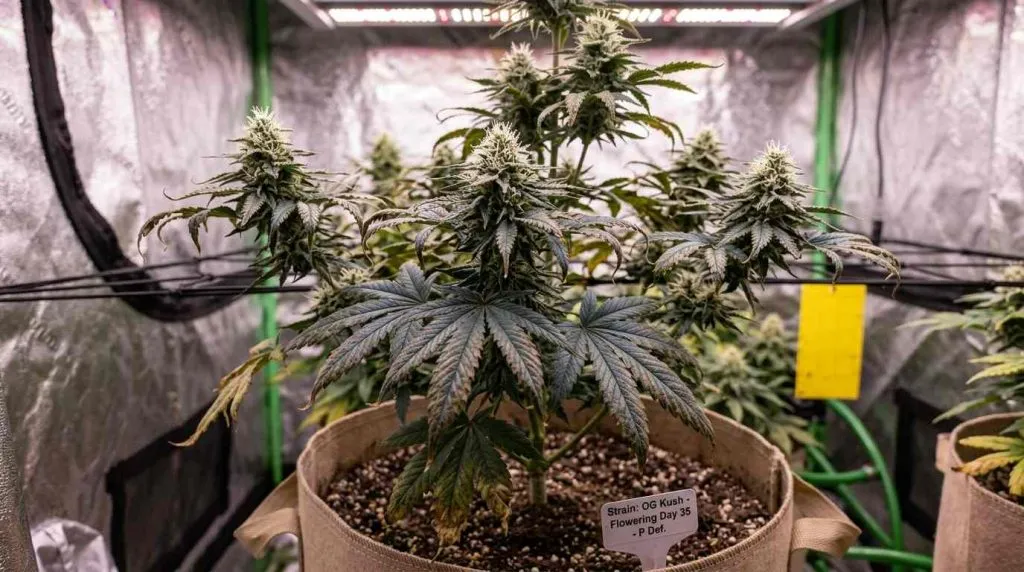
Some leaf decline is normal near harvest. However, widespread darkening, rusty patches, and premature leaf death during early or mid-flowering should not be mistaken for a natural fade.
Do not immediately apply a concentrated bloom booster. Extra phosphorus will not correct cold roots, overwatering, incorrect pH, salt buildup, or root damage. It may increase nutrient concentration and make the problem worse.
The clearest sign of recovery is that no new leaves develop the same symptoms. Existing brown patches will remain, but the damage should stop spreading and normal growth should gradually resume.
How to Confirm Phosphorus Deficiency
Dark leaves, brown patches and purple stems can suggest phosphorus deficiency in cannabis, but none of these symptoms confirms it on its own. Similar changes can be caused by genetics, cold temperatures, excess nitrogen, other nutrient deficiencies or unhealthy roots.
A reliable diagnosis considers three things:
- Where the symptoms appeared first
- How the leaf damage looks and progresses
- Whether root-zone conditions could be restricting nutrient uptake
Because phosphorus is mobile, symptoms usually begin on older leaves near the bottom or middle of the plant. If the newest growth is affected first, another problem is more likely.
Diagnose the Problem in the Correct Order
Check the plant and its growing conditions before adding extra phosphorus.
| Step | What to check |
| 1. Find the first affected leaves | Confirm that symptoms began on older, mature foliage |
| 2. Examine the damage | Look for dark leaves, irregular bronze or brown patches, stiffness and downward curling |
| 3. Check plant development | Note any slowing of shoots, branches or flower growth |
| 4. Review recent changes | Consider cold conditions, heavy watering, stronger feeding or transplant stress |
| 5. Inspect the root zone | Check pH, temperature, drainage and nutrient strength |
| 6. Compare similar problems | Rule out nitrogen, potassium, magnesium and environmental stress |
Phosphorus deficiency becomes more likely when several symptoms appear together. A typical pattern includes dark or blue-green older leaves, reddish-brown patches, stiff foliage and slowing growth.
Root-zone problems should always be checked before changing the feeding programme. Cold, waterlogged or salt-affected media can prevent the roots from absorbing phosphorus even when enough is already present.
Grower tip: Think about what changed shortly before the symptoms appeared. A cold night, extra watering or stronger feed can reveal the cause more quickly than leaf color alone.
Why Purple Stems Do Not Always Indicate a Deficiency
Purple or red stems are often linked with phosphorus deficiency, but many healthy cannabis plants naturally develop this pigmentation.
Stem color may also be influenced by:
- Genetics
- Cold temperatures
- Strong light exposure
- General environmental stress
Use the surrounding foliage and plant growth to decide whether the color is significant.
| What you see | What it may mean |
| Purple stems with healthy leaves and steady growth | Most likely genetic pigmentation |
| Purple coloring after cold conditions | Possible temperature stress or temporarily reduced uptake |
| Purple stems with dark, spotted older leaves | Phosphorus deficiency is more likely |
| Purple stems with stalled growth and curled leaves | Inspect pH, temperature and root health |
Do not increase nutrients simply because the stems are purple. If the foliage is healthy and the plant is growing normally, continue monitoring it.
Phosphorus Deficiency vs Similar Cannabis Problems
Several nutrient and environmental problems can produce symptoms that resemble phosphorus deficiency. The location and pattern of the damage help separate them.
| Problem | Where it begins | Main visual difference |
| Phosphorus deficiency | Older leaves | Dark foliage, irregular bronze or brown patches and stiff downward curling |
| Nitrogen deficiency | Older leaves | Even yellowing across the leaf |
| Potassium deficiency | Older leaves | Burnt-looking tips and outer leaf edges |
| Magnesium deficiency | Older leaves | Yellowing between green veins |
| Calcium deficiency | New growth | Distorted young leaves and irregular spotting |
| Excess nitrogen | Across the plant | Very dark, glossy leaves with hooked tips |
| Cold or wet roots | Variable | Slow growth, drooping and possible purple coloring |
| Natural late-flower fade | Older leaves near harvest | Gradual yellowing rather than dark, spotted foliage |
Potassium deficiency is commonly confused with phosphorus deficiency because both affect older leaves and cause brown tissue. Potassium damage usually begins around the leaf margins, while phosphorus-related patches tend to appear irregularly across darkened leaves.
Excess nitrogen may also cause dark leaves and downward clawing. These leaves are normally glossy and intensely green, rather than dull with bronze or reddish-brown damage.
The strongest indication of phosphorus deficiency is therefore a combination of older-leaf damage, unusually dark foliage, irregular brown patches, stiff downward curling and slowed development.
What Causes Phosphorus Deficiency in Cannabis?
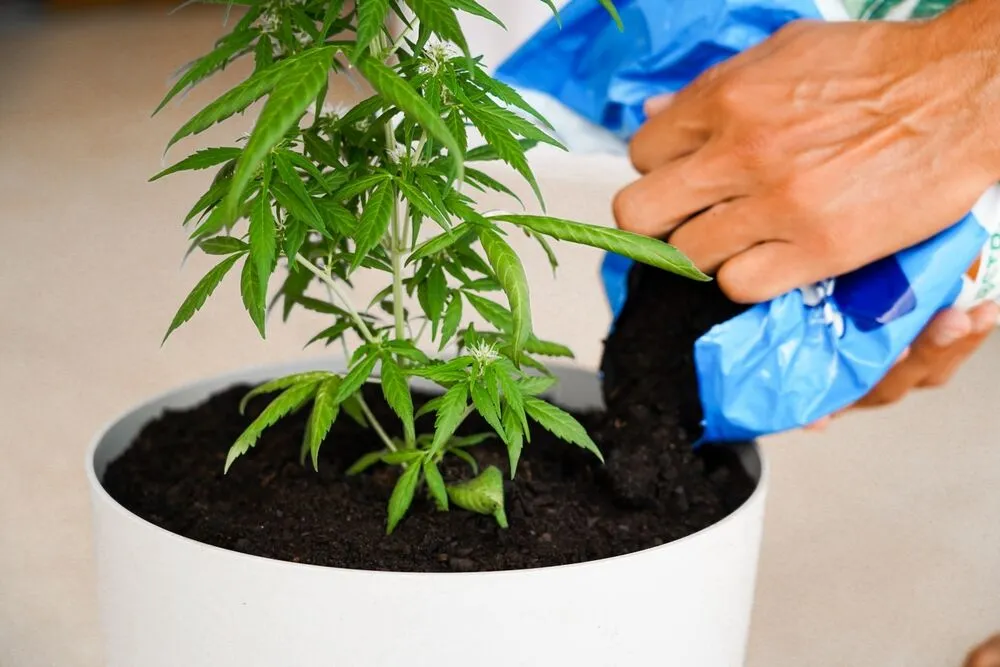
Phosphorus deficiency in cannabis is not always caused by too little phosphorus in the fertilizer. More often, the nutrient is already present but the roots cannot absorb it efficiently. This is known as nutrient lockout.
Before increasing the feed, check the entire root zone. Incorrect pH, cold temperatures, waterlogged media, salt buildup and root damage can all reduce phosphorus uptake.
| Possible cause | What happens in the root zone | What to check |
| Incorrect pH | Phosphorus becomes less available | Input and root-zone pH |
| Cold conditions | Root activity and nutrient uptake slow | Pot or reservoir temperature |
| Overwatering | Water displaces oxygen around the roots | Drying time and drainage |
| Salt buildup | High nutrient concentrations stress roots | Feed and runoff EC |
| Root damage | The plant cannot explore the medium effectively | Root color, smell and condition |
| Insufficient feeding | The nutrient supply is genuinely too low | Fertiliser label and feeding history |
Incorrect Root-Zone pH and Phosphorus Lockout
Phosphorus availability changes with pH. In soil, it becomes less accessible when conditions are excessively acidic or alkaline because it can react with other minerals and form compounds that roots struggle to absorb. General crop guidance places the greatest soil phosphorus availability at approximately pH 6.0–7.0.
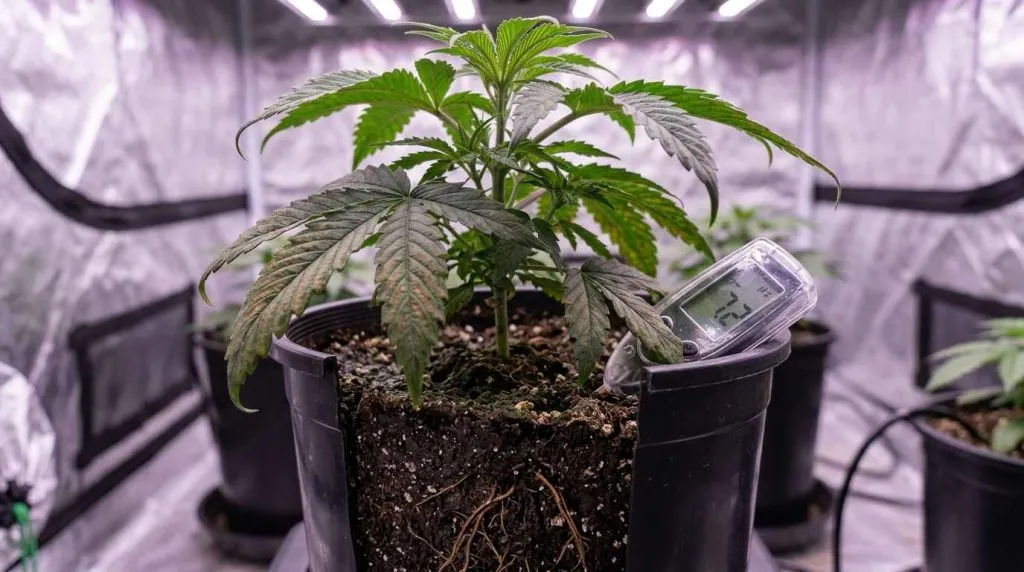
For most cannabis grows, aim for:
- Soil: approximately pH 6.0–7.0
- Coco and hydroponics: approximately pH 5.5–6.5
Do not rely only on the pH of the water before nutrients are added. Mix the complete feed first, then measure the final solution. Where possible, also check the root-zone or runoff readings to identify a developing imbalance.
Grower tip: A plant can show phosphorus deficiency even when you are using a phosphorus-rich bloom feed. If pH is outside the suitable range, adding more fertilizer will not restore uptake.
Cold Root-Zone Temperatures
Cold roots absorb water and nutrients more slowly. This can create temporary phosphorus deficiency symptoms even when the growing medium contains enough of the nutrient.
Problems become more likely when the root zone falls to around or below 15°C/59°F, particularly when the medium is also wet. Cold, damp conditions restrict root growth and reduce the plant’s ability to access relatively immobile phosphorus.
When growing indoor cannabis seeds, check the temperature beside the pots rather than relying only on a sensor at canopy height. Containers sitting directly on a cold floor may be several degrees cooler than the surrounding air.
Overwatering, Poor Drainage and Low Root Oxygen
Healthy roots need both moisture and oxygen. Overwatering cannabis plants is one of the most common causes of poor root health. When the medium remains saturated, water fills the air spaces around the roots and slows respiration. Nutrient uptake becomes less efficient, and the plant may begin displaying phosphorus deficiency alongside drooping or stalled growth.
Common warning signs include:
- Pots remaining heavy for several days
- A musty or sour smell from the medium
- Slow water use
- Constantly wet lower soil
- Poor drainage after irrigation
Allow the medium to dry appropriately between waterings and make sure excess water can drain freely. Increasing phosphorus will not correct an oxygen-starved root zone.
Salt Buildup and Nutrient Imbalances
Repeated heavy feeding can leave unused mineral salts in the growing medium. As the electrical conductivity rises, roots find it harder to take up water and maintain a balanced nutrient supply.
Salt buildup is particularly common when growers frequently add nutrients but produce little drainage, use hard water, or allow fertilizer solution to collect beneath the pots. Excess nutrients can also interfere with the uptake of other elements. Research on cannabis has found that increasing root-zone phosphorus and overall nutrient concentration above adequate levels does not necessarily improve yield or cannabinoid production.
Check input and runoff EC where possible. A large difference between them may indicate that salts are accumulating in the medium.
Root Damage and Unhealthy Growing Media
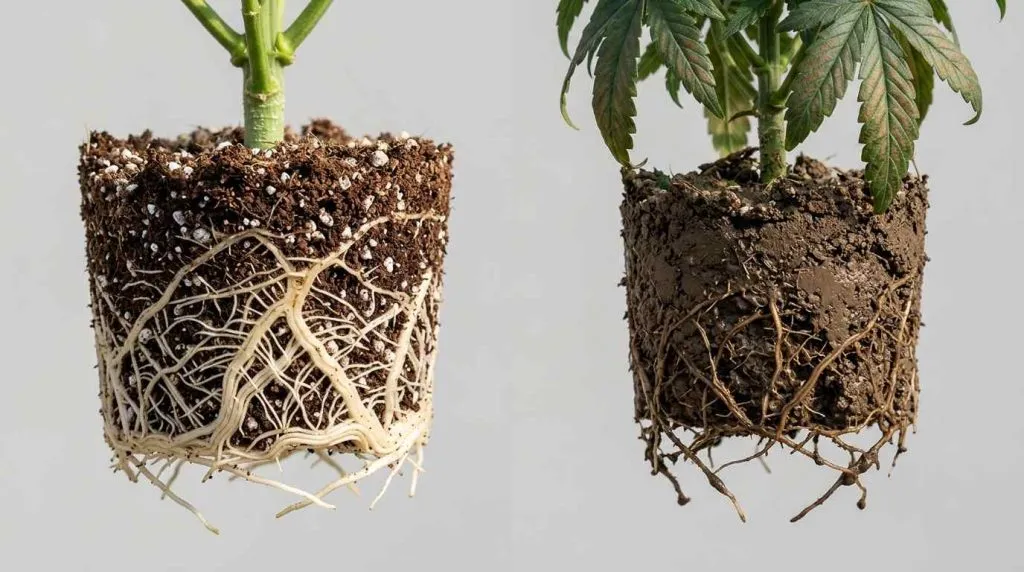
Roots must grow through the cannabis growing medium to reach available phosphorus. Compaction, root rot, transplant damage and poor aeration reduce the amount of healthy root surface available for nutrient uptake. Root growth is therefore a major part of phosphorus nutrition.
Healthy roots are generally pale and firm. Brown, slimy or foul-smelling roots suggest a more serious root problem that must be corrected before the plant can resume normal feeding.
Old or compacted growing media can also hold too much water and too little air. Choose a clean, free-draining substrate and avoid pressing it firmly into the container.
Incomplete Feeding or Insufficient Phosphorus
A genuine shortage is possible, especially when plants are grown in depleted soil, reused media or an incomplete nutrient programme. It may also occur when a grower continues using a very low-strength seedling or vegetative feed after the plant’s requirements have increased.
Check the fertilizer label to confirm that it contains phosphorus and is suitable for both the growing method and growth stage. Organic amendments may release nutrients gradually, so they may not correct an active deficiency quickly.
Increase feeding cautiously and follow the manufacturer’s starting rate rather than applying a concentrated bloom booster. Cannabis research shows that very low phosphorus supply can restrict growth, but raising phosphorus far above adequate levels does not consistently produce larger harvests.
How to Fix and Prevent Phosphorus Deficiency in Cannabis
The safest way to fix phosphorus deficiency in cannabis is to correct the root-zone problem before adding more phosphorus. Incorrect pH, cold roots, overwatering, salt buildup, and root damage can all prevent uptake even when the nutrient is already present.
Work through the following steps in order and avoid changing several parts of the grow at once.
Step 1: Check Root-Zone pH and EC
Check the pH after mixing all nutrients and additives.
Aim for approximately:
- Soil: pH 6.0–7.0
- Coco and hydro: pH 5.5–6.5
EC measures the concentration of dissolved nutrients and salts. Runoff is the liquid that drains from the container after watering. When runoff EC is much higher than the input, salts may be building up around the roots.
Growers without an EC meter can look for:
- White mineral deposits
- Burnt leaf tips
- Symptoms appearing after strong or repeated feeding
- Runoff regularly left beneath the pot
Correct pH gradually with a properly mixed nutrient solution rather than making an extreme adjustment in one watering.
Grower tip: Always measure pH after adding nutrients because fertilizers can change the final reading.
Step 2: Correct Temperature, Watering, and Drainage
Cold or saturated roots cannot absorb phosphorus efficiently.
Check the temperature near the pots, especially when they sit on concrete or another cold surface. Phosphorus uptake can slow when the root zone falls to around or below 59°F/15°C, particularly when the growing medium remains wet.
Raise containers away from cold floors and keep conditions stable. Water according to the moisture level of the medium rather than following a fixed schedule.
- Allow soil to partially dry before watering again.
- Keep coco evenly moist without leaving it waterlogged.
- Make sure containers drain freely.
- Remove runoff instead of allowing pots to sit in it.
Grower tip: Lift the pot before watering. A noticeably lighter container usually provides a better guide than watering by the calendar.
Step 3: Address Salt Buildup or Nutrient Lockout
Repeated heavy feeding can leave unused salts in the medium, making water and nutrient uptake more difficult.
Do not automatically flush every plant showing phosphorus deficiency symptoms. A large plain-water flush can saturate soil and create further root stress.
When salt buildup is likely:
- Reduce nutrient strength temporarily.
- Use a correctly pH-balanced solution.
- Allow sufficient drainage.
- Remove runoff after watering.
- Recheck pH and EC at the next irrigation.
The treatment should suit the growing medium. Soil generally requires a gentler correction than coco, while hydroponic growers can adjust or replace the reservoir.
Step 4: Resume Balanced Feeding
Once pH, temperature, watering, and salt levels are under control, return to a complete nutrient programme at moderate strength.
Use a fertilizer made for the growing medium and current stage of growth. A complete feed supplies phosphorus alongside nitrogen, potassium, calcium, magnesium, and micronutrients.
If the plant has been underfed, increase the concentration gradually. A stressed plant is less likely to respond well to a sudden full-strength feed.
Keeping a basic record of watering, nutrient strength, pH, and plant response can help prevent the same issue from returning.
Step 5: Increase Phosphorus Only if Necessary
Only increase phosphorus after ruling out lockout and checking the existing feed.
A true shortage may occur in:
- Depleted or heavily reused soil
- An incomplete nutrient programme
- Plants kept on weak seedling feed for too long
- Flowering plants receiving insufficient balanced nutrition
Check the fertilizer label before adding another product. If more feeding is required, begin with the manufacturer’s lower recommended amount and monitor the response.
Avoid repeatedly applying concentrated bloom boosters. More phosphorus does not automatically produce larger flowers and can contribute to salt buildup or other nutrient imbalances.
Organic amendments such as bone meal and bat guano release nutrients gradually. They may help maintain prepared soil but are unlikely to provide a rapid correction.
Treatment in Soil, Coco, and Hydro
| Growing method | Recommended approach |
| Soil | Check pH and watering first. Allow saturated soil to dry and avoid heavy flushing unless salt buildup is strongly suspected. |
| Coco | Monitor input and runoff pH and EC. Use a complete coco feed and allow controlled drainage. |
| Hydroponics | Check reservoir pH, EC, temperature, oxygenation, and nutrient age. Rebalance or replace the solution when necessary. |
In every system, improve root health before increasing nutrient strength.
Recovery Timeline and What to Expect
Once the underlying cause is corrected, the damage should stop spreading within several days. Healthier growth may become visible within approximately 5–10 days, although plants with damaged roots may take longer.
Existing brown patches and dead tissue will not turn green again. Look instead for:
- No new spots
- Existing damage no longer expanding
- Healthier new leaves
- Improved water use
- Renewed shoot or flower development
Do not remove every marked leaf immediately. Leaves that still contain healthy green tissue can continue supporting the plant.
Preventing Phosphorus Deficiency
To prevent the problem from returning:
- Maintain the correct pH for the growing medium.
- Keep the root zone warm and well oxygenated.
- Avoid fixed watering schedules.
- Do not leave containers standing in runoff.
- Increase nutrient strength gradually.
- Use a complete feeding programme.
- Monitor pH, EC, and plant health during flowering.
Phosphorus deficiency is often caused by poor uptake rather than a lack of fertilizer. Stable root conditions and balanced feeding are usually more effective than adding high-phosphorus products.
Conclusion
Phosphorus deficiency in cannabis is usually caused by poor nutrient uptake rather than a true lack of phosphorus. Issues such as incorrect root-zone pH, cold temperatures, overwatering, salt buildup, and unhealthy roots can all block absorption even when nutrients are present.
Symptoms typically appear first on older leaves, which may darken and develop bronze or reddish-brown patches, become stiff, curl downward, and slow overall growth. Purple stems can occur at the same time, but they are not a reliable diagnostic sign on their own.
Before increasing phosphorus, correct the growing environment. Adjust pH into the proper range, improve drainage and oxygen flow, maintain warm root conditions, and reduce excess salts if needed. Once conditions stabilize, resume a balanced nutrient feed and only supplement phosphorus if a clear deficiency persists.
Damaged leaves will not recover, so focus on healthy new growth and stopping symptom progression.
Frequently Asked Questions
What does phosphorus deficiency look like in cannabis?
Phosphorus deficiency usually begins on older lower leaves. The foliage may become unusually dark or blue-green before developing rusty, bronze, reddish-brown, or dark brown patches. Affected leaves can become stiff, curl downward, dry out, and eventually die.
Can incorrect pH cause phosphorus deficiency?
Yes. Incorrect root-zone pH can make phosphorus less available, even when enough is present in the soil or nutrient solution. Aim for approximately pH 6.0–7.0 in soil and 5.5–6.5 in coco or hydroponic systems.
Do purple stems mean a cannabis plant needs phosphorus?
Not necessarily. Purple or red stems can be caused by genetics, cold temperatures, strong light exposure, or general stress. Phosphorus deficiency is more likely when purple stems appear alongside dark, spotted older leaves, downward curling, and slowed growth.
Should I flush a plant with phosphorus deficiency?
Do not flush automatically. Flushing may help when salt buildup or severe nutrient imbalance has been confirmed, but it can make an overwatered soil grow worse. Check pH, EC, drainage, watering habits, and root health before deciding whether a flush is necessary.
How long does phosphorus deficiency take to correct?
Once the underlying cause is fixed, the damage should stop spreading within several days. Healthier growth may become visible within approximately 5–10 days, although plants with significant root damage can take longer. Existing brown or dead leaf tissue will not recover.


