




Calcium deficiency in cannabis is one of the most common nutrient problems growers encounter, but it's also one of the most commonly misdiagnosed. The first signs of calcium deficiency in cannabis leaves are usually small rust-colored spots, distorted new growth, curled leaf edges, and slowed development around the growing tips. While these calcium deficiency symptoms in cannabis can look alarming, they do not always mean the plant needs more calcium.
In many cases, the problem is caused by poor root-zone pH, high EC, overwatering, damaged roots, or environmental conditions that prevent the plant from absorbing and transporting calcium. This guide explains how to identify calcium deficiency in cannabis, diagnose the underlying cause, fix it step by step, and prevent it from returning so your plants can continue growing and flowering normally.
Key Takeaways
- Calcium deficiency usually affects young leaves and growing tips first.
- Rust-colored spots and distorted new growth are the most common symptoms.
- Poor pH, high EC, and unhealthy roots often cause calcium uptake problems.
- Cal-Mag only helps when the plant is genuinely receiving too little calcium.
- Damaged leaves will not recover, so monitor fresh growth for improvement.
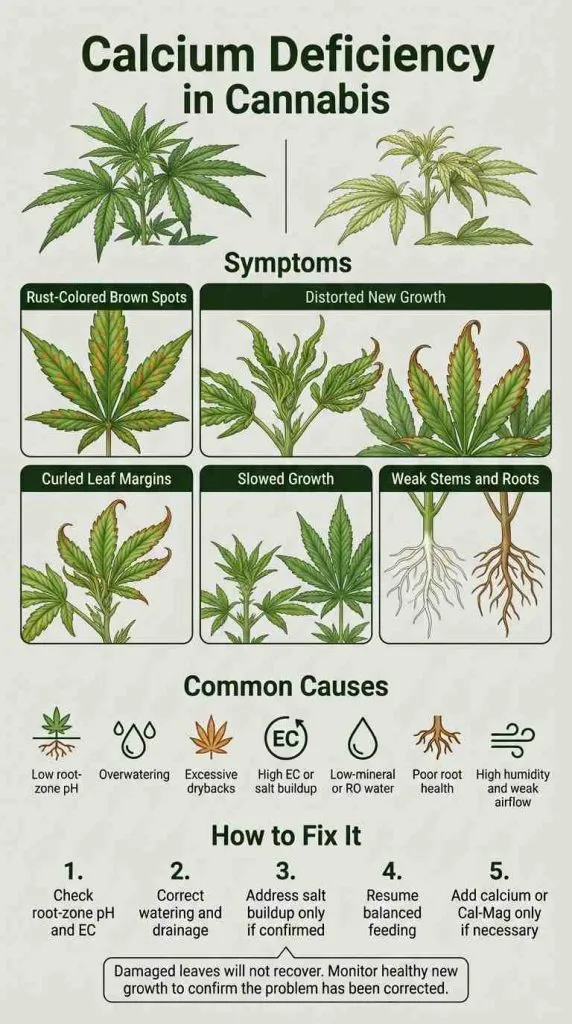
What is Calcium Deficiency in Cannabis?
Calcium deficiency in cannabis occurs when a plant cannot absorb or transport enough calcium to support healthy new growth. Calcium helps form cell walls, develop roots, and maintain strong stems and shoots.
Because calcium cannot be easily moved from older leaves into new tissue, symptoms usually appear first on young leaves and active growing tips. However, visible damage does not always mean the nutrient solution lacks calcium. Incorrect pH, high EC, or damaged roots can cause nutrient lockout in cannabis, while overwatering, inconsistent irrigation, and poor transpiration can restrict calcium movement.
For this reason, growers should check the root zone and growing conditions before automatically adding Cal-Mag. More calcium will not correct a transport or uptake problem and may increase salt buildup.
How to Identify Calcium Deficiency in Cannabis
The clearest signs of calcium deficiency are irregular brown spots, distorted new leaves, curled margins, and slowed growth near the top of the plant. These symptoms are most useful when considered together.
Calcium deficiency rarely begins as widespread yellowing on the oldest fan leaves. If lower foliage is affected first while new growth remains healthy, compare the symptoms with other marijuana nutrient deficiencies before changing the feeding program.
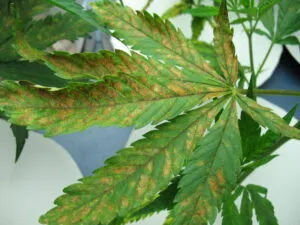
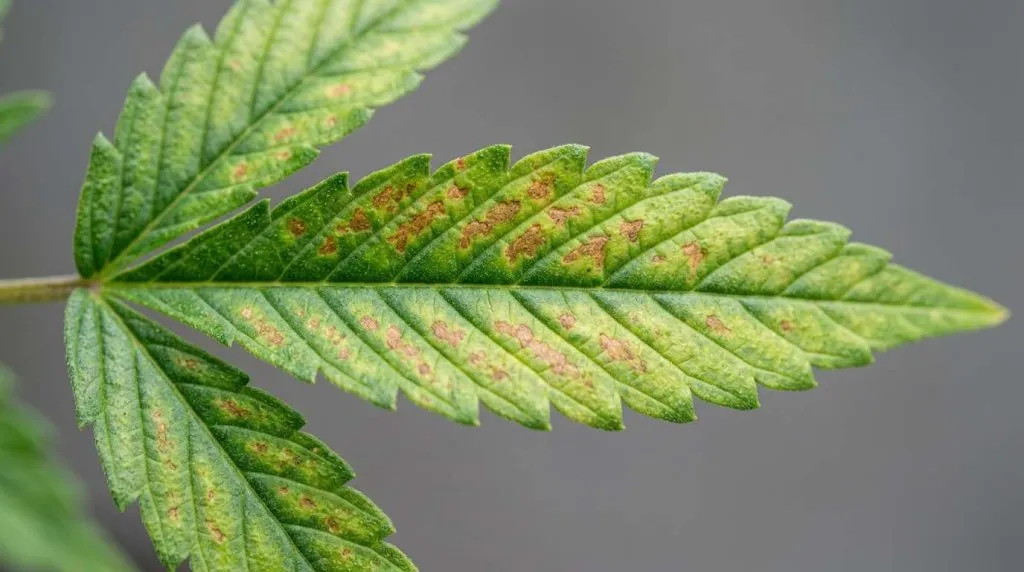
Rust-Colored or Brown Spots
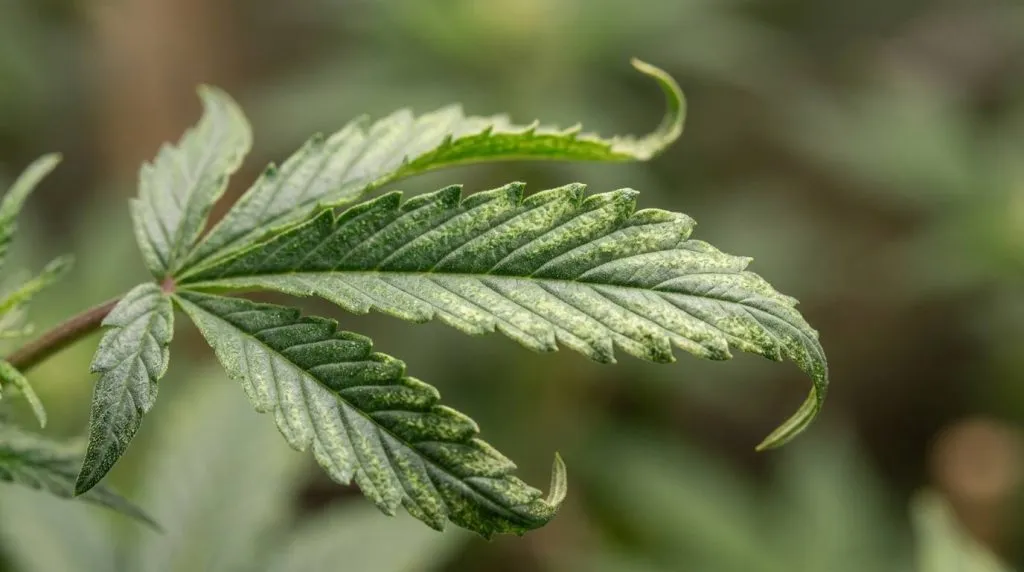
Small brown, tan, or rust-colored spots often appear on young cannabis leaves. They may begin as tiny pinpricks before expanding into irregular patches of dead tissue.
Unlike interveinal yellowing, these marks do not always follow the veins in a clear pattern. Similar spotting may also result from pests, nutrient burn, pH problems, or magnesium deficiency in cannabis, so check which leaves were affected first and look for accompanying symptoms.
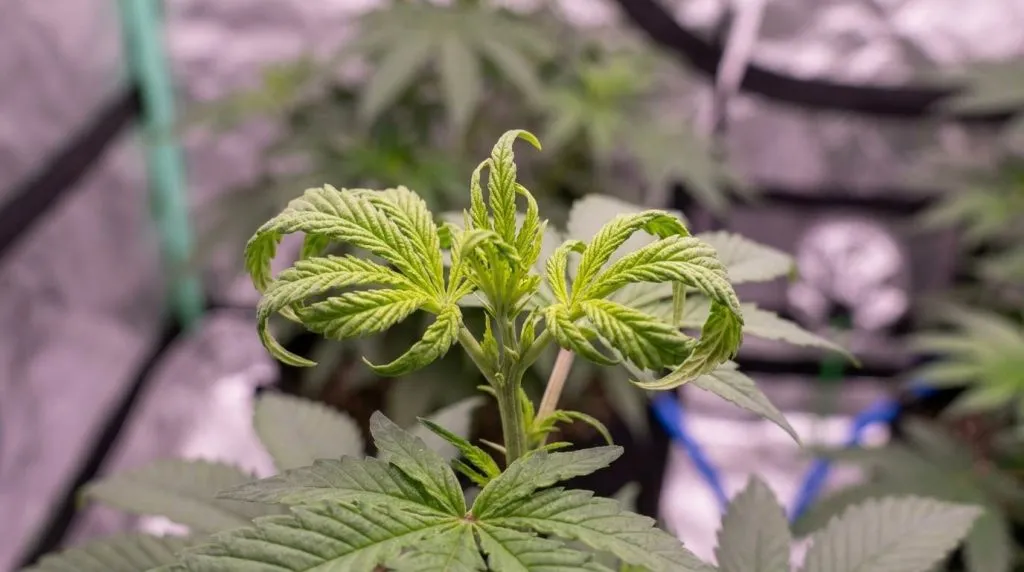
Twisted or Distorted New Growth
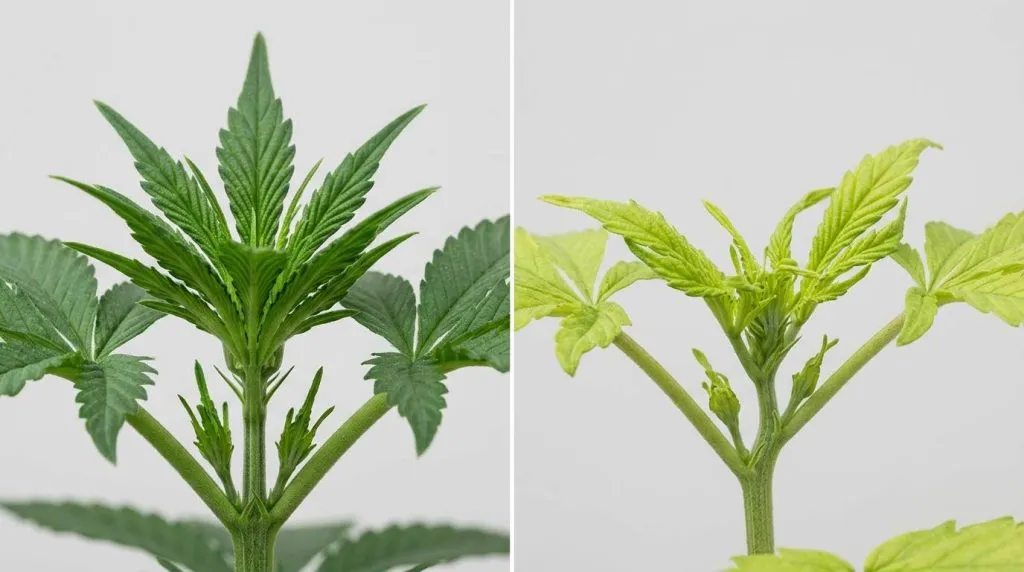
New leaves may emerge twisted, puckered, crinkled, or uneven. Some remain smaller than normal or fail to open fully.
Distorted growth near the top of the plant can indicate calcium problems, although zinc deficiency in cannabis may also produce small or misshapen young leaves. Check for irregular brown spotting and root-zone problems before deciding on a treatment.
Curled and Damaged Leaf Margins
The edges of young leaves may curl downward, hook inward, or develop an irregular shape. As the problem progresses, affected margins can become dry and brittle.
Curling alone does not confirm calcium deficiency. Heat stress, excessive light, overfeeding, and watering problems can produce similar leaf shapes. Look for accompanying brown spots and malformed new growth before reaching a diagnosis.
Slowed or Stunted New Growth
Calcium deficiency can slow the development of new shoots and growing tips. Internodes may remain short, emerging leaves may stay undersized, and the top of the canopy can become uneven.
Severe cases may damage the growing point itself, limiting branch development and the production of healthy new tissue. Early diagnosis is particularly important when growing autoflower cannabis seeds, as their fixed lifecycle leaves less time to recover from prolonged stress.
Weak Stems and Root Development
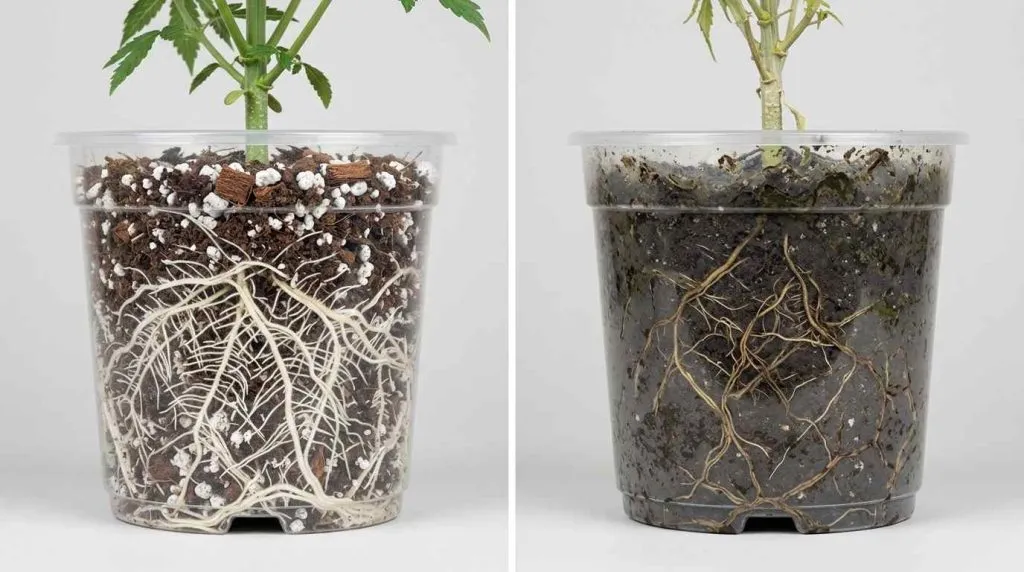
Calcium supports both cell structure and root-tip development. When uptake remains restricted, new stems may become weaker and the root system may produce fewer healthy tips and root hairs.
Root symptoms are difficult to identify without inspecting the root ball or reservoir. Brown, slimy, or foul-smelling roots may indicate root disease rather than calcium deficiency alone.
How the Symptoms Progress
| Stage | Typical symptoms |
| Early | Small rust spots, slightly uneven leaves, and mild distortion in new growth |
| Moderate | Larger brown patches, curled margins, slower shoots, and misshapen leaves |
| Advanced | Dead leaf tissue, damaged growing tips, weak stems, poor root growth, and reduced flower development |
Existing damage will not normally disappear after the underlying problem has been corrected. Brown spots and distorted leaves usually remain visible.
Instead, monitor the newest growth. If fresh leaves emerge without additional spotting or deformation over the following several days, calcium uptake is likely improving.
How to Confirm Calcium Deficiency
Brown spots and distorted leaves can point toward calcium deficiency, but they are not enough to confirm it on their own. Similar damage can be caused by pests, heat stress, nutrient burn, potassium problems, root disease, and unsuitable pH.
A reliable diagnosis should consider three things together:
- Where the symptoms appeared first.
- How the damage is progressing.
- What is happening in the root zone.
Calcium deficiency in cannabis usually affects new leaves, fresh shoots, and active growing tips before older fan leaves. The plant may also show irregular rust-colored spots, curled margins, and slowed development.
Before adding calcium, check whether the plant can absorb the nutrients already available. Root-zone pH, EC, watering frequency, drainage, root health, and environmental conditions can all restrict calcium uptake.
Diagnose the Problem in the Correct Order
Use the following process before treating the plant:
- Check which leaves are affected first.
Calcium deficiency usually begins on new or actively developing growth. Damage that starts on older lower leaves is more likely to involve a mobile nutrient such as magnesium, nitrogen, or potassium. - Inspect the leaf pattern.
Look for irregular brown or rust-colored spots alongside twisted, crinkled, or undersized new leaves. One isolated spot is not enough to confirm a deficiency. - Rule out pests and physical damage.
Check both sides of the leaves for insects, eggs, webbing, feeding marks, or residue. Pest damage often creates pale stippling rather than distorted new growth. - Measure root-zone pH.
Calcium may be present but unavailable when pH falls outside the suitable range for the growing medium. Test the root zone or runoff rather than relying only on the pH of the water going in. - Check EC and nutrient strength.
High root-zone EC can make it harder for roots to absorb water and calcium. Review both the feed strength and runoff readings where applicable. - Review watering and drainage.
Overwatering reduces oxygen around the roots, while severe drybacks can interrupt the movement of calcium through the plant. Both can produce deficiency-like symptoms. - Inspect root health.
Healthy roots are generally firm and light in color. Brown, slimy, damaged, or foul-smelling roots suggest a root-zone problem that must be corrected before nutrient uptake can recover. - Review the nutrient program.
Confirm whether the base feed already contains calcium. Supplements should only be considered after uptake problems and an inadequate calcium supply have been identified.
This order reduces the risk of treating a pH, irrigation, or root problem by simply adding more Cal-Mag.
Calcium Deficiency vs Similar Cannabis Problems
The location of the damage provides one of the strongest diagnostic clues. Calcium deficiency tends to affect new growth, while several mobile nutrient deficiencies begin on older leaves.
| Problem | Leaves Affected First | Typical Symptoms | Key Difference |
| Calcium deficiency | New leaves and growing tips | Rust spots, distorted growth, curled margins | Damage appears alongside malformed new tissue |
| Magnesium deficiency | Older lower leaves | Yellowing between green veins, followed by rust spots | Interveinal yellowing normally appears before spotting |
| Potassium deficiency | Older leaves | Burned margins, yellowing, and dry leaf edges | Damage usually begins around the outer edge of mature leaves |
| Nutrient burn | Leaf tips across the plant | Brown or scorched tips, dark foliage, clawing | Damage begins at the tips rather than as random spots |
| Heat or light stress | Upper canopy | Upward curling, bleaching, dry edges | Most severe closest to the heat or light source |
| Spider mites or thrips | Any exposed leaves | Pale speckling, silvery marks, feeding damage | Insects, eggs, waste, or webbing may be visible |
| Root disease | May affect the whole plant | Drooping, slow growth, discoloration, multiple deficiencies | Roots may be brown, soft, slimy, or unpleasant-smelling |
| pH-related lockout | Varies by nutrient affected | Several deficiency symptoms at once | Root-zone readings fall outside the suitable range |
Calcium deficiency is more likely when rusty spotting and distorted new growth appear together. If the symptoms are limited to old leaves, follow a uniform burn pattern, or appear alongside visible pests, another diagnosis is more likely.
It is also possible for more than one problem to occur at the same time. For example, overwatering may damage the roots and restrict calcium uptake, while high EC creates additional leaf burn. Correcting the root-zone conditions is therefore more important than matching the plant to a single photograph.
What Causes Calcium Deficiency in Cannabis?
Calcium deficiency in cannabis is not always caused by too little calcium. Often, enough is present, but problems with pH, roots, irrigation, EC, water quality, or the growing environment prevent the plant from absorbing and moving it efficiently.
Because calcium travels upward with water, anything that disrupts root function or water movement can affect new growth first.
Common Causes of Calcium Deficiency
| Cause | Why It Restricts Calcium | Most Common In |
| Low root-zone pH | Calcium becomes harder for roots to absorb | Soil and coco |
| Overwatering | Low oxygen reduces root activity | Soil and coco |
| Excessive drybacks | Water movement slows or stops | Coco and small pots |
| High root-zone EC | Excess salts restrict water uptake | Coco and hydro |
| RO or soft water | Water contains little calcium | Coco and hydro |
| High humidity | Reduced transpiration slows calcium transport | Indoor grows |
| Nutrient imbalance | Excess minerals interfere with uptake | Any system |
Low Root-Zone pH and Poor Calcium Availability
When the root zone becomes too acidic, calcium is harder for the roots to absorb. This can cause deficiency symptoms even when the growing medium still contains enough calcium.
The pH of the feed does not always match conditions around the roots. Salt buildup, repeated acidic irrigation, and decomposing organic matter can gradually lower root-zone pH.
Check runoff or root-zone readings where possible and correct the pH gradually using the range recommended for your growing medium.
Overwatering, Poor Drainage and Root Damage
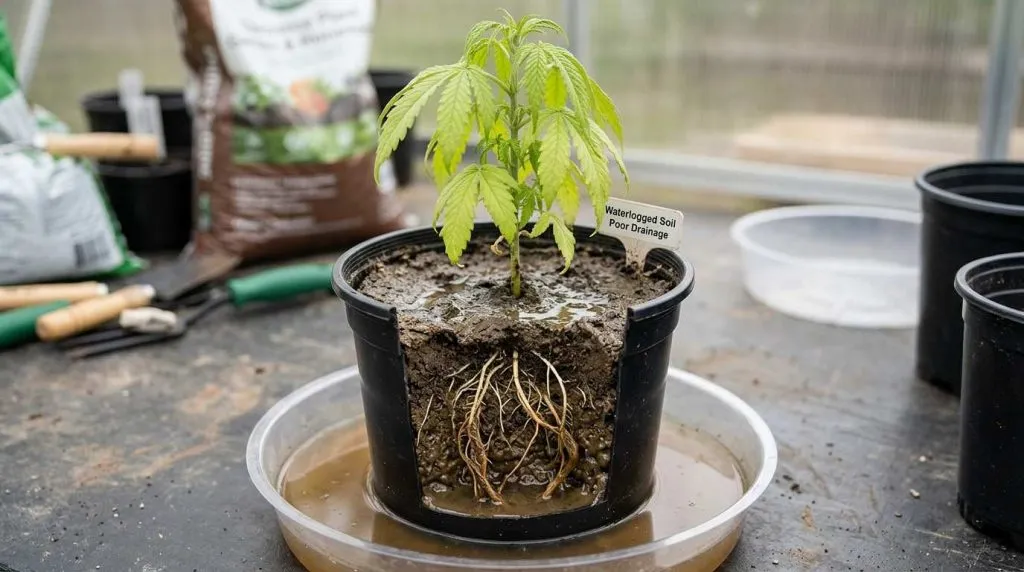
Roots need oxygen to absorb water and nutrients efficiently. When soil or coco remains saturated, water fills the air spaces and root activity begins to decline.
Frequent watering, compacted soil, blocked drainage, or oversized containers can all keep the root zone wet for too long. Prolonged saturation may also lead to root disease.
Allow the medium to lose some moisture between waterings and inspect the roots if the plant remains droopy. Brown, slimy, or foul-smelling roots point to root damage rather than a simple nutrient shortage.
Inconsistent Irrigation and Excessive Drybacks
A dryback is the period when the growing medium loses moisture between irrigations. Some drying is healthy, but allowing the medium to become extremely dry can interrupt the flow of water and calcium to new growth.
Repeated cycles of severe drying followed by heavy watering may also cause sudden changes in root-zone EC. This is especially common in coco, small containers, and warm grow rooms.
Aim for consistent moisture based on the medium, container size, and the plant’s rate of water use.
Salt Buildup and High Root-Zone EC
EC measures the concentration of dissolved mineral salts around the roots. When EC becomes too high, roots have greater difficulty taking up water, which also reduces calcium transport.
High EC may result from overfeeding, excessive additives, inadequate runoff, or allowing the medium to dry too far. Burned tips, dark foliage, and several nutrient symptoms appearing together are common warning signs.
Check feed and runoff EC where possible. Flush only when measurements and plant symptoms confirm salt buildup.
Low-Mineral Water or Insufficient Calcium
Reverse-osmosis and very soft water contain little calcium or magnesium. If the base nutrient does not replace these minerals, the plant may not receive enough calcium for healthy new growth.
This is more common in coco and hydroponics because the growing medium provides little calcium of its own. Poorly buffered coco may also hold calcium before the plant can use it.
Review the water source and nutrient label before adding a supplement.
High Humidity, Weak Airflow and Poor Transpiration
Transpiration is the loss of water through the leaves. As this happens, more water is drawn upward from the roots, carrying calcium with it.
When humidity is too high, transpiration slows and less calcium may reach young leaves. Weak airflow and dense canopies can make the problem worse by trapping moist air around the foliage.
Maintain suitable humidity for the growth stage and provide gentle airflow through the canopy.
Nutrient Imbalances and Excess Calcium Antagonists
Excessive potassium, magnesium, ammonium, or sodium can interfere with calcium uptake. This often happens when several strong additives are combined with a complete base feed.
The result may look like calcium deficiency even though plenty is present in the nutrient solution. High overall EC can make the problem worse.
Use a balanced feeding program, increase nutrient strength gradually, and review the full nutrient mix before adding another supplement.
How to Fix and Prevent Calcium Deficiency in Cannabis
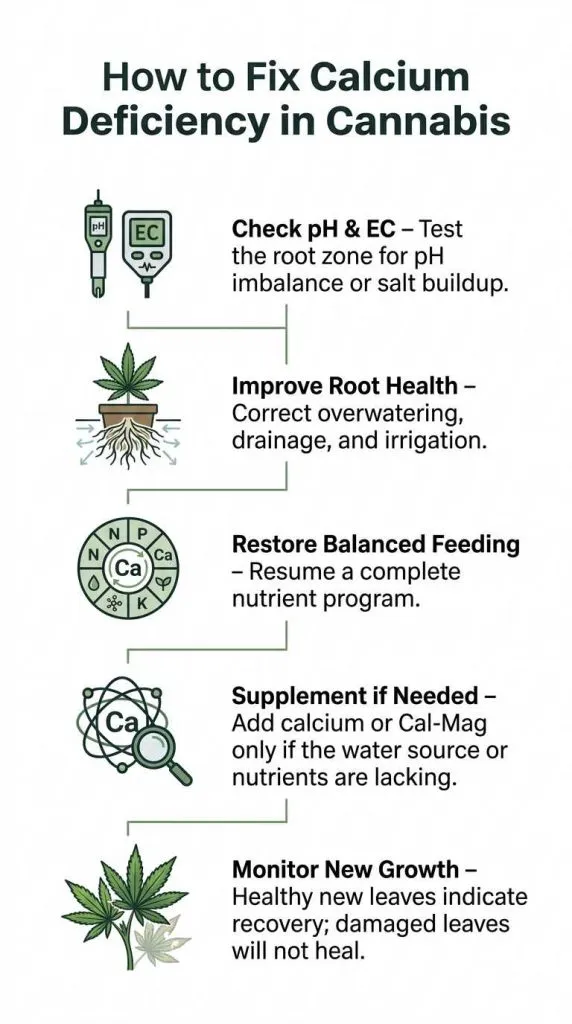
The best way to fix calcium deficiency in cannabis is to identify what is restricting calcium uptake before adding more nutrients. Work through the following steps in order and avoid changing pH, feeding, irrigation, and supplements at the same time.
Step 1: Confirm the Symptoms
Check the youngest leaves and growing tips for rust-colored spots, distorted growth, curled margins, or slowed development. Existing damage will not disappear, so photograph the plant and monitor whether fresh symptoms continue to appear.
If the damage begins on older leaves, follows a uniform tip-burn pattern, or appears alongside visible pests, calcium deficiency may not be the cause.
Grower Tip: Inspect both sides of affected leaves with a magnifying lens to rule out mites, thrips, and other pests.
Step 2: Check Root-Zone pH and EC
Test the nutrient solution and, where possible, the runoff or root zone. A suitable input pH does not guarantee that conditions around the roots are correct.
Low root-zone pH can reduce calcium availability, while high EC makes it harder for roots to absorb water. Correct unsuitable pH gradually and only flush when EC readings confirm significant salt buildup.
Grower Tip: Calibrate pH and EC meters regularly. Incorrect readings can lead to unnecessary adjustments and further nutrient lockout.
Step 3: Correct Watering and Root Conditions
Roots need moisture and oxygen to absorb calcium efficiently. Constantly wet soil or coco can reduce oxygen levels, while severe drybacks interrupt water and calcium movement.
Adjust irrigation to suit the medium, container size, and plant stage. Ensure containers drain freely and do not remain in standing runoff.
Inspect the roots if possible. Healthy roots are usually firm and light-colored. Brown, slimy, or foul-smelling roots indicate root damage that must be corrected before uptake improves.
Grower Tip: Lift the pot before watering. Learning the difference between a wet and partially dry container is more reliable than following a fixed schedule.
Step 4: Resume Balanced Feeding
Once pH, EC, irrigation, and root conditions are stable, continue with a complete nutrient program designed for the growing medium.
Do not increase the entire feed because damaged leaves look severe. Existing spots cannot heal, and stronger feeding may raise EC without improving calcium uptake.
Check whether the base nutrient already contains calcium before adding another product.
Step 5: Supplement Calcium Only if Necessary
Additional calcium may be needed when using reverse-osmosis water, very soft water, coco coir, or a nutrient formula that supplies little calcium.
Use a suitable calcium or Cal-Mag supplement at the recommended rate and include it when calculating total EC. Avoid combining several calcium products, as excess calcium can interfere with magnesium, potassium, iron, and other nutrients.
Grower Tip: Make one feeding change at a time and monitor the newest growth before adjusting the program again.
Recovery Timeline and What to Expect
Healthier new growth may begin appearing within five to seven days after the underlying issue has been corrected. Plants with damaged roots may take longer.
Brown spots and distorted leaves will remain visible. Recovery should be judged by fresh leaves emerging without new spotting, curling, or deformation.
Avoid removing every damaged leaf immediately. Foliage that is still partly healthy can continue supporting photosynthesis.
How to Prevent Calcium Deficiency
Prevention depends on maintaining healthy roots, balanced nutrition, and steady water movement through the plant.
- Keep root-zone pH within the range recommended for the medium.
- Monitor EC to prevent fertilizer salt buildup.
- Avoid prolonged saturation and severe drybacks.
- Use a complete nutrient program suited to the growing system.
- Maintain suitable humidity and airflow.
- Check the mineral content of tap, soft, or RO water.
- Inspect new growth regularly.
- Record changes to feeding, irrigation, and environmental conditions.
Grower Tip: Keep a simple grow diary containing pH, EC, watering frequency, nutrient strength, temperature, and humidity. This makes recurring problems much easier to trace.
Preventing Calcium Deficiency in Different Growing Mediums
| Growing Medium | Common Risk | Best Prevention |
| Soil | Low pH, overwatering, poor drainage | Use aerated soil, maintain suitable pH, and allow appropriate drying |
| Coco coir | Calcium binding, irregular irrigation, high EC | Use buffered coco, coco nutrients, consistent irrigation, and runoff monitoring |
| Hydroponics | Unstable pH or EC, low oxygen, root stress | Maintain the reservoir, oxygenate the solution, and inspect roots regularly |
| RO water | Very low mineral content | Use nutrients formulated for RO water or add minerals when required |
Calcium Deficiency in Soil
Soil often contains calcium, so deficiency symptoms are commonly caused by acidic conditions, poor drainage, or unhealthy roots.
Use a well-aerated mix and avoid watering by calendar. Calcium-rich amendments may help prevent future shortages, but slow-release materials are not usually suitable for correcting an active deficiency.
Calcium Deficiency in Coco Coir
Coco can hold calcium on its exchange sites, particularly when it has not been properly buffered.
Use pre-buffered coco and nutrients designed for the medium. Maintain consistent irrigation and monitor runoff EC, as both excessive drying and salt accumulation can restrict calcium uptake.
Calcium Deficiency in Hydroponics
Hydroponic growers control the nutrients, pH, EC, oxygen, and water conditions around the roots.
Keep reservoir conditions stable, maintain adequate oxygenation, and inspect roots for discoloration or slime. Calcium symptoms in hydro may be caused by root stress or high EC rather than a weak nutrient formula.
Calcium Deficiency When Using RO Water
Reverse-osmosis filtration removes most dissolved calcium and magnesium. These minerals must therefore come from the nutrient program.
Check whether the base nutrients are formulated for RO water before adding Cal-Mag. Supplement only when the existing feed does not provide enough calcium.
Conclusion
Calcium deficiency is often caused by poor uptake rather than a lack of calcium. Check root-zone pH, EC, watering, root health, and environmental conditions before adding supplements.
Once the cause is corrected, monitor new growth rather than damaged leaves. Stable pH, healthy roots, consistent irrigation, and balanced feeding provide the best long-term prevention.
Frequently Asked Questions
What does calcium deficiency look like in cannabis?
Common signs include rust-colored spots, distorted new growth, curled leaf edges, and dry patches on young leaves.
Which leaves does calcium deficiency affect first?
Calcium deficiency usually affects the newest leaves and growing tips first because the plant cannot easily move calcium from older growth.
What pH causes calcium lockout in cannabis?
Calcium uptake may decline when root-zone pH falls outside the suitable range. Aim for around 6.2-6.8 in soil and 5.8-6.2 in coco or hydroponics.
Can overwatering cause calcium deficiency?
Yes. Waterlogged roots receive less oxygen, reducing their ability to absorb water and calcium.
Should I flush a cannabis plant with calcium deficiency?
Only flush if high EC or salt buildup has been confirmed. Unnecessary flushing can remove nutrients and slow recovery.
Should I use Cal-Mag for calcium deficiency?
Use Cal-Mag only when the nutrient program or water source provides too little calcium. It will not correct poor pH, damaged roots, or high EC.
Can cannabis plants receive too much calcium?
Yes. Excess calcium can raise EC and interfere with the uptake of magnesium, potassium, iron, and other nutrients.
Will calcium-damaged leaves recover?
No. Existing spots and dead tissue will remain. Judge recovery by healthy new leaves appearing without further damage.
How long does calcium deficiency take to correct?
New growth may improve within five to seven days after the underlying cause is fixed. Plants with damaged roots may take longer.


