




Manganese deficiency in cannabis usually appears as yellowing between the veins of young leaves, followed by fine bronze or brown speckles as the problem develops. Although it can look like a simple nutrient shortage, the real cause is often high root-zone pH, salt buildup, poor drainage, or damaged roots preventing the plant from absorbing manganese properly.
Because the symptoms can resemble iron, magnesium, zinc, calcium, or light stress, accurate diagnosis matters. Adding more nutrients without checking pH, EC, and root health can make the problem worse.
In this guide, you'll learn how to identify manganese deficiency, rule out similar problems, correct the underlying cause, monitor recovery, and prevent it from returning. Understanding these interactions helps growers avoid misdiagnosis and ensures that corrective actions target the root cause rather than masking symptoms with unnecessary nutrient adjustments, leading to faster recovery and healthier new growth over time in controlled environments cannabis cultivation.
Key Takeaways
- Manganese deficiency usually starts on young leaves with yellowing between green veins.
- Fine bronze or rust-colored speckles are a strong identifying symptom.
- High root-zone pH and nutrient lockout are more common than a true lack of manganese.
- Damaged leaves will not recover, so judge progress by the appearance of new growth.
- Correcting pH, salt buildup, and root health should come before using supplements.
What is Manganese Deficiency?
Manganese deficiency occurs when cannabis plants cannot absorb enough manganese for healthy growth. Though required only in small amounts, manganese plays an important role throughout the cannabis vegetative stage and cannabis flowering stage.
In leaves, manganese supports energy production from light. When uptake is limited, young leaves show interveinal yellowing and fading green color.
In most cases, the issue is not a lack of manganese in the feed but reduced availability in the root zone. High pH is a common cause because it limits manganese uptake, often leading to nutrient lockout in cannabis. Poor roots, overwatered cannabis plants, salt buildup, and nutrient imbalances can all contribute.
Because of this, adding more manganese rarely fixes the problem. It is more effective to first check pH and root health to restore proper nutrient absorption.
Correct diagnosis prevents unnecessary supplementation and helps restore balanced growth by addressing the underlying environmental or root-zone conditions affecting nutrient uptake more effectively long term management approach.
How to Identify Manganese Deficiency
Correctly identifying manganese deficiency is the first step toward fixing it. While the symptoms can appear similar to iron, magnesium, or zinc deficiencies, paying close attention to where the symptoms appear, how they develop, and how quickly they spread will help you make a much more accurate diagnosis.
One mistake I often see growers starting with beginner-friendly cannabis strains make is treating every yellow leaf as a nutrient deficiency. In reality, a single discolored leaf could simply be the result of physical damage, pests, or natural aging. Instead, inspect several leaves across the plant and look for a consistent pattern. Manganese deficiency has a distinctive progression that becomes easier to recognize once you know what to look for.
Early Signs of Manganese Deficiency
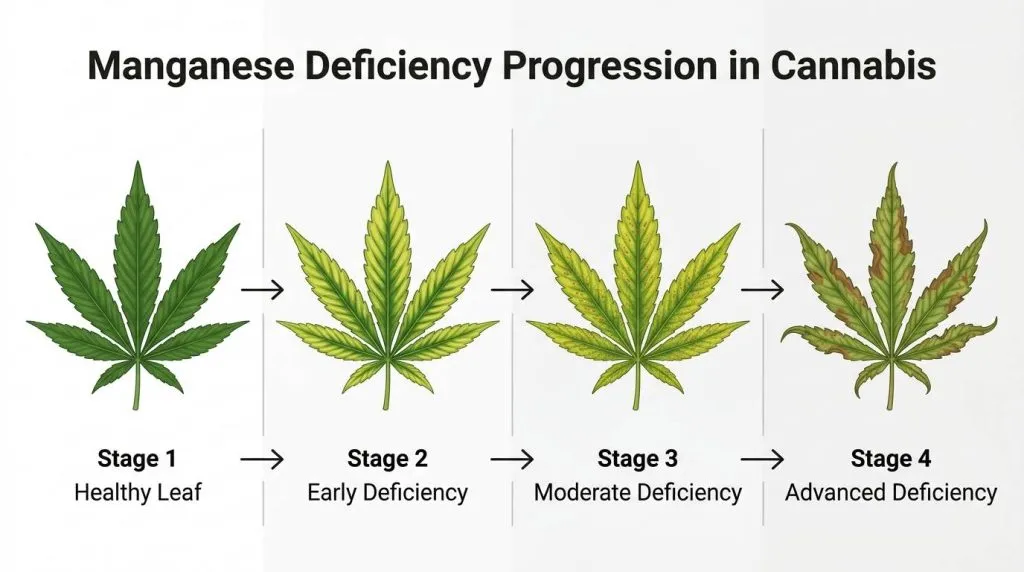
Manganese deficiency almost always begins on the youngest leaves near the growing tips. Because manganese is a relatively immobile micronutrient, the plant cannot easily move it from older leaves to support new growth. As a result, the newest foliage begins showing symptoms first while the lower fan leaves often remain healthy.
Interveinal Chlorosis
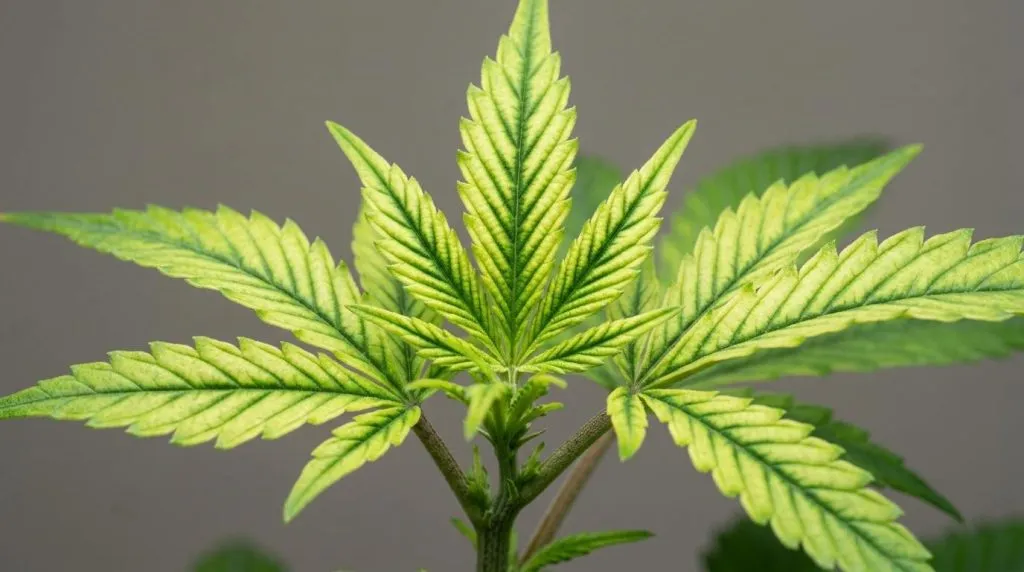
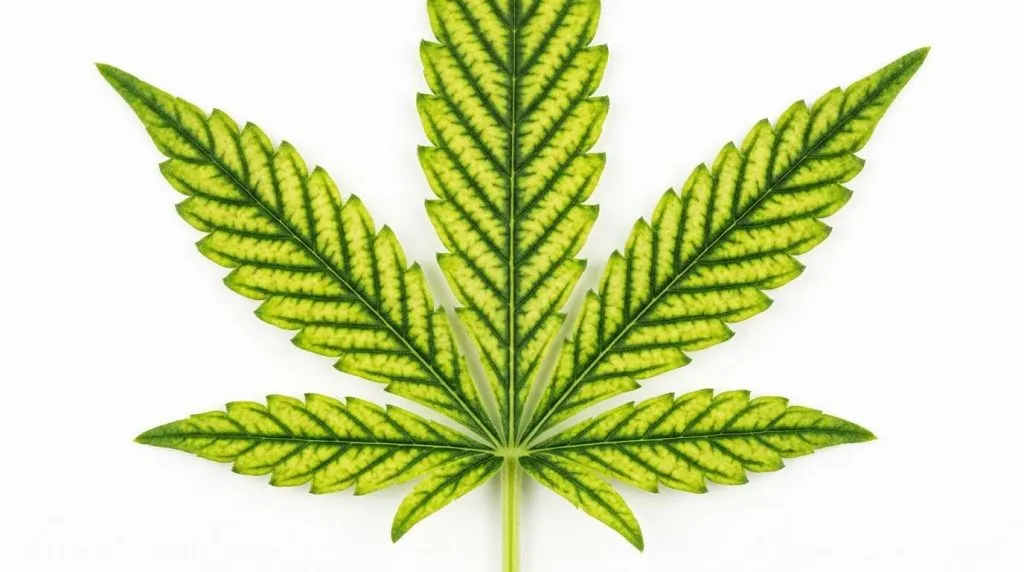
The earliest symptom is interveinal chlorosis, which means the tissue between the leaf veins begins turning pale green or yellow while the veins themselves stay noticeably darker. At first, this contrast can be subtle and is easiest to spot under natural light or by comparing the affected leaf with a healthy one from lower down the plant.
Unlike nitrogen deficiency, which causes leaves to fade evenly, manganese deficiency creates a distinctive network of green veins surrounded by lighter tissue. The yellowing normally starts near the center of the leaf before gradually spreading toward the edges.
Yellowing Between the Veins
As the deficiency progresses, the yellow areas become brighter and more widespread. The veins continue to remain green, creating a striped or net-like appearance across the leaf surface.
Rather than affecting the entire canopy overnight, you'll usually notice several young leaves around the same growing tip developing similar symptoms over the course of a few days. If only a single leaf is affected, the problem is less likely to be manganese deficiency.
Pale or Mottled New Growth
New leaves may emerge looking washed out instead of the rich green you would expect from healthy cannabis. Some leaves develop an uneven, mottled appearance with alternating patches of light and dark green.
This stage is easy to overlook because the plant often continues growing. Compare the newest growth with older healthy leaves and refer to a cannabis leaf symptoms guide if you're unsure, the difference in color becomes much more obvious.
When inspecting your plant, follow this simple routine:
- Start at the highest growing tips.
- Compare several new leaves rather than one damaged leaf.
- Look for yellowing between the veins while the veins remain green.
- Compare the newest growth with healthy lower leaves.
- Check whether the symptoms are spreading across multiple shoots.
Advanced Signs of Manganese Deficiency
If the underlying cause isn't corrected, the symptoms become much more obvious over the following days.
Bronze or Brown Patches
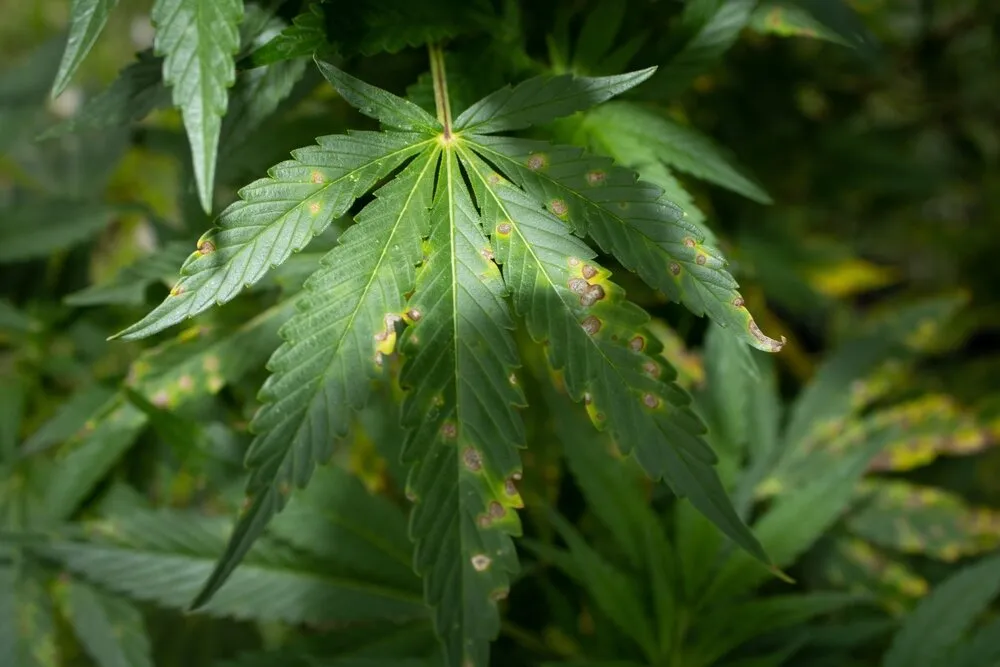
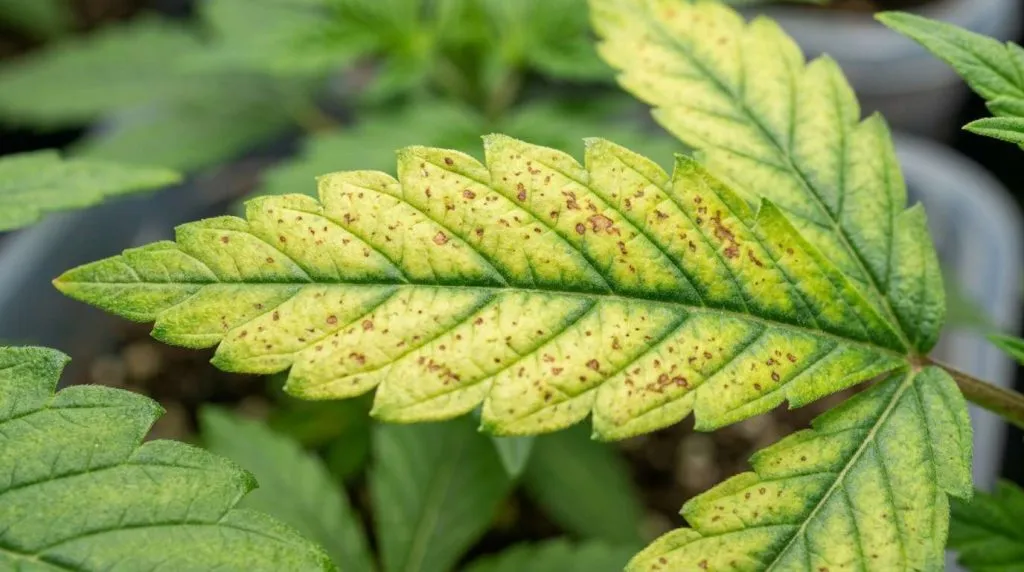
One feature that often separates manganese deficiency from iron deficiency is the appearance of small bronze, rust-colored, or brown spots on cannabis plants. These usually develop within the yellow tissue between the veins rather than randomly across the leaf.
The spots often begin as tiny speckles before gradually merging into larger patches. As more leaf tissue becomes damaged, the leaf loses its ability to photosynthesize efficiently.
Necrotic Spots
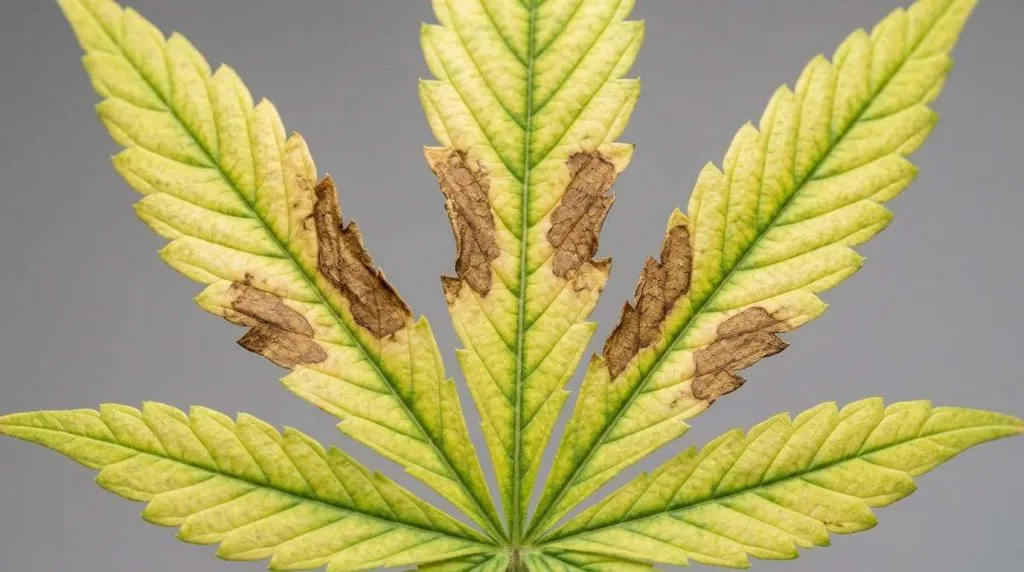
Eventually, some of the bronze patches become necrotic, meaning the affected tissue has died. These dead areas appear dry, dark brown, or almost black and cannot recover, even after the deficiency has been corrected.
Fortunately, cannabis can still make a full recovery provided the underlying problem is identified early and healthy new growth resumes.
Brittle or Distorted Leaves
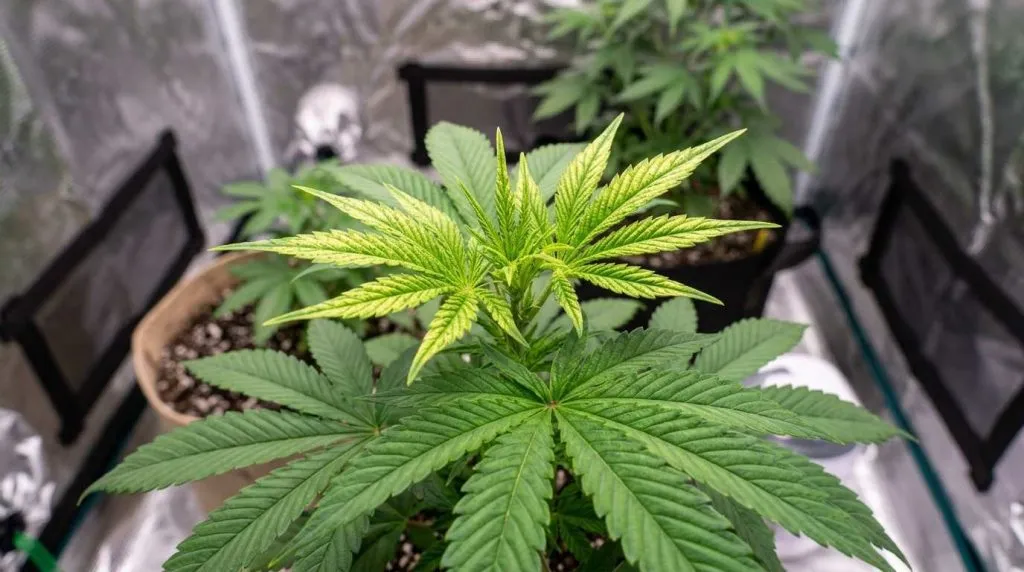
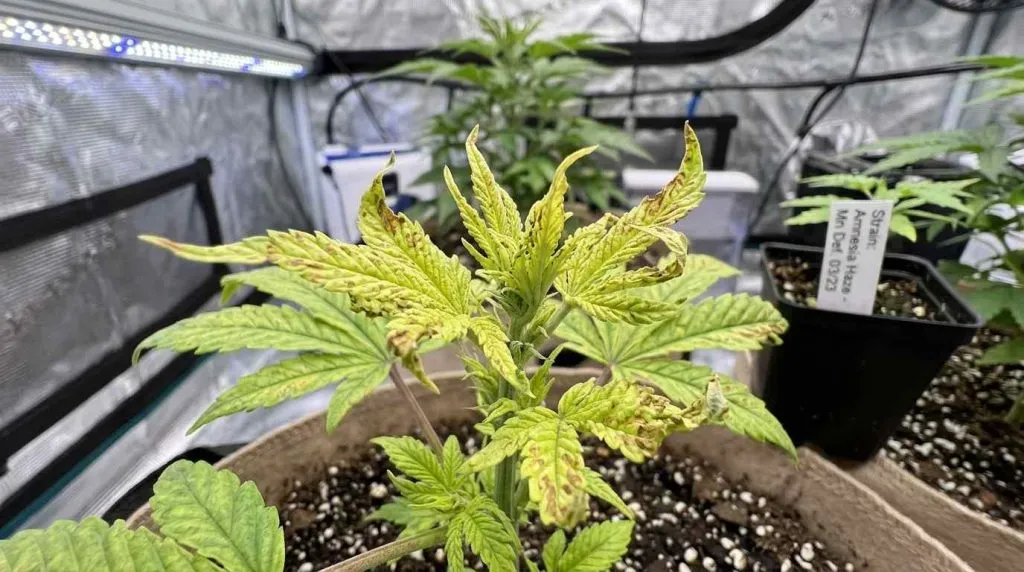
As new leaves continue developing without enough manganese, they may emerge smaller than normal, become slightly twisted, or feel brittle to the touch. The leaf edges can curl or wrinkle, particularly if the deficiency has been present for an extended period.
Because the newest leaves are affected first, the top of the plant often appears less vigorous than the lower canopy.
Reduced Growth
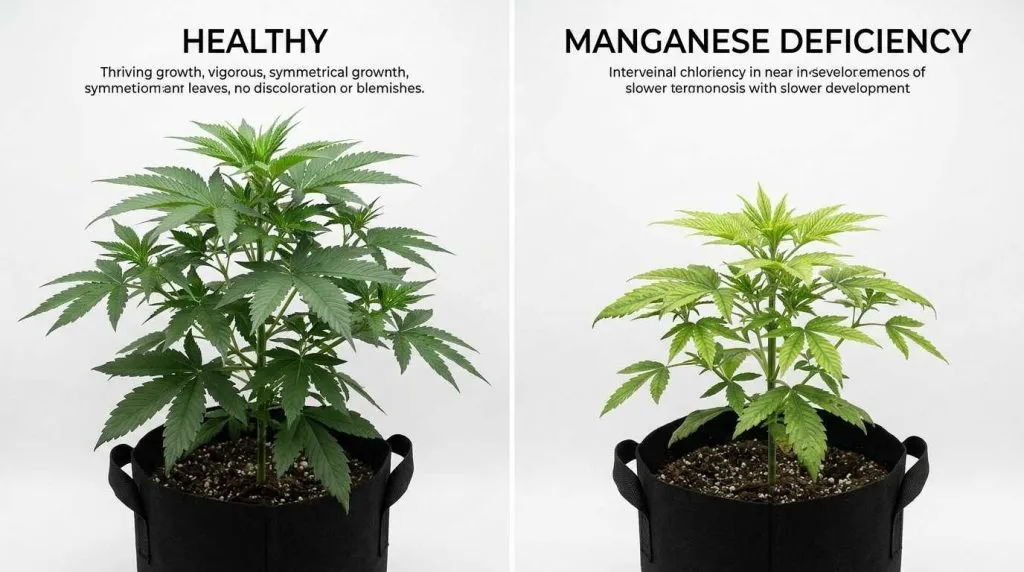
Manganese is essential for photosynthesis and several enzyme-driven processes, so prolonged deficiency eventually slows the entire plant. New shoots elongate more slowly, leaves remain smaller, and overall development becomes less vigorous.
If flowering plants experience severe manganese deficiency, bud development may also slow because the plant cannot produce energy as efficiently.
How Symptoms Change Throughout the Grow
Although manganese deficiency can develop at almost any stage, the symptoms and their impact vary depending on the plant's age. Growers cultivating indoor cannabis seeds can usually track pH, EC, watering, and environmental changes more closely, which often makes the underlying cause easier to identify.
| Growth Stage | What You'll Usually See |
| Seedling | Relatively uncommon. When it does occur, it's usually caused by an unsuitable growing medium, incorrect pH, or overwatering. Young plants may become pale and develop slowly. |
| Vegetative | The most common stage for manganese deficiency. New growth develops interveinal chlorosis followed by bronze spotting if left untreated. Plants generally recover well when corrected early. |
| Flowering | New leaves around the buds may yellow and develop brown spots. If the deficiency continues, photosynthesis becomes less efficient, which can reduce flower development and overall plant performance. |
In my experience, deficiencies identified during the vegetative stage are usually straightforward to correct because the plant has plenty of time to produce healthy new growth. During late flowering, however, the focus shifts toward preventing the problem from worsening rather than expecting damaged leaves to recover.
Where Manganese Deficiency Appears on the Plant
One of the most reliable ways to distinguish manganese deficiency from several other nutrient problems is where the symptoms first appear.
Because manganese is relatively immobile inside the plant, cannabis cannot efficiently move it from older leaves to developing shoots. Instead, the newest leaves must rely on a continuous supply from the roots. If uptake is interrupted, the growing tips show symptoms before the lower canopy.
For beginners, I recommend inspecting your plants from the top down:
- Check the newest leaves at the growing tips first.
- Compare them with healthy fan leaves lower on the plant.
- Look for multiple affected leaves rather than isolated damage.
- Check both the main stem and side branches, as deficiencies usually appear consistently across actively growing shoots.
The table below can help you quickly narrow down the cause.
| Symptom | More Likely Manganese Deficiency? |
| Yellowing begins on young leaves | Yes |
| Green veins remain visible | Yes |
| Bronze or brown speckles develop | Strong indicator |
| Symptoms begin on older fan leaves | More likely magnesium or nitrogen deficiency |
| Uniform yellowing across the whole leaf | Consider nitrogen deficiency |
| Only one or two leaves affected | More likely physical damage, pests, or environmental stress |
Remember that leaf symptoms alone rarely tell the whole story. Think of them as the plant's way of telling you where to investigate next. Once you've identified the characteristic pattern on the newest growth, the next step is to confirm the diagnosis by checking the root-zone pH, nutrient strength, and overall root health before making any corrections.
How to Diagnose Manganese Deficiency in the Correct Order
Before reaching for a manganese supplement, take a few minutes to work through a systematic diagnosis. In my experience, most suspected manganese deficiencies turn out to be caused by high pH, nutrient lockout, or poor root health rather than a true lack of manganese in the feed.
Following these six steps will help you identify the underlying cause and avoid making the problem worse by adding nutrients the plant can't absorb.
Step 1: Check Where Symptoms Started
Start by identifying which leaves showed symptoms first. Manganese is a relatively immobile nutrient, so deficiencies almost always appear on the newest growth before spreading elsewhere.
Inspect the growing tips and upper canopy. If several young leaves are developing similar symptoms while the lower fan leaves remain healthy, manganese deficiency becomes more likely.
If the oldest fan leaves yellowed first, you're probably dealing with a different issue such as magnesium or nitrogen deficiency.
Ask yourself:
- Are the newest leaves affected first?
- Are several growing tips showing the same symptoms?
- Are the lower leaves still mostly healthy?
If the answer is yes, move to the next step.
Step 2: Examine the Leaf Pattern
Now look closely at the affected leaves. You're checking whether the symptoms match the classic manganese deficiency pattern described earlier.
Look for:
- Yellowing between dark green veins (interveinal chlorosis)
- Pale or mottled new growth
- Fine bronze or rust-colored speckles
- Slight twisting or curling of young leaves in more advanced cases
Avoid relying on a single damaged leaf. Compare several new leaves under natural light or a white inspection light, as colored grow lights can hide subtle changes.
If the symptoms don't match this pattern, another deficiency or environmental issue is more likely.
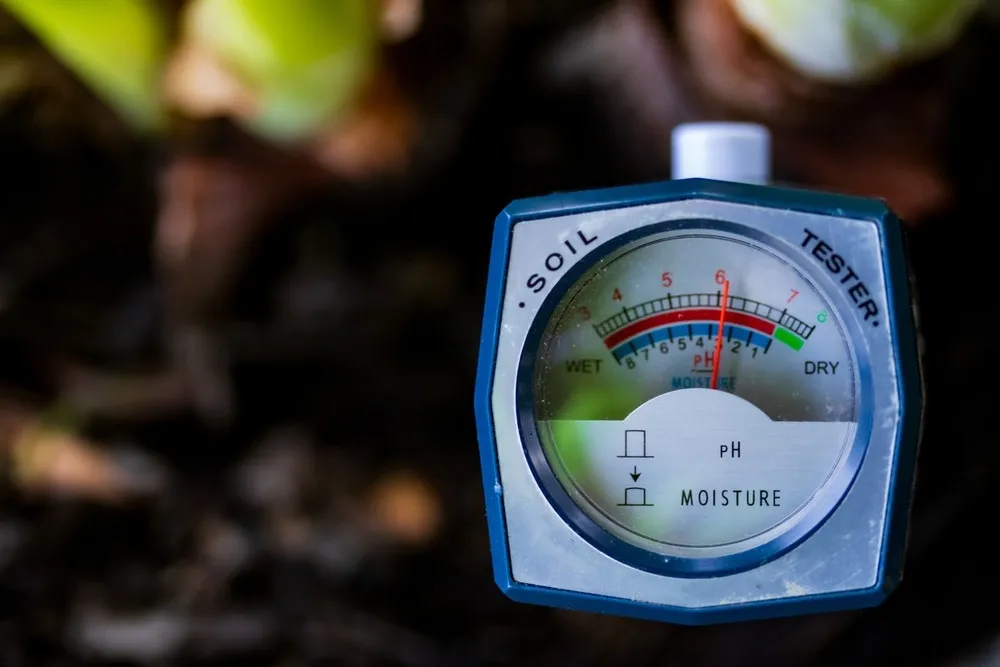
Step 3: Test Root-Zone pH
The next step is checking pH. This is one of the most common causes of manganese deficiency symptoms because manganese becomes less available as the root zone becomes too alkaline.
Measure the nutrient solution before watering using the correct cannabis nutrient feeding schedule for your grow. Comparing the two readings helps show whether the growing medium has drifted outside the ideal range.
As a general guide:
| Growing Medium | Recommended pH |
| Soil | 6.0–6.5 |
| Coco & Hydro | 5.5–6.2 |
Don't worry about chasing a perfect number. Instead, look for readings that are consistently above the recommended range.
If pH is too high, correct it first before considering additional manganese.
Step 4: Check EC and Feeding History
Once pH looks acceptable, review your feeding program.
Measure the EC or ppm of your nutrient solution before watering. If possible, measure the runoff as well.
A runoff EC that's significantly higher than your feed often indicates fertilizer salts have accumulated in the root zone, potentially causing nutrient lockout. A very low EC may simply mean the plant hasn't received enough nutrition.
Also think back over the past week or two.
Ask yourself:
- Have I recently increased feeding strength?
- Have I changed nutrient brands or additives?
- Have I been watering with plain water for an extended period?
- Is my runoff EC much higher than my feed?
These answers often reveal the cause before any supplements are needed.
Step 5: Inspect Root Health
Healthy roots are essential for nutrient uptake, including manganese.
If possible, inspect the root system or the growing medium. Healthy roots should be firm and cream to white. Brown, slimy, or foul-smelling roots may indicate cannabis root rot or oxygen deprivation.
Also check for:
- Poor drainage
- Constantly wet growing media
- Compacted soil
- Standing runoff in trays
Even a perfectly balanced nutrient solution won't correct manganese deficiency if unhealthy roots can't absorb it.
Step 6: Review Recent Changes
Finally, think about what changed shortly before the symptoms appeared.
Many deficiencies begin after a change in the growing environment rather than appearing randomly.
Consider whether you've recently:
- Switched nutrient brands
- Changed water source
- Added lime or another pH-adjusting product
- Transplanted into a new growing medium
- Flushed the plant
- Changed your watering schedule
- Experienced unusually cold root temperatures
Identifying the trigger often makes the solution much more obvious.
Quick Diagnosis Checklist
Before treating manganese deficiency, work through this checklist:
| Step | What to Check | If Yes | If No |
| Step 1 | Symptoms began on new growth? | Continue | Consider magnesium or nitrogen deficiency |
| Step 2 | Yellowing between green veins with bronze speckles? | Continue | Consider iron, zinc, or another issue |
| Step 3 | Root-zone pH within range? | Continue | Correct pH first |
| Step 4 | EC and feeding look normal? | Continue | Address nutrient imbalance or salt buildup |
| Step 5 | Roots healthy? | Continue | Improve root health before feeding |
| Step 6 | Recent changes explain symptoms? | Correct the trigger | Consider further investigation |
Working through these six steps takes only a few minutes, but it can prevent unnecessary treatments and help you solve the real problem faster. In most cases I've seen, restoring the correct pH or improving root conditions resolves manganese deficiency symptoms without needing a dedicated manganese supplement.
How to Confirm It's Manganese Deficiency
By now, you've identified the symptoms and checked your pH, feeding routine, and root health. The final step is making sure manganese deficiency is the best match before changing your nutrient program.
One lesson I've learned over years of growing is that yellow leaves rarely tell the whole story. Instead of focusing on one symptom, compare where the symptoms started, how they developed, and how the newest growth looks today. Looking at the whole plant almost always leads to a more accurate diagnosis.
Manganese vs Iron Deficiency
Both deficiencies affect young growth and cause interveinal chlorosis, but manganese deficiency usually develops fine bronze or rust-colored speckles as it progresses. Iron deficiency in cannabis generally causes cleaner, more uniform yellowing without spotting during the early stages.
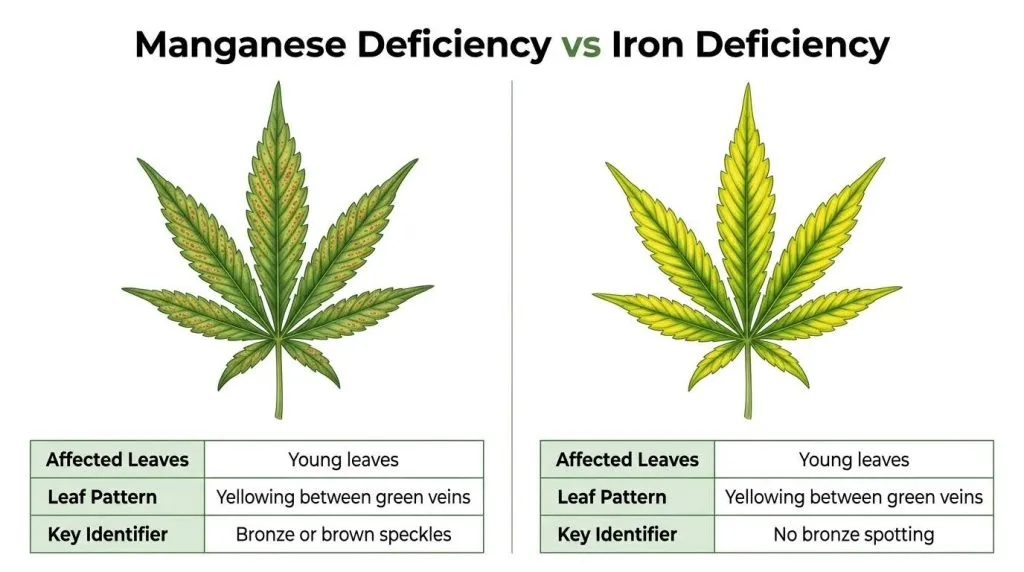
| Feature | Manganese Deficiency | Iron Deficiency |
| First leaves affected | Young leaves | Youngest leaves |
| Yellowing pattern | Mottled between green veins | More uniform |
| Bronze or rust speckles | Common | Rare |
| Leaf color | Pale green to yellow | Bright yellow to almost white |
| Best clue | Bronze spotting develops | Leaves bleach without spotting |
Look for: If the newest leaves are almost white but remain smooth and free of bronze speckles, iron deficiency is more likely.
Manganese vs Magnesium Deficiency
The easiest way to separate these deficiencies is by checking where the symptoms began. Manganese deficiency starts on new growth, while magnesium deficiency in cannabis appears on older fan leaves because magnesium can be moved from mature leaves to developing shoots.
| Feature | Manganese Deficiency | Magnesium Deficiency |
| First leaves affected | New growth | Older fan leaves |
| Lower canopy affected first | No | Yes |
| Veins remain green | Yes | Yes |
| Bronze spotting | Common later | Sometimes in severe cases |
| Best clue | Top of plant affected | Bottom of plant affected |
Look for: If the oldest fan leaves yellowed before the growing tips, magnesium deficiency is the more likely diagnosis.
Manganese vs Zinc Deficiency
Both deficiencies affect young growth, but zinc deficiency in cannabis has a greater effect on leaf size and plant structure. New leaves often emerge smaller, narrower, and tightly clustered around the growing tip.
| Feature | Manganese Deficiency | Zinc Deficiency |
| First leaves affected | Young leaves | Young leaves |
| Interveinal yellowing | Common | Common |
| Bronze speckles | Common | Uncommon |
| Small, narrow leaves | Occasionally | Common |
| Short internodes | Rare | Common |
| Best clue | Bronze spotting | Crowded growing tips |
Look for: If new leaves are unusually small with very tight node spacing, zinc deficiency is more likely than manganese deficiency.
Manganese vs Calcium Deficiency
Calcium deficiency in cannabis also affects new growth, but the damage is usually more irregular. Instead of a clear pattern between the veins, you'll often see random brown spots, curled leaf edges, and malformed new leaves.
| Feature | Manganese Deficiency | Calcium Deficiency |
| First leaves affected | Young leaves | Young leaves |
| Interveinal yellowing | Main symptom | Less common |
| Brown spots | Fine spots between veins | Random scattered spots |
| Leaf shape | Usually normal early on | Often distorted |
| Best clue | Green veins remain visible | Misshapen new growth |
Look for: If the leaf is twisted or malformed before significant yellowing develops, calcium deficiency becomes more likely.
Manganese vs Light Stress
Light stress can bleach the upper canopy under powerful cannabis grow lights. The biggest clue is that the damage follows the position of the grow light rather than appearing evenly across new growth.
| Feature | Manganese Deficiency | Light Stress |
| Distribution | Across multiple growing tips | Directly beneath the light |
| Green veins remain | Usually | Not always |
| Bronze speckles | Common | Rare |
| Bleached leaves | Rare | Common |
| Best clue | Pattern follows new growth | Pattern follows light footprint |
Look for: If only the tallest shoots closest to the light are affected, slightly raise or dim the fixture for a few days before changing your feeding program.
How to Fix and Prevent Manganese Deficiency
Most cases of manganese deficiency are caused by conditions that prevent the roots from absorbing manganese rather than a lack of the nutrient itself. Before reaching for supplements, restore the root zone to a healthy state. Working through the following steps in order will usually resolve the problem more effectively than changing multiple things at once.
Step 1: Correct Root-Zone pH
The first priority is restoring the correct pH. Even if your nutrient solution contains enough manganese, the roots cannot absorb it efficiently when the root zone becomes too alkaline.
Use these target ranges as a guide: These ranges vary depending on your cannabis growing medium.
| Growing Medium | Recommended Root-Zone pH |
| Soil | 6.0–6.5 |
| Coco Coir | 5.7–6.2 |
| Hydroponics | 5.5–6.2 |
If the pH is outside the recommended range, make gradual adjustments over the next few irrigations rather than trying to correct everything at once. Stable pH is far more important than chasing one perfect number.
Step 2: Address Salt Buildup
If runoff EC is much higher than the nutrient solution you're feeding, excess fertilizer salts may be restricting manganese uptake.
In soil or coco, flush only when necessary by following our guide on flushing cannabis. Use correctly pH-adjusted water and allow sufficient runoff to rinse the growing medium evenly.
In hydroponics, replace the reservoir with a fresh nutrient solution and confirm both the EC and pH before restarting the system.
Correcting salt buildup often restores nutrient uptake without needing additional manganese.
Step 3: Resume Balanced Feeding
Once the root zone has been corrected, return to a complete nutrient program with the correct cannabis NPK ratio.
Begin at a moderate feeding strength, especially if the plant has recently been flushed or the roots are recovering. Avoid increasing nutrient concentrations to compensate for the deficiency, as this can create further imbalances.
I've found that many growers continue feeding plain water for too long after flushing. Instead, resume a balanced nutrient program once the growing medium has stabilized so the plant has access to both macro and micronutrients.
Step 4: Improve Root Conditions
Healthy roots are essential for nutrient uptake. If the root system remains stressed, correcting the pH alone won't solve the problem.
Check for:
- Constantly wet growing media
- Poor drainage
- Compacted soil or coco
- Brown, slimy, or foul-smelling roots
- Cold root-zone temperatures
- Low oxygen levels in hydroponic systems
Healthy roots should be firm and cream to white in color. If they're brown, soft, or have an unpleasant smell, address the root problem before adjusting the feeding schedule again.
Allow the growing medium to partially dry between irrigations, ensure containers drain freely, and keep hydroponic reservoirs well aerated. Improving root health is often the turning point in recovery.
Step 5: Supplement Only if Necessary
Only consider a manganese or micronutrient supplement after correcting the pH, checking runoff EC, and improving root conditions.
Use the recommended dosage on the label and avoid combining several supplements at once. More manganese will not speed recovery and excessive micronutrients can interfere with the uptake of other essential elements.
For most growers, a quality base nutrient or balanced micronutrient supplement is all that's needed once the underlying cause has been corrected.
Step 6: Monitor New Growth
Once you've corrected the problem, resist the temptation to keep making adjustments every day.
Existing yellow or brown leaves won't recover. Instead, judge your progress by watching the newest growth over the next several days.
Positive signs include:
- Healthy green new leaves
- No additional bronze speckling
- Normal leaf size and shape
- Steady growth from the growing tips
- Symptoms no longer spreading
One habit that's helped me over the years is checking the same growing tip every few days rather than inspecting the entire plant daily. It's a much more reliable way to see whether recovery has started.
Recovery Timeline
Recovery depends on how early the problem was identified and whether the roots were affected.
| Time After Correction | What to Expect |
| 1–3 days | Symptoms should stop spreading if pH or nutrient lockout was the cause. |
| 3–7 days | New leaves should emerge greener with fewer signs of chlorosis. |
| 1–2 weeks | Healthy growth should replace damaged foliage at the growing tips. |
| More than 2 weeks | Plants with root damage may need additional time before normal growth resumes. |
If symptoms continue to spread after a week, retest the root-zone pH and runoff EC before increasing nutrient strength. Revisit your diagnosis to make sure manganese deficiency is still the most likely cause.
Preventing Future Deficiencies
The easiest way to prevent manganese deficiency is to keep the root zone stable throughout the grow.
To reduce the risk:
- Check pH before every feed.
- Use a complete nutrient containing micronutrients.
- Increase feeding strength gradually.
- Monitor runoff EC periodically.
- Avoid overwatering and poor drainage.
- Keep hydroponic reservoirs clean and well aerated.
- Record pH, EC, and feeding changes in a simple grow log.
Over the years, I've found that growers who keep track of their pH, EC, and watering schedule usually spot small problems before they become visible deficiencies. A simple grow log takes only a few minutes to maintain, but it can save weeks of troubleshooting later.
Conclusion
Manganese deficiency in cannabis is usually a root-zone problem rather than a simple shortage of manganese. The most reliable way to fix it is to identify where the symptoms began, confirm the leaf pattern, and then check pH, EC, feeding history, and root health before adding supplements.
Young leaves with interveinal yellowing and fine bronze speckles are strong indicators, but similar symptoms can resemble several cannabis nutrient deficiencies, making accurate diagnosis essential. Taking the time to rule these out helps prevent unnecessary feeding changes.
Once the underlying cause is corrected, focus on the newest growth rather than damaged leaves. Stable pH, balanced nutrition, healthy roots, and consistent monitoring will usually prevent manganese deficiency from returning.
Frequently Asked Questions
Can cannabis recover from manganese deficiency?
Yes, cannabis plants can recover if the problem is identified early and the underlying cause is corrected. Damaged leaves will not return to their original colorr, but new growth should emerge healthier once manganese uptake is restored.
What pH causes manganese deficiency in cannabis?
Manganese becomes less available when the root zone is too alkaline. Problems are more likely when soil pH rises above approximately 6.5 or when coco and hydroponic systems remain above their recommended range. Always check the root-zone pH rather than relying only on the water going in.
Should I flush a plant with manganese deficiency?
Only flush if runoff EC, feeding history, or visible salt buildup suggests that excess fertilizer is causing nutrient lockout. Unnecessary flushing can remove useful nutrients and delay recovery. Correcting pH may be enough if salt accumulation is not present.
How quickly does manganese deficiency improve?
Symptoms may stop spreading within one to three days after the cause is corrected. Healthier new growth is often visible within three to seven days, although plants with damaged roots may take one to two weeks or longer to recover fully.
Can too much manganese harm cannabis plants?
Yes. Excess manganese can become toxic and interfere with the uptake of iron, magnesium, and other nutrients. Supplements should only be used after pH, EC, feeding strength, and root health have been checked, and they should always be applied at the recommended dose.


