




Organic compost tea for cannabis is a freshly brewed liquid made from mature compost or finished worm castings, water, and carefully measured optional amendments. Used correctly, cannabis compost tea can help distribute compost-derived material through the root zone and support an organically managed growing medium. This guide explains how to make compost tea for cannabis from start to finish, including the equipment you need, exact ingredient amounts, brewing time, and the correct way to apply it. You will also learn how the recipe changes between vegetative growth and flowering, how often to use it, and how to recognize a failed batch before it reaches your plants. The aim is to help you produce a simple, consistent brew without overcomplicating the process.
Key Takeaways
- Organic compost tea for cannabis is made by brewing mature compost or finished worm castings in aerated water.
- A simple base recipe is easier to manage than a heavily amended brew containing multiple additives.
- Brew cannabis compost tea continuously for around 24–36 hours and use it soon after finishing.
- Apply it as part of a normal watering, adjusting the amount to the container size and current soil moisture.
- Vegetative plants may benefit from light additions such as kelp or fish hydrolysate, while compost tea for cannabis in flower should be kept simpler.
- A healthy brew should smell earthy. Discard any batch that smells rotten, sour, or sewage-like.
- Compost tea can support an organically managed root zone, but it cannot replace balanced nutrition, proper watering, suitable lighting, or healthy roots.

- What Is Cannabis Compost Tea?
- What compost tea can and cannot do
- Ingredients and Equipment for Cannabis Compost Tea
- Five-Gallon Compost Tea Recipe for Cannabis
- How to Brew Compost Tea Step by Step
- Vegetative vs Flowering Compost Tea
- How Much Compost Tea Should You Apply?
- How Often Should You Use Compost Tea?
- How to Tell If Compost Tea Has Gone Bad
- Common Compost Tea Mistakes
- Conclusion
- Frequently Asked Questions
What Is Cannabis Compost Tea?
Cannabis compost tea is a water-based preparation made by steeping mature compost or finished worm castings. During brewing, water extracts soluble compounds and fine organic particles while carrying microorganisms from the original compost into the liquid. Aerated compost tea uses a pump and air stones to maintain oxygen and keep the liquid circulating. As Oregon State University Extension explains, aeration increases dissolved oxygen and influences which bacteria and fungi remain active inside the brewer.
Unlike solid compost, which is mixed into or spread across cannabis soil and other solid growing mediums, compost tea can be applied evenly as part of a normal watering. It should not be confused with other dark-colored organic liquids, as their ingredients, preparation, and uses can differ considerably.
| Term | Definition |
| Compost tea | Mature compost steeped or brewed in water |
| Aerated compost tea | Compost tea continuously supplied with oxygen |
| Compost extract | Compost mixed with water and used without an extended brewing period |
| Worm-bin leachate | Liquid draining from the bottom of a worm bin |
| Sprouted seed tea | A preparation made from germinated seeds rather than compost |
Grower tip: Do not assume every dark liquid draining from organic material is compost tea. Worm-bin leachate can become oxygen-depleted and should not automatically be applied like a clean, freshly aerated brew.
What compost tea can and cannot do
| Category | Description |
| Can do | Compost tea can introduce soluble compounds, fine organic matter, and compost-derived microorganisms into the growing medium. When growing organic cannabis, a well-made compost tea may support biological activity in the root zone and provide a mild supplementary input between regular waterings. Because it is applied as a liquid, it also helps distribute compost-derived material more evenly through containers, raised beds, and larger soil systems. |
| Cannot do | Compost tea is not a substitute for choosing the best soil for growing weed or following a balanced cannabis nutrient program. It will not correct a severe deficiency overnight. Before adding another input, diagnose the cannabis nutrient deficiency and check whether pH, irrigation, or root health is limiting nutrient uptake. Compost tea also cannot increase THC on its own or compensate for poor lighting and unsuitable temperature. Research into disease suppression has produced variable results, so it should not be treated as a dependable pesticide or cure for root and foliar problems. It also cannot repair roots already damaged by overwatering, low oxygen levels, or disease. |
Grower Tip: Diagnose struggling plants before adding compost tea. Another liquid application can make an overwatered or overfed root zone harder to assess.
Ingredients and Equipment for Cannabis Compost Tea
A clean, well-aerated setup is more important than a long list of additives. For a beginner batch of cannabis compost tea, you only need a few basic tools: a clean 5-gallon bucket, an aquarium or hydroponic air pump, two air stones or a diffuser, and clean tubing. You’ll also want a fine mesh bag for holding compost, a measuring cup and spoon, a stirring utensil, and a watering can or jug. If you plan to apply the tea through a sprayer, include a fine filter to prevent clogging from small particles.
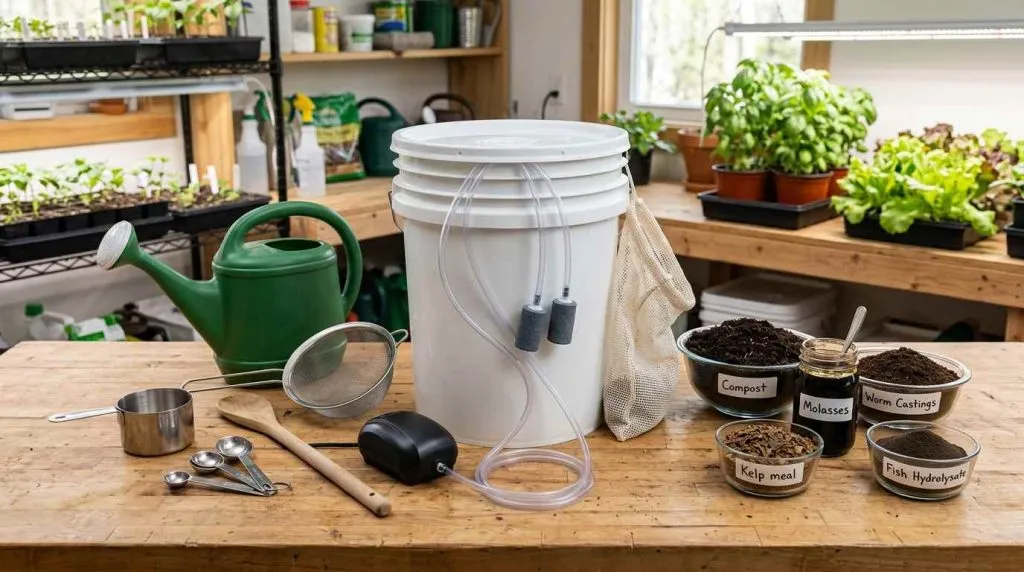
| Item | Purpose | Required |
| 5-gal bucket | brewing vessel | Yes |
| air pump | oxygenation | Yes |
| air stones | dissolve oxygen | Yes |
| tubing | connects pump | Yes |
| mesh bag | holds compost | Yes |
| dechlorinated water | base medium | Yes |
| compost/castings | microbial source | Yes |
| molasses | microbial food | No |
| kelp | micronutrients | No |
| fish hydrolysate | nitrogen source | No |
| humic products | soil conditioning | No |
| filter | sprayer protection | Optional |
The base recipe uses four gallons of suitable water and four cups of mature compost, finished worm castings, or a blend of both. University of Connecticut Extension lists about four cups of quality compost in a five-gallon brewer as one practical starting point. Using four gallons of water leaves enough headroom for circulation and possible foam. This ratio is a widely used starting point and keeps the brew balanced without overloading it. The bucket should not be filled to the top, as space is needed for aeration, bubbling, and foam formation during brewing.
Molasses, kelp, fish hydrolysate, and humic products are optional rather than essential. Growers who want to prepare more of their own inputs can learn how to make homemade cannabis fertilizer, but each amendment should be introduced separately so its effect is easier to assess. Avoid raw manure and rely on finished compost and worm castings.
Safety note: Compost tea is not sterile. Begin with clean, fully matured compost and sanitized equipment. Microbial foods such as molasses may also support unwanted organisms when the starting compost is contaminated, so keep them optional and measured. Aeration alone does not guarantee a safe batch.
Five-Gallon Compost Tea Recipe for Cannabis
This beginner recipe uses mature compost or finished worm castings as the base. Molasses, kelp, and fish hydrolysate are optional amendments rather than essential ingredients. Keeping the first few batches simple makes it easier to judge how your plants respond and reduces the chance of adding more nutrition than the growing medium needs.
Five-Gallon Recipe
| Ingredient | Amount |
| Suitable water | 4 gallons |
| Mature compost or finished worm castings | 4 cups |
| Unsulfured blackstrap molasses | Up to 1 tablespoon, optional |
| Kelp meal or soluble kelp | Up to 1 tablespoon, optional |
| Fish hydrolysate | Up to 1 tablespoon during vegetative growth only, optional |
Leave the final gallon of bucket capacity empty so there is enough room for circulation, stirring, and possible foam. Compost or worm castings provide the main compost-derived material, so you do not need to include every optional amendment in one batch.
During vegetative growth, a small amount of fish hydrolysate or kelp may be used when it suits the existing feeding program. Once flowering begins, leave out fish hydrolysate and keep other additions modest. Product concentrations vary, so check the manufacturer’s rate before using any amendment.
One-Gallon Conversion
| Ingredient | Amount |
| Suitable water | 0.8–1 gallon |
| Compost or worm castings | ¾–1 cup |
| Molasses | Up to ½ teaspoon, optional |
| Kelp | Up to ½ teaspoon, optional |
| Fish hydrolysate | Up to ½ teaspoon during vegetative growth only |
Use fully matured, earthy-smelling compost and clean equipment. Aeration cannot make poor-quality or contaminated starting material suitable for use.
Grower tip: Measure every amendment. A lightly amended cannabis compost tea is easier to assess than a strong mixture containing several products.
How to Brew Compost Tea Step by Step
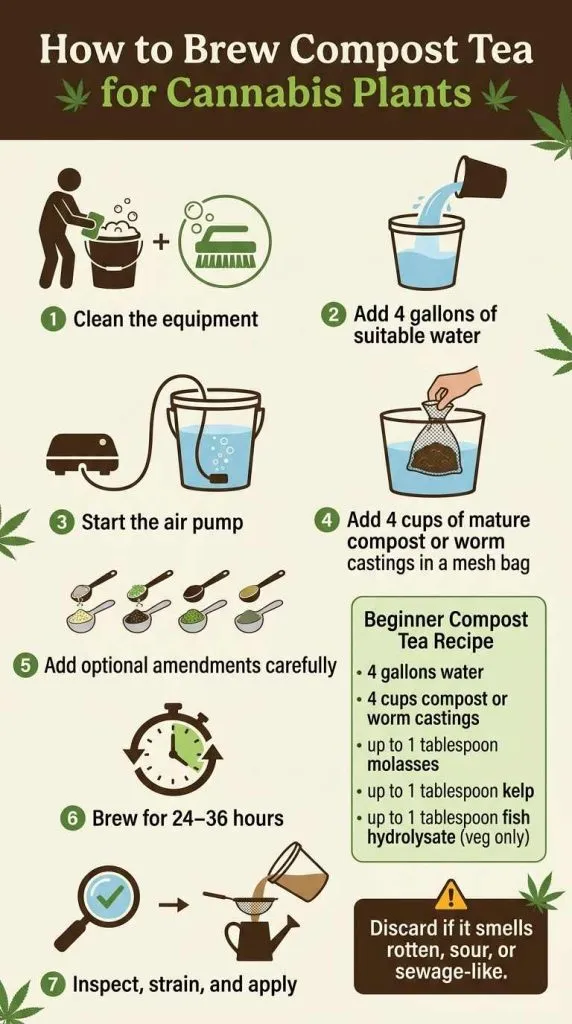
Step 1: Clean the Equipment
Wash the bucket, tubing, air stones, mesh bag, measuring tools, and stirring utensil before brewing. Remove old organic residue or biofilm and avoid equipment that contains fertilizer, pesticide, or cleaning-product residue.
Step 2: Prepare the Water
Add four gallons of suitable water to a clean 5-gallon bucket. Chloramine is more persistent than free chlorine and is used because it provides longer-lasting disinfection as water moves through supply pipes. The EPA explains how chloramines are used in drinking water, while its current monochloramine guidance notes that leaving water standing at room temperature does not remove it. Check your local water report before preparing cannabis compost tea and use a suitable chloramine-removal treatment when required.
Step 3: Start the Air Pump
Place the air stones on opposite sides of the bucket and switch on the pump. Check that water moves through the entire container rather than bubbling strongly in one small area.
Step 4: Add the Compost
Put four cups of mature compost, finished worm castings, or a blend of both into a clean mesh bag. Secure it and suspend it in the circulating water. Loose compost can also be used, but the finished tea will require more thorough filtering.
Step 5: Add Optional Amendments
Measure any molasses, kelp, or fish hydrolysate carefully. Add only ingredients that suit the plant’s stage and existing feeding program.
Step 6: Brew for 24–36 Hours
Keep the pump running continuously throughout the brewing period. A 24–36-hour window gives new growers a manageable starting point, although some controlled horticultural recipes extend closer to 48 hours.
Step 7: Inspect, Strain and Apply
Remove the compost bag and check the aroma. A usable batch should smell earthy rather than rotten, sharply sour, or sewage-like. Strain the tea when needed and apply it promptly as part of a normal watering instead of storing it.
Vegetative vs Flowering Compost Tea
The base brewing method remains the same throughout the grow, but optional amendments should reflect how cannabis NPK requirements change at each growth stage. During vegetative growth, a small amount of fish hydrolysate or kelp may be included alongside mature compost or worm castings. Growers following a veganic growing method should omit fish-based products and use plant-derived amendments such as kelp instead. Keep these additions measured, especially when the growing medium already contains nitrogen-rich amendments.
Organic compost tea for cannabis in flower should be simpler. Once plants enter the transition stage, reduce or remove fish hydrolysate to avoid supplying unnecessary nitrogen. Kelp can still be used sparingly, but compost tea should not be turned into a concentrated bloom feed by adding large quantities of guano, phosphorus products, or several supplements at once.
| Growth stage | Recommended approach | Optional additions | Main caution |
| Seedling | Usually unnecessary | None | Young roots benefit more from stable moisture |
| Vegetative growth | Standard base tea | Small amount of kelp or fish hydrolysate | Avoid combining with a strong nitrogen feed |
| Transition | Use a lightly amended tea | Kelp only if needed | Watch for dark leaves and excessive stretch |
| Early to mid-flower | Keep the recipe simple | Minimal kelp | Apply to the soil, not developing flowers |
| Late flower | Reduce or discontinue | Usually none | Avoid adding unnecessary moisture or nutrients |
In my experience, flowering plants respond more predictably to a clean base brew than to a heavily fortified mixture. Let the main growing medium and flowering nutrition supply the plant’s core requirements.
Because autoflower cannabis seeds move through a shorter, age-driven life cycle, keep compost tea applications light and avoid making several amendment changes at once.
How Much Compost Tea Should You Apply?
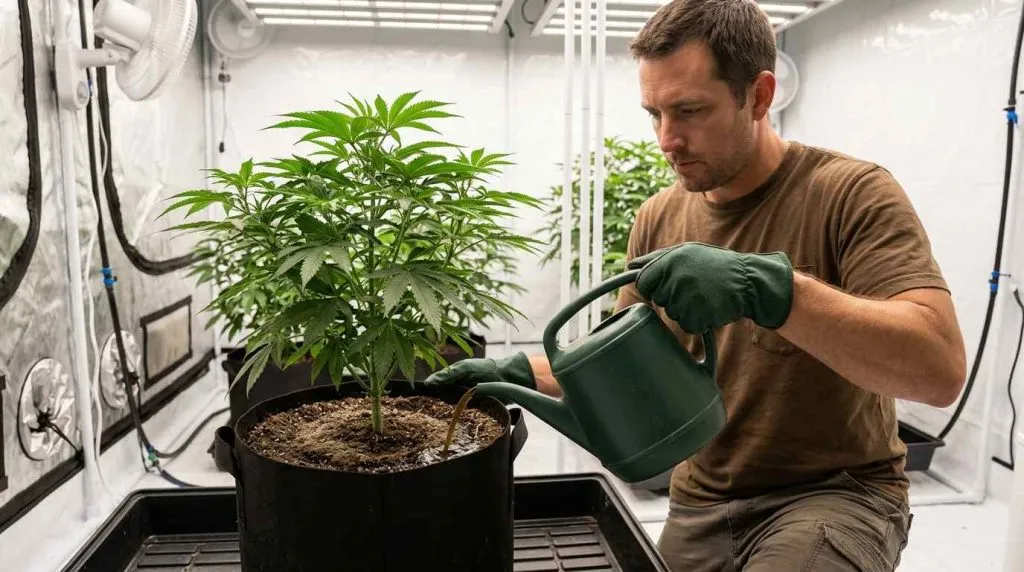
The right amount of compost tea depends on container size, soil moisture, drainage, and the strength of the brew. Apply it as part of a normal watering, not as an extra liquid feed on top of already wet soil.
| Container size | Starting amount per plant |
| 1–2 gallons | 8–16 fl oz |
| 3–5 gallons | 16–32 fl oz |
| 7–10 gallons | 32–64 fl oz |
| More than 10 gallons | ½–1 gallon |
| Raised beds | Apply evenly across the active root area |
These starting amounts assume you are using the lightly amended base recipe without further dilution. When using a concentrated commercial product or a stronger homemade recipe, follow its dilution instructions instead.
How to Apply Compost Tea
- Check the soil first. Lift the container or test the top inch of the growing medium. If the pot still feels heavy or the soil is damp, wait before applying.
- Stir the finished brew. Gently mix the tea so fine particles remain evenly distributed.
- Pour slowly around the root zone. Apply the tea across the soil surface rather than concentrating it against the main stem.
- Let the medium absorb it. Pause between pours so the liquid spreads through the root area instead of running straight through the pot.
- Stop before waterlogging. Use the tea to replace part or all of a regular watering and avoid forcing excessive runoff.
These figures are starting ranges, not fixed targets. A dry fabric pot may accept more than a recently watered plastic container of the same size.
When trying a new cannabis compost tea recipe, test it on one healthy plant first. Watch leaf color, posture, soil drying time, and new growth for several days before treating the whole grow.
Grower tip: Lift each container before watering. If it still feels heavy, wait until the root zone is ready for moisture.
How Often Should You Use Compost Tea?
Compost tea should not be applied at every watering. New growers often get better results by leaving enough time between applications to observe how the soil and plants respond.
| Growth stage | Conservative starting frequency |
| Seedling | Usually unnecessary |
| Established vegetative growth | Every 10–14 days |
| Transition and early flower | About every 14 days |
| Mid-flower | Every 14–21 days, if needed |
| Late flower | Reduce or discontinue |
| Well-amended living soil | Every 2–4 weeks or only when useful |
These intervals should be adjusted to the fertility of the growing medium. Cannabis grown in rich living soil may require compost tea less often than plants in a lightly amended mix.
Reduce the frequency if leaves become unusually dark, the containers stay wet for too long, or the plants already receive a complete nutrient program. Healthy growth is not a reason to add more inputs. From a grower’s perspective, the best schedule is the least frequent one that produces a clear, repeatable benefit without disturbing irrigation or nutrient balance.
How to Tell If Compost Tea Has Gone Bad
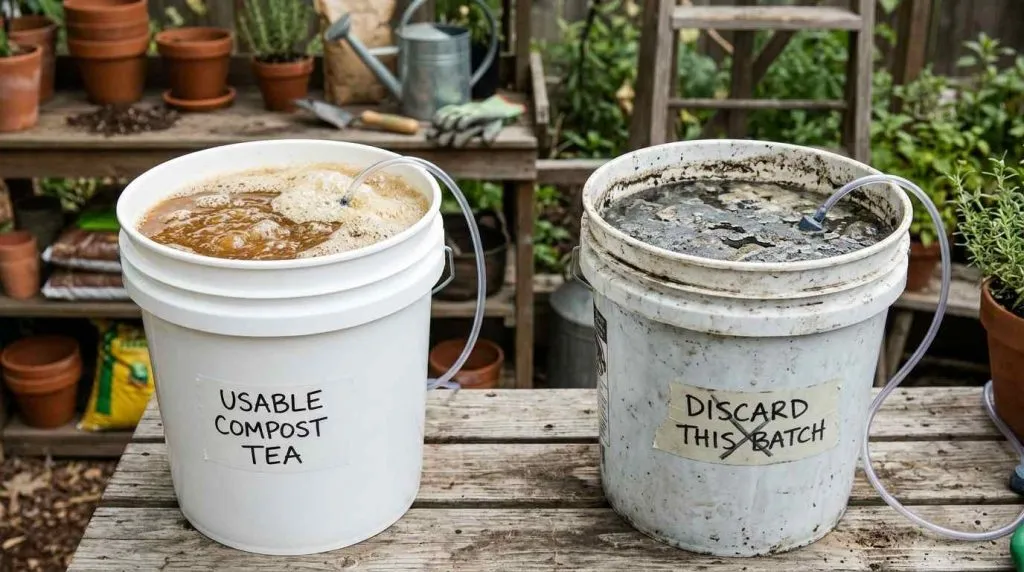
A usable compost tea should smell earthy, similar to damp soil or finished compost. A failed batch often develops an unmistakable rotten-egg, sewage-like, putrid, or sharply sour odor. This usually indicates that oxygen levels dropped and unwanted anaerobic activity became established.
| Check | Usable compost tea | Batch to discard |
| Smell | Earthy or mildly sweet | Rotten, sewage-like, or strongly sour |
| Aeration | Continuous water movement | Pump failure or stagnant areas |
| Surface | Light foam or no foam | Thick slime, greasy film, or unusual growth |
| Brewing time | Within the planned window | Left warm or unaerated for an extended period |
| Starting material | Mature and clean | Raw, unfinished, or foul-smelling |
| Equipment | Clean before brewing | Old residue or biofilm present |
Foam alone does not confirm that cannabis compost tea is healthy. Molasses and other ingredients can produce foam even when the brew is poorly balanced, while a clean batch may show very little.
Do not try to rescue bad compost tea by adding more molasses, restarting the pump, or diluting it. Dispose of the liquid away from the grow, then wash the bucket, tubing, mesh bag, and air stones before brewing again.
Grower tip: When there is genuine doubt about the smell or brewing history, discard the batch. Replacing a few cups of castings is safer than applying questionable tea to every plant.
Common Compost Tea Mistakes
Most problems with cannabis compost tea come from making the brew more complicated than it needs to be. Avoid these common mistakes:
- Using immature compost: Unfinished material is unstable and may introduce unwanted compounds or organisms into the root zone.
- Adding too many amendments: Combining molasses, kelp, fish products, guano, and other supplements can create an unpredictable mixture.
- Using insufficient aeration: An underpowered pump or poorly positioned air stones may leave parts of the bucket stagnant.
- Extending the brewing time: Longer is not always better, especially when water temperatures are warm or oxygen levels are unknown.
- Applying it to wet soil: Compost tea should replace a scheduled watering rather than add more moisture to a saturated container.
- Combining it with full-strength nutrients: This makes it difficult to identify which input caused nutrient stress.
- Spraying developing flowers: Added moisture and organic residue can increase mold and contamination risks.
- Storing the finished brew: Freshly brewed compost tea should be applied promptly.
Grower tip: Change one part of your cannabis compost tea recipe at a time. From experience, small adjustments make plant responses much easier to read.
Conclusion
Making organic compost tea for cannabis is less about adding as many ingredients as possible and more about keeping the process clean, measured, and consistent. Start with mature compost or finished worm castings, use suitable water, maintain steady aeration, and brew within a controlled window. Apply the finished tea only when the root zone is ready for moisture, and adjust the recipe to suit the plant’s stage. Most importantly, trust your senses. If the brew smells wrong or the process has been interrupted, discard it and start again.
Frequently Asked Questions
Can compost tea burn cannabis plants?
A simple cannabis compost tea made from mature compost or finished worm castings is usually mild. However, adding too much molasses, kelp, fish hydrolysate, or other amendments can make the brew stronger than expected and contribute to nutrient stress.
Can I use compost tea at every watering?
No. Most growers should begin by applying compost tea every 10–14 days during vegetative growth and less often during flowering. Using it at every watering can keep the root zone too wet and make it difficult to judge how plants are responding.
Does compost tea increase THC?
Compost tea does not increase THC by itself. Potency is influenced mainly by genetics, light intensity, plant health, environmental control, and harvest timing. A well-managed root zone may support healthy growth, but compost tea should not be treated as a potency booster.
Can I spray compost tea on cannabis plants?
Compost tea can be used as a foliar spray during vegetative growth, but it should be filtered carefully and applied with caution. Avoid spraying developing flowers, as added moisture and organic residue can increase the risk of mold and contamination.
Is worm casting tea the same as compost tea?
Tea brewed from finished worm castings is a type of compost tea. It should not be confused with worm-bin leachate, which is the liquid that drains naturally from a worm bin and may become anaerobic or contain unsuitable microorganisms.


