




How much do autoflowering plants yield? A broad indoor planning range is 30–100 g of dried flower per plant, although some plants produce less and exceptional harvests can exceed 200 g. Outdoor autoflower yields vary with sunlight, climate and weather.
Autoflower yield per plant depends on genetics, lighting, root health and growing conditions. Even the highest yielding autoflower strains cannot guarantee maximum harvests. This guide explains average autoflower yields indoors and outdoors, the factors affecting production, and how to measure dry harvest weight accurately.
Key Takeaways
- Indoor yield: A broad planning range is 30–100 g of dried flower per plant.
- Outdoor yield: Sunlight, climate and plant health influence harvest weight.
- High-yielding strains: Genetics affect potential yields, but results vary.
- Yield factors: Lighting, watering, nutrients and root development affect production.
- Harvest measurement: Compare dried, trimmed flower weight rather than fresh weight.
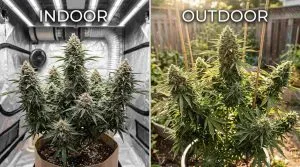
How Much Can an Autoflower Yield?
There is no scientifically established average covering all autoflower strains and growing environments. These figures are examples for planning, not research-derived averages.
| Growing conditions | Illustrative dry yield per plant | What it may indicate |
| Indoor, restricted growth | 20–50 g | Small canopy or an early setback |
| Indoor, healthy growth | 50–100 g | Suitable light and consistent care |
| Indoor, highly productive | 100–200 g or more | Productive genetics and suitable conditions |
| Outdoor, limited conditions | 20–60 g | Partial shade or unsettled weather |
| Outdoor, good conditions | 60–150 g | Regular direct sunlight and healthy growth |
| Outdoor, exceptional conditions | Over 150 g | Possible, but not a routine expectation |
A greenhouse study by Vergara and Ruterbories (2026) found relationships between early plant growth and final autoflower yield. Its results apply to the cultivars and conditions studied; they cannot establish a universal harvest target for home growers.
Average Autoflower Yield Indoors
An indoor harvest is easier to assess when you record both plant count and growing area.
A common indoor setup uses full-spectrum LED lighting on an 18/6 schedule: 18 hours on and six hours off. Some growers choose 20/4. The right choice depends on fixture intensity and total light received each day, not just hours on the timer. See the autoflower light schedule for the different options.
How to Check Light Coverage
Start at the fixture manufacturer's recommended distance. Measure light at canopy height beneath the middle of the fixture and near each edge. A PPFD sensor measures light available for photosynthesis, while DLI describes the total received during a day. The autoflower PAR, PPFD and DLI explanation shows how these measurements relate.
Rodriguez-Morrison and colleagues (2021) showed that indoor cannabis flower yield responded to light intensity. Their experiment was not an autoflower-specific trial, so it should not be used to predict exact autoflower harvest weights.
Grower's Tip: Check readings in the corners, not only beneath the fixture. An even canopy often makes better use of the light already available.

Average Autoflower Yield Outdoors
Outdoor autoflower yield depends heavily on the site. A bright but shaded garden may receive fewer useful hours of direct sunlight than an open location. Choose a spot with consistent sun, ideally six to eight hours or more where climate permits.
Check morning and afternoon sun, not only midday conditions. Provide good air movement and shelter from prolonged rain or damaging wind. The autoflower temperature and humidity guide explains why stable conditions matter.
A container with drainage holes lets you move plants into shelter when necessary. Start with a suitable growing medium and adjust watering to the weather rather than following a fixed calendar. See how to grow autoflowers outdoors and consider outdoor autoflower seeds suited to your climate.
Grower's Tip: Observe direct sunlight for a full day before placing a container. Nearby buildings or trees can remove several hours of useful light.
Highest-Yielding Autoflower Strains
The highest yielding autoflower on a product page may not give the biggest harvest in a small tent. Match plant height and structure to your available space, then compare the same yield units.
| Autoflower strain | MSNL-listed indoor potential | Growth characteristic |
| Big Bud Autoflower | 500–600 g/m² | Compact growth with large flower clusters |
| GG4 Autoflower | 500–600 g/m² | Short structure with resin-rich flowers |
| THC Bomb Autoflower | 400–500 g/m² | Compact plant with a short flowering window |
These are advertised area-based yield potentials, not expected grams from one plant. The high-yield autoflower seeds selection is useful for comparing varieties, but check height and flowering information alongside the yield claim.

What Affects Autoflower Yield?
Genetics and Early Plant Development
Autoflowers begin flowering according to internal developmental timing. Leckie and colleagues (2024) identified a genetic mechanism associated with flowering that does not depend on day length. Different varieties can still develop at different rates.
Begin with healthy autoflower seeds and a growing medium appropriate for young roots. During the first weeks, look for new leaves, a firm stem and steady development. The autoflower week-by-week guide provides a useful growth-stage reference. If a plant remains unusually small and its leaves appear unhealthy, review the causes of stunted autoflower growth before changing several conditions at once.
Container Size, Water and Nutrients
Many growers start autoflowers in their final pots to avoid disturbing the roots during early growth. An 11–19 L container is a practical option for many varieties, but the appropriate size depends on expected plant dimensions and the growing medium. The autoflower pot size guide explains the trade-offs.
After watering, lift the container to learn its wet weight. Check again as it becomes lighter, and feel beneath the surface before applying more water. Roots need oxygen as well as moisture. The autoflower watering guide covers how demand changes as the plant grows.
Begin feeding cautiously, particularly in a nutrient-rich medium. Increase only when growth and leaf condition justify it; adding more nutrients does not automatically add flower weight. Use the autoflower feeding schedule to understand changing requirements.
Gentle Training and Canopy Shape
Low-stress training (LST) is commonly used to spread flexible branches so more flower sites receive light. On a healthy young plant, bend a supple stem sideways and secure it loosely with a soft tie. Inspect the attachment regularly and loosen it before it restricts the stem. Avoid training if growth has already slowed.
Grower's Tip: Test a stem with gentle pressure before moving it. If it resists, stop; forcing a rigid branch can cause damage that outweighs any potential benefit.
The autoflower LST instructions explain the method in more detail.
How to Calculate Dry Autoflower Yield
Weigh flowers after drying and trimming, using the same method for each harvest. Fresh flower contains water and may include leaves and stems, making wet weights misleading. For example, 100 g of fresh flower might become roughly 15–25 g of dried, trimmed flower, depending on moisture loss and how much material is removed.
| Measurement | How to use it |
| Dry grams per plant | Compare individual plants |
| Total dry grams | Record the complete harvest |
| Grams per m² | Divide total dry grams by the growing area in m² |
| Seed-to-harvest days | Compare development time between crops |
Four plants yielding 45, 55, 65 and 75 g provide 240 g total, averaging 60 g per plant. If grown across 1 m², the area yield is 240 g/m². Check flower maturity rather than relying on dates alone; the autoflower harvest readiness guide describes what to examine.
Why Are My Autoflower Yields Low?
Use the plant's growth history to identify likely causes. A larger nutrient dose late in flowering cannot make up for every problem that occurred earlier.
| Observation | Possible cause | What to check |
| Thin, stretched stems | Insufficient light | Fixture distance and light distribution |
| Small plant before flowering | Interrupted root development | Drainage and watering habits |
| Brown leaf tips | Excess nutrient concentration | Feed strength and root-zone conditions |
| Small lower flowers | Uneven canopy exposure | Shading and branch position |
| Damaged flowers near harvest | Excess moisture or disease | Air movement and signs of rot |
Change one factor at a time, then watch new growth.
Conclusion
Autoflower yield per plant is more useful as a planning range than a promised number. Assess light coverage, protect early roots and record dry weights consistently. For outdoor plants, consider local sunlight and weather. Comparing your own harvest records will tell you more than selecting a strain by its maximum advertised yield alone.
Frequently Asked Questions
How much does one autoflower yield indoors?
An illustrative indoor planning range is 30–100 g of dried flower. Actual harvests may fall below or above it.
How much will four autoflowers yield?
At 30–100 g per plant, four plants would produce approximately 120–400 g dry. This is a calculation, not a forecast.
Can an autoflower yield more than 200 grams?
Yes, exceptionally productive plants can exceed 200 g dry, but that is not a dependable expectation.
Does a bigger pot increase autoflower yield?
A suitable pot supports root development, but additional volume alone does not guarantee more flower.
Is autoflower yield measured wet or dry?
Use dried, trimmed flower weight when comparing harvests. Fresh weight includes water lost during drying.
References
- Vergara, D., & Ruterbories, K. A. (2026). High-THC Cannabis sativa in a New York greenhouse: yield and economic factors. Journal of Cannabis Research, 8, 85.
- Rodriguez-Morrison, V., Llewellyn, D., & Zheng, Y. (2021). Cannabis yield, potency, and leaf photosynthesis respond differently to increasing light levels in an indoor environment. Frontiers in Plant Science, 12, 646020.
- Leckie, K. M., et al. (2024). Loss of daylength sensitivity by splice site mutation in Cannabis pseudo-response regulator. The Plant Journal, 118(6), 2020–2036.
