



Growing high-quality autoflower cannabis indoors starts with understanding how PAR, PPFD, and DLI affect autoflowers throughout every stage of growth. These lighting metrics help determine how much usable light your plants receive, making them essential for healthy development and maximizing yields. While autoflowers thrive under intense lighting, more isn't always better. Too little light can result in weak, stretched plants, while excessive intensity can cause light stress, bleaching, and reduced flower quality.
In this guide, you'll learn what PAR, PPFD, and DLI mean, how they work together, and why they're important for indoor cannabis cultivation. We'll cover the ideal light levels for seedlings, vegetative growth, and flowering, explain how to measure light intensity accurately, and compare the different types of grow lights available for autoflowers. By the end of this article, you'll have the knowledge to optimize your lighting setup, avoid common mistakes, and create the ideal conditions for healthy, resin-rich harvests.
Key Takeaways
- PAR, PPFD and DLI each measure different aspects of plant lighting. PAR defines the usable light spectrum, PPFD measures light intensity at the canopy, and DLI calculates the total amount of light your autoflowers receive each day.
- Autoflowers require different light intensities throughout their life cycle. Seedlings thrive with lower PPFD levels, while vegetative and flowering plants benefit from progressively higher light intensity to maximize healthy growth and bud development.
- More light isn't always better. Excessive PPFD can cause light stress, bleaching and reduced flower quality, making it important to provide the correct light levels rather than simply the brightest light possible.
- Modern full-spectrum LED grow lights offer the best combination of efficiency, coverage and control. Choosing a quality fixture with published PPFD maps and adjustable output helps you deliver the right amount of light at every stage of growth.
- Measuring and monitoring your lighting produces more consistent results. Using a PAR meter or PPFD measuring app, combined with proper light positioning and environmental control, helps optimize plant health and improve harvest quality.
PAR, PPFD and DLI, what are they and what do they measure?
If you have spent time searching for different lights online, you may have come across the terms PAR, PPFD, and DLI. You may be thinking what these mean and how they relate to the light’s performance and efficacy.
Cannabis plants require light for photosynthesis and growth. Not every grow light has the same spectrum or efficacy, and the only real way to see what your grow light can do is to check the PAR or PPFD levels. Lucky for you, lighting manufacturers will have already done the testing and calculated how much light and coverage their lights produce.
Below is an explanation of the meanings of PAR, PPFD, and DLI, what they are, and how they are measured.
| Measurement | What it Measures | Unit | Why it Matters |
| PAR (Photosynthetically Active Radiation) | The range of light wavelengths used for photosynthesis (400–700nm) | Nanometers (nm) | Determines whether a light source produces usable light for plant growth. |
| PPFD (Photosynthetic Photon Flux Density) | The amount of usable light reaching the plant canopy every second | μmol/m²/s | Measures light intensity and help determine whether plants are receiving enough light. |
| DLI (Daily Light Integral) | The total amount of usable light received over a full day | mol/m²/day | Combines PPFD and photoperiod to show the plant's total daily light exposure. |
What is PAR (photosynthetically active radiation)?
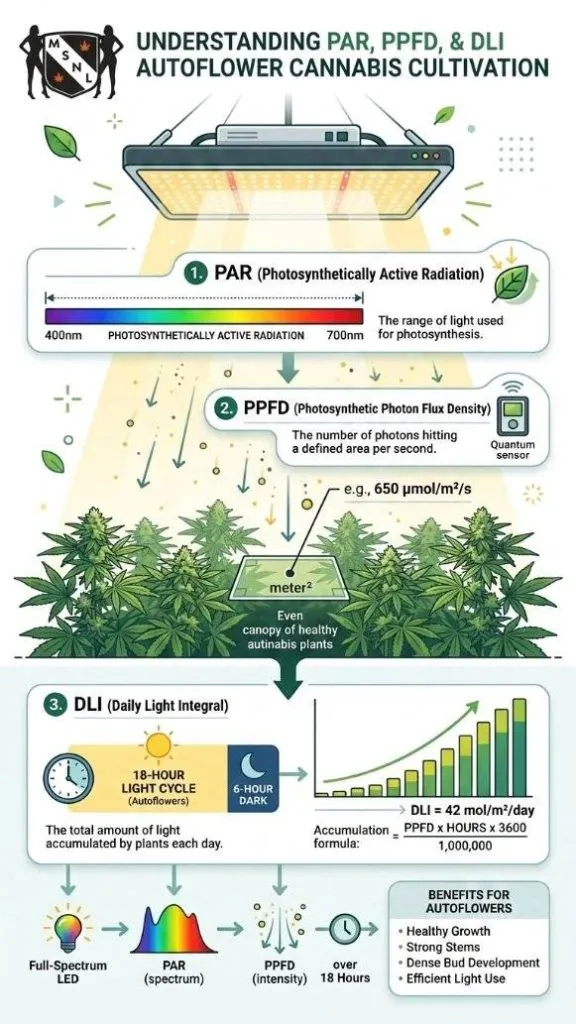
Photosynthetically active radiation is the spectrum of light that autoflowering cannabis plants need for photosynthesis and energy. PAR (Photosynthetically Active Radiation) describes the range of light wavelengths between 400 and 700 nanometers that plants use for photosynthesis. While PAR defines the quality of usable light, it doesn't indicate how much of that light actually reaches the canopy that is measured using PPFD, and how well your plants grow and bloom.
- PAR refers to the spectrum range between 400 and 700 nanometers.
What is PPFD (photosynthetic photon flux density)?
PPFD (Photosynthetic Photon Flux Density) measures how many photosynthetically active photons reach one square meter of the plant canopy every second. Expressed as μmol/m²/s, it is the most useful measurement for determining whether your plants are receiving enough light at each stage of growth. The photosynthetic photon flux density is measured in micromoles per square meter per second (μmol/m²/s). When researching grow lights, it is best to check the PPFD rating.
- The light intensity (PPFD) drops significantly as the light source is moved farther away.
What is DLI (daily light integral)?
DLI refers to how much photosynthetically active radiation a cannabis plant’s canopy receives over 24 hours. Now you may be thinking, why does that matter to me, and what difference does it make compared to PPFD? Well, Daily Light Integral (DLI) measures the total amount of photosynthetically active light a plant receives over a 24-hour period. Rather than looking at light intensity alone, DLI considers both PPFD and the length of the light cycle, making it a valuable tool when optimizing plant growth and energy efficiency, especially when operating on a large, profit-driven commercial-scale project.
What is the ideal PAR, PPFD and DLI for autoflower cannabis plants?
Although cannabis is a high-light crop, every stage of growth has an optimal light intensity range. Providing too little light can slow growth and cause plants to stretch, while excessive PPFD can overwhelm the plant's ability to photosynthesize efficiently, resulting in light stress and reduced flower quality. More light does not automatically produce bigger harvests, making it essential to provide the correct PPFD and DLI for each stage of growth.
Outdoors, it seems that cannabis plants can thrive and enjoy a full spectrum of light waves. Indoors, you can recreate the same wavelength as the sun and dial in the exact levels of PAR and PPFD. The following are the different levels for each stage of growth, as a guide to achieving optimal lighting requirements.
| Growth Stage | Recommended PPFD | Target DLI | Typical Light Schedule |
| Seedling | 100–300 μmol/m²/s | 14–22 mol/m²/day | 18–20 hours |
| Vegetative | 400–600 μmol/m²/s | 25–40 mol/m²/day | 18–20 hours |
| Flowering | 700–900 μmol/m²/s | 35–45 mol/m²/day | 18–20 hours |
Ideal lighting targets for autoflower seedlings
Everything starts at the seedling stage, and giving your plants the right amount of light intensity will pay off massively. During the seedling stage, autoflowers have limited leaf surface area and relatively small root systems. Low light intensity often results in elongated stems as seedlings stretch toward the light source, while excessive intensity can slow early development by placing unnecessary stress on young plants. Too much light and you can stunt growth. Finding the right balance is the key to giving your seedlings the best start in life.
- Autoflower seedlings require low light levels, gentle watering and a balanced nutrient programme during their first two weeks of growth.
- Seedlings typically spend their first two weeks establishing roots before entering the vegetative stage, making this one of the most important periods when growing autoflowers week by week.
- Low light intensity causes plants to stretch with a thin stem.
- Too much light intensity will cause light burns and stress
PAR and PPFD in the seedling stage
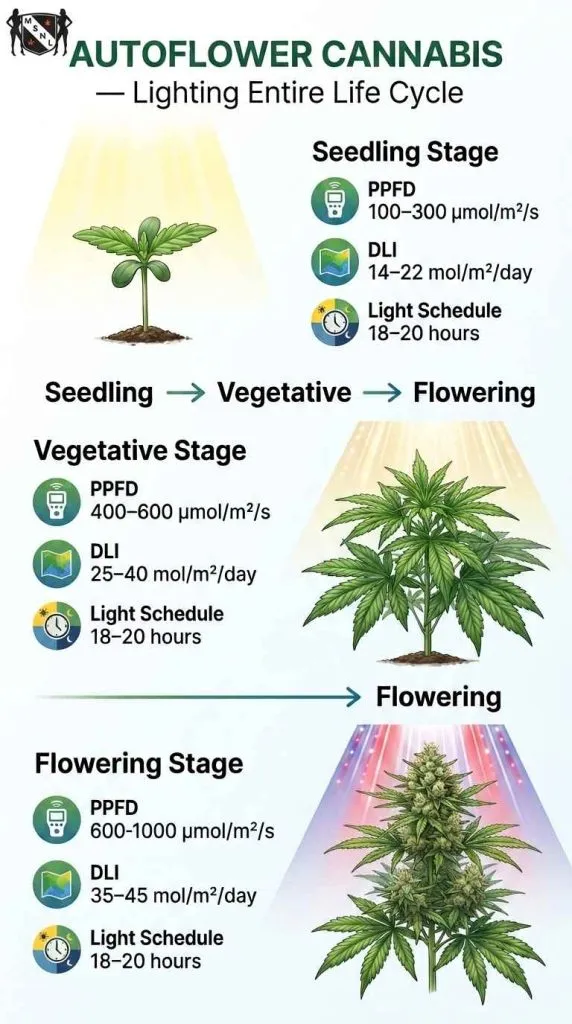
- A PPFD of approximately 100–300 μmol/m²/s is generally recommended for autoflower seedlings, providing sufficient light for healthy development without overwhelming young plants.
- Auto seedlings do not require much light or nutrients at this early stage
DLI in the seedling stage
- Autos in the seedling stage require 14-22 mol/m²/day
Ideal lighting targets for autoflowers in the vegetative stage
The vegetative stage is when your autos focus all their energy on a strong root base, developing a thick central stem, producing fan leaves, axillary shoots and internodes. It is during the vegetative stage that your autos will truly establish themselves.
Autos have a relatively short vegetative period lasting around weeks 3-5, which is why many growers begin low stress training autoflowers during this stage to create a more even canopy, so making sure you provide the perfect amount of light can make or break your grow. Below are the optimal PAR and PPFD levels for 18/6.
PAR and PPFD in the vegetative stage
- 400 to 600 μmol/m²/s is the ideal amount of PPFD to give your autoflowering cannabis plants
Maintaining a PPFD between approximately 400 and 600 μmol/m²/s provides enough usable light to support vigorous vegetative growth, encouraging strong stems, healthy leaf development and the formation of multiple flowering sites.
DLI in the vegetative stage
- The recommended DLI during the vegetative stage will be 25 and 40 mol/m²/day
Ideal lighting targets for autoflowers in the flowering stage
The flowering stage is when your plants begin producing buds, and understanding how long autoflowers stay in the flowering stage makes it much easier to manage lighting, feeding and environmental conditions. Giving your autos the right amount of lighting will determine how big, dense and abundant your harvest will be. The following explains the different light ranges for flowering autos.
PAR and PPFD in the flowering stage
- During flowering, most autoflowers perform well with a canopy PPFD of approximately 700–900 μmol/m²/s, provided temperature, nutrition and environmental conditions are also well managed.
Keeping a consistent lighting regime at this PPFD level helps plants reach their full genetic potential, making it especially beneficial when growing high yield autoflower seeds under powerful LED lighting.
Excessively high PPFD, particularly under powerful modern LED fixtures, can contribute to light stress and flower bleaching if plants are unable to utilize the additional photons efficiently. This risk increases when high light intensity is combined with poor environmental conditions or inadequate nutrition. This causes the top colas to turn albino white, lose aroma and serve no purpose once harvested. Light burn can also be caused by the light being too close to the top of the canopy.
DLI in the flowering stage
- 35 and 45 mol/m²/day will be optimal for flowering autoflowers
What grow lights do I use for the best PAR, PPFD and DLI performance?
The more you read about growing high-grade cannabis, the more you will learn that plants require a specific spectrum. There are many types of grow lights available designed for cannabis cultivation. When it comes to choosing a grow light, you will want to answer the following questions:
- Does the light have a good PPFD level?
- How much electricity does the light use?
- Does the light have a dimmable option?
- Is the light from a well-known, reputable brand?
- Are you able to see photos of other growers using the light?
- Will the light provide adequate coverage for your grow tent or indoor growing space?
Below is a breakdown of the different types of lights, including PAR, PPFD, and DLI ratings.
LED grow lights
Modern full-spectrum LED grow lights have become the preferred choice for growers cultivating indoor autoflower seeds, thanks to their high photon efficiency, lower heat output and ability to deliver consistent PPFD across the canopy. They are energy-efficient, produce less heat than HID grow lights, and provide plants with a full spectrum of light. This means they are ideal for the seedling, vegetative and growing phase.
Most LED grow lights are designed with a dimmable ballast, so you can adjust output and energy consumption as needed.
- LED grow lights are available in different sizes and models
- LED grow lights produce a full spectrum for veg and bloom
- They can be closer to the canopy due to a low heat output
- Most LED grow lights use between 250 and 600 W of power
- LED grow lights can be expensive compared to HID lights
| Grow Light | Efficiency | Heat Output | Lifespan | Best Use | Suitable for Autoflowers |
| LED | Excellent | Low | 50,000+ hours | Seedling to harvest | 5/5 |
| HPS | Moderate | High | 10,000–20,000 hours | Flowering | 4/5 |
| Metal Halide | Moderate | High | 10,000–15,000 hours | Vegetative growth | 3/5 |
| CFL / T5 | Low | Very Low | 8,000–20,000 hours | Seedlings and clones | 2/5 |
HPS (high-pressure sodium) grow lights
HPS grow lights require a ballast, bulb, and reflector, and range from 400W to 1000W. They are best suited for the flowering period due to the bulb's spectrum and, when paired with a metal halide light, produce the optimal spectrum for plant growth.
HPS lights are well known for producing a lot of heat and are not as efficient in terms of PAR and spectrum.
- Best suited for the flowering stage
- The bulbs can produce a lot of heat
- The ballast can also run hot
- The bulbs cannot be exposed to a spray
- HPS are not as efficient as LEDs
MH (metal halide) grow lights
Metal halide lights are the same ones you see lighting up parking lots and football stadiums. They produce a rich blue light which favors the vegetative stage; however, they lack the spectrum required for bud production. Metal halide lights are great for the seedling and vegetative stages; however, they need to be paired with an HPS when flowering.
- Metal halides are superb for producing vegetative growth
- They are available, ranging from 250w to 1000w
- They should be paired with HPS lights for a full spectrum
T5 / CFL (fluorescent grow lights)
CFL lights are superb for clones, seedlings, and early vegetation; however, they do not have the power or intensity to produce large plants with big buds. T5 strip lights are ideal for small grow spaces, use very little power, and produce a soft, rich, blue light.
- CFL bulbs or T5 strip lights are perfect for creating a small vegging tent
- Clones and seedlings thrive under soft CFL lighting
- CFL grow lights (6400k) promote healthy foliage and growth
- CFL lights use minimal electricity and are very efficient
How do you measure PAR, PPFD and DLI?
Treating growing cannabis like science will be beneficial in producing the most consistent crops time after time. If you are the type of grower who likes to be in full control and know everything about your plants, then knowing how to measure PAR, PPFD and DLI will be advantageous. The following explains how to measure each item and the tools and equipment required.
Measuring PAR (photosynthetically active radiation)
Once you know how much PAR your grow lights produce, you can calculate the PPFD and DLI. You measure PAR with a PAR meter. The meter will measure light intensity in the 400-700 nanometer range.
Measuring PPFD (photosynthetic photon flux density)
The PPFD value indicates how much light is hitting the canopy per second. This is also measured with a PAR meter and expressed as μmol/m²/s. You can adjust light intensity, fixture height and dimmer settings until your canopy reaches the recommended PPFD, while maintaining healthy watering and environmental conditions.
Measuring DLI (daily light integral)
Once you know your PPFD value, the next step in calculating the DLI is to multiply the number of hours the light is on per day by the PPFD value. To measure the daily light integral, you need to calculate a mol/m²/day formula that shows exactly how much light your autos receive over 24 hours.
To calculate this figure, you multiply the number of hours of daylight your plants receive by the PPFD value, for example, 18 hours x PPFD value.
The correct lighting distance
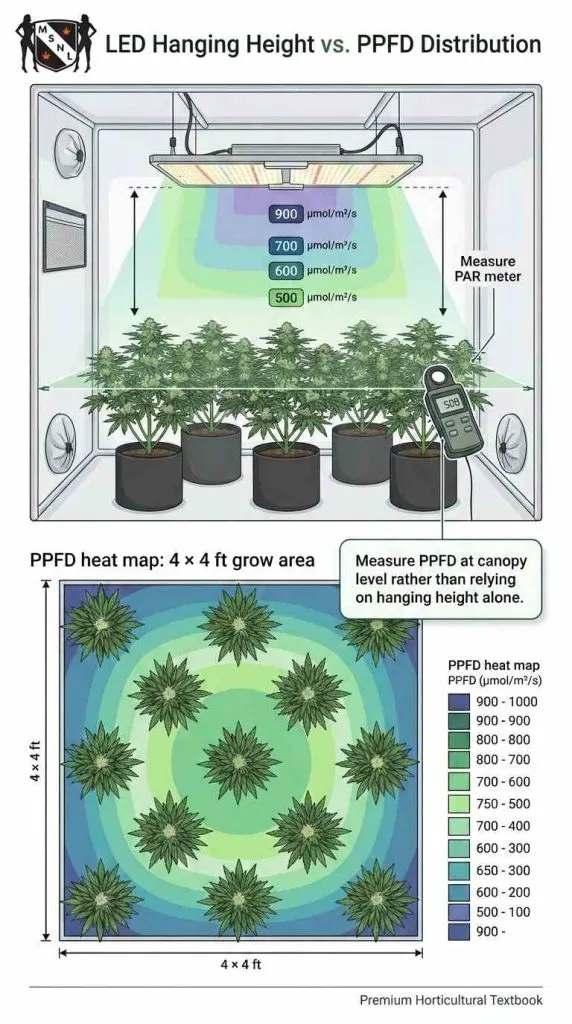
Hanging your grow light correctly ensures that your plants receive an evenly distributed light source and plenty of PAR-rich light. When you hang your light, using a PAR meter will tell you the sweet spot. As your cannabis plants get taller, you can raise the light accordingly to maintain the optimal distance in relation to PPFD.
If you do not have a PAR meter and are not sure where to hang your light, follow the guide below. This distance will prevent light burn, keep temperatures cooler and still provide the canopy optimal light spread.
- Seedling Stage = 12-18 inches above
- Vegetative Stage = 18-24 inches above
- Flowering Stage = 18 -24 inches above
| Growth Stage | Target PPFD | Typical LED Hanging Distance* |
| Seedling | 100–300 μmol/m²/s | 24–36 inches (60–90 cm) |
| Vegetative | 400–600 μmol/m²/s | 18–24 inches (45–60 cm) |
| Flowering | 700–900 μmol/m²/s | 12–24 inches (30–60 cm) |
The importance of airflow ventilation and PPFD
Maintaining a consistent grow room environment with stable temperatures, humidity and airflow helps plants make the most of higher PPFD levels. Cannabis plants will grow and yield much better when the temperature, humidity and ventilation are well dialled in as shown below.
Seedling stage -
- 100 to 300 μmol/m²/s
- Temperature = 24 degrees Celsius, light on / 18 degrees Celsius, lights off
- Humidity = 65-70%
Vegetative stage -
- 400 to 600 μmol/m²/s
- Temperature = 24 degrees Celsius, light on / 18 degrees Celsius, lights off
- Humidity = 50-60%
Flowering stage -
- 700 to 900 μmol/m²/s
- Temperature = 24 degrees Celsius, light on / 18 degrees Celsius, lights off
- Humidity = 45-50%
Using fans to keep the grow space cool will help maintain a consistent temperature and circulate air throughout the room. Oscillating fans blowing on the canopy and the grow lights will help prevent heat stress while keeping PPFD levels optimal.
If you find that your grow lights are creating too much heat and the canopy level is too hot and dry despite producing the recommended PAR levels, increase the distance between the light and the canopy.
It is much better to grow at cooler, comfortable temperatures and humidity levels, and slightly lose out on PAR. Using an oscillating fan to blow into the space beneath and above the lights can also help keep the room temperature lower.
| Growth Stage | PPFD | Temperature (Lights On) | Relative Humidity |
| Seedling | 100–300 μmol/m²/s | 24°C | 65–70% |
| Vegetative | 400–600 μmol/m²/s | 24°C | 50–60% |
| Flowering | 700–900 μmol/m²/s | 24°C | 45–50% |
Conclusion
If you really want to take your indoor grow game to the next level and be as clinical and professional as possible, then working with PAR, PPFD and DLI is advised. You will be able to rest assured that your plants are receiving the optimal amount of light they need, without worrying about giving them too little or too much.
Invest in a PAR meter and get into the habit of recording PPFD levels at each stage of the grow cycle. Once you get into the practice of being data-driven, you will be able to fine-tune your grow room and growing environment much more easily and mastering PAR, PPFD and DLI isn't about chasing the highest light levels, it's about giving your autoflowers the right amount of usable light throughout each stage of growth. Combined with good environmental control and quality genetics, these measurements allow you to grow healthier plants, avoid common lighting mistakes and consistently produce high-quality harvests.
For the first-time or beginner grower who is perhaps looking to buy a grow light, the best advice I can give is to do plenty of research. Do not focus on lumens; focus only on PAR and PPFD analysis. Investing in the right grow light that produces the best crops is an essential part of any grower's arsenal.
Do not be afraid to ask the company questions, check out what grows from other people using their lights and see what forums and other growers say. Grow lights nowadays are much more expensive compared to 10-15 years ago, so make the right choice and invest your money wisely!
Monitoring the grow room environment and followin strict water and feeding plan, will be the difference in producing the ultimate harvests, once you have perfected PAR and PPFD levels. Keep an eye on your plants for signs of light burn or heat stress especially during the flowering period.
Frequently Asked Questions
What is the ideal PPFD for autoflowers?
The ideal PPFD varies depending on the stage of growth. Seedlings typically perform best between 100–300 μmol/m²/s, vegetative plants between 400–600 μmol/m²/s, and flowering autoflowers between 700–900 μmol/m²/s, assuming optimal growing conditions.
What is the best DLI for autoflowering cannabis?
Autoflowers generally thrive with a Daily Light Integral (DLI) of 35–45 mol/m²/day during flowering, while earlier stages require lower levels. DLI reflects the total amount of light plants receive over a full day.
Can autoflowers receive too much light?
Yes. Excessive light intensity can lead to light stress, causing symptoms such as bleached buds, leaf curling and reduced growth. It's important to stay within recommended PPFD ranges for each stage.
Should autoflowers be grown under 18/6 or 20/4 lighting?
Both schedules are effective. An 18/6 cycle offers a good balance between growth and energy efficiency, while 20/4 can slightly increase total light exposure and potentially boost growth.
How far should LED grow lights be from autoflowers?
The correct distance depends on the fixture, but as a general guide: 24–36 inches for seedlings, 18–24 inches during vegetative growth, and 12–24 inches during flowering. Always adjust based on PPFD readings or manufacturer recommendations.


