




Lollipopping autoflowers is a pruning technique used to remove weak, shaded lower growth that is unlikely to develop into well-formed flowers. Some growers use this method to open up crowded canopies, improve airflow and make plant maintenance easier. However, not every autoflower needs pruning, and removing too much growth can affect development.
Knowing when and how to lollipop autoflowers is important because these plants have a limited growing period before flowering. This guide explains how to identify unwanted growth, make careful cuts and avoid unnecessary stress while protecting healthy branches and leaves.
Key Takeaways
- What lollipopping does: Removes selected lower shoots and flower sites that receive limited light.
- When to lollipop: Early flowering is a commonly used window, provided the plant is healthy.
- How much to remove: Focus on weak, shaded growth rather than following a fixed percentage.
- Potential benefits: A more open canopy, better access for maintenance and fewer small lower flowers.
- What to avoid: Heavy pruning, removing healthy branches and expecting guaranteed increases in yield.

- What is Lollipopping Autoflowers?
- What Are the Benefits and Limits?
- Should You Lollipop Your Autoflower?
- When to Lollipop Autoflowers
- How to Lollipop Autoflowers Step by Step
- Aftercare: What to Do Next
- Common Mistakes When Lollipopping Autoflowers
- Should You Lollipop Autoflowers Outdoors?
- Frequently Asked Questions
- References
What is Lollipopping Autoflowers?
Some plants have a full upper canopy with thin branches hidden underneath. Those shaded shoots may form small, loose flowers. Lollipopping removes selected lower shoots, leaving fuller growth above clearer stems.
A shoot is a small branch growing from a larger stem. A flower site is the point where flowers begin to form. A node is where a leaf or branch joins the stem. If these terms are new, the cannabis nodes and internodes explanation shows where branches join a stem.
With defoliating autoflowers, growers remove selected leaves. Lollipopping mainly removes weak shoots or flower sites. Keep healthy leaves: they capture light for growth.
What Are the Benefits and Limits?
An open lower canopy is easier to inspect and may improve air movement. It can mean fewer tiny flowers to trim. But each removed branch also costs the plant leaves and potential flowers.
| Possible result | What it means in practice |
| Easier inspection | You can see lower stems and check for damage or pests. |
| Less crowded growth | Air may move more freely around the base, provided ventilation is suitable. |
| Fewer small lower flowers | Some shaded sites are removed before they develop further. |
| Bigger harvest | Not guaranteed; removing useful growth may reduce total weight. |
In an indoor cannabis trial, Massuela et al. (2022) compared lollipopping with other pruning treatments and unpruned plants. Lollipopping changed plant structure but did not produce a statistically reliable increase in total CBD yield over unpruned plants. The study did not specifically test autoflowers, so it cannot tell us exactly how every auto will respond.
Danziger and Bernstein (2022) also found that flower position and planting density affected cannabinoid uniformity in cannabis. This does not prove removal increases harvest weight. For a wider view of other factors, see how light, plant health and the growing space affect autoflower yields.
Should You Lollipop Your Autoflower?
Before cutting, check whether lower branches receive light or sit beneath thick foliage. Autoflowers with open growth may not need pruning.
| What you see | What to do |
| Thin lower shoot that stays in deep shade | Consider removing it if the plant is healthy. |
| Lower branch with a tip reaching the light | Keep it, even if it starts close to the pot. |
| Small plant with only a few branches | Leave it to build more growth. |
| Drooping, yellowing or stalled development | Do not lollipop; find the cause first. |
| Plant already carrying well-developed flowers | Avoid major branch removal. |
A plant may be stunted rather than naturally compact. Persistent drooping, damaged leaves or stalled growth are reasons to avoid pruning.
Grower Tip: Follow a lower branch with your eyes from where it joins the stem all the way to its tip. If the tip reaches good light, keep it. A branch is not useless just because it grows near the bottom.
When to Lollipop Autoflowers
Some growers lollipop at the start of flowering, when stems are still growing taller and small white hairs appear at flower sites. Judge the stage and plant health, not its age in weeks.
Autoflowers begin flowering through an age-related genetic process rather than needing a particular change in daylength. Leckie et al. (2024) identified a genetic change associated with this trait. It does not establish a pruning window. An autoflower week-by-week timeline can help you identify the stage your plant has reached.
| Stage | Sensible approach |
| Seedling, with only a few leaves | Do not lollipop. |
| Growing plant, building its first branches | Watch which shoots reach the light; do not rush. |
| Early flower, with some branch stretch | Consider limited removal of clearly shaded shoots. |
| Flowers increasing in size | Avoid heavy cutting; protect remaining leaves. |
| Late flower | Leave healthy branches alone. |
During the flowering stretch, stems grow taller as flower sites appear. The signs of autoflower stretching can help you identify it. Do not compensate for a missed window with bigger cuts.
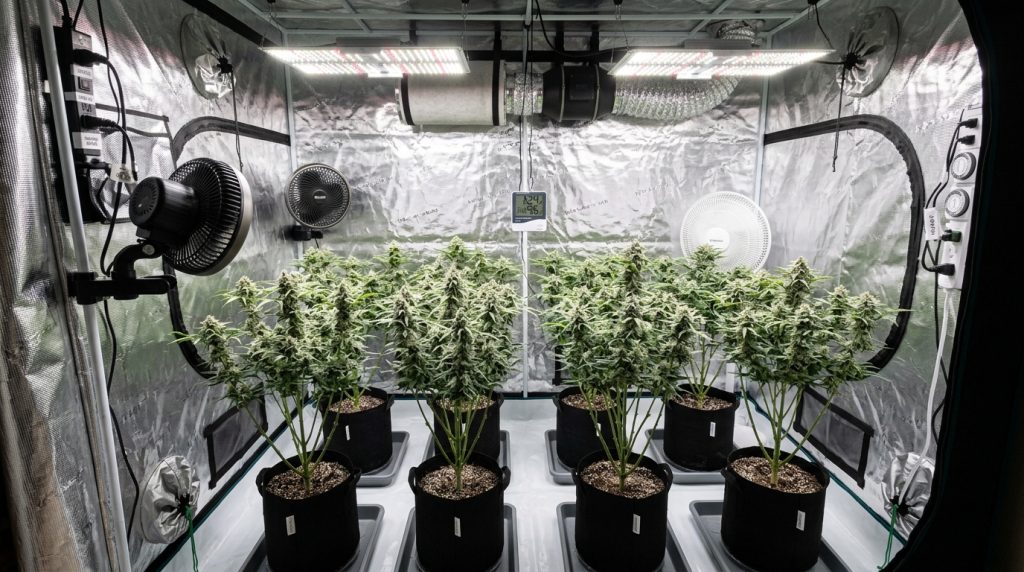

How to Lollipop Autoflowers Step by Step
Step 1: Gather Your Tools and Check the Plant
Use sharp pruning scissors with narrow tips. Clean the blades with 70% isopropyl alcohol and let them dry. Keep alcohol away from flames. Set a clean container beside the pot for removed shoots, so the cut pieces do not fall back into the leaves.
Check that leaves are firm and new shoots are growing. If the plant is drooping, damaged or stalled, put the scissors away and check the growing conditions first.
Step 2: Find One Weak Shoot
Look underneath the upper leaves. Find a thin branch that stays in shade while larger branches rise above it. Trace that thin branch back to the point where it joins a thicker stem. This joining point is the place you need to see clearly before making any cut.
Next, check whether the branch tip is actually getting light. Move a nearby leaf to look, then let it fall back into place. If the branch tip is already up near the top, keep it. If it remains trapped below other branches and has little space to grow, it may be a candidate for removal.
Grower Tip: Choose the first branch before picking up the scissors. Point to the small branch you want to remove and then to the thicker stem you must keep. This makes it easier to avoid cutting the wrong one.

Step 3: Make a Clean Cut
Hold the tip of the unwanted branch gently, keeping your fingers well away from the scissors. Do not pull it. Place the open scissor blades around that branch near the place where it joins the thicker stem. Make sure only the small branch is between the blades.
Close the scissors once to cut it. Keep the blades clear of the thicker stem so you do not nick or crush it. Lift away the removed shoot. Never tear a branch off by pulling; that can peel the surface of the stem and cause unnecessary damage.
If you can only see the joining point by twisting branches sharply, stop and choose an easier shoot. A safe cut matters more than removing every shaded branch. Keep your free hand below the cutting point and away from the closing blades.
Step 4: Decide Whether to Remove a Flower Site or a Whole Branch
Sometimes a branch is healthy but has one tiny flower site hidden close to the main stem. You do not need to remove the entire branch. Find the little side growth, check where it attaches, and cut only that small piece while keeping the branch and its leaves.
If a thin branch has several shaded sites and its tip cannot reach the light, removing that one branch may be more sensible. For example, if a branch has one well-lit tip but two tiny sites hidden against the main stem, keep the branch and consider removing only those hidden sites. You do not need to cut the whole branch just because part of it is shaded. If a flower site sits too close to the main stem for a clean cut, leave it rather than risk damaging the stem.
Keep every healthy branch whose tip already reaches the canopy. If a large leaf is temporarily covering a site, try moving or gently tucking the leaf aside before considering a cut. Low-stress training for autoflowers describes how growers use soft ties to position flexible branches without removing them.
Step 5: Stop and Check Your Work
After one or two cuts, step back. Check that the lower stems have more space and healthy branches remain. You may already be finished.
Do not remove a fixed percentage of leaves or automatically clear the bottom third. There is no proven safe amount that fits every autoflower. Take a photograph so you can compare the plant with its appearance over the following days.
Aftercare: What to Do Next
Leave the plant in its normal growing conditions. Pruning alone is not a reason to add extra nutrients, water more often or change the light schedule. Check the growing medium before watering because the plant may use water differently after losing leaves.
Over the following days, check for firm leaves and continued development. Drooping or yellowing may relate to light, watering or other conditions rather than pruning alone. Check the possible causes of yellowing autoflower leaves before assuming pruning is responsible.
Keep air circulating gently around the canopy, without pointing a strong fan directly at flowers. Pruning cannot replace suitable ventilation or temperature and humidity control for autoflowers.
Grower Tip: Do not plan another pruning session for the next day. Give the plant time to show how it responds and only act again if there is a clear reason.
Common Mistakes When Lollipopping Autoflowers
Removing healthy lower branches. A lower branch can still produce useful flowers if its tip has good light. Look at the entire branch, not just where it starts.
Cutting too early. A young shoot may seem small because it has only just formed. Give the plant time to develop before deciding it is unproductive.
Stripping leaves to create a certain shape. Healthy fan leaves support growth. Keep them unless there is a separate, specific reason to remove one.
Trying several training methods together. Heavy bending, topping and branch removal in one session make the plant harder to assess and may add unnecessary stress.
Expecting pruning to fix low light. If the entire canopy is poorly lit, removing branches is not a substitute for correcting the light setup. Understanding PAR, PPFD and DLI for autoflowers helps explain why the amount of light reaching leaves matters.

Should You Lollipop Autoflowers Outdoors?
Outdoors, a branch shaded in the morning may receive sun later. Check at different times before cutting.
Keep branches that receive light. Only consider removing thin, permanently shaded shoots in crowded growth. The same cautious approach applies to growing autoflowers outdoors.

Conclusion
Lollipopping autoflowers can help manage crowded lower growth, but it is not necessary for every plant. The aim is to remove weak, shaded shoots while protecting healthy branches and leaves that support flower development.
For new growers, the most important part is knowing when to leave a plant alone. Check its health, identify growth that is unlikely to develop well, and avoid unnecessary pruning once flowers are established. A more open canopy can make maintenance easier, but increased yields are not guaranteed.
Frequently Asked Questions
How Much Growth Should You Remove When Lollipopping Autoflowers?
There is no proven percentage that is safe for every autoflower. Some plants may only need one or two small shoots removed, while others need no pruning. Focus on identifying growth that stays shaded rather than trying to clear a certain amount of the lower canopy.
Can You Lollipop Autoflowers More Than Once?
Some growers make a second small adjustment if new lower growth becomes crowded. However, repeated pruning removes leaves and shoots that the plant has spent energy developing. Avoid further cuts unless there is a clear reason, particularly once flowers are increasing in size.
Does Lollipopping Autoflowers Reduce Popcorn Buds?
Removing small, shaded flower sites can reduce the number of loose lower buds left at harvest. These are commonly called popcorn buds because of their small size. However, lollipopping does not guarantee that the remaining flowers will become larger or denser.
How Long Does an Autoflower Take to Recover From Lollipopping?
There is no fixed recovery period. A healthy plant may continue growing without obvious interruption after minor pruning, while a stressed plant may develop more slowly. Monitor new growth over the following days rather than expecting recovery within a specific number of hours.
Can Lollipopping Autoflowers Prevent Bud Rot?
Lollipopping may improve airflow around crowded lower branches, but it cannot prevent bud rot on its own. Excess moisture, poor ventilation and dense flowers can still create conditions that encourage fungal growth. Maintaining suitable humidity and checking flowers regularly remain important.
References
- Massuela, D. C., et al. (2022). Impact of Harvest Time and Pruning Technique on Total CBD Concentration and Yield of Medicinal Cannabis. Plants, 11(1), 140. https://doi.org/10.3390/plants11010140
- Danziger, N., & Bernstein, N. (2022). Too Dense or Not Too Dense: Higher Planting Density Reduces Cannabinoid Uniformity but Increases Yield/Area in Drug-Type Medical Cannabis. Frontiers in Plant Science, 13, 713481. https://doi.org/10.3389/fpls.2022.713481
- Leckie, K. M., et al. (2024). Loss of daylength sensitivity by splice site mutation in Cannabis pseudo-response regulator. The Plant Journal, 118(6), 2020–2036. https://doi.org/10.1111/tpj.16726

