




Topping cannabis is a plant-training technique used to control height, encourage more side growth, and create a wider, more even canopy. If you are learning how to top cannabis, the process involves removing the main growing tip so the branches below can take on a stronger role.
Done at the right time, topping a cannabis plant can make indoor canopy management easier and help create more evenly positioned flowering sites. However, topping is a high-stress training method, so plant health, timing, and recovery all matter.
In this guide, you will learn when to top cannabis, how many nodes to wait for, how to make the cut, what recovery looks like, and whether weed topping can help improve yield potential.
Key Takeaways
- Autoflowers can be topped, but their shorter vegetative stage leaves less time for recovery, so timing is especially important.
- Topping cannabis removes the main growing tip and encourages stronger lateral growth.
- Healthy plants are usually better candidates for topping once they have around 4–6 established nodes.
- Learning how to top cannabis correctly means making one clean cut and avoiding damage to the shoots below.
- Topping marijuana plants can help control height and create a flatter canopy, but it does not guarantee higher yield.
- What is Topping Cannabis?
- When Should You Top a Cannabis Plant?
- How to Top Cannabis Step by Step
- What Happens After Topping Cannabis?
- Does Topping Cannabis Increase Yield?
- Can You Top Autoflower Cannabis Plants?
- Can You Top Cannabis During Flowering?
- Topping vs FIMing vs LST
- Week-by-Week Example of Topping Cannabis
- Conclusion
- Topping Cannabis FAQs
What is Topping Cannabis?
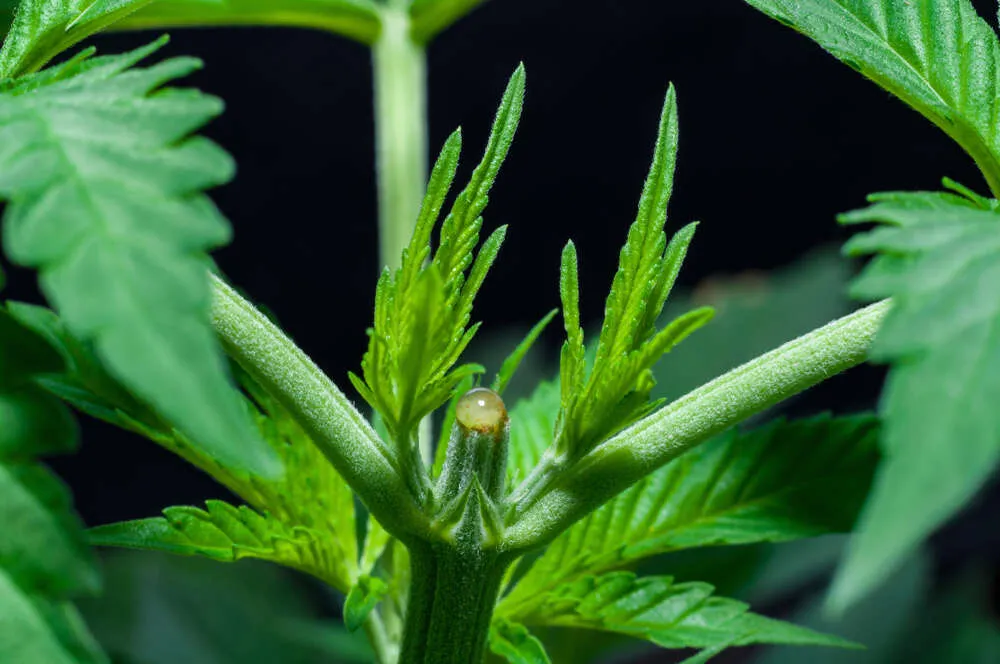
Topping cannabis means cutting off the growing tip at the top of the main stem of the cannabis plant. Growers call it a high-stress cannabis training technique because part of the plant is physically removed.
Cannabis naturally tends to put more growth into its main stem, a process known as apical dominance. If left alone, this often gives the plant a taller, Christmas-tree-like shape.
When you remove the main growing tip, the plant can put more growth into the side branches below the cut. The two shoots closest to the cut can then develop into new leading branches, helping create a shorter, wider plant with a flatter canopy.
For growers, the main benefit is greater control over plant height and shape.
Grower Tip: Think of topping as a way to shape your plant. It does not increase yield simply because you make a cut. Any yield benefit depends on how well the wider canopy is managed afterward.
When Should You Top a Cannabis Plant?
The best time to top a cannabis plant is during the healthy vegetative stage of cannabis, once it has developed enough structure to recover from the cut. Rather than relying on the plant’s age, look at its node development and overall health.
How Many Nodes Before Topping Cannabis?
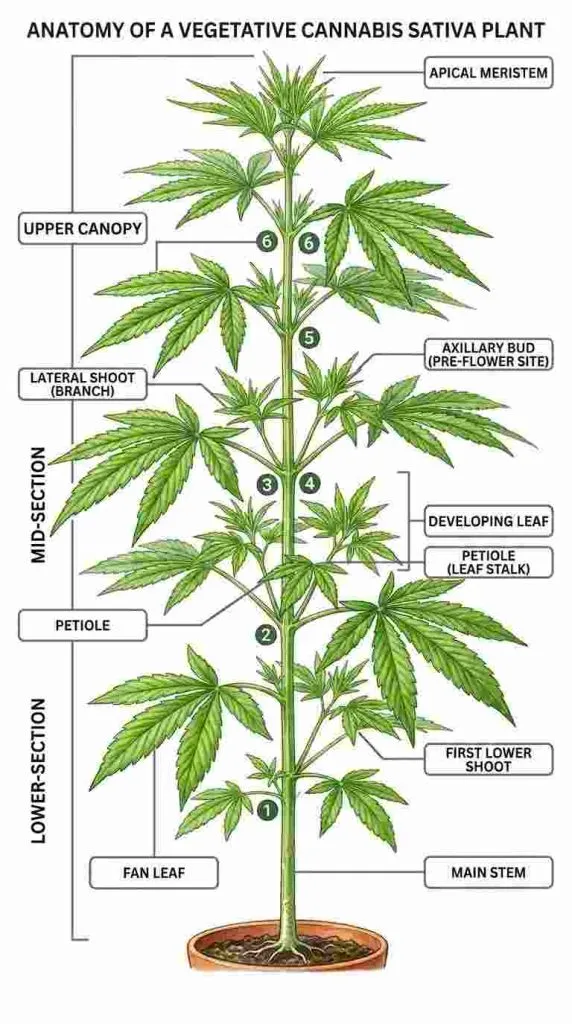
A node on a cannabis plant is the point on the main stem where a pair of leaves and side branches develops. For a first topping, around 4–6 established nodes is a useful general range for a healthy cannabis plant.
Some growers prefer to wait until the plant has developed more nodes before making the first cut. There is no single node number that works for every cultivar or growing environment, so plant health is just as important as node count.
Check Plant Health Before Topping
Before topping, look for signs that the plant is growing well:
| Check | What You Want to See |
| New growth | Active growth at the top and branches |
| Branches | Several established side branches |
| Leaves | Healthy-looking leaves without widespread discoloration |
| Pests or disease | No obvious signs of damage |
| Watering and nutrition | No major signs of stress |
When Should You Avoid Topping?
Avoid topping very young seedlings or plants that are already struggling. Wait if the plant is recovering from transplanting, nutrient problems, overwatering, underwatering, pests, or disease. Topping is also best completed during vegetative growth rather than once the plant has started flowering.
Grower Tip: If you are unsure whether your plant is ready, waiting for stronger, active growth is usually better than topping too early.
How to Top Cannabis Step by Step
If you are learning how to top cannabis for the first time, the process is simple: find the main growing tip, choose where you want to make the cut, remove it cleanly, and then give the plant time to recover.
Before you start, make sure the plant is healthy and growing actively.
| What You Need | What It Is For |
| Sharp pruning scissors or snips | Making a clean cut through the stem |
| Isopropyl alcohol | Cleaning your cutting tool |
| Healthy cannabis plant | A plant strong enough to recover from topping |
Step 1: Check That Your Plant Is Ready
Only top a cannabis plant during healthy vegetative growth. Look for around 4–6 established nodes, active new growth, healthy leaves, and several developing side branches.
A node is the point where leaves and branches grow from the main stem.
Do not top a plant simply because it has reached a certain age. If it looks stressed, recently transplanted, damaged, or is growing slowly, give it more time.
Step 2: Find the Main Growing Tip
Look at the very top of the plant and follow the main central stem upward. The small cluster of new leaves at the top is the main growing tip you will remove.
Now look just below it. You should see a node with two side shoots growing in opposite directions. These shoots can become the plant's new leading branches after topping.
Step 3: Clean Your Scissors
Wipe your scissors or snips with isopropyl alcohol and let them dry before making the cut.
Use a sharp tool so you can cut through the stem cleanly. Avoid pinching, crushing, or tearing it.
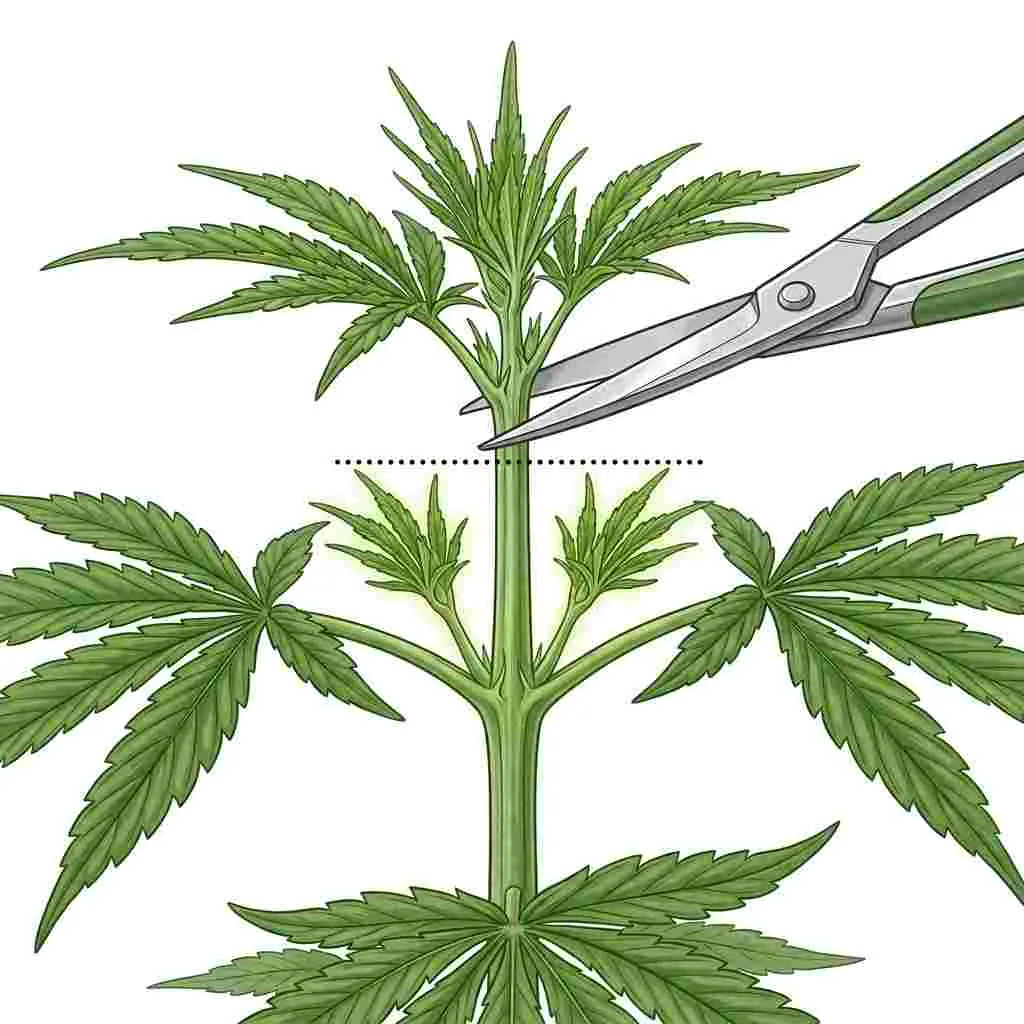
Step 4: Choose Where to Top
For your first topping, choose an established node with plenty of healthy growth beneath it.
You do not have to cut above one exact node. The important thing is to leave enough leaves and branches below the cut for the plant to continue growing strongly.
Step 5: Make the Cut
Position your scissors just above the node you have chosen.
Make one clean cut through the main stem, removing the growing tip. Be careful not to cut or damage the two shoots directly below it.
Once the top has been removed, these side shoots can begin developing as the new main growing points.
Step 6: Let the Plant Recover
Do not top the plant again immediately. Keep your normal watering, lighting, and environmental routine and give it time to return to active growth.
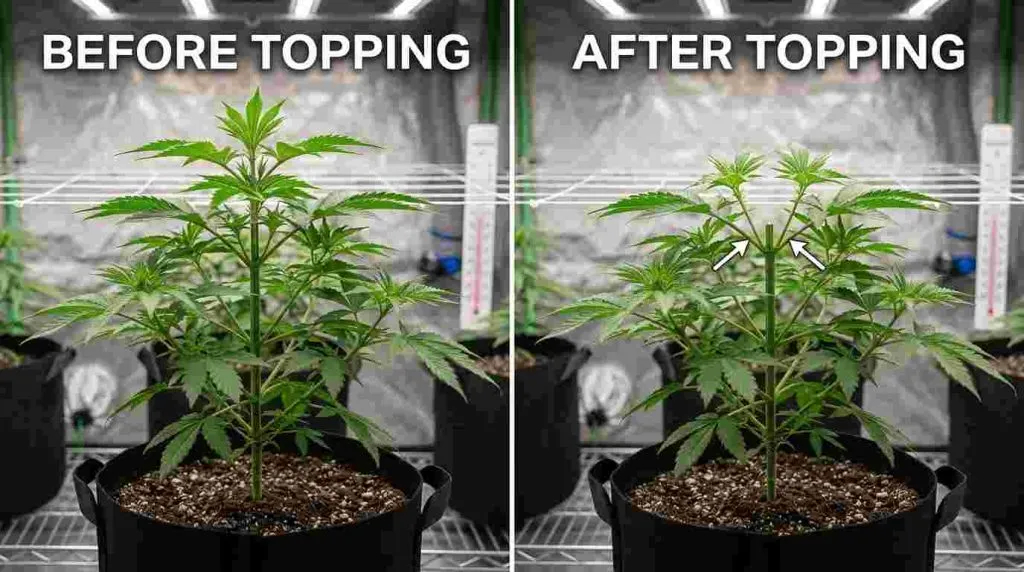
Over the following days, watch the two shoots beneath the cut. They should begin developing more strongly as the plant starts forming a wider structure.
Grower Tip: Take a photo before topping, another immediately afterward, and one several days later. This gives you an easy way to see how the new branches are developing and whether the plant has returned to healthy growth.
What Happens After Topping Cannabis?
After topping cannabis, the plant begins redirecting growth toward the side shoots below the cut. For a new grower, the main thing to watch for is healthy new growth, rather than expecting the plant to change shape immediately.
How Long Does Cannabis Take to Recover After Topping?
There is no exact recovery time. How quickly a plant responds can depend on its cultivar, age, health, growing conditions, where the cut was made, and whether it has recently undergone other training.
You may notice the two shoots beneath the cut beginning to grow more strongly within the following days, but developing a wider canopy takes longer.
| What to Watch For | Good Sign |
| New shoots | Steady growth beneath the cut |
| Leaves | Healthy color and normal posture |
| Overall growth | Plant has resumed active development |
When Can You Top Cannabis Again?
Do not top again according to a fixed number of days. Wait until the plant has clearly returned to active growth and developed healthy new branches.
Grower Tip: Let the plant show you when it has recovered. Strong new growth is a better guide than the calendar.
Does Topping Cannabis Increase Yield?
Topping can improve yield potential, but topping alone does not guarantee a larger harvest.
Growers use topping because removing the main growing tip encourages more lateral growth. This can create a flatter canopy with flowering sites spread more evenly beneath indoor grow lights, helping growers make better use of the available space.
| Topping Can Help With | Why It Matters |
| More lateral branches | Creates more potential flowering sites |
| Flatter canopy | Helps keep growth at a similar height |
| Light distribution | Can expose more of the canopy to available light |
| Height control | Makes taller plants easier to manage indoors |
Research supports the idea that topping changes cannabis plant structure, but the effect on yield is not always the same. One controlled study found that topped plants produced more inflorescence dry weight, while another found that some pruning methods increased yield and others had little effect. Results can vary by cultivar, pruning method, plant density, and growing conditions.
Important: More colas do not automatically mean more total yield. Plant health, light exposure, root space, nutrition, environment, and enough recovery time all influence the final harvest.
Grower Tip: Focus on creating a healthy, evenly lit canopy rather than simply trying to produce as many branches as possible.
Can You Top Autoflower Cannabis Plants?
Yes, you can top autoflower cannabis plants, but timing is more important than with photoperiod plants. Autoflowering cannabis plants usually have a shorter vegetative stage, which gives them less time to recover before flowering begins.
A fast-growing, healthy autoflower with strong vegetative growth is a better candidate for topping than a slow-growing, stressed, or very short-cycle plant.
| Better Candidate | Higher-Risk Candidate |
| Healthy, active growth | Slow or stressed growth |
| Enough vegetative time remaining | Flowering is close |
| Strong branch development | Weak or damaged plant |
For new growers, low-stress training autoflowers is often the easier option because it shapes the plant without removing the main growing tip.
If you want to compare topping with other more intensive methods, our guide to high-stress training autoflowers explains the main techniques and when they may be suitable.
Can You Top Cannabis During Flowering?
Topping is normally performed during vegetative growth rather than after the cannabis flowering stage has begun.
Once flowering starts, the plant is directing more of its energy toward developing flowers. Removing the main growing tip at this stage can force it to spend resources on healing and rebuilding its structure instead.
If height or canopy shape becomes a problem during flowering, less disruptive training methods are usually a better option than topping.
Grower Tip: Finish major topping work before flowering begins so the plant has time to recover and develop its new structure.
Topping vs FIMing vs LST
Topping, FIMing, and low-stress training all aim to change how a cannabis plant grows, but they use different methods.
| Method | Stress Level | What It Does | Best Suited To |
| Topping | High | Removes the main growing tip | Controlling height and creating new leading branches |
| FIMing | High | Partially removes the newest growth | Encouraging several new shoots |
| LST | Low | Bends and secures branches | Widening the canopy without cutting |
Topping vs FIMing
Topping removes the growing tip completely, while FIMing cannabis removes only part of the newest growth. FIMing can encourage several new shoots, but the result is often less predictable than a clean topping cut.
Topping vs LST
Low-stress training (LST) reshapes the plant by bending and securing branches rather than removing growth. It can help create a wider, more even canopy with less recovery stress than topping.
Grower Tip: New growers who are uncomfortable making a cut may find LST easier to learn first.
Common Cannabis Topping Mistakes
Most topping problems come from poor timing or adding stress when the plant is not ready.
| Mistake | Why It Can Cause Problems |
| Topping too early | Young plants have less established growth to support recovery |
| Topping a stressed plant | Adds more stress before the existing problem is resolved |
| Making a rough cut | Crushing or tearing the stem causes unnecessary tissue damage |
| Topping near flowering | Leaves less time for the plant to develop its new structure |
| Training again too soon | Adds more stress before active growth has returned |
Grower Tip: Do not rush repeated topping. Wait until the plant is clearly growing strongly again before deciding whether it needs more high-stress training.
Week-by-Week Example of Topping Cannabis
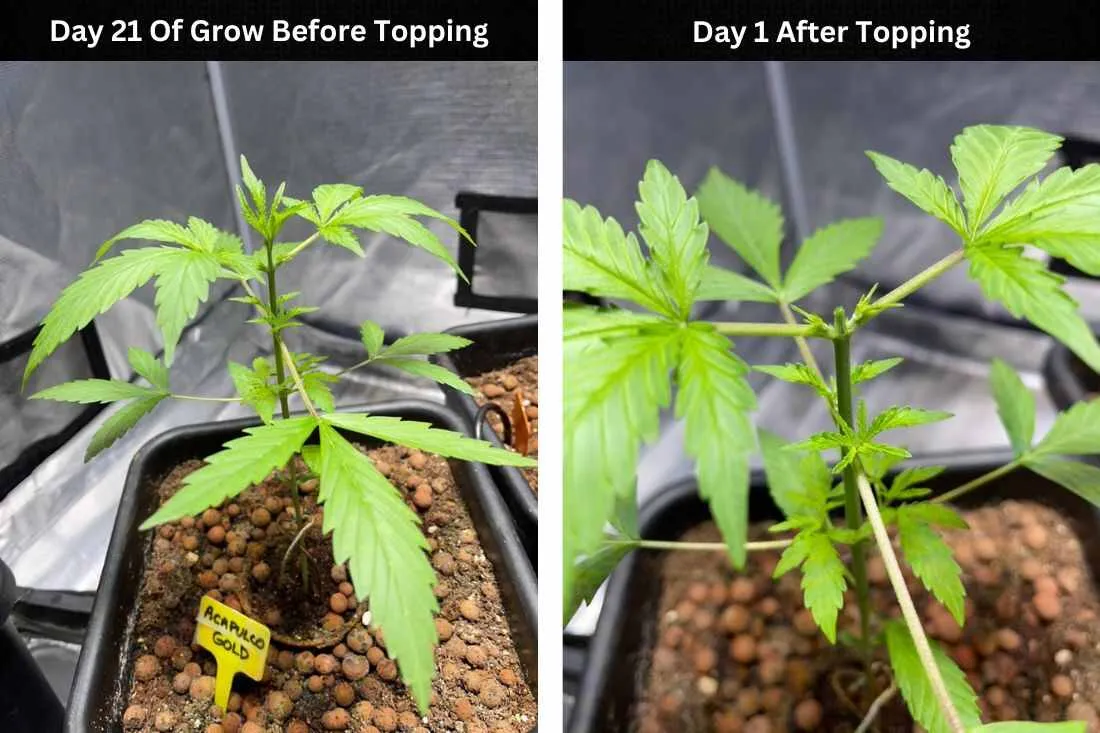
To show what topping cannabis can look like in practice, we tracked an Acapulco Gold Auto before and after topping.
We do not usually recommend topping autoflowering cannabis plants to new growers because their shorter vegetative stage gives them less time to recover before flowering begins. In this grow, however, the plant was healthy, growing actively, and had enough time left before flowering to respond well to the cut.
Strain: Acapulco Gold Auto
Day 1: Immediately After Topping
Before topping, the plant had an established main stem with healthy side growth. Once the growing tip was removed, the two shoots directly below the cut were left in place to develop into the new leading branches.
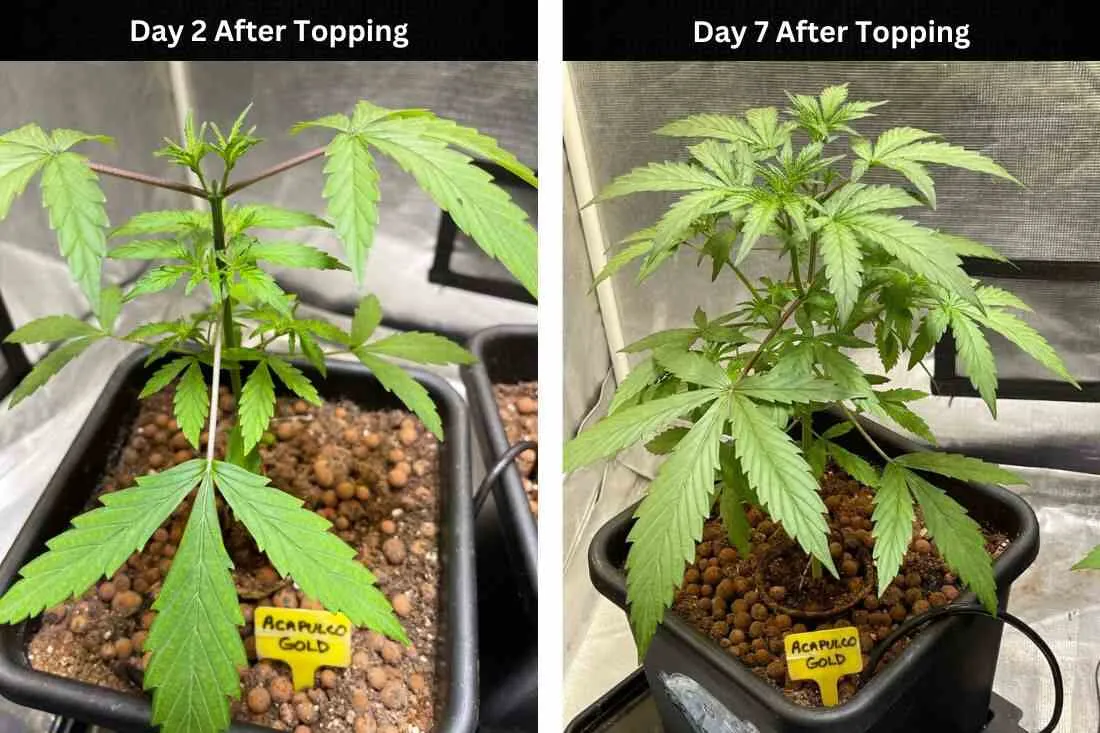
One Week After Topping
Seven days later, the plant had resumed active growth and the side shoots beneath the cut were developing more strongly. There were no obvious signs of prolonged stress in this example.
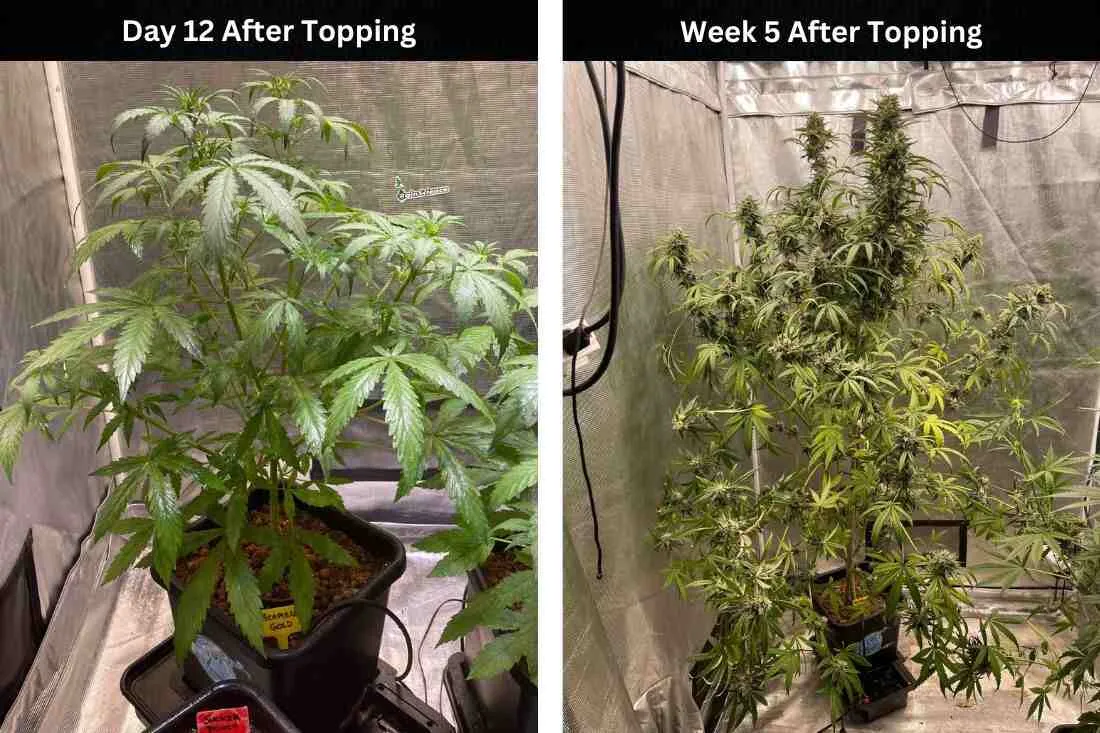
Day 12 to Week 5
By day 12 after topping, the plant had continued to increase in size and early signs of flowering were beginning to appear.
By week 5 after the cut, the plant was fully into flowering and several developed flowering sites were visible across the wider structure created after topping.
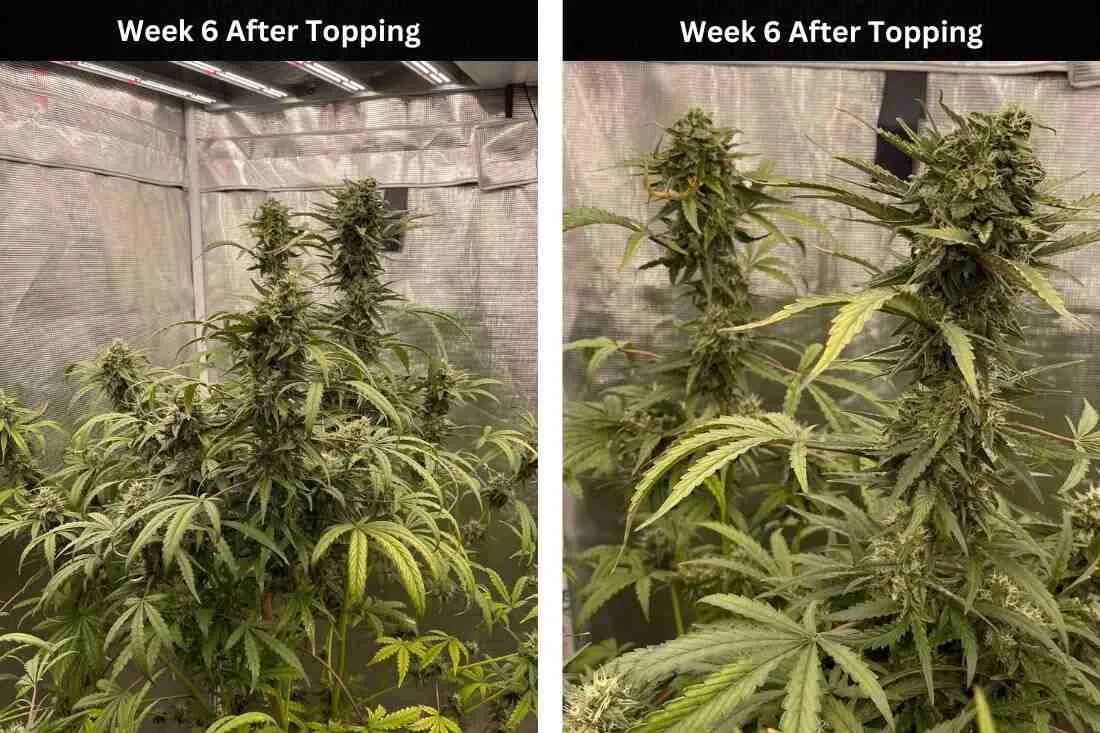
Week 6 After Topping
By week 6 after topping, flowering was well advanced and the plant had developed multiple mature bud sites rather than relying on one dominant central cola.
| Stage | What We Observed |
| Day 1 | Main growing tip removed with two shoots left below the cut |
| Week 1 | Active growth resumed and side shoots became more prominent |
| Day 12 | Plant continued developing as flowering approached |
| Week 5 | Multiple flowering sites were established |
| Week 6 | Flowering was well advanced across the wider canopy |
Grower Tip: This is one successful grow example, not a fixed recovery timeline. Autoflowers can respond differently depending on cultivar, plant health, growth rate, and when topping is performed.
Conclusion
Topping cannabis is a simple way to change how a plant grows by removing the main growing tip and encouraging more lateral development.
For new growers, the key is timing. Wait until the plant is healthy, actively growing, and has enough established nodes before making the cut. After topping, allow the plant to recover before adding more high-stress training.
Topping can help control height, create a flatter canopy, and improve how available light reaches different parts of the plant. However, it does not guarantee a larger harvest. Plant health, lighting, environment, nutrition, and canopy management all influence the final result.
If you are learning how to top cannabis for the first time, focus on making one clean cut and then watching how the plant responds.
Topping Cannabis FAQs
How many nodes should a cannabis plant have before topping?
A healthy plant is commonly topped once it has around 4–6 established nodes. However, there is no single node count that suits every cultivar or growing setup. Plant health and active vegetative growth are just as important as the number of nodes.
How long does a cannabis plant take to recover after topping?
There is no fixed recovery time. Some plants begin showing stronger lateral growth within several days, while others take longer. Recovery depends on cultivar, plant health, growing conditions, and whether the plant has recently undergone other training.
How many times can you top a cannabis plant?
There is no universal maximum. A plant can be topped more than once if it remains healthy and has enough vegetative time to recover between cuts. Wait for strong new growth before deciding whether to top again.
Is topping better than low-stress training?
Not necessarily. Topping removes plant tissue and creates more stress, while low-stress training reshapes the canopy by bending branches. Both can help control plant shape, so the better choice depends on the plant, available time, and grower experience.
Can topping cannabis increase the number of colas?
Topping can encourage the shoots below the cut to become new leading branches, which may create more prominent flowering sites. However, more colas do not automatically mean more total yield. The final harvest still depends on plant health, light, environment, and overall canopy management.


