




Learning how to supercrop autoflowers can help you create a more even canopy, improve light penetration, and strengthen branches when performed at the right stage of growth. Supercropping autoflowers is an advanced high-stress training (HST) technique that many experienced growers use to manage plant height, support heavier buds, and make better use of their growing space.
Because autoflowering cannabis plants have a short vegetative stage, timing is critical. Unlike photoperiod plants, autoflowers have a limited recovery window, so supercropping should only be performed on healthy, vigorous plants during early vegetative growth. When done correctly, this technique can strengthen stems, improve canopy structure, and help plants support larger flowers throughout the flowering stage.
In this guide, you'll learn how to supercrop autoflowers safely with a step-by-step walkthrough, discover the best time to perform the technique, understand the risks and benefits, and learn how combining supercropping with low-stress training (LST) can help you grow healthier plants and potentially improve your yields.
Key Takeaways
- Supercropping autoflowers is a high-stress training (HST) technique that involves gently crushing and bending stems to improve canopy structure and strengthen branch development.
- The best time to supercrop autoflowers is during the early vegetative stage, while plants are healthy, vigorous and have enough time to recover before flowering.
- Only supercrop healthy autoflowering plants, as stressed or slow-growing plants are less likely to recover successfully.
- The goal is to soften the inner stem without tearing the outer skin, allowing the plant to heal and form a strong supporting "knuckle."
- Combining supercropping with low-stress training (LST) can help create a more even canopy, improve light penetration and make better use of your grow space.
- Avoid supercropping once your autoflowers begin flowering, as recovery time is limited and excessive stress can reduce plant performance.
- Supercropping is an advanced technique that requires patience and careful timing. While it can help improve plant structure and potentially increase yields, genetics, lighting, nutrition and environmental conditions remain the biggest factors influencing your harvest.
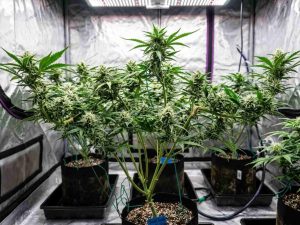
What Is Supercropping?
Super cropping is a plant training technique that requires gently twisting and snapping a plant's internode at the side branch or stem. The aim of supercropping is to gently crush the inner tissues of a stem while leaving the outer skin intact. The plant responds by repairing the damage with reinforced tissue, while the bent branch alters hormone distribution and helps create a more even canopy.
Where the break occurred, a wide, snakehead-shaped, solid wooden knuckle will develop. These knuckles create chunky, tough side branches capable of supporting more weight. The following explains how to supercrop autoflowering plants and why starting with vigorous high yielding autoflower strains can help you make the most of this advanced training technique.
Compared with topping, FIMing, low-stress training (LST) and selective pruning, supercropping is one of the more advanced training techniques because it intentionally damages plant tissue to encourage structural changes.
| Training Method | Stress Level | Suitable for Autoflowers | Skill Level |
| Low-Stress Training (LST) | Low | Excellent | Beginner |
| Leaf Defoliation | Low to Moderate | Good | Beginner |
| Supercropping | High | Suitable when timed correctly | Advanced |
| Topping | High | Less suitable for most autoflowers | Advanced |
| FIMing | High | Less suitable for most autoflowers | Advanced |
Can You Supercrop Autoflowers?
Yes, you can; however, you have to be very selective when super-cropping the plant due to the very short vegetative phase, and also consider the recovery time. Supercropping can be an effective technique for experienced growers, but because autoflowers have a short vegetative stage, the potential benefits must be weighed against the risk of slowing growth through unnecessary stress, but it needs to be done correctly. The more you learn about your autos, the easier it becomes to identify the right time to apply this technique alongside other forms of high stress training for autoflowers.
What Are the Advantages of Supercropping Autoflowers?
In my own grows, I only supercrop healthy, vigorously growing plants during early vegetative growth. I've found that strong plants usually recover quickly, whereas slower-growing plants often benefit more from low-stress training alone.
- The plant will produce thicker side branches and larger buds
- Supercropped plants appear more vigorous and robust
- Many growers report higher yields after successful supercropping because improved canopy structure can expose more flowering sites to light. However, results vary depending on genetics, plant health and growing conditions.
- The reinforced 'knuckle' that forms after healing often creates stronger branches that can support heavier flowers later in the flowering cycle.
- The technique is simple to do and costs nothing
What Are the Disadvantages of Supercropping Autoflowers?
Whilst super cropping is one of those techniques that can be extremely advantageous for plant growth and bud development, there are some disadvantages to consider.
- Weak plants can suffer a broken stem and fail to recover
- Severely damaged or already stressed plants may fail to recover after supercropping.
- Autos can grow stunted if supercropped too late
- Some autoflowering strains will adapt better than others
When Is the Best Time to Supercrop Autoflowers?
Knowing when to train your autos is beneficial for recovery time and avoiding stunted growth. If you're aiming to maximize autoflower yields, timing every training technique correctly is essential. You will have a very short window to perfect the supercropping technique, and it will be during the early vegetative stage.
Below are the breakdowns of why you should only supercrop during vegetation and when you should consider avoiding supercropping your autos.
| Growth Stage | Recommendation | Reason |
| Seedling (Weeks 1–2) | Not recommended | Plants are establishing roots and stems are too soft. |
| Early Vegetative (Weeks 2–3) | Best time to supercrop | Plants recover quickly and have time to continue growing. |
| Late Vegetative | Suitable for vigorous plants | Recovery time is shorter before flowering begins. |
| Pre-Flower | Generally avoid | Plants are shifting energy towards flower production. |
| Flowering | Not recommended | Recovery is slower and bud development may be affected. |
Why the Early Vegetative Stage Is the Safest Window to Supercrop Autos
I always say that if you are growing autoflowering cannabis plants or photoperiod, to always do all your training during the vegetative window. The reason is that your plants are only producing foliage, stems and new growth shoots.
It is during this stage that your plants have the best chance to recover and bounce back without suffering slow recovery, stunted growth, or producing dwarf-sized plants. Once flowering begins, the plant shifts more of its energy towards flower production. Applying high-stress training during this transition can slow recovery because the plant has less time to replace damaged tissue before bud development accelerates.
This is why cannabis plants stretch and transition from vegetation to bloom. Applying high-stress training, such as super cropping, can disrupt the transition stage and affect growth rate and flower production.
When Should You Avoid Supercropping Autoflowers?
Avoid supercropping once your autos show signs of transitioning into flower. The internodal distance will stretch, and small white pistils will appear, indicating the first wave of pre-flowers.
- Supercropping during the flower will cause stress
- Plants may recover slowly with stunted growth
- Yields may be significantly affected
- Plants may grow short
- Stress may cause hermaphrodism
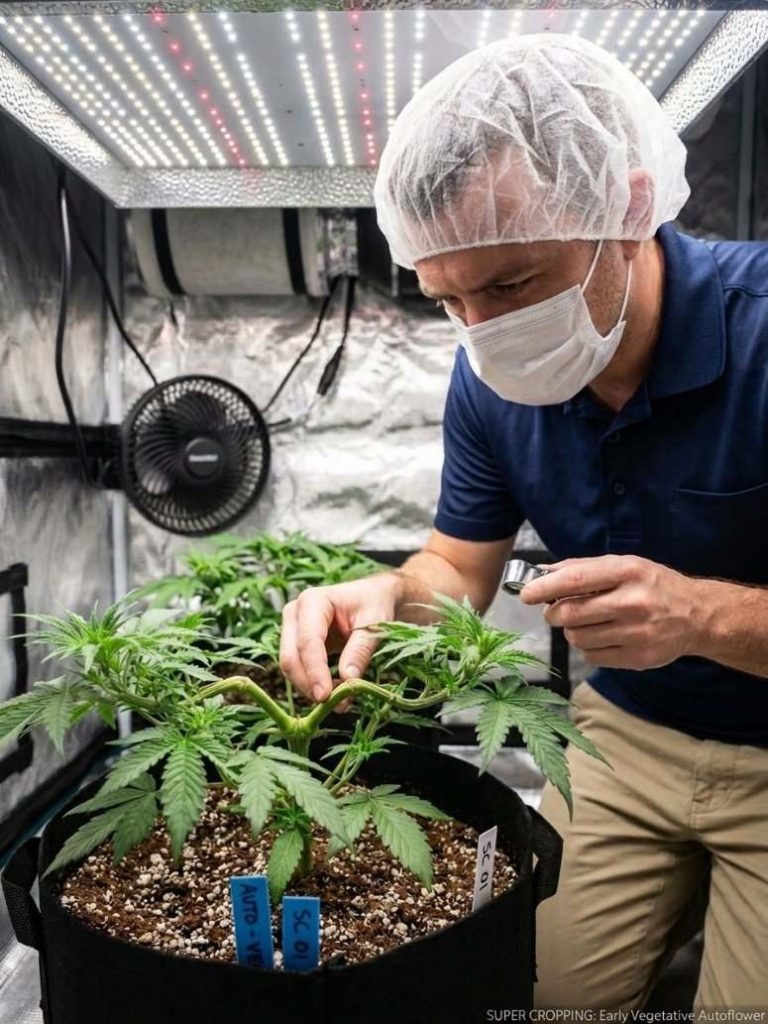
How to Supercrop Autoflowers Step by Step
Supercropping autoflowers requires a lighter touch than supercropping photoperiod plants. Autoflowers begin flowering according to age rather than a change in the light cycle, so they have less time to recover if the stem is badly damaged. Only use this technique on a healthy, vigorously growing plant that is still in its vegetative stage.
There is limited controlled research specifically testing supercropping on autoflowering cannabis. Most recommendations are based on experienced grower practice and the broader scientific understanding that plants alter their growth in response to mechanical stimulation.
Step 1: Check That the Autoflower Is Ready
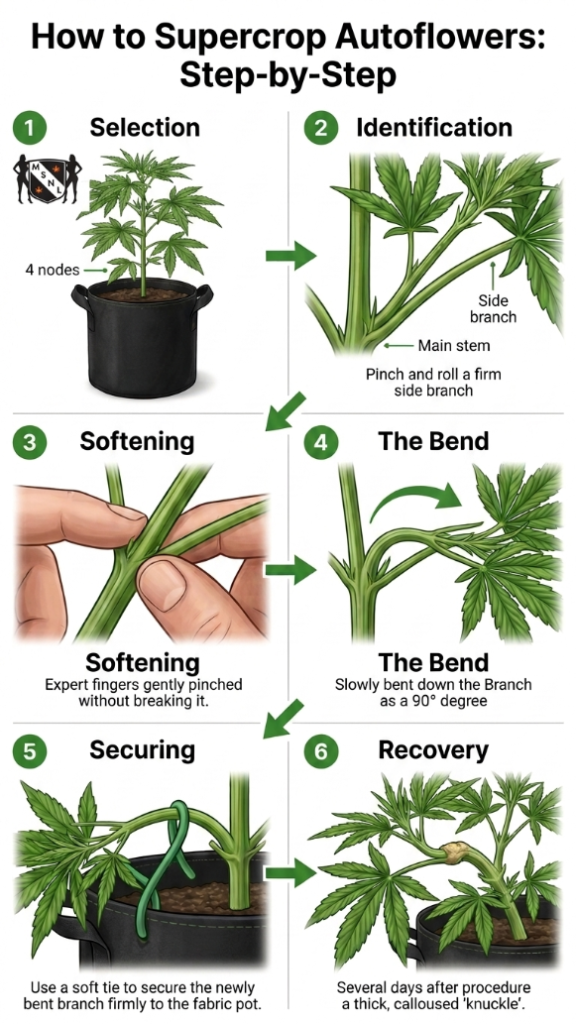
Wait until the plant is growing vigorously and has developed several established nodes and side branches. The stem should be green and flexible but firm enough to resist light pressure.
Do not supercrop:
- Seedlings with thin, delicate stems
- Plants that are growing slowly
- Plants showing nutrient deficiencies, pest damage or water stress
- Autoflowers that have started producing clear pre-flowers or stretching into bloom
Autoflowers can begin flowering only a few weeks after germination, although the exact timing varies by cultivar and growing conditions. This short vegetative period is why the training window is limited.
Step 2: Choose One Suitable Stem
For a first attempt, select one healthy upper side branch rather than training the whole plant. Choose a section that is:
- Green rather than woody
- Firm but still pliable
- Free from splits, lesions or previous damage
- Long enough to bend without touching the growing medium
Avoid the soft growth directly beneath the newest leaves. It tears easily and may not be developed enough to form a controlled bend. Also avoid the hard, woody base of the main stem, which is more likely to snap than fold.
The aim is to lower a tall branch so that it sits closer to the rest of the canopy. Grower guidance generally recommends working with mature but still flexible green stems.
Step 3: Select the Bending Point
Choose a bare section of stem between two nodes. Leave enough space above and below your fingers so you do not crush a node, leaf stalk or developing shoot.
A suitable point is usually a few centimetres below the tip of the branch, where the stem has enough length above it to be repositioned. Select the exact point according to the shape of the plant rather than following a fixed measurement.
Before applying pressure, decide which direction the branch will bend. It should move into open space instead of covering another growing tip.
Step 4: Soften the Inner Stem
Hold the selected section between your thumb and forefinger. Gently squeeze and roll the stem between your fingers for several seconds.
Gradually increase the pressure until the inner tissue feels softer and the stem becomes easier to move. Work slowly. You may feel a slight internal give, but you should not hear a sharp snap or tear through the outer surface.
The objective is to compress the inner tissue while keeping the outer layer of the stem as intact as possible. Do not twist the branch forcefully or attempt to break it in a single movement.
Step 5: Bend the Branch Carefully
Once the stem feels pliable, slowly bend the branch towards the open area of the canopy. Support the stem with your other hand so the pressure remains concentrated at the softened point.
A controlled bend of approximately 45–90 degrees is normally enough. Stop immediately if:
- The outer stem begins to tear
- The branch resists strongly
- The bend starts moving towards a node
- The entire branch feels as though it may detach
After bending, the branch will usually hang down or remain roughly horizontal. Some drooping immediately afterwards is normal.
Step 6: Secure the Branch if Needed
The branch may begin lifting itself back towards the light. Use a soft plant tie to hold it in the intended position when necessary.
Attach the tie loosely so it does not cut into the stem as the branch thickens. Secure the other end to the edge of the pot or another stable support.
Avoid thin string, bare wire or tight zip ties because they can damage the outer stem. Soft garden ties are easier to adjust as the plant grows.
Step 7: Check for Splitting
Inspect the bending point immediately.
If the outer skin remains intact, leave the branch alone and allow it to recover. If there is a small split but the branch is still attached, gently close the wound and wrap it with plant-repair tape or clean grafting tape.
Support a badly weakened branch with a soft tie, bamboo cane or small splint. The tape should hold the damaged surfaces together without tightly constricting the stem.
A branch that has become completely detached cannot be reliably repaired and should be removed cleanly.
Step 8: Allow the Autoflower to Recover
Avoid further high-stress training while the plant heals. Keep its normal watering, lighting and feeding routine consistent rather than attempting to stimulate recovery with extra water or nutrients.
Check the branch once or twice each day. During a successful recovery, you should see:
- The leaves remaining green
- The tip beginning to turn upwards towards the light
- Continued growth above the bend
- The damaged area gradually becoming firm and swollen
Initial improvement may be visible within one or two days, while the reinforced knuckle can take longer to develop. Recovery speed varies with plant health, genetics and environmental conditions, so avoid promising a fixed recovery period.
Step 9: Remove or Loosen Supports
Once the branch can support itself, loosen or remove the tie. Check taped areas regularly to ensure the wrapping is not restricting the expanding stem.
Remove the tape only after the wound has closed and the branch feels stable. If the branch still bends excessively at the damaged point, leave the support in place and check it again after several days.
Step 10: Avoid Repeating the Technique Too Soon
Because autoflowers have a limited recovery window, allow the plant to resume vigorous growth before considering any additional training. One carefully selected bend may be enough to level the canopy.
Do not repeatedly crush the same section of stem. Further canopy adjustments are better made with low-stress training, using soft ties to reposition healthy branches without creating another wound.
Supercropping does not guarantee a larger harvest. Its main practical purpose is to manage plant height, reposition dominant branches and create a more even canopy. Any effect on yield will also depend on genetics, lighting, root health, nutrition and the wider growing environment.
Repair if Necessary
The only downside to supercropping cannabis plants is that when things go wrong, you need to act fast and be ready to repair the botched supercrop attempt. The only times you will find plants that do not react well to supercropping are when the stem is not mature or hard enough to withstand a twist and break, or when the plant is not healthy.
- Twist wire around the open slit and wait 1–2 weeks before removing it
- Cut off any wilted or dead-looking growth after supercropping
- Use bamboo canes and gardening wire to create support
Why Supercropping Works Best with Low-Stress Training Methods
We all know how simple and effective the low-stress technique can be for autoflowering plants. Tying plants down with thick gardening wire and supercropping is just one of several techniques growers use to improve plant structure and maximize yields. Combining it with methods such as lollipopping autoflowers or SCROG training for autoflowers can further improve canopy management.
LST refers to the low-stress technique, which allows plants to grow with a bushy, top-heavy canopy. All of the primary and secondary colas are large sized and well developed. Many growers who want to get their most out of their grow space will implement the LST technique.
- LST allows the structure and shape to be changed, producing bigger yields
- LST can be done several times during the vegetative stage
- LST does not cause high stress levels, meaning plants can quickly recover
Many experienced growers combine LST with selective supercropping to create a flatter canopy, improve light penetration, and maximize the use of grow space. When timed correctly, this combination can produce more consistent yields than either technique alone. The stem will be thick and round, the side branches will appear strong and woody, and the amount of weight from buds your autos will be able to support will be increased.
Mistakes to Avoid When Supercropping Autoflowering Cannabis Plants
Before you go ahead and try supercropping for the very first time, make sure you understand when to defoliate autoflowers and avoid combining too many training techniques at once.
- Using young and softwood plants
- Not allowing the plant to recover
- Using too much pressure
- Tearing an open slit in the stem
- Leaving wilted growth to stay on the plant
| Common Mistake | Potential Result | Best Practice |
| Supercropping too early | Soft stems may split or fail to recover | Wait until the plant has developed sturdy stems during vegetative growth. |
| Supercropping too late | Reduced recovery time before flowering | Complete high-stress training before the pre-flowering stage. |
| Applying excessive pressure | The stem may tear instead of bending | Gently soften the stem before making the bend. |
| Training unhealthy plants | Slower recovery and reduced growth | Only train healthy, vigorously growing plants. |
| Not supporting damaged stems | Branches may collapse during healing | Use soft plant ties or garden tape to support damaged stems until they recover. |
Frequently Asked Questions
Below are the most frequently asked questions about supercropping autoflowering cannabis.
Does Supercropping Autoflowers Increase Yield?
It can help increase yields and produce sturdy, robust, and resilient plants.
Is Supercropping Too Stressful for Autoflowers?
As long as your auto is healthy and strong, supercropping is not too stressful, but it must be performed at the right time.
How Long Does It Take an Autoflower to Recover from Supercropping?
Most healthy autoflowers begin recovering within a few days, although complete healing and the formation of the characteristic “knuckle” usually takes between 5 and 10 days depending on the plant's vigor and growing conditions.
Can You Supercrop an Autoflower During Flowering?
Doing so will only cause stress and potentially damage the plant, resulting in slow growth and a potential hermaphrodite.


