




Godfather OG is a high-potency cannabis strain with a reputation built around one famous question: is it really one of the strongest strains ever tested?
That reputation came from a Godfather OG sample reported at 34.04% activated THC in High Times' 2017 potency rankings. It was an exceptional result, but it should not be treated as the standard for every plant. THC levels can vary with genetics, phenotype, growing conditions, harvest timing and testing methods.
There is also more to Godfather OG than strength. It is an indica-dominant hybrid with a compact growth pattern, heavy resin production and a rich mix of earthy, piney, spicy and sweeter fruit notes. From a grower's point of view, it responds well to topping, canopy training and SCROG, although dense growth means airflow and humidity need some attention later in flowering.
In this Godfather OG strain review, we'll look at its potency, genetics, taste, aroma, effects and growing characteristics, while separating documented facts from the claims that have built up around the strain over the years.
Key Takeaways
- Godfather OG is known for very high THC potential, but the famous 34.04% result came from one tested sample and should not be viewed as a guaranteed figure.
- It is generally classed as an indica-dominant hybrid, with most plants developing a relatively compact structure and strong lateral branching.
- The flavor is more complex than its potency reputation suggests, with common notes of earth, pine, spice, grape and citrus.
- Godfather OG responds well to training, including topping, low-stress training and SCROG, although dense flowers make good airflow important during late bloom.
- It is better judged as a complete strain rather than simply a THC record-holder, because phenotype, cultivation and chemical variation can all affect the final plant.
What is the Godfather OG Strain?
Godfather OG is generally described as an indica-dominant hybrid with the dense structure and relaxing character commonly associated with many Indica cannabis strains.
Its exact history is less straightforward.
One commonly reported version combines XXX OG with Alpha OG. However, the Godfather OG tested by High Times in its 2017 potency rankings was listed as Cherry Pie × Granddaddy Purps × OG Kush. This is worth knowing because cannabis strain names are not always genetically standardized.
Research into cannabis chemistry has found considerable variation between plants carrying the same cultivar name, particularly in terpene composition.[1] That makes it more useful to judge the particular seed line or plant in front of you than assume every version of Godfather OG will be genetically identical.
For the version covered here, Godfather OG Feminized is bred as a feminized photoperiod line with an indica-leaning structure, medium height and high THC potential.
How Strong Is Godfather OG?
Godfather OG unquestionably belongs in the conversation around high THC cannabis strains, but the famous 34.04% figure needs some context.
High Times reported that a Godfather OG sample tested by Canna Safe Analytics reached 34.04% activated THC. Activated THC was calculated using the formula:
(THCA × 0.877) + THC
The result was enough to put Godfather OG at the top of the publication's 2017 potency rankings.
That doesn't mean every plant will reach 34%.
Cannabinoid production depends on genetics, phenotype, light intensity, nutrition, plant health, harvest timing and testing methodology. Studies examining cannabis chemistry have also found meaningful differences between samples and cultivars.[3]
The seed line covered in this review is listed at up to 33% THC, which should still be treated as genetic potential rather than a guaranteed result.
In other words, Godfather OG can be extremely potent, but chasing a particular percentage is probably the wrong way to judge the plant.
Is Godfather OG Just About THC?
No.
One of the problems with judging cannabis purely by THC percentage is that it tells you relatively little about aroma, flavor, plant structure or the overall experience.
Personally, those are the things that make Godfather OG interesting.
The flowers I've encountered have had a heavy OG character without tasting one-dimensional. There is plenty of earth and pine, but sweetness starts to come through as the flower is broken apart, followed by grape, citrus and spice.
That's far more memorable to me than simply saying it is strong.
What Does Godfather OG Smell Like?
Godfather OG has a deep, unmistakably earthy smell.
Pine is one of the first aromas I notice, followed by the spicy, slightly sharp character common to a lot of OG varieties. Break the flower apart and sweeter notes become easier to pick out. Depending on the phenotype, that can move towards grape, citrus or an almost candied fruit smell.
It isn't a particularly discreet strain once flowering gets going.
The smell develops strongly as the flowers mature, so growers working indoors should plan their odor control before plants reach late flowering rather than trying to solve the problem afterwards.
Terpenes play a major role in these differences. Research has shown substantial variation in terpene profiles between cannabis plants, including plants sold under the same cultivar name.
Our guide to what terpenes do in weed explains how compounds including limonene, myrcene, caryophyllene and pinene contribute to cannabis aroma and flavor.
What Does Godfather OG Taste Like?
The sweetness tends to arrive first for me, but it doesn't stay that way for long.
Earthy and savory flavors quickly take over, followed by pine and a slight grape-like sweetness on the finish. Some plants can also bring a brighter citrus edge.
A good dry and cure makes a noticeable difference.
When properly finished, the smoke can become much smoother and the sweeter parts of the flavor are easier to pick apart. Rushing this stage tends to flatten the aroma and leave more of the rough, green taste associated with poorly finished flower.
If you're growing your own crop, our guide on how to cure cannabis properly covers the process in more detail.
What Are the Effects of Godfather OG?
Godfather OG is usually described as having a strong initial cerebral effect followed by heavier physical relaxation.
That broadly matches my own experience.
The beginning can feel upbeat and mentally noticeable before gradually becoming calmer and much more body-focused. With larger amounts, the relaxing side becomes considerably more pronounced.
That makes it a strain I'd generally associate with the end of the day rather than something I'd choose before work or anything requiring sharp concentration.
There are downsides.
High-THC cannabis can be uncomfortable for people with low tolerance, particularly when consumed too quickly. Possible unwanted effects can include dizziness, anxiety, impaired coordination and excessive sedation.
If you're new to high-potency cannabis, Godfather OG deserves some respect. More THC doesn't automatically mean a better experience.
{{block class="FishPigExtend\Wordpress\Block\Product\Related" sku="GOD-F010"}}
What Is Godfather OG Used For?
You will often see Godfather OG described online as a strain for sleep, pain, stress or appetite. Those descriptions should be treated carefully.
There is research into cannabinoids for chronic pain and sleep, but that is not the same as proving that Godfather OG itself treats a medical condition.
A 2025 systematic review of randomized trials found that some THC-containing cannabinoid products may produce small reductions in chronic pain, but they were also associated with increased dizziness, sedation and nausea.[4]
Research into cannabis and sleep is similarly mixed. A systematic review found some evidence of small improvements in sleep among people with chronic pain, while also noting increased risks of effects such as dizziness, fatigue and somnolence.[5]
These studies used different cannabinoid preparations and were not trials of Godfather OG.
For that reason, I wouldn't describe the strain as a treatment for insomnia, anxiety, depression or chronic pain. It is more accurate to say that many consumers associate high-THC, indica-leaning cannabis with strong relaxation and evening use, while individual reactions can vary considerably.
What is the Godfather OG Terpene Profile?
Godfather OG is commonly associated with terpenes such as:
- Limonene – citrus-like
- Beta-caryophyllene – peppery and spicy
- Myrcene – earthy and herbal
- Pinene – pine-like
- Linalool – floral
I wouldn't treat that list as a fixed chemical recipe.
A study examining plants from 32 cannabis seed sources found considerable terpene variation both between cultivars and between plants carrying the same cultivar name.
Another controlled study examining terpene levels in cannabis plants found around 20% variability among several commonly measured terpenes even when plants were grown under controlled conditions and harvested at the same time.
So if you want to know the precise terpene profile of a particular Godfather OG harvest, laboratory analysis is more useful than a generic strain description.
Is Godfather OG Indica or Sativa?
Godfather OG is generally sold as an indica-dominant hybrid, with this version listed around 60% indica and 40% sativa.
That classification fits the way most of the plants I've grown have behaved.
They stayed reasonably compact, produced close internodal spacing and developed plenty of lateral growth.
I did, however, get one plant that stretched considerably more than the others and took slightly longer to finish.
That's a useful reminder that seed-grown cannabis can show phenotype variation even when the plants share the same parents.

How to Grow Godfather OG
Godfather OG is a photoperiod cannabis seeds, which gives you plenty of control over how long the plant remains in vegetative growth before flowering.
I grew four plants indoors and six outdoors. Most developed in a fairly similar way, although one showed noticeably taller, more sativa-like growth.
I wouldn't call Godfather OG completely "plant and forget," because the best plants benefited from some canopy work.
Step 1: Let the Plant Establish Itself
Give young plants time to develop a healthy root system and several full nodes before applying high-stress training.
Godfather OG naturally develops fairly tight internodal spacing, so shaping the plant early can help prevent the center becoming crowded later.
Step 2: Top During Vegetative Growth
I topped my plants after the fourth node and again once they had developed further.
The outdoor plants had enough recovery time for an additional topping, while the indoor plants were topped twice.
You don't need to follow that exact schedule. Plant health matters more than counting days.
Our guide to when and how to top cannabis explains when a plant is developed enough to handle the technique safely.
Step 3: Open Up the Canopy
Godfather OG responds well to having its branches spread outward rather than being allowed to grow as one dense central mass.
Low-stress training works well here.
I also had good results using selective super cropping on the larger branches. I wouldn't super crop every stem; the aim is to improve canopy shape without putting the whole plant through unnecessary stress.
Step 4: Use a SCROG Net Indoors
Before flowering, I placed a SCROG net across the indoor plants and continued spreading branches outward.
This helped make better use of the available horizontal space and stopped the tighter growth from stacking too heavily in the center.
Aim for an even canopy rather than forcing every empty square of the net to be filled.
Step 5: Watch Humidity as Flowers Thicken
The flowers become dense later in bloom.
Good airflow becomes increasingly important as buds gain weight, particularly inside the plant where leaves and branches overlap.
Avoid allowing dead leaves or weak lower growth to remain trapped inside a crowded canopy.
Step 6: Don't Rush Harvest and Curing
Potency shouldn't be the only factor deciding harvest time.
Watch flower maturity and trichome development rather than simply harvesting on a fixed calendar date.
Once harvested, dry the flowers gradually and give them enough curing time for the aroma and flavor to develop properly.
What Does Godfather OG Look Like?
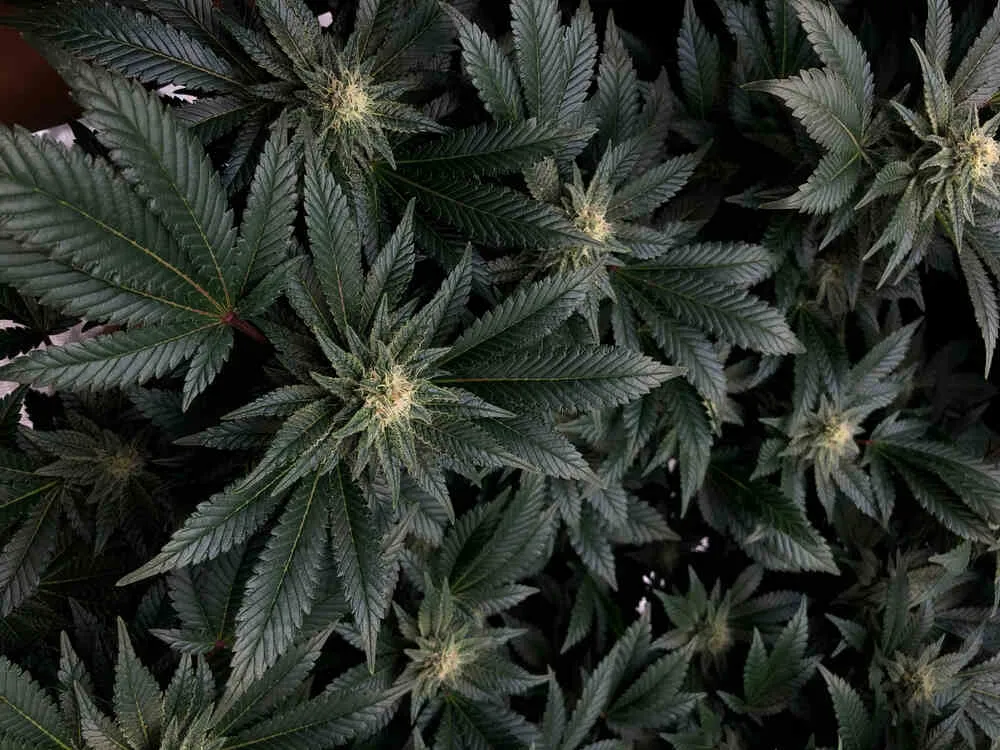
Godfather OG can be a particularly attractive plant as flowering progresses.
Most plants begin with fairly conventional dark green foliage, but colder conditions and phenotype differences can bring out purple and reddish shades in the flowers and surrounding leaves.
The contrast between darker flower tissue, orange pistils and a heavy resin coating can make mature buds visually impressive.
Not every plant will show strong purple coloration, though.
Color expression is influenced by genetics and environmental conditions, so I wouldn't grow Godfather OG purely on the expectation that every plant will turn purple.
Is Godfather OG Easy to Grow?
I'd put Godfather OG in the beginner-to-intermediate range.
It isn't especially difficult, and the plants I've grown responded well to training. The main things to watch are canopy density, humidity during late flowering and the amount of stress applied during vegetative growth.
A first-time grower could handle it, but you'll get more from the plant if you're comfortable with basic canopy management.
Is Godfather OG Really the World's Strongest Strain?
Not in any permanent or scientifically useful sense.
A Godfather OG sample genuinely topped High Times' 2017 potency rankings at a reported 34.04% activated THC.[2] That's an impressive result and an important part of the strain's history.
But it was one tested sample.
Cannabis chemistry varies between plants, environments, harvests and testing laboratories. New cultivars have also appeared since 2017 with similarly extreme potency claims.
So I'd describe Godfather OG as one of the strains that helped define the high-THC era, rather than claiming that it remains the strongest cannabis strain in the world.
That distinction doesn't make it any less interesting.
Godfather OG still combines unusually high potency potential with compact growth, heavy resin production and a flavor profile that has more going on than its headline THC figure suggests.
For me, that's a better reason to grow it than chasing a record.
Conclusion
Godfather OG built its reputation on extreme potency, but there is more to the strain than a headline THC figure.
The best examples combine strong effects with dense growth, heavy resin production and a layered mix of earth, pine, spice and sweeter fruit notes. It also responds well to training, making it a practical option for growers who want to shape an even canopy rather than deal with excessive stretch.
The famous 34.04% THC result helped put Godfather OG on the map, but it should be viewed as one exceptional tested sample rather than a guarantee. Genetics, phenotype, growing conditions and testing methods all influence the final cannabinoid profile.
For me, Godfather OG is most interesting when judged as a complete strain rather than simply as a potency contest winner.
Frequently Asked Questions
How strong is Godfather OG?
Godfather OG is considered a very high-THC strain. A sample featured by High Times in 2017 reportedly tested at 34.04% activated THC. That was a specific competition sample, so individual plants should not be expected to reach the same figure. Potency can vary with genetics, phenotype, environment and harvest conditions.
Is Godfather OG indica or sativa?
Godfather OG is generally classed as an indica-dominant hybrid, often listed around 60% indica and 40% sativa. Most plants tend to show relatively compact growth, although individual phenotypes can stretch more or take slightly longer to finish.
What does Godfather OG taste like?
Godfather OG usually combines earthy, piney and spicy flavors with sweeter notes of grape and citrus. The exact balance can vary between plants. A careful dry and cure can also make a noticeable difference to how clearly those flavors come through.
Is Godfather OG difficult to grow?
Godfather OG is reasonably manageable for growers who understand basic environmental control and plant training. It responds well to topping, low-stress training and SCROG. The main areas to watch are canopy density, airflow and humidity as the flowers become heavier later in bloom.
Is Godfather OG really the strongest strain in the world?
It would be difficult to call any strain the world's strongest with certainty. Godfather OG earned that reputation after a sample topped High Times' 2017 potency rankings, but cannabis chemistry varies between plants and new high-THC cultivars continue to appear. It is more accurate to describe Godfather OG as one of the strains that became famous for exceptional potency.
References
1. Booth JK, et al. (2020). Terpene Synthases and Terpene Variation in Cannabis sativa. Plant Physiology. Researchers found substantial terpene variation both between cultivars and among plants obtained under the same cultivar names. View study on PubMed
2. High Times (2017). The Strongest Strains on Earth 2017. Reports the Godfather OG competition sample at 34.04% activated THC and explains how the figure was calculated. Read the High Times report
3. Fischedick JT, et al. (2015). Development and Validation of a Reliable and Robust Method for the Analysis of Cannabinoids and Terpenes in Cannabis. Journal of AOAC International. Demonstrates analytical methods for cannabinoids and terpenes and discusses chemical variability among cannabis samples. View study on PubMed
4. McDonagh MS, et al. (2025). Cannabis-Based Products for Chronic Pain: An Updated Systematic Review. Annals of Internal Medicine. Found that some THC-containing cannabinoid products may slightly reduce pain but can increase adverse effects including dizziness, sedation and nausea. View study on PubMed
5. Wang L, et al. (2021). Medical cannabis and cannabinoids for impaired sleep: a systematic review and meta-analysis of randomized clinical trials. Sleep. Found small improvements in sleep outcomes in some chronic-pain populations, alongside increased adverse effects. View study on PubMed
6. Giovannoni S, et al. (2023). Determination of variability of terpenes and terpenoids in Cannabis sativa. Journal of Chromatography A. Reported measurable terpene variation among plants grown under controlled conditions. View study on PubMed

