




Terpenes are aromatic compounds that give cannabis its distinctive citrus, pine, fruity, floral, earthy, and spicy scents. While terpenes in cannabis are best known for shaping aroma and flavor, they also play roles in plant defense and are being studied for possible interactions with cannabinoids such as THC and CBD.
Unlike THC, cannabis terpenes do not produce an intoxicating high on their own. Research into their potential effects is growing, but much of the evidence remains preclinical, so claims about specific medical benefits or guaranteed effects should be treated cautiously.
In this guide, we explain what terpenes are in cannabis, what they do in weed, how they differ from cannabinoids, the most common terpenes growers encounter, and what current research tells us about their potential effects.
Key Takeaways
- Terpenes are aromatic compounds that give cannabis cultivars much of their characteristic smell and flavor.
- Terpenes and THC are different compounds. THC is intoxicating, while terpenes do not produce a THC-like high on their own.
- The main terpenes in cannabis include myrcene, limonene, pinene, linalool, beta-caryophyllene, humulene, and terpinolene.
- Researchers are investigating whether cannabis terpenes can influence cannabinoid activity, but the entourage effect remains a hypothesis and human evidence is still limited.
- For growers, genetics sets the potential terpene profile, while temperature, harvest timing, drying, curing, and storage can affect how much aroma and flavor is preserved.
What are terpenes in cannabis, and where do they come from?
Terpenes are aromatic organic compounds found throughout the plant kingdom, including cannabis. They are responsible for many of the citrus, pine, fruity, floral, earthy, and spicy aromas associated with different cultivars and also contribute to the flavor of the finished flower.
In cannabis, terpenes are produced mainly in glandular trichomes, the resin glands found in the highest concentrations on the flowers and surrounding sugar leaves. These trichomes also produce cannabinoids such as THC and CBD, although terpenes and cannabinoids are different types of compounds.
A plant's genetics largely determines which terpenes in cannabis are produced and their relative concentrations. Growing conditions, plant maturity, harvest timing, drying, curing, and storage can also affect the final terpene profile.
You can learn more about these resin-producing structures in our guide to cannabis trichomes.
Grower tip: Terpenes are volatile compounds, so excessive heat, light, oxygen, and rough handling can reduce their concentration after harvest. Careful drying cannabis before curing helps preserve the natural aroma and flavor of the buds.
What do terpenes do in weed?
The most clearly established role of terpenes in weed is producing aroma and contributing to flavor. However, terpenes also perform important functions for the cannabis plant itself and are being studied for their potential interactions with cannabinoids.
Aroma, flavor, and plant protection
Different terpene combinations create the distinctive scent profiles associated with cannabis cultivars. Limonene is commonly linked with citrus aromas, pinene with pine, and beta-caryophyllene with spicy or peppery notes.
Terpenes can also form part of a plant's natural defense system. Across plant species, these compounds may help deter certain insects and herbivores, inhibit some microbes, and contribute to chemical signaling during environmental stress.
For cannabis growers, terpene production should not be treated as a replacement for proper pest or environmental management. Healthy plants, stable temperatures and humidity, and early pest detection remain much more important.
Do terpenes affect THC?
Terpenes do not contain THC and do not produce the same intoxicating effects. Researchers are investigating whether certain cannabis terpenes may influence how cannabinoids such as THC and CBD affect the body.
This is often discussed as part of the entourage effect hypothesis. The theory proposes that cannabinoids, terpenes, and other cannabis compounds may interact and influence the overall effects of a cultivar. However, this has not been conclusively established in humans, and much of the available research is still laboratory-based or preclinical.
| Role of cannabis terpenes | What the evidence currently suggests |
| Aroma | Well established |
| Flavor | Well established |
| Plant defense and signaling | Well established across many plants |
| Produce a THC-like high | No |
| Influence THC or CBD effects | Possible, but human evidence is limited |
| Therapeutic effects | Under investigation; many findings are preclinical |
For growers comparing high THC strains, THC percentage alone does not describe the full character of a cultivar. Cannabinoid levels, terpene profile, genetics, growing conditions, Cannabinoid levels, terpene profile, genetics, growing conditions and harvest timing all influence the finished flower.
Cannabis terpene chart
Cannabis produces dozens of terpenes, but a smaller group makes up many of the aroma profiles growers recognize. The chart below highlights some of the most common terpenes in cannabis, their typical aromas, and key characteristics.
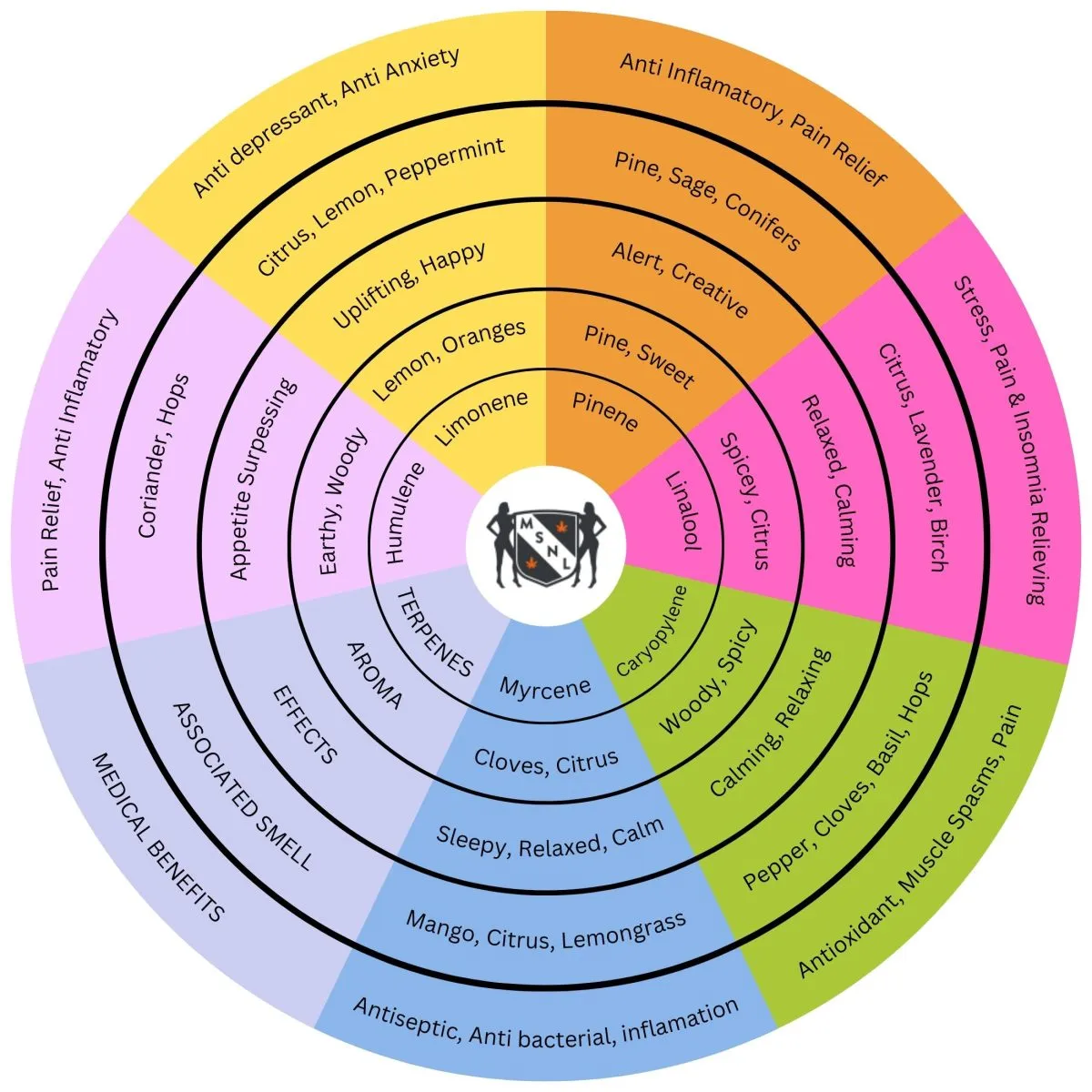
Terpene levels vary by genetics and can also be influenced by growing conditions, harvest timing, drying, curing, and storage.
Grower tip: Excessive heat, light, and rough handling can accelerate terpene loss. Gentle harvesting and controlled drying help preserve aroma and flavor.
What are the main terpenes found in cannabis?
The most useful way to compare cannabis terpenes is by their aroma and characteristics rather than assigning unproven medical benefits to each one.
| Terpene | Typical aroma | Key characteristics | Strain examples |
| Myrcene | Earthy, musky | Common in cannabis and contributes strongly to some cultivar aromas | White Widow, Bubba Kush |
| Beta-caryophyllene | Peppery, spicy | Can interact with CB2 cannabinoid receptors but is not intoxicating | Cookies strains, OG Kush |
| Limonene | Citrus | Also abundant in citrus peel and widely studied for biological activity | Wedding Cake, Super Lemon Haze |
| Linalool | Floral, lavender | Also found in lavender and other aromatic plants | LA Confidential, Master Kush |
| Pinene | Pine, woody | One of the most widespread terpenes in plants | Gushers, Blue Dream |
| Humulene | Earthy, woody | Also found in hops and contributes herbal notes | Headband OG, Sour Diesel |
| Terpinolene | Floral, herbal, citrus | Often creates a complex fresh aroma | Jack Herer, Durban Poison |
| Nerolidol | Woody, floral | Usually present in smaller amounts but can add woody notes | Chemdawg, Skunk #1 |
Genetics determines a plant's potential terpene profile, but cultivation and post-harvest handling influence how much is retained in the finished flower.
What is the difference between terpenes and cannabinoids?
Terpenes and cannabinoids are both compounds found in cannabis, but they perform different roles. Terpenes primarily contribute to aroma and flavor, while cannabinoids such as THC and CBD interact more directly with the body's endocannabinoid system.
THC can activate CB1 receptors and produce intoxication, while CBD interacts with the endocannabinoid system in more complex ways without causing a THC-like high. Terpenes are chemically different and are not classified as cannabinoids.
One notable exception is beta-caryophyllene, a terpene found in cannabis, black pepper, and other plants that can bind selectively to CB2 receptors. This demonstrates that some terpenes can interact with cannabinoid-related pathways, although they remain distinct from cannabinoids.
| Feature | Terpenes | Cannabinoids |
| Main role in cannabis | Aroma and flavor | Produce many of cannabis's biological effects |
| Examples | Myrcene, limonene, pinene | THC, CBD, CBG |
| Produce a THC-like high? | No | THC can |
| Interact with the ECS? | Some may; beta-caryophyllene binds CB2 | Yes, through several mechanisms |
| Found outside cannabis? | Very common in plants | Less widespread |
Grower tip: A strong-smelling plant does not necessarily have a high THC content. Terpene concentration and cannabinoid potency are separate traits, so aroma alone cannot reliably indicate strength.
Can terpenes have side effects?
Terpenes naturally occur in cannabis and many foods and plants, but natural does not automatically mean risk-free. Effects depend on the terpene, concentration, route of exposure, and individual sensitivity.
Some people may experience irritation of the throat, eyes, skin, or respiratory system when exposed to concentrated terpenes. Headaches or sensitivity to strong aromas can also occur in some individuals.
Concentrated terpene products deserve particular caution because they can contain levels far higher than those naturally present in cannabis flower. Anyone who experiences persistent irritation or other unwanted symptoms should stop exposure and seek medical advice if necessary.
For growers, the key point is that higher terpene content is not automatically better. The goal should be preserving the plant's natural terpene profile through correct curing followed by proper cannabis storage helps protect the terpene profile after harvest.
Do cannabis terpenes have medical benefits?
Cannabis terpenes are being studied for a range of potential therapeutic effects, but the evidence is still developing. Many findings come from cell and animal studies, while some human research involves isolated terpenes, essential oils, or standardized plant extracts rather than cannabis itself. This means individual terpenes should not be described as proven treatments for specific conditions.
Mood, anxiety, and depression
Several terpenes have been investigated for their effects on mood and stress-related pathways. Linalool, for example, has been studied for possible antidepressant and anti-anxiety activity, although much of the evidence is preclinical or comes from research involving linalool-rich essential oils.
Limonene has also shown anti-anxiety effects in mice, with researchers identifying possible involvement of dopamine and GABA signaling. However, this does not establish that limonene-rich cannabis will produce the same effect in people.
Research on beta-caryophyllene has produced similar results in animal models. One study found reductions in stress-related behaviors in mice, potentially involving its activity at CB2 receptors. Human clinical evidence is still needed.
Antimicrobial activity
Laboratory research has found that some terpenes and terpene derivatives can inhibit certain bacteria and fungi, including drug-resistant microorganisms. This has generated interest in their potential role in developing new antimicrobial treatments.
However, laboratory antimicrobial activity does not mean that cannabis or terpene-rich products can treat infections in humans.
Respiratory research
A human clinical trial investigated Myrtol, a standardized plant extract containing alpha-pinene, limonene, and 1,8-cineole, in people with acute bronchitis. Participants receiving the extract recovered more quickly than those receiving placebo. However, Myrtol is a standardized medicinal preparation rather than cannabis, so the results should not be used as evidence that cannabis terpenes treat bronchitis or viral infections.
Pain research
Terpenes are also being investigated for possible pain-related effects. In a mouse study, alpha-humulene, geraniol, linalool, and beta-pinene produced antinociceptive responses and showed additive effects when combined with the synthetic cannabinoid receptor agonist WIN55,212-2.
This provides interesting preclinical support for possible terpene-cannabinoid interactions, but it does not prove that these terpenes enhance THC or CBD pain relief in humans.
| Research area | Terpenes studied | Current evidence |
| Mood and anxiety | Linalool, limonene, beta-caryophyllene | Promising, but largely preclinical |
| Depression | Linalool, beta-caryophyllene, terpineol | Mostly animal and mechanistic research |
| Antimicrobial activity | Various terpenes | Strong laboratory interest; limited clinical evidence |
| Respiratory symptoms | Alpha-pinene, limonene, 1,8-cineole | Human evidence exists for standardized Myrtol, not cannabis |
| Pain | Alpha-humulene, geraniol, linalool, beta-pinene | Encouraging animal research; human evidence limited |
Grower tip: A cultivar's terpene profile can help describe its aroma and chemistry, but it should not be used to predict guaranteed medical effects. Genetics, growing conditions, harvest timing, and curing can all change terpene concentrations, while individual responses to cannabis can vary considerably.
Overall, terpenes in cannabis are scientifically interesting, but their medical potential should not be overstated. Current research supports continued investigation rather than treating individual terpenes as established therapies.
Conclusion
Cannabis terpenes are aromatic compounds that shape the smell and flavor of different cultivars while also supporting plant defenses. They are chemically distinct from cannabinoids such as THC and CBD, although researchers continue to study how some terpenes may interact with cannabinoid pathways. Current evidence suggests potential roles in areas such as mood, pain, and antimicrobial activity, but much of this research remains preclinical. For growers, genetics sets the foundation for terpene production, while environment, harvest timing, drying, curing, and storage influence how much is retained. Preserving terpenes helps protect the aroma, flavor, and overall quality of finished cannabis flower.
Frequently Asked Questions
What are terpenes in cannabis?
Terpenes are aromatic organic compounds produced by cannabis and many other plants. They are responsible for much of the citrus, pine, fruity, floral, earthy, and spicy aroma and flavor associated with different cannabis cultivars.
Do terpenes contain THC?
No. Terpenes and THC are different compounds. THC is a cannabinoid responsible for most of cannabis's intoxicating effects, while terpenes primarily contribute aroma and flavor and do not produce a THC-like high on their own.
Can terpenes affect how cannabis feels?
Possibly. Researchers are investigating whether certain terpenes in cannabis can influence cannabinoid activity. This is often associated with the entourage effect hypothesis, but high-quality human evidence remains limited, and individual terpenes cannot reliably predict how a cultivar will feel.
Are cannabis terpenes addictive?
Cannabis terpenes themselves are not considered addictive and do not produce the intoxicating effects associated with THC. This is separate from cannabis use disorder, which is primarily associated with repeated use of THC-containing cannabis products.
What affects terpene levels in cannabis?
Genetics has the greatest influence on a plant's potential terpene profile, but temperature, light, plant health, harvest timing, drying, curing, and storage can all affect how much is retained. Growers should avoid excessive heat and rough handling if preserving aroma and flavor is a priority.
References
- Sommano, S. R., Chittasupho, C., Ruksiriwanich, W., & Jantrawut, P. (2020). The Cannabis Terpenes. Molecules, 25(24), 5792. https://doi.org/10.3390/molecules25245792
- Ferber, S. G., Namdar, D., Hen-Shoval, D., Eger, G., Koltai, H., Shoval, G., Shbiro, L., & Weller, A. (2020). The “Entourage Effect”: Terpenes Coupled with Cannabinoids for the Treatment of Mood Disorders and Anxiety Disorders. Current Neuropharmacology, 18(2), 87–96. https://doi.org/10.2174/1570159X17666190903103923
- Aly, E., Khajah, M. A., & Masocha, W. (2020). β-Caryophyllene, a CB2-Receptor-Selective Phytocannabinoid, Suppresses Mechanical Allodynia in a Mouse Model of Antiretroviral-Induced Neuropathic Pain. Molecules, 25(1), 106. https://doi.org/10.3390/molecules25010106
- dos Santos, É. R. Q., Maia, J. G. S., Fontes-Júnior, E. A., & Maia, C. S. F. (2022). Linalool as a Therapeutic and Medicinal Tool in Depression Treatment: A Review. Current Neuropharmacology, 20(6), 1073–1092. https://doi.org/10.2174/1570159X19666210920094504
- Song, Y., Seo, S., Lamichhane, S., Seo, J., Hong, J. T., Cha, H. J., & Yun, J. (2021). Limonene has anti-anxiety activity via adenosine A2A receptor-mediated regulation of dopaminergic and GABAergic neuronal function in the striatum. Phytomedicine, 83, 153474. https://doi.org/10.1016/j.phymed.2021.153474
- Hwang, E. S., Kim, H. B., Lee, S., et al. (2020). Antidepressant-like effects of β-caryophyllene on restraint plus stress-induced depression. Behavioural Brain Research, 380, 112439. https://doi.org/10.1016/j.bbr.2019.112439
- Vieira, G., Cavalli, J., Gonçalves, E. C. D., et al. (2020). Antidepressant-Like Effect of Terpineol in an Inflammatory Model of Depression: Involvement of the Cannabinoid System and D2 Dopamine Receptor. Biomolecules, 10(5), 792. https://doi.org/10.3390/biom10050792
- Weston-Green, K., Clunas, H., & Jimenez Naranjo, C. (2021). A Review of the Potential Use of Pinene and Linalool as Terpene-Based Medicines for Brain Health: Discovering Novel Therapeutics in the Flavours and Fragrances of Cannabis. Frontiers in Psychiatry, 12, 583211. https://doi.org/10.3389/fpsyt.2021.583211
- Mahizan, N. A., Yang, S. K., Moo, C. L., et al. (2019). Terpene Derivatives as a Potential Agent against Antimicrobial Resistance (AMR) Pathogens. Molecules, 24(14), 2631. https://doi.org/10.3390/molecules24142631
- Matthys, H., de Mey, C., Carls, C., Ryś, A., Geib, A., & Wittig, T. (2000). Efficacy and tolerability of myrtol standardized in acute bronchitis: A multi-centre, randomised, double-blind, placebo-controlled parallel group clinical trial vs. cefuroxime and ambroxol. Arzneimittel-Forschung, 50(8), 700–711. https://doi.org/10.1055/s-0031-1300276
- LaVigne, J. E., Hecksel, R., Keresztes, A., & Streicher, J. M. (2021). Cannabis sativa terpenes are cannabimimetic and selectively enhance cannabinoid activity. Scientific Reports, 11, 8232. https://doi.org/10.1038/s41598-021-87740-8


