




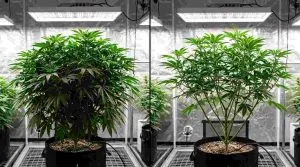
.Cannabis defoliation is the selective removal of fan leaves to manage a dense canopy, improve airflow, and reduce excessive shading. Learning how to defoliate cannabis correctly is important because removing too many leaves, or working on an already stressed plant, can slow growth and recovery.
This cannabis defoliation guide explains when to defoliate cannabis, which fan leaves to remove, and how much foliage beginners should take off at one time. We also cover defoliating cannabis during vegetative growth and flowering, light vs heavy defoliation, indoor vs outdoor plants, recovery, and the most common leaf-removal mistakes new growers should avoid.
Key Takeaways
- Only defoliate healthy plants: Avoid leaf removal when plants are already dealing with watering, nutrient, heat, pest, disease, or transplant stress.
- Start with light defoliation: New growers should remove selected leaves gradually rather than stripping large amounts of healthy foliage at once.
- Remove leaves for a reason: Prioritize damaged or yellowing foliage and fan leaves that are heavily overlapping, restricting airflow, or creating excessive shade.
- Use plant condition instead of a fixed schedule: The best time to defoliate cannabis depends on growth stage, canopy density, plant health, and recovery.
- Defoliation does not guarantee higher yields: Treat it as a canopy-management technique for improving airflow and light distribution rather than a guaranteed way to increase harvest size.
- What is Cannabis Defoliation?
- Should you Defoliate Your Cannabis Plant?
- When to Defoliate Cannabis: The 3-Stage Timing Guide
- When NOT to Defoliate Cannabis
- How Many Leaves Should You Remove?
- How to Defoliate Cannabis Step by Step
- Light vs Heavy Defoliation: What About Schwazzing?
- Indoor vs Outdoor Cannabis Defoliation
- Common Cannabis Defoliation Mistakes
- Does Cannabis Defoliation Increase Yield? What the Evidence Says
- Conclusion
- Frequently Asked Questions
What is Cannabis Defoliation?
Cannabis defoliation is the selective removal of leaves while the plant is actively growing. Growers mainly remove large fan leaves that are damaged, overcrowding the canopy, restricting airflow, or heavily shading growth below. Smaller sugar leaves around developing flowers are generally left in place unless damaged.
Defoliating cannabis is different from trimming or pruning cannabis plants. Defoliation focuses mainly on removing selected leaves during growth, while pruning can also involve removing shoots or branches to shape the plant.
The goal is not to strip the plant bare, but to remove selected leaves where doing so improves airflow, light distribution, and canopy access.
Should you Defoliate Your Cannabis Plant?
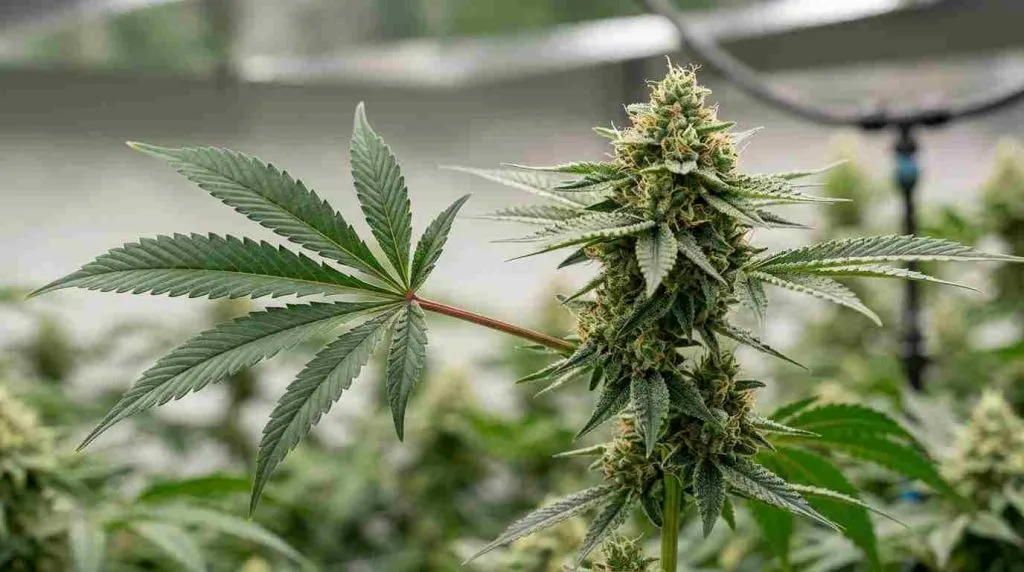
Not every cannabis plant needs defoliation. It can be useful when a healthy plant develops a dense canopy, large overlapping fan leaves, restricted airflow, or excessive shading that blocks lower growth.
Avoid defoliating cannabis when the plant is already stressed, growing slowly, or recovering from cannabis watering problems such as overwatering or underwatering, nutrient issues, heat stress, pests, or transplanting.
| Plant Condition | Defoliate? |
| Healthy with dense foliage | Yes, selectively |
| Poor airflow through the canopy | Consider light defoliation |
| Heavy shading from large fan leaves | Remove selected leaves |
| Stressed or slow-growing plant | No |
| Nutrient, pest, or watering problems | Fix the problem first |
When to Defoliate Cannabis: The 3-Stage Timing Guide
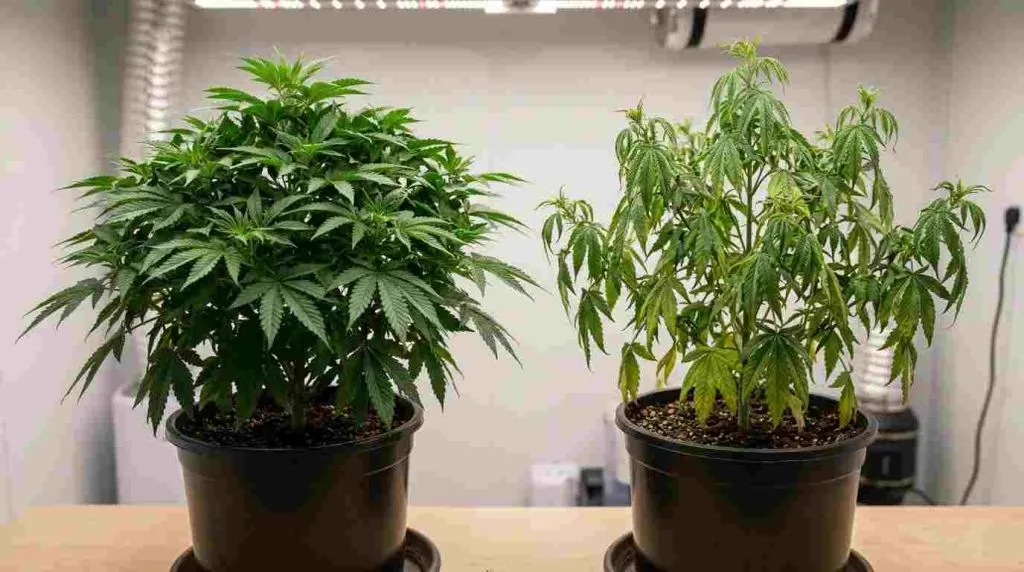
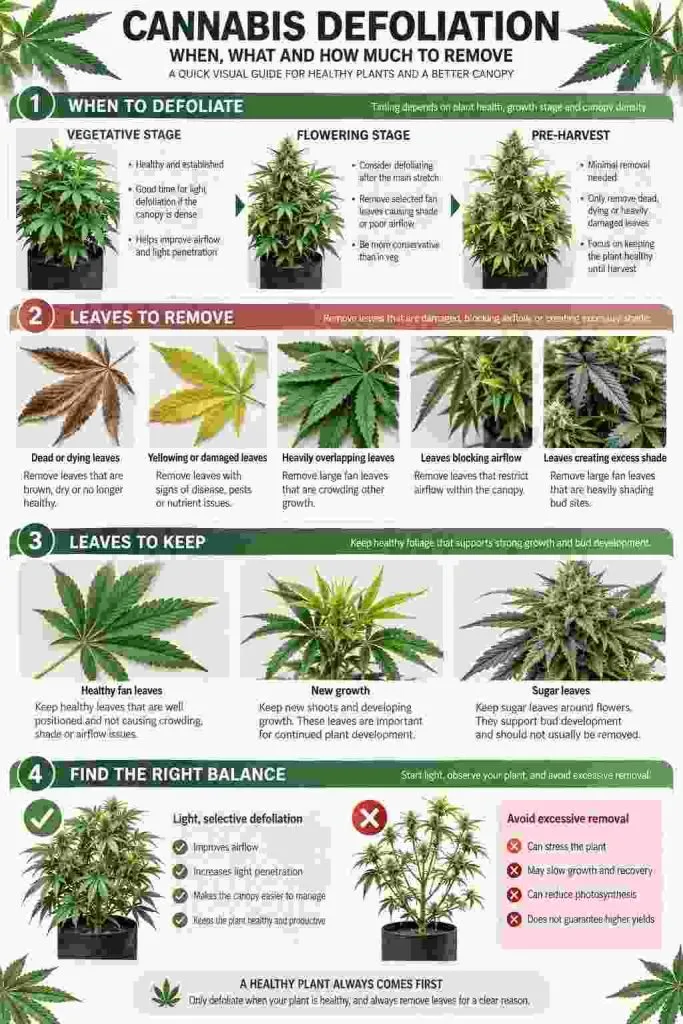
Knowing when to defoliate cannabis is just as important as knowing which leaves to remove. Rather than following an exact week-by-week schedule, use plant health, canopy density, and recovery to decide when defoliation is needed.
| Growth Stage | Typical Approach | Main Goal |
| Vegetative stage | Light, selective defoliation | Improve airflow and open dense growth |
| Flowering stage | Conservative removal after the stretch | Reduce excessive shading and canopy crowding |
| Pre-harvest | Minimal removal when needed | Remove dead, damaged, or deteriorating leaves |
Stage 1 – Defoliating Cannabis During Veg
During the cannabis vegetative stage, wait until the plant is established. This means it has developed several healthy cannabis nodes and internodes, is growing actively, and shows no obvious signs of stress.
Remove selected fan leaves if they overlap heavily, restrict airflow, or consistently shade developing growth below. Avoid stripping away healthy foliage simply to make the plant look tidier.
Stage 2 – Defoliating Cannabis During Flowering
During the first few weeks of flowering, cannabis plants often grow rapidly in height. This period is known as the flowering stretch.
Once this rapid growth begins to slow, assess the canopy again. Selected fan leaves can be removed where foliage has become crowded or is heavily shading developing flowers.
Keep cannabis defoliation controlled during flowering and avoid repeated heavy sessions that could slow recovery.
Stage 3 – Pre-Harvest Defoliation
Heavy defoliation shortly before harvest is generally unnecessary because the plant has little time to respond.
Instead, remove dead, badly damaged, or deteriorating leaves and any foliage creating a clear airflow or moisture problem around the flowers.
Grower tip: Let the plant tell you when it is ready. If growth has slowed, leaves are drooping, or the plant has not fully recovered from its previous defoliation, wait before removing more.
When NOT to Defoliate Cannabis
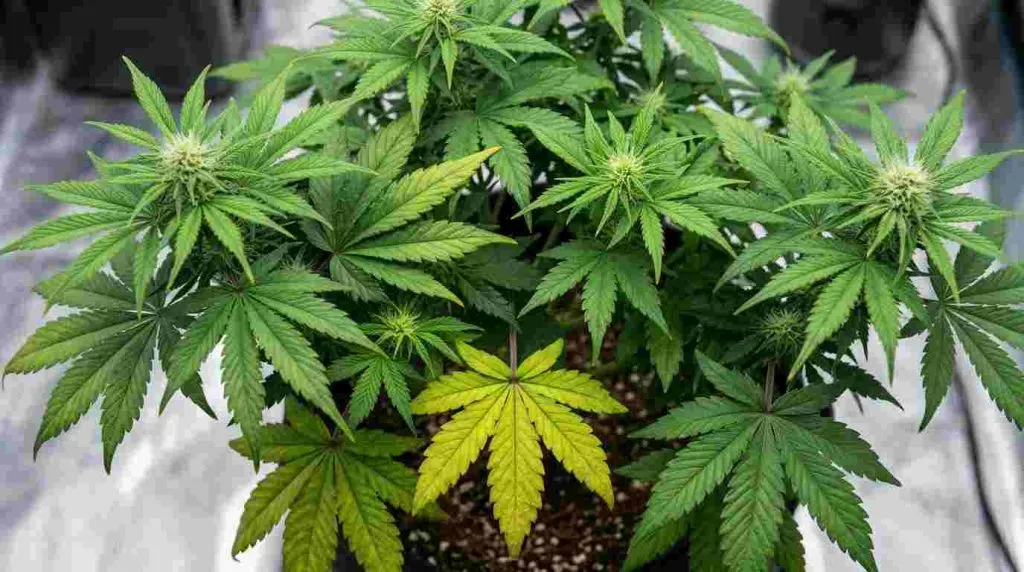
Knowing when not to defoliate cannabis is important because removing healthy leaves adds stress. If the plant is already struggling, fix the underlying problem first and wait for normal growth to return.
| Avoid Defoliating When | What to Do Instead |
| Leaves show heat or light stress | Correct temperature, light intensity, or distance |
| Nutrient deficiency is visible | Identify and correct the deficiency first |
| Leaf tips show nutrient burn | Reduce excess feeding and monitor recovery |
| Plant is overwatered or underwatered | Restore a consistent watering routine |
| Pests or disease are present | Treat the problem before removing healthy foliage |
| Plant was recently transplanted | Allow time for roots and growth to recover |
| Growth is weak or unusually slow | Find the cause before adding more stress |
Grower tip: Wait until the plant is healthy, upright, and actively producing new growth before considering another defoliation session.
How Many Leaves Should You Remove?
When defoliating cannabis, start conservatively. For beginners, removing around 10% or less of the foliage in one session is a sensible starting point, especially with a strain you have not grown before.
Begin with damaged, yellowing, or unhealthy leaves. Then remove only the large fan leaves that are heavily overlapping, restricting airflow, or clearly shading important growth below.
There is no universal percentage that suits every cannabis plant. Size, genetics, growth stage, health, and canopy density all affect how much foliage can be removed safely.
Grower tip: Stop once airflow and light access improve. You can always remove more later, but you cannot put a healthy leaf back.
How to Defoliate Cannabis Step by Step
If this is your first time defoliating cannabis, the safest approach is to work slowly and remove only leaves that have a clear reason to come off. The aim is to open the canopy without stripping away healthy foliage the plant can still use.
Step 1 – Check Plant Health
Look over the entire plant before removing anything. It should be upright, actively growing, and free from obvious heat, light, watering, nutrient, pest, or disease problems.
If the plant is already stressed or growth has slowed, leave it alone until normal growth returns.
Step 2 – Prepare Clean Tools
Use a clean, sharp pair of pruning scissors or snips. Clean the blades before starting and between different plants to reduce the chance of spreading pests or disease.
Make sure you can clearly see the stems and branches before making any cuts.
Step 3 – Identify Which Leaves to Remove
Start with the easiest decisions:
- Dead or dying leaves
- Yellowing or badly damaged leaves
- Large fan leaves overlapping other foliage
- Fan leaves restricting airflow through dense areas
- Leaves heavily shading useful growth below
Do not remove a large fan leaf simply because of its size. If it is healthy and not causing crowding or shading, leave it in place.
Step 4 – Remove Leaves Conservatively
Hold the selected fan leaf by its stem and make a clean cut near where the leaf stem meets the branch. Avoid cutting into the branch, new shoots, or developing flowers.
Work around the plant gradually instead of clearing one entire area at once.
Step 5 – Reassess the Canopy
After every few leaves, stop and look at the whole plant again.
Ask yourself:
- Can air move more easily through the canopy?
- Are heavily shaded areas more open?
- Does the plant still have plenty of healthy foliage?
If the answer is yes, you may already have removed enough.
Step 6 – Allow the Plant to Recover
Once you finish, leave the plant to recover and continue its normal growth. Do not immediately plan another defoliation session based on a fixed number of days.
Wait until the plant is healthy, growing normally, and actually needs more canopy management.
Grower tip: Take a photo before you start and another when you finish. For new growers, comparing the two makes it much easier to see how much foliage has been removed and helps prevent over-defoliation.
Light vs Heavy Defoliation: What About Schwazzing?
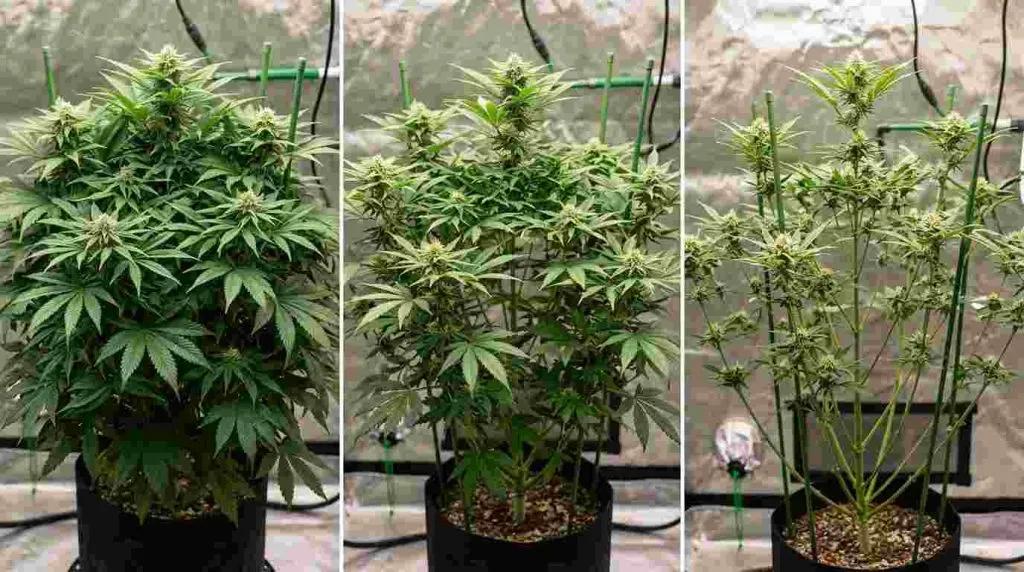
Light defoliation means selectively removing a small number of fan leaves that are damaged, overcrowded, or blocking airflow and light. This is generally the better starting point for new growers.
Heavy defoliation removes much more foliage in a single session and places greater stress on the plant.
Schwazzing is an advanced form of heavy cannabis defoliation where a large proportion of fan leaves are removed at specific stages of growth. Although some growers use this technique to manage dense canopies, removing too much healthy foliage can slow recovery and affect plant performance.
Grower tip: If you are new to defoliating cannabis, start light. You can always remove another leaf later.
Indoor vs Outdoor Cannabis Defoliation
Cannabis defoliation can be useful indoors and outdoors, but the reasons for doing it may differ. Growers still choosing genetics can compare indoor cannabis seeds with outdoor cannabis seeds based on the environment they plan to grow in. Indoor plants grow under fixed lights and rely on fans for air movement, so dense canopies can create shaded areas and pockets of humid air.
Outdoor plants receive sunlight from changing angles and typically have more natural airflow and space, meaning they may require less intervention.
| Factor | Indoor Plants | Outdoor Plants |
| Light | Fixed overhead position | Sun changes position |
| Airflow | Controlled with fans | More natural air movement |
| Space | Often restricted | Usually more space available |
| Defoliation | Useful for dense canopies | Often more selective |
| Main goal | Manage airflow and shading | Remove problem foliage where needed |
Grower tip: Don't copy an indoor defoliation routine outdoors. Judge each plant by its canopy and growing conditions.
Common Cannabis Defoliation Mistakes
The most common mistake when defoliating cannabis is removing too many healthy leaves at once. Beginners should work gradually and stop once airflow and canopy access have improved.
Other mistakes include:
- Defoliating a stressed plant: Correct watering, nutrient, heat, pest, or disease problems first.
- Following a fixed calendar: Defoliate because the plant needs it, not simply because a certain week has arrived.
- Removing healthy leaves unnecessarily: Large fan leaves do not automatically need removing.
- Heavy defoliation during flowering: Excessive removal can create unnecessary stress when flowers are developing.
- Repeating sessions too quickly: Give the plant time to return to normal growth before removing more foliage.
Grower tip: When unsure about a healthy leaf, leave it. Conservative removal is easier to correct than over-defoliation.
Does Cannabis Defoliation Increase Yield? What the Evidence Says
Defoliation can support cannabis plant training by opening a dense canopy, improving airflow, reducing excessive shading, and allowing available light to reach more areas of the plant. However, this does not mean removing fan leaves will automatically increase yield.
A 2025 study published in Industrial Crops and Products found that defoliation affected the two tested cannabis cultivars differently and reduced floral biomass in one. Earlier controlled research also found that defoliation did not significantly increase cannabinoid yield per plant compared with untreated plants.
Results can therefore vary depending on cultivar, plant health, environment, canopy density, timing, and how aggressively foliage is removed.
Grower tip: Use cannabis defoliation to solve a canopy problem, not as a guaranteed way to produce a larger harvest.
Conclusion
Cannabis defoliation can be a useful way to manage dense foliage, improve airflow, and reduce excessive shading when it is done selectively. The key is to remove leaves for a clear reason rather than stripping healthy foliage from the plant.
For new growers, start light, work with healthy plants, and allow time for recovery between sessions. Pay attention to how each plant responds rather than following a rigid defoliation schedule.
Used carefully, defoliation can become part of a wider canopy-management approach. Low-stress training cannabis plants can help spread the canopy with less stress, while topping cannabis plants can be used to change the plant’s structure more significantly.”
Frequently Asked Questions
When Should You Defoliate Cannabis?
The best time to defoliate cannabis depends on plant health and canopy density. Selective removal can be carried out during vegetative growth and, when needed, after the main flowering stretch. Avoid defoliating plants that are stressed, damaged, or struggling to grow normally.
How Many Fan Leaves Should I Remove at Once?
There is no exact amount that works for every plant. New growers can use around 10% or less of the foliage as a conservative starting point. Remove damaged leaves first, followed by selected fan leaves causing significant crowding, poor airflow, or shading.
Can You Defoliate Cannabis During Flowering?
Yes, but cannabis defoliation during flowering should be controlled. Once the rapid flowering stretch begins to slow, selected fan leaves can be removed if the canopy is overcrowded or heavily shaded. Avoid aggressive or repeated removal that could unnecessarily stress the plant.
Can You Defoliate Autoflower Cannabis?
You can defoliate autoflowers, but a lighter approach is usually more suitable because their shorter growth cycle gives them less time to recover from unnecessary stress. Autoflowers have a shorter, fixed growth cycle, giving them less time to recover from unnecessary stress. Prioritize leaf tucking where possible and remove foliage only when there is a clear benefit.
How Long Does Cannabis Take to Recover After Defoliation?
Recovery time varies depending on plant health, growth stage, cultivar, environment, and how much foliage was removed. Instead of waiting a fixed number of days, look for healthy new growth and normal plant development before considering another session.


