




Healthy cannabis roots are the foundation of a strong, productive plant. From the moment a seed germinates, the cannabis root system begins absorbing water and mineral nutrients, anchoring the plant, and supporting growth above the soil. How well the cannabis plant root system develops depends on factors such as oxygen, moisture, temperature, soil structure, container size, and available space.
Understanding how roots develop can also help growers answer practical questions such as how deep do cannabis roots go, do cannabis roots grow during flowering, and how deep to plant weed seeds in soil. In this guide, we explain cannabis root anatomy, development, depth, healthy root characteristics, and the most common root problems, along with practical ways to maintain a healthy root zone from germination through flowering.
Key Takeaways
- Cannabis roots absorb water and mineral nutrients, anchor the plant, support respiration, and interact with microorganisms in the surrounding rhizosphere.
- The cannabis root system develops most rapidly during seedling and vegetative growth, although roots remain active throughout the plant's lifecycle.
- Do cannabis roots grow during flowering? Yes, but root-system expansion generally slows as more plant resources are directed toward flower development.
- How deep are weed roots? There is no fixed depth. Genetics, soil structure, moisture, compaction, container size, and growing conditions all influence how deep cannabis roots go.
- When learning how deep to plant weed seeds in soil, around 1 cm (0.4 inches) is generally sufficient. Healthy development after germination depends on good drainage, oxygen, consistent moisture, balanced nutrition, and enough space for roots to expand.
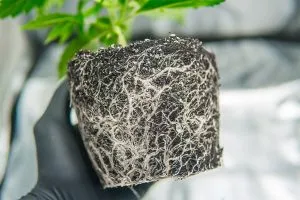
What do cannabis roots do?
Cannabis roots form the foundation of the cannabis plant root system, absorbing water and essential mineral nutrients from the cannabis growing medium and transporting them to the rest of the plant. They also anchor the plant, helping keep it stable as stems, branches, and flowers develop.
The root system needs access to oxygen for respiration, which provides the energy required for nutrient uptake, root growth, and other metabolic processes. Roots can also store carbohydrates and nutrients that the plant may draw on during different stages of development.
Around the cannabis roots is the rhizosphere, a biologically active zone where roots interact with beneficial fungi, bacteria, and other microorganisms. These microbes can influence nutrient availability and overall root health.
Grower tip: Healthy root function depends on the balance between moisture and oxygen. A growing medium that stays constantly saturated can reduce oxygen around the roots and restrict nutrient uptake and growth.
What does the cannabis root system look like?
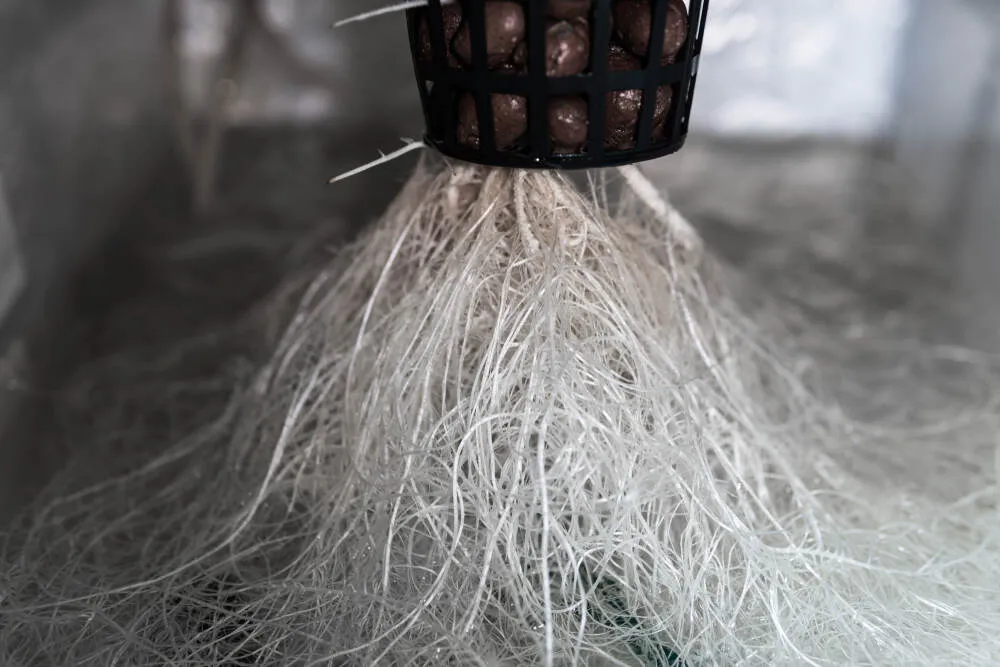
The cannabis root system develops as a branching network beneath the growing medium. Its exact size and shape vary with genetics, container size, soil structure, moisture, and growing conditions, but a seed-grown cannabis plant typically develops a main root supported by progressively finer lateral roots and root hairs.
| Part of the cannabis root system | Main role |
| Taproot | Primary root that grows downward and helps anchor the plant |
| Lateral roots | Branch outward through the medium to access water and nutrients |
| Root hairs | Increase the surface area available for water and mineral uptake |
| Adventitious roots | Develop from stems or other non-root tissue |
| Rhizosphere | Zone around the roots where microbes interact with the plant |
Taproot
The taproot is the primary root that emerges from a cannabis seed during germination. It initially grows downward, anchoring the young plant while exploring the growing medium for water and nutrients. As the seedling develops, smaller roots begin branching from it.
Lateral and secondary roots
Lateral roots grow outward from the primary root and branch repeatedly through the surrounding medium. This creates a wider cannabis plant root system and allows the plant to access resources across a larger area.
Root hairs
Root hairs are tiny extensions that develop along young root tissue. They greatly increase the surface area available for absorbing water and mineral nutrients. These delicate structures can be damaged by severe drying, prolonged waterlogging, or rough handling during transplanting.
Adventitious roots
Adventitious roots develop from plant tissue other than the original primary root, such as the stem. They are especially important when you clone marijuana plants, as cuttings must develop a new root system from stem tissue.
The rhizosphere
The rhizosphere is the narrow area of growing medium immediately surrounding cannabis roots. It contains bacteria, fungi, and other microorganisms that interact with the root system and can influence nutrient availability and root health.
Grower tip: Avoid unnecessarily disturbing fine roots during transplanting. Damaging young roots and root hairs can temporarily reduce water and nutrient uptake while the plant recovers.
How do cannabis roots develop?
Cannabis root development starts at germination and continues throughout the plant’s life, although the rate of expansion changes between growth stages. In general, the cannabis root system establishes rapidly during seedling and vegetative growth before expansion slows as flowering progresses.
| Growth stage | Root development | Grower focus |
| Seedling | Primary root emerges and begins branching | Avoid overwatering and maintain gentle aeration |
| Vegetative | Fast root expansion and lateral branching | Provide adequate container space, oxygen, and moisture |
| Flowering | Roots remain active, but expansion typically slows | Maintain a stable, healthy root zone |
Cannabis roots during germination and seedling growth
Germination begins when the primary root, often called the radicle, breaks through the seed shell and grows downward. Lateral roots soon begin branching from this initial root, creating the foundation of the developing cannabis plant root system.
Young roots are particularly sensitive to waterlogged conditions, so seedlings need consistent moisture without keeping the growing medium permanently saturated.
Root growth during the vegetative stage
The vegetative stage is generally the main period of cannabis root system expansion. Roots spread vertically and laterally as they explore the growing medium for water and nutrients. Adequate container space, good drainage, oxygen, and consistent moisture encourage a well-branched root system before flowering begins.
Grower tip: When transplanting cannabis plants, give the roots sufficient space before flowering rather than waiting until the plant becomes heavily root-bound.
Do cannabis roots grow during flowering?
Yes. Cannabis roots do grow during flowering, but overall root-system expansion generally slows as more resources are directed toward reproductive growth and flower development. Roots still absorb water and nutrients and remain metabolically active throughout flowering.
Recent research on cannabis cuttings has also shown that adventitious rooting and flowering can occur at the same time, supporting the more accurate view that root growth slows during flowering rather than stopping completely.
How deep do cannabis roots go?
There is no single answer to how deep cannabis roots go. Root depth varies with genetics, soil structure, moisture, compaction, container size, and growing environment. In loose outdoor soil, cannabis roots can spread much farther than they can in pots. Research in hemp has reported rooting depths of up to around 2 meters in some field conditions, but this is not typical of every cannabis plant.
| Growing condition | Effect on roots |
| Loose, deep soil | Allows greater vertical and lateral growth |
| Compacted or waterlogged soil | Restricts penetration and oxygen |
| Containers | Limit root spread to available pot volume |
Cannabis root depth outdoors vs in containers
Growers using outdoor cannabis seeds in suitable open soil can give roots considerably more room to develop downward and outward than plants restricted to containers. Container-grown cannabis is restricted by the pot, so root depth depends largely on container dimensions. This is why how deep are weed roots varies widely between grows.
Grower tip: Choose a container with enough volume for the plant's expected size rather than targeting a specific root depth.
How deep to plant weed seeds in soil
Plant weed seeds about 1 cm (0.4 inches) deep in lightly moistened soil. Planting too deeply can slow emergence, while shallow planting can increase drying. For more detail on planting depth and early seedling care, see our guide on how to germinate marijuana seeds.
What do healthy cannabis roots look like?
Healthy cannabis roots are typically white, cream, or light tan, with a firm texture and plenty of fine branching. Young feeder roots and root hairs are especially important because they provide a large surface area for absorbing water and mineral nutrients.
| Healthy root sign | What to look for |
| Color | White, cream, or light tan |
| Texture | Firm rather than soft or slimy |
| Structure | Fine branching distributed through the medium |
| Smell | Fresh, neutral, or earthy |
Color alone isn't enough to determine root health. Soil, organic matter, and some nutrients can naturally stain cannabis roots brown or tan without indicating disease. Instead, assess their color alongside texture, smell, root distribution, and the overall health of the plant.
Grower tip: When transplanting, inspect the exposed root ball. Healthy roots should spread through the growing medium rather than forming a dense mass circling the container.
How to keep cannabis roots healthy
Healthy cannabis roots depend on a stable root zone with the right balance of oxygen, moisture, temperature, nutrients, and space. Rather than relying on one product or “root booster,” focus on maintaining conditions that allow the cannabis root system to function efficiently.
| Root-zone factor | What growers should aim for |
| Oxygen | Loose, well-aerated growing medium |
| Moisture | Even moisture without prolonged saturation |
| Temperature | Stable conditions without excessive heat or cold |
| Nutrition | Balanced feeding with suitable pH and EC |
| Space | Enough room for roots to expand without becoming root-bound |
Maintain oxygen and drainage
Cannabis roots need oxygen for respiration. Compacted soil, poor drainage, and constantly saturated media reduce air around the roots, which can restrict nutrient uptake and increase the risk of root problems. Use a well-draining medium and containers with adequate drainage.
Water correctly
When watering cannabis plants, thoroughly moisten the active root zone, then allow the medium to partially dry before watering again. Avoid repeatedly soaking already-wet soil or allowing the entire root ball to become bone dry.
Grower tip: Lift container-grown plants before watering. A noticeably lighter pot is often a more reliable indicator than following a fixed watering schedule.
Maintain the right root-zone temperature
Root-zone temperature affects respiration and nutrient uptake and, particularly when growing cannabis hydroponically, the amount of dissolved oxygen available to roots. The ideal range varies between soil, coco, and hydroponic systems, so aim for stable temperatures and avoid extreme heat or cold around the roots.
Manage nutrients, pH and EC
Healthy root development depends on balanced nutrition rather than excessive phosphorus or potassium. Keep pH and EC appropriate for your growing medium, as incorrect root-zone conditions can contribute to nutrient lockout in cannabis and excessive salt accumulation.
Give roots enough space
Choosing the right pots for growing cannabis plants gives roots enough space to expand and reduces the risk of plants becoming severely root-bound. Providing enough root volume during vegetative growth helps establish a well-developed root system before flowering begins.
Common cannabis root problems
Cannabis root problems often produce similar above-ground symptoms, including drooping, yellowing, slow growth, and poor nutrient uptake. Before treating the plant, check root-zone moisture, drainage, container size, and the condition of any visible roots.
| Root problem | Common signs | Typical cause |
| Overwatering | Drooping, yellowing, slow growth | Growing medium stays saturated |
| Root rot | Brown or slimy roots, foul smell, wilting | Prolonged wet, oxygen-poor conditions |
| Root-bound plant | Fast-drying pots, slowed growth, circling roots | Container is too small |
| Fungus gnats | Small flies near soil, weak growth | Larvae developing in damp medium |
Overwatering and low root-zone oxygen
Overwatering keeps air-filled spaces in the growing medium saturated, reducing oxygen available to cannabis roots. Plants may droop, yellow, and grow slowly even though the soil remains wet.
Root rot
Persistent saturation and poor drainage can create low-oxygen conditions that damage roots and favor root rot. Affected cannabis roots may become brown, soft, or slimy and develop an unpleasant odor. For treatment, see our dedicated cannabis root rot guide.
Root-bound plants
When roots outgrow their container, they can begin circling the pot and competing for limited water and nutrients. Growth may slow, and the medium may dry unusually quickly.
Fungus gnats and root pests
Fungus gnats on cannabis are particularly problematic in consistently damp growing media because their larvae can feed on fine roots, especially in young plants. Adults flying around the soil surface are an early warning sign.
Grower tip: Diagnose the underlying root-zone problem before adding nutrients or treatments, as several root issues produce very similar leaf symptoms.
Conclusion
A healthy cannabis root system supports water and nutrient uptake, plant stability, and steady growth from germination through flowering. Root development is strongest during the early stages, so giving cannabis roots enough oxygen, moisture, space, and balanced nutrition from the start can prevent many common problems later.
Rather than focusing on one product or nutrient, growers should aim for a stable root zone with good drainage, suitable temperatures, and enough room for roots to expand. Healthy roots may be hidden below the surface, but their condition has a major influence on the health and performance of the entire plant.
Frequently Asked Questions
How deep do cannabis roots go?
There is no fixed depth for cannabis roots. Outdoor plants grown in loose, well-aerated soil can develop roots much deeper and wider than container-grown plants. Root depth depends on genetics, soil structure, moisture, compaction, and available space. In pots, the dimensions of the container largely determine how far the cannabis root system can expand.
Do cannabis roots grow during flowering?
Yes. Cannabis roots continue functioning and can still grow during flowering, but overall root-system expansion generally slows compared with the vegetative stage. The roots remain responsible for absorbing water and nutrients throughout flowering, making it important to maintain stable moisture, oxygen, pH, and root-zone conditions until harvest.
How deep should you plant weed seeds in soil?
Cannabis seeds are generally planted around 1 cm (0.4 inches) deep in lightly moistened soil. Planting too deeply can make it harder for the seedling to reach the surface, while seeds planted too shallowly can dry out more easily. Keep the medium moist but not saturated during germination.
What color should healthy cannabis roots be?
Healthy cannabis roots are commonly white, cream, or light tan, but color alone should not be used to diagnose root health. Soil, organic matter, and nutrients can naturally stain roots. Healthy roots should also feel firm, show fine branching, and smell fresh or earthy rather than sour or rotten.
How can you encourage a healthy cannabis root system?
Focus on maintaining good drainage, oxygen, consistent moisture, balanced nutrition, suitable pH and EC, stable root-zone temperatures, and enough container space. Avoid repeatedly overwatering the medium or allowing plants to become severely root-bound. A stable root environment is generally more important than relying on additional root stimulants or high levels of individual nutrients.


