




Growing autoflowering cannabis indoors is one of the most rewarding ways to produce a top-quality harvest within as little as 10-12 weeks. Many first-time growers start with a grow tent and some autoflowering cannabis seeds. However, knowing which tent size is best, how many plants can be grown, and what the ideal growing conditions are can be confusing.
In this article, I will guide you through the different grow tent options and everything you need to know about growing autoflowers in a grow tent. Covering how many is the right number, tent size and plant count options, considerations when setting up your grow tent, why tent size matters and how to choose the right tent for your needs!
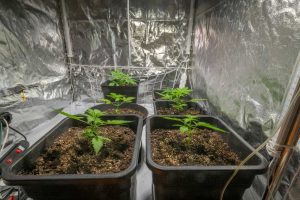
- How many autoflowers can you fit in a grow tent?
- Setting up your tent, depending on the size of your grow space
- Factors that affect how many autoflowers you can grow in a tent
- Why does the size of your grow tent matter?
- How to choose the right tent size for your needs
- Frequently asked questions about the number of autoflowers you can grow in a tent
How many autoflowers can you fit in a grow tent?
So your grow tent delivery has arrived and you are more than excited to set it up, install and hang your equipment and to get the ball as an autoflowering grower rolling! The next question to ask yourself is how many autoflowers can you fit in a grow tent? What is the right amount?
As an indoor grower, your priority should be to use your grow space as efficiently as possible. This means having the right number of autoflowering plants without overcrowding and achieving the maximum possible yield. Keep in mind that how tall your autoflowers grow and the genetics you choose will also influence how many plants you can fit comfortably inside your tent. Below is a breakdown of how many autos you can fit in a grow tent for a Sea of Green setup, where plants are grown closely together.
Before deciding on plant numbers, it's also worth understanding how much an autoflower can yield, as fewer well-grown plants can often outperform an overcrowded tent.
Choosing the right autoflowering cannabis seeds is just as important as choosing the right grow tent, as different genetics can vary in size and yield.
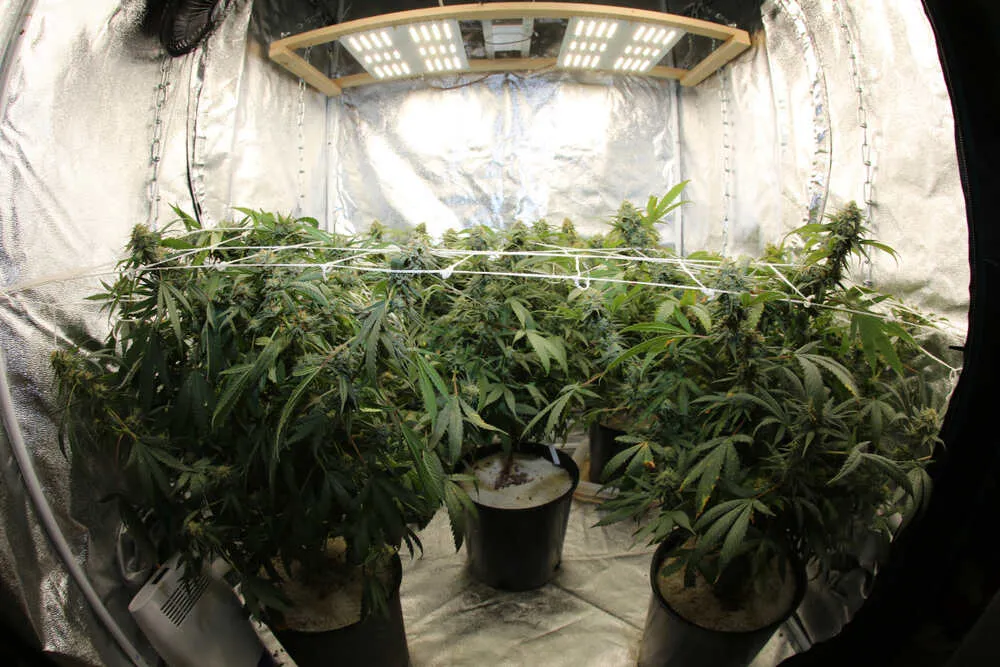
Optimal plant count by tent size
Finding the right balance between plant count, light penetration, and airflow can be challenging for first-time growers. An efficient grow tent should provide enough space for each autoflower to receive even light coverage, maintain stable temperature and humidity levels, and allow fresh air to circulate freely throughout the canopy. You should also have enough room to access your plants for watering, training, and maintenance without overcrowding the tent.
The recommended plant counts below are based on a Sea of Green (SOG) setup using 10L fabric pots. These recommendations maximise growing space while maintaining healthy airflow and light distribution. If you live in a country or region with legal plant count restrictions, always follow your local regulations.
| Grow Tent Size | Recommended Plant Count | Plant Layout | Recommended Pot Size | Best Suited For |
| 2m × 2m | 16 autoflowers | 4 × 4 rows | 10L fabric pots | Small indoor grow rooms |
| 2m × 4m | 24 autoflowers | 6 × 4 rows | 10L fabric pots | High-yield Sea of Green setups |
| 3m × 3m | 25 autoflowers | 5 × 5 rows | 10L fabric pots | Medium-scale indoor grows |
| 4m × 4m | 36 autoflowers | 6 × 6 rows | 10L fabric pots | Large grow rooms and commercial-style setups |
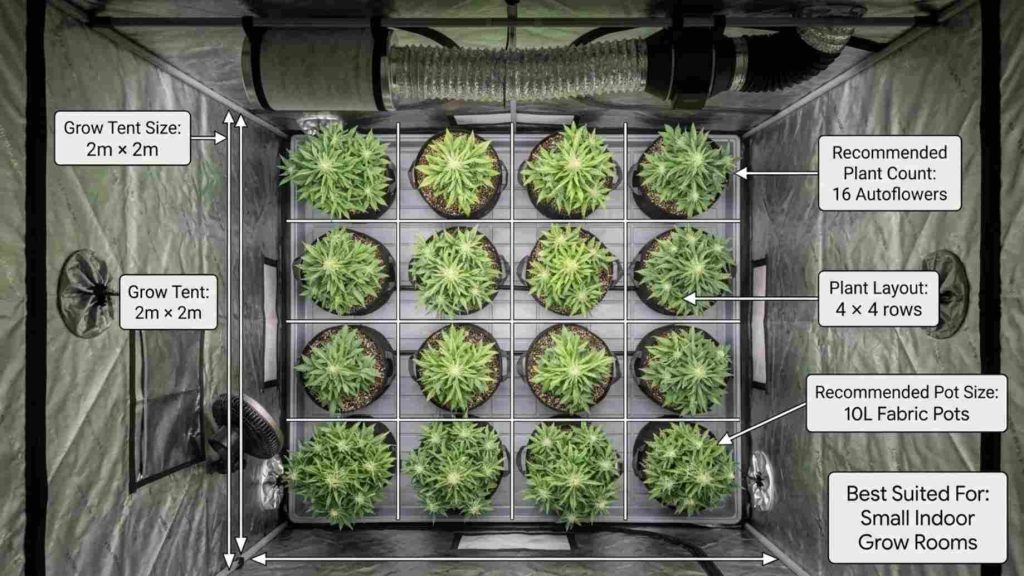
Why these plant counts work
The recommended plant numbers help create an efficient growing environment by ensuring:
- Even light penetration across the entire canopy.
- Stable temperature and humidity levels that are easier to control.
- Good airflow and ventilation to reduce the risk of mould and pests.
- Enough space to move around the tent and care for your plants.
- Adequate spacing so flowering plants are not touching one another.
- Full use of the available growing area without leaving large unused spaces.
Setting up your tent, depending on the size of your grow space
If you are a beginner grower, then you may be starting out using a converted clothes wardrobe or closet. You may be using the smallest tent possible or are working with what little space you may have.
Setting up your grow tent with the right pot size, lighting set-up, and ventilation system will allow you to produce high-grade cannabis buds every time, regardless of the scale you are growing on. Below is a breakdown of what to consider when setting up your tent.
- Your extraction kit should freely hang without being overcrowded
- Leave plenty of space around the edge of the pots to easily maneuver
- Your tent should be easily accessible at all times
Choosing a pot size for your tent
When it comes to choosing the right container, selecting the best pot size for autoflower seeds will encourage healthy root development and maximise your plants' growth potential, you will need to think about whether you want to grow a small number of plants, typically between 4 and 6, or whether you prefer a high-volume Sea of Green set-up. Autoflowering cannabis plants work extremely well in both scenarios.
- If your goal is to grow a small number of larger autoflowers, I recommend using the largest fabric pots your grow tent can comfortably accommodate. A larger root zone gives the roots more room to develop, allowing plants to grow bigger and produce higher yields.
- For Sea of Green (SOG) setups, I recommend 10L fabric pots as they provide an excellent balance between plant size and making efficient use of the available grow space.
- In my experience, fabric pots outperform plastic pots because they provide better drainage, improve airflow around the roots and naturally air-prune the root system.
- Always make sure your pots have plenty of drainage holes to prevent waterlogging.
- Although autoflowers can be grown in containers smaller than 10L, I generally avoid doing so because they often produce dwarf-sized plants with significantly lower yields.
Once you've chosen your pot size, germinate your autoflower seeds before planting them directly into their final container, as autos generally perform best without transplanting, and do not repot. Autos thrive when they are left alone and do not respond well to repotting!
Pairing the correct pot size with the best soil for autoflowers will help create the ideal environment for healthy root growth and vigorous development.
You'll also need to adjust your watering routine depending on your container size, so it's worth learning how much water autoflowers need throughout each stage of growth.
Lighting setups based on your grow tent size
Choosing the right grow light is one of the most important decisions you'll make when setting up an indoor grow tent. Before purchasing a light, measure the usable space inside your tent and make sure there is at least 30 cm (12 inches) between the edge of the light fixture and the tent walls. This allows fresh air to circulate properly and helps maintain stable temperature and humidity levels.
For most indoor growers, full-spectrum LED grow lights are the preferred option because they are energy-efficient, produce less heat, and can often be dimmed to suit each stage of growth. Pairing the correct fixture with the best light schedule for autoflowers will help maximise growth and flowering. HID lighting is still an effective choice for larger grow rooms but generates considerably more heat and requires additional ventilation.
| Lighting Type | Typical Power Range | Advantages | Considerations | Best For |
| LED Grow Lights | 50W–1000W | Energy-efficient, low heat output, full-spectrum lighting, dimmable, can be positioned closer to the canopy | Higher upfront cost than some alternatives | Most home growers and grow tents |
| HID (MH & HPS) | 400W–1000W | Powerful light intensity and excellent canopy penetration | Produces significant heat, requires a ballast and reflector, higher electricity consumption | Large grow spaces with strong ventilation |
| Compact Fluorescent (CFL) | 125W–300W | Low cost and suitable for seedlings or clones | Insufficient light intensity for flowering cannabis | Seedling and propagation stages only |
Lighting tips for autoflowering cannabis
- Leave adequate space between the grow light and the tent walls to improve airflow.
- LED grow lights can be dimmed to adjust light intensity, PPFD and DLI, helping you provide the correct amount of light throughout each stage of growth.
- Excessive light intensity can cause light burn, bleached buds, and plant stress.
- Metal halide (MH) bulbs produce a blue-rich spectrum that is ideal for vegetative growth.
- High-pressure sodium (HPS) bulbs produce a red-rich spectrum better suited to flowering.
- Many HID growers use MH during vegetative growth before switching to HPS for flowering to provide the most suitable light spectrum throughout the plant's life cycle.
Ventilation systems to use for your tent
Inside your grow tent, proper ventilation and airflow are essential. How well your tent ventilates can play a major role in temperature and humidity levels, and in whether your buds develop mould.
- Use an extractor large enough to recycle the air inside the tent with ease
- Your extraction kit should be able to hang without being overcrowded
- The extractor should cause the tent to suck inwards, creating a negative drag effect
- Intake fans can be placed at the base of the tent to pull fresh cooler air inside
- Oscillating fans will create air currents and a fresh breeze for the plants
Factors that affect how many autoflowers you can grow in a tent
You do not want to grow too few plants, leaving too much free space and resulting in low yields. Then again, overcrowding the grow tent with as many plants as possible is not advised either, as it can affect airflow and flower development and run the risk of mould. The following explains the factors that affect how many autoflowers you can grow in a tent.
Training techniques that help fit more plants
Several training techniques can be performed on an autoflowering cannabis plant. Training autos can not only improve yields and enhance light penetration but also affect the number of colas produced. Below is a list of the different plant training techniques that can be performed before day 35 of growth.
- LST - Low stress training creates bushy plants and more colas
- Topping - Creates multiple top cola buds
- Fimming - Allows plants to produce dense lower colas
- Super Crop - Breaking stems to produce plant hormones
Due to the short vegetation cycle with autos, your window to train them will begin from week 3-5. You should also consider that some plant training technique may not be practical due to the recovery time required. Autos that are trained too late can become stunted and produce lower yields.
Why overcrowding can affect yield and plant health
An overcrowded grow room full of flowering autos may look good; however, you will create an environment prone to pathogens such as powdery mildew and mould, and it can be an ideal growing environment for pesky spider mites.
- Overcrowding can limit your access to plants in an emergency
- Air flow is significantly affected, resulting in poor ventilation
- Plants touching one another can spread insects and pathogens easily
- Buds can develop with mould spores and quickly spread
- Spider mites can quickly spread amongst overcrowded plants
- Light penetration will be inferior to that of a grow room with adequate spacing
Maintaining airflow in crowded grow tents
Airflow inside your grow tent plays a crucial role in maintaining a consistent, stress-free growing environment. Autoflowering cannabis plants should have access to fresh air from outside, containing CO2, as well as a gentle wind that blows through the middle and top of the canopy.
- Using 1-2 small oscillating fans can work great inside small tents
- Large grow tents will need to use tall oscillating fans
- Poor airflow will result in stagnant warm air, ideal for mould
- The current blowing at your plants should not be too strong
Why does the size of your grow tent matter?
The size of your grow tent will determine how many plants can comfortably grow. This means that the plants have plenty of fresh air, enough space between them, optimal light penetration and PAR uptake. Optimal environmental control, adequate light coverage, and proper spacing between your autos are the key to a successful harvest.
Environmental controls for tent grows
Controlling your indoor environment is what makes indoor growing so advantageous. The smaller a grow space is, the easier it may be to ventilate and maintain a consistent growing environment. Below is a list of all the equipment you will need inside your grow tent for environmental control.
- Extractor fan
- Carbon filter
- Aluminium ducting
- Oscillating fans
- Digital Hygrometer
Maximising light coverage for your plants
There is a balance between giving your plants too little light, resulting in small-sized buds, and giving them too much, causing light burn. However, maximising your light coverage will make you a more efficient grower and help your energy bills go further.
- Defoliation of fan leaves blocking lower buds is advised
- Using the LST method creates an open structure
- Raise your grow light as the plant grows, maintaining the same distance
Why adequate tent space reduces the risks of pests and mould
The last thing you want is to take all that time growing your favourite autos only to discover they have developed mould or you are suffering from a severe spider mite issue! One of the easiest ways to solve this problem is to space your autoflowering cannabis plants out evenly, so they are not touching one another.
I recommend leaving 60-80 cm of space between each plant, giving them enough room to comfortably grow without fighting for light, to have plenty of fresh air around them, and, most importantly, to allow you to enter the tent, work, and move freely without being stuck for space.
How to choose the right tent size for your needs
The beauty of growing in grow tents is that they come in different shapes and sizes, making them highly practical and convenient for bedroom and home growers! Choosing the best tent for you should be based on several factors, such as the strains you will grow, plant count, estimated yield, and budget considerations. Below, explain how to choose the right tent size for your needs and what to consider before investing in a grow tent.
What type of strains are suited to your grow tent?
One of the many advantages of growing autoflowering cannabis plants is the fact that they grow to a medium height, reaching a final height between 80 and 125 cm. This makes me well-suited for indoor growers with limited space and height, and a great choice for beginner growers who prefer a low-maintenance and easy-to-grow variety.
If you're working with limited vertical space, indica autoflower seeds are often the best choice thanks to their naturally compact growth.
Balancing plant count and yield goals
The idea of growing as much weed as physically possible and filling your grow tent from wall to wall sounds good on paper; however, it is not recommended. Finding the right balance between plant count and yield is key to maintaining an optimal indoor growing environment.
If maximising your harvest is the goal, choosing high-yield autoflower seeds can make a significant difference without increasing the number of plants you grow.
- Research large-yielding autoflowering strains before buying
- Apply plant training techniques to enhance structure and yield
- Leave space between the plants for optimal airflow
- Create a crop rotation regime to boost yields
Choosing a tent size based on your budget
Grow tents can be an expensive but worthwhile investment, and if it's your first time growing autos indoors, then you may not feel the need for anything too big. In fact, a simple 1.2m x 1.2m x 2m tent would be ideal, allowing you to grow 6-9 autos inside.
Growers looking for multiple harvests each year may also benefit from fast flowering autoflower seeds, which help reduce the time between harvests.
- Search online to see what different companies offer
- Many companies offer a complete grow tent option
Frequently asked questions about the number of autoflowers you can grow in a tent
How many autoflowers can I grow per square meter?
You can grow between 2 and 6, depending on the size of the pots used.
What happens if I grow too many autoflowers in one grow tent?
You will run the risk of developing mould due to poor ventilation and airflow
Is it better to use fewer large autoflowers or smaller autoflowers?
This will depend on how many plants you want to grow, and if you use a Sea of Green set-up
Do different autoflowers require different grow tent sizes?
No, the size of your autos will range between 80 and 125 cm typically, regardless of the tent size.
How much yield can I expect from a tent full of autoflowers?
If the growing conditions are optimal, you can expect to hit the grams/m2 recommended by the breeder.


