




Growing autoflowers in a grow tent gives you greater control over lighting, temperature, humidity and airflow. However, choosing the right auto grow tent involves more than finding enough room for your pots. Plant height, canopy spread, light coverage and ventilation all affect how many autoflowers you can grow comfortably.
Whether you are using an all-in-one grow tent kit or building your own setup, understanding how much space each plant needs can help prevent overcrowding and support healthy growth. In this guide, I'll explain how many autoflowers fit into different grow tent sizes, what equipment you need and how to grow autoflowers in a grow tent, from choosing the right layout to managing your growing environment.
Key Takeaways
- Grow tent size and plant count: A 60 × 60 cm tent generally suits one autoflower, while a 120 × 120 cm tent can accommodate three to five moderate-sized plants.
- Choose the right growing space: Plant height, canopy width, pot size and light coverage determine how many autoflowers fit comfortably.
- Lighting and ventilation: Full-spectrum LED lighting, fresh air and consistent environmental conditions support healthy plant development.
- Autoflower light schedules: Autoflowers can grow and flower under a consistent 18/6 or 20/4 light schedule without switching to 12/12.
- Avoid overcrowding: Leaving enough room between plants improves access, light distribution and air circulation throughout the growing cycle.
How Many Autoflowers Can You Grow in a Tent?
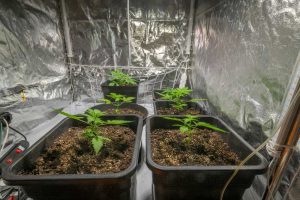
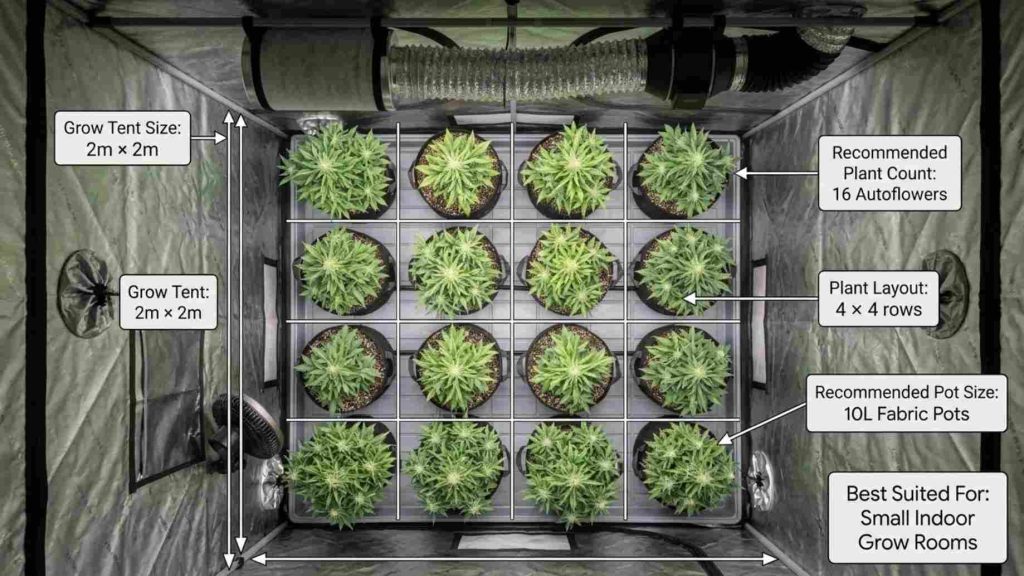
For a first grow, I would start with one autoflower in a 60 × 60 cm tent, two or three in a 90 × 90 cm tent, or three to five in a 120 × 120 cm tent. These are planning ranges, not fixed limits. An autoflower bred to stay compact will take up less room than a tall plant with long side branches, and training can make a plant wider than expected.
The usable growing area also depends on your light. A fixture may fit inside a tent without providing even coverage across its full floor. If the edges receive much less light than the middle, the practical growing area is smaller than the tent footprint.
Recommended plant count by grow tent size
| Grow tent size | Approximate size | Beginner plant count | Suitable arrangement |
| 60 × 60 cm | 2 × 2 ft | 1 | One compact autoflower |
| 60 × 120 cm | 2 × 4 ft | 1–2 | Two compact plants or one with a wider canopy |
| 90 × 90 cm | 3 × 3 ft | 2–3 | Small group with access between pots |
| 120 × 120 cm | 4 × 4 ft | 3–5 | Several moderate-sized plants |
| 150 × 150 cm | 5 × 5 ft | 5–8 | Larger home setup with suitable light coverage |
The table assumes reasonably compact to moderate plants, suitable fixtures and enough space for maintenance. It is not a recommendation to fill every available corner. If your chosen genetics tend to grow tall or wide, start at the lower end of the range. Always follow local cultivation limits.
Why fewer plants can make better use of a tent
A tent receives a limited amount of light from its fixture. Adding plants does not create more light; it increases competition for that coverage. Once leaves overlap heavily, the lower canopy can become shaded, and reaching the rear pots becomes difficult. Crowding also reduces the room available for air to move around the flowers.
The difference is particularly clear when comparing a few larger plants with a Sea of Green setup. Sea of Green uses more smaller plants to form a fairly level canopy, often in compact containers. It can work with autoflowers, but plant size must stay reasonably consistent and access needs careful planning. The Sea of Green method for autoflowers explains the approach in more detail.
Do not choose plant numbers from breeder yield figures alone. Those figures describe possible performance under particular conditions, not what every grower can expect. See how much an autoflower can yield for the factors behind those estimates.
Grower tip: Arrange the empty pots in the tent before germinating any seeds. Hang the light, place the extractor and open the door fully. If you cannot reach every pot comfortably, reduce the number before the plants start growing.
What Size Grow Tent Do Autoflowers Need?
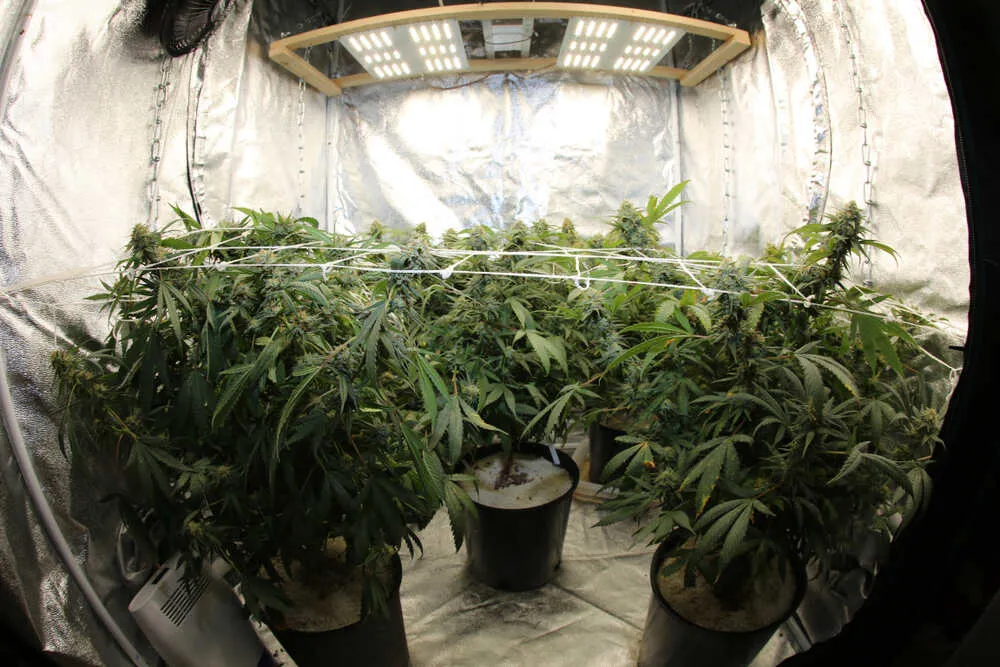
Choose a tent around the mature size of your plants and the room available in your home. Floor space is important, but the tent's height matters just as much. Even an autoflower described as compact can become difficult to manage if the light fixture hangs too close to the upper branches.
There is considerable variation between strains. Some autos stay short with tight branching; others develop a taller central stem and a broad canopy. Expected indoor height is useful for planning, but it is only an estimate. The guide to how tall autoflowers grow explains why final size can vary.
Allow for pots, lights and vertical clearance
A tent advertised as 160 cm tall does not provide 160 cm of space for the plant. The pot lifts the plant above the floor, the light and hanging fittings occupy the roof area, and every fixture needs clearance above the canopy. Some extractors and ducting also hang inside the tent.
| Equipment or plant feature | Space it occupies | What to check |
| Pot and drainage tray | Space below the plant | Pot height and access to runoff |
| LED fixture and hangers | Overhead space | Fixture dimensions and mounting |
| Light-to-canopy gap | Clearance above the leaves | Manufacturer guidance and light readings |
| Extraction equipment | Roof or side space | Duct bends and unobstructed airflow |
| Mature branches | Width around each plant | Room for inspection and circulation |
Do not rely on one universal light-hanging distance. Fixture output, heat management and beam spread vary. Follow the manufacturer's instructions and take canopy readings where possible. A taller tent gives you more flexibility, but good layout still matters.
Match the genetics to the footprint
For a narrow tent, look for autoflowers with a compact growth habit and controlled side branching. For a wider tent, larger strains may be practical if the light covers their canopy. Do not assume that a short flowering time means a short plant, or that every autoflower will finish at the same height.
Leave room to unzip the door, reach the rear corners and route the exhaust.
How to Set Up a Grow Tent for Autoflowers
A reliable auto grow tent does not require complicated equipment, but each part has a job. The light supplies energy for growth, extraction replaces warm and humid air, circulation fans move air through the canopy, and containers need to drain freely. Set everything up before bringing young plants into the tent.
Choose a light with suitable canopy coverage
Full-spectrum LEDs are practical for many home tents because efficient fixtures can deliver useful light with less heat than many older HID systems. Start with the manufacturer's flowering coverage map rather than the advertised wattage alone. A powerful fixture concentrated in the middle can still leave the edges poorly lit.
Two measurements are useful: PPFD describes the amount of photosynthetically active light reaching an area each second, while daily light integral (DLI) accounts for that light over the full day. The guide to PAR, PPFD and DLI for autoflowers explains how to interpret these figures without relying on wattage alone.
In a 2021 indoor cannabis study, Rodriguez-Morrison, Llewellyn and Zheng reported higher flower yields as canopy light intensity increased across their tested range. The plants in that study flowered under a 12-hour day, so it cannot establish an ideal light intensity for every autoflower. It does show why actual light reaching the canopy matters when evaluating a fixture.
Adjust intensity and hanging height as plants develop, following the fixture's guidance. Watch for uneven growth or upper leaves showing signs of excessive light rather than assuming brighter is always better.
Keep a consistent autoflower light schedule
Autoflowers begin flowering without needing shorter days. Leckie and colleagues (2024) identified a mutation associated with daylength-insensitive flowering in cannabis, helping explain this characteristic.
For a home grow tent, 18 hours of light and 6 hours of darkness is a common starting schedule. Some growers use 20/4. Both allow a consistent cycle through growth and flowering, but more light hours do not automatically mean better results. Intensity, electricity use and tent temperature also matter. The autoflower light schedule guide covers those choices in greater depth.
Install extraction and gentle air circulation
A typical tent uses an inline extractor to remove air from near the roof, with fresh replacement air entering through a lower intake. A carbon filter may be fitted when scent control is needed. Check that the extractor suits the tent volume as well as the resistance created by the filter and ducting. Keep bends in the ducting as simple as the room allows.
Circulation fans serve a different purpose. They move air within the tent, especially around the lower branches and developing flowers. Aim for gentle movement of leaves, not a constant blast at one spot.
This is not just about comfort. In research on greenhouse-grown cannabis, Buirs, Lung and Punja (2025), increased air circulation around flowers reduced the incidence of Botrytis bud rot under the conditions tested. That finding does not provide a guaranteed prevention method for a home tent, but it supports avoiding stagnant air around dense flowers.
Monitor temperature and humidity at canopy level
Keep a digital thermometer and hygrometer near the canopy, away from direct light and the humidifier outlet.
| Stage | Temperature starting range | Relative humidity starting range |
| Seedling | 22–25°C | 60–70% |
| Early growth | 22–26°C | 55–65% |
| Flowering | 20–26°C | 40–50% |
These are practical starting points rather than exact requirements for every strain. Adjust based on plant condition, ventilation and the environment outside the tent. The detailed guide to temperature and humidity for autoflowers covers the changes across the life cycle.
Grower tip: Check the tent during both light and dark periods. A reading taken when the LED is running may look fine, while the same tent can become cooler and more humid after the light switches off.
Select containers and a growing medium
For many moderate-sized autoflowers, 10–15 L pots offer a useful balance between root space and room on the tent floor. Larger plants may benefit from 15–20 L containers, but container size alone cannot guarantee a larger harvest. The autoflower pot size guide explains the trade-offs.
Fabric pots allow moisture to leave through the sides; plastic pots usually retain it for longer. Both are suitable with correct watering and drainage. Use trays to catch runoff, then empty them rather than leaving the roots standing in water.
A light, well-drained medium is useful for beginners. Avoid keeping the entire pot saturated around a small seedling. For a closer look at texture and drainage, see the guide to soil for autoflowers.
You can sow into the final container to avoid a transplant, although careful transplanting can also work. The important point is to avoid unnecessary root disturbance during a relatively short early growth period.
What Affects How Many Autoflowers Fit in a Tent?
The canopy changes as branches extend, and a training method that reduces height may increase width. Reassess spacing before flowering becomes dense.
Canopy width, pot spacing and access
There is no fixed minimum distance that suits every autoflower. Two compact plants may grow close together without creating a problem, while two broad plants may overlap heavily even when their pots are far apart. Keep enough room to inspect lower leaves, remove drainage trays and reach all sides of the canopy.
If plants grow into one another, avoid responding by stripping away large amounts of healthy foliage. Check whether light positioning, modest branch adjustment or a lower plant count would address the actual problem.
Training changes how much room each plant needs
Low-stress training guides flexible branches outward, which can keep the canopy lower and spread growth across the light footprint. That wider shape uses more floor space. The guide to low-stress training autoflowers explains the method in detail.
Topping, fimming and supercropping are more disruptive approaches and can require recovery time. Autoflowers continue through their life cycle without a light-cycle trigger, so stressful work done at the wrong stage can leave less time for the plant to recover. Beginners are often better served by gentle training or leaving a healthy plant to develop naturally.
Grower tip: When bending branches, picture the canopy a couple of weeks ahead. Spreading one plant may push it into the next, so allow for the final shape rather than tying every branch into the space available today.
Choosing the Right Grow Tent for Your Budget
A complete all in one grow tent kit can be convenient for a first setup, but a kit is only useful when the equipment matches the tent. Check the light's flowering footprint, extractor capacity, duct openings and available hanging height rather than buying on tent dimensions alone.
| Buying option | Advantage | Main consideration |
| All-in-one grow tent kit | Components purchased together | Check actual light coverage and extraction capacity |
| Separate equipment | More flexibility over individual parts | Check compatibility and total cost |
Also think about operating costs. A larger fixture and extractor can use more electricity, produce more noise and affect the temperature of the surrounding room. The ideal tent is one you can run and maintain consistently, not simply the largest one that fits indoors.
Before adding plants, operate the empty setup with the light and extraction running. Check that air has a clear route in and out, that electrical connections are away from water, and that you can open the tent without moving equipment. This also gives you a chance to spot unwanted heat or noise.
Conclusion
How many autoflowers you can grow in a tent depends on the mature plants, useful light coverage and space left for ventilation and access. Begin with a manageable number, choose genetics that suit the footprint and allow for the canopy to expand. A slightly less crowded tent is easier to look after during the entire cycle and gives you more room to respond if the plants grow larger than expected.
Frequently Asked Questions
How many autoflowers can I grow in a 2 × 4 tent?
One or two autoflowers are sensible for a beginner in a 60 × 120 cm tent. Two compact plants can use the length well, but one broad or heavily trained plant may occupy most of the canopy area.
How many autoflowers fit in a 4 × 4 tent?
A 120 × 120 cm tent can typically accommodate three to five moderate-sized autoflowers with suitable lighting and ventilation. Use fewer if your chosen strains have a wide growth habit.
Can I grow autoflowers in an all-in-one grow tent?
Yes. Check that the included light covers the canopy, the extractor can exchange air effectively and there is enough height for the pots and light clearance. Kit contents vary.
Do autoflowers need a 12/12 light schedule in a tent?
No. Autoflowers initiate flowering without a change to shorter days. Many growers keep an 18/6 or 20/4 schedule throughout the crop, adjusting light intensity as plants develop.
Does adding more autoflowers increase yield?
Not necessarily. Once the canopy is full, extra plants may compete for the same light and reduce access. Plant health, genetics, light coverage and steady conditions matter more than pot count alone.
References
- Leckie, K. M., et al. (2024). Loss of daylength sensitivity by splice site mutation in Cannabis pseudo-response regulator. The Plant Journal. https://doi.org/10.1111/tpj.16726
- Rodriguez-Morrison, V., Llewellyn, D., & Zheng, Y. (2021). Cannabis yield, potency, and leaf photosynthesis respond differently to increasing light levels in an indoor environment. Frontiers in Plant Science, 12, 646020. https://doi.org/10.3389/fpls.2021.646020
- Buirs, L., Lung, S., & Punja, Z. K. (2025). The epidemiology and management of Botrytis cinerea causing bud rot on greenhouse cultivated cannabis (Cannabis sativa L.). Canadian Journal of Plant Pathology. https://doi.org/10.1080/07060661.2025.2478250

