




Autoflowers can be grown successfully in hydroponic systems, giving growers direct control over nutrients, pH, oxygen levels, and conditions around the root zone. The trade-off is that hydroponics can be less forgiving than soil, particularly with autoflowers, whose short lifecycle leaves less time to correct feeding or environmental problems.
In this guide, we’ll look at the hydroponic systems best suited to autoflowers, the equipment you need to get started, and how to manage each stage of growth. We’ll also cover pH and EC targets, reservoir management, common root and nutrient problems, and the key differences between growing autoflowers in hydroponics and soil.
Key Takeaways
- Autoflowers can grow very well in hydroponic systems, including DWC, ebb and flow, and drip irrigation, provided the root zone and nutrient solution are managed carefully.
- Hydroponics gives you precise control over feeding, but autoflowers have a short lifecycle, so pH, EC, and reservoir conditions need to be checked regularly.
- DWC and drip systems are particularly accessible options, while ebb and flow can suit growers running several autoflowers at the same time.
- Nutrient strength should increase gradually as plants mature, with seedlings requiring a light feed and flowering plants tolerating higher EC levels.
- Healthy roots are central to successful hydro grow, so maintain good oxygenation, suitable water temperatures, and a stable environment throughout the crop.
What is hydroponics?
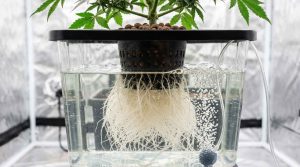
Hydroponics refers to a method of growing cannabis without using soil. When growing autoflower seeds hydroponically, plants can be supported in rockwool, hydroton, or coco coir and supplied with nutrients through drippers or an oxygenated nutrient solution.”
This means that unlike soil, which depends on nutrients being slowly delivered back to roots, autos grown in hydro can use more nutrients instantly and grow much faster and larger as a result.
This is one reason why autos grown in hydroponic systems can produce such impressive yields. There are many types of hydro systems available to a home grower, as covered below.
The different types of hydroponic systems
Growing cannabis using hydroponics may seem complex; however, you will be surprised at just how easy using hydro systems is! The most commonly used hydroponic systems are deep water culture (DWC), ebb and flow, and dripper systems. Below, I will explain each system in detail and what you need to know before investing in one.
| System | Best for | Key point |
| DWC | 1–2 plants | Roots sit in oxygenated nutrient solution |
| Ebb & flow | Multiple plants | Floods and drains the root zone |
| Drip system | Beginners | Delivers nutrients through drip lines |
Deep water culture (DWC)
DWC, in my opinion, is easily the highest-yielding system, because the roots of your auto will be suspended in an oxygen-rich nutrient solution 24 hours a day. A DWC system comprises a plastic bucket, an air stone, an air pump, and a lid that houses a net pot with hydroton clay balls.
An air pump is connected to an air stone, which creates dissolved oxygen inside the reservoir. A nutrient change is required once every 5-7 days depending on how mature the plants are.
- DWC systems are ideal for small spaces and growing one single plant.
- The roots have access to dissolved oxygen and nutrients.
- Autos grown in a DWC system can grow very large.
- DWC does require regular maintenance.
- Vegetation time is minimized to 7-10 days
Ebb & flow
Also known as flood and drain systems, ebb and flow tables work by slowly flooding the table where your autos are sitting on, inside pots. When growing autos using an ebb and flow system, you can use either hydroton clay balls or coco coir as your growing medium. Multiple plants can be grown at once, making this system optimal for Sea of Green setups and maximum yields.
A pump is connected to a reservoir underneath the table, which floods the table and drains away when you programmed the feeding schedule. When flooding the table and allowing it to drain, you supply the roots with oxygen and nutrients, and you can feed 3-5 times a day once you enter the flowering stage.
- Check to see if your grow space will comfortably fit an ebb and flow table.
- Using hydroton works incredibly well when growing autos using ebb and flow.
- Mature plants can be fed up with 5 times per day when flowering
- Vegetation time is minimized to 7-10 days
Drip systems
Dripper systems are probably the best systems for a soil grower switching to hydroponics. A dripper system kit is made up of a pump, tubing and drip lines. You connect the pump to a timer, which slowly drips nutrients to the roots for 15 minutes at a time.
In the past, when using hydroton and a dripper ring, I was able to keep the pump on for 24 hours a day, and the plants were absolutely thriving! You can use coco coir, rockwool or hydroton for dripper systems. Some soil growers even enjoy using dripper systems to feed water at the same time and at the same exact rate every day.
- Dripper systems are a great starting point for beginners.
- These systems are easy to set up and are low cost.
- They can be used for one or many plants.
- Dripper systems are almost silent compared to an air pump.
Essential equipment to grow autoflowers hydroponically.
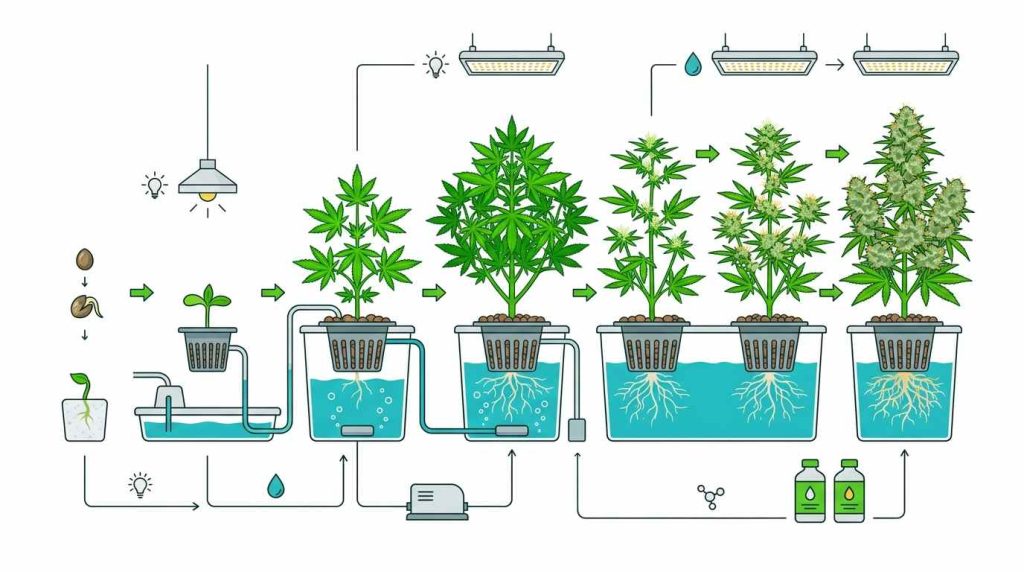
Hydroponic systems require a pump or air pump and use moving parts that require electricity. Below is a list of everything that you will need to grow autos using hydroponics:
| Equipment | Purpose |
| Hydroponic system | Supports the plants and root zone |
| Autoflower seeds | Genetics for the grow |
| Air/water pump | Moves water or adds oxygen |
| EC meter | Measures nutrient strength |
| pH pen | Measures solution pH |
| Hydro nutrients | Supplies essential nutrients |
Week-by-week guide to grow autoflowers hydroponically
Autos are fast-growing varieties that thrive inside hydroponic systems. Below, we’ll cover how each stage changes when using hydroponics. For a broader look at the entire lifecycle from seed to harvest, our week-by-week autoflower growing guide explains what to expect as the plant develops.”
| Stage | Environment | EC |
| Seedling | 24°C · 60–70% RH | Minimal |
| Vegetative | 24°C · 60% RH | 0.8–1.2 |
| Flowering | 24°C · 40–50% RH | 1.2–1.8 |
Germinating in hydroponics
Autos do not respond particularly well to unnecessary transplant stress, so when germinating autoflower seeds for a hydro system, I prefer to start them directly in a rockwool cube or starter plug that can be transferred into the final setup. I will plant the seed directly into the rockwool cube or place the small rockwool starter cube inside the hydroponic-filled net pot or inside coco coir, depending on the system and set-up.
Seedling stage
The autoflower seedling stage will take 14 days. During this time, your autos are developing their first set of roots and their first true leaves. At this stage, your hydroponic autoflower seedlings do not require much light intensity and minimal nutrient levels.
- Temperature of 24°C
- Maintain a relative humidity level of 60-70%
- Keep the EC nutrient solution level minimal.
Vegetative stage
The vegetative stage of an auto will last for another 2 weeks before automatically transitioning to flower. Autos that are grown in hydroponic systems will grow much faster than in soil, and it is over the next 3 weeks that your plants will really establish themselves as robust and vigorous plants capable of big yields.
- Temperature of 24°C
- Maintain a relative humidity level of 60%.
- Keep the EC nutrient solution between 0.8 and 1.2 mS/cm.
Flowering stage
It is during the flowering stage when you really get to see how incredible hydroponic systems are for autoflowering genetics! The buds form and develop so quickly and grow with compact and hard-to-squeeze characteristics. Check developing flowers regularly for signs of mold as harvest approaches. Autoflowers do not require a 12/12 light cycle to flower, so if you are deciding how long to keep the lights on, our guide to the best light schedule for autoflowers compares the main options. If flushing forms part of your approach, our guide on when to flush autoflowers explains how to judge the timing using plant maturity rather than a fixed light schedule.
- Temperature of 24°C
- Maintain a relative humidity level of 40-50%
- Keep the EC nutrient solution between 1.2 and 1.8 mS/cm.
Things you should look out for when growing autoflowers in hydroponics
The beauty of growing autoflowering cannabis plants using soil is that you can make a feeding or watering error, and the plants will show signs 72 hours later. Hydroponics, on the other hand, is much more complex and demanding. You will be responsible for how your plants are fed and maintaining the nutrient reservoir.
Below, I’ll break down all the things to look out for when growing autos using hydro, such as feeding requirements, monitoring pH and EC and proper reservoir management.
What nutrients should hydroponics setups contain
When you are buying your nutrients, you will need to make sure that you have the complete range of primary, secondary and micronutrients/trace elements. Hydroponic nutrients are synthetic and made from chemicals. This means that the plants are able to access and absorb the nutrient immediately, which is the main reason why autos grown in hydroponic systems can become massive.
Primary nutrients:
- Nitrogen (N)
- Phosphorus (P)
- Potassium (K)
Secondary nutrients:
- Calcium (Ca)
- Magnesium (Mg)
Trace elements:
- Iron (Fe)
- Manganese (Mn)
- Boron (B)
- Zinc (Zn)
- Copper (Cu)
- Molybdenum (Mo)
- Chlorine (Cl)
- Nickel (Ni)
General autoflower feeding chart guidance
Autoflowers generally respond better when nutrient strength is increased gradually rather than pushed aggressively from the beginning. Our autoflower nutrient feeding schedule provides a broader stage-by-stage reference, although hydro growers should still use EC and plant response to fine-tune their feed. The reason is that autos are more sensitive to nutrients, and due to the extra fast transition from seed until bloom, they prefer a lower ratio of nutrients. You can take your EC level higher once flowering has commenced, but do not exceed 1.8 mS/cm to avoid over-fertilisation.
Ensuring your pH level is suitable for hydroponic grows
pH determines everything when you are growing cannabis, and you have to be extra vigilant and on the ball when growing autos in hydroponics. If your pH level is not within the optimal range of 5.5 - 6.5, then your plants will not be able to access the nutrients despite the nutrient solution containing plenty of nutrients.
Nutrient lockout can result in nutrient deficiencies and plant health diminishing quickly in hydro systems, and any pH-related issue should be amended immediately. I would advise that you develop a habit of checking the pH level of the reservoir every 6-9 hours, and adjust using pH Up or pH Down products.
- A digital pH pen will allow you to see the exact pH level of your reservoir
- Adjusting the pH using pH Up or Down is the easiest method
- The pH of the reservoir can drift, so daily monitoring is essential
- Keep the pH level within a range between 5.5 - 6.5 for optimal nutrient uptake
Managing your EC, PPM and reservoir temperature
- Use an EC meter to check the strength of your nutrient solution
- Keep the EC of the nutrient solution between 0.8 and 1.2 mS/cm during veg
- Keep the EC of the nutrient solution between 1.2 and 1.8 mS/cm during flower
- Reservoir temperature should range between 18–24°C
- An aquarium tank heater works perfectly for maintaining water temperature
Common autoflower hydroponics issues and how to avoid them
If you do take on the challenge of growing autoflowering plants in hydro, then you will need to anticipate potential issues and know in advance how to fix them. Below are highlights of the different problems you may face: nutrient deficiencies, root-related problems and environmental factors such as lighting, airflow, temperature and more.
| Problem | What to check |
| Nutrient deficiency | EC and reservoir pH |
| Nutrient lockout | pH range |
| Root problems | Water temperature and oxygen |
| Poor growth | Light, temperature and airflow |
| Mould risk | Humidity and air movement |
Nutrient deficiencies
A nutrient deficiency will occur if the EC levels are too low, or you have a pH problem and the plants are experiencing nutrient lockout. Nutrient problems often become visible in the leaves first. If discoloration is the main symptom, our guide to yellow leaves on cannabis plants explains how to distinguish feeding problems from pH, watering, root and environmental issues.
Root problems
Keeping your roots well oxygenated and supplying a balance of nutrients will be the key to how healthy and robust your plants grow, and what they are capable of yielding. I can tell you from experience that the roots of an auto grow at a rapid rate and quickly fill the pot.
Check the roots on a daily basis and check that the water temperature is not too hot. This can become a prime breeding ground for pathogens, especially if there are low levels of oxygen in the water.
Environmental issues (such as lighting, airflow, etc)
There is no point in having your hydroponic system working well if the growing environment is not ideal. Autos grown hydroponically still need light intensity to match their stage of development. Understanding PAR, PPFD and DLI for autoflowers can help you judge how much usable light the canopy is actually receiving rather than simply increasing lamp power.
- Use a PAR meter to check the PPFD levels in your grow room
- Multiple oscillating fans will create fresh air currents
- Thick and well-developed colas are prone to mould
Why use hydroponics over soil when growing autoflowers?
Over the last 20 years growing indoors, I have tried and tested all methods of growing and discovered the best tricks and tips for boosting yields. One thing I can confidently say is that autoflowers thrive in hydroponic systems. Below explains all the benefits of using hydroponics for autoflowers, and why you should consider growing your next round of autos in hydro.
Benefits of using hydroponics for autoflowers
- Hydroponics produce very large yields
- Autos can grow very fast during vegetation
- The roots have the opportunity to become well developed
- Hydro systems such as DWC are ideal for 1 or 2 plants
- Ebb and flow and dripper systems are perfect for SOG grows
- Plants will produce thick and compact top-quality buds
- There is no need to hand-water every day
Faster growth and higher yield
Even when growing photoperiods with hydroponics, you have to restrict the vegetation time down to 10 days to avoid the plants becoming too large. Hydroponics can support rapid growth, but final autoflower yield still depends on genetics, lighting, nutrition, environmental control and how well the root zone is managed.
Greater control over nutrients and root health
As a fan of growing organically, I do enjoy the fact that with hydro you have a much greater control over nutrients and root health. Feeding hydroponic autos requires a strict feeding regimen that is very EC-specific for each growth stage. Hydroponics allows you to grow in a sterile, bacteria- and organic-free environment, which is advantageous for better overall root health and development.
Cleaner and more efficient indoor grows
Organic growing is a lot of fun, involving composting, microbes and beneficial microorganisms. Hydroponics is the complete opposite and operates in a clean, sterile and microbe-free environment. This means you can experience a cleaner and more effective indoor grow!
Conclusion
Growing autoflowers hydroponically gives growers far greater control over the root zone, nutrient strength, and feeding schedule compared with soil cultivation. Systems such as DWC, ebb and flow, and drip irrigation can all perform well with autoflower genetics, but each demands careful attention to reservoir conditions and the overall growing environment.
Because autoflowers have a short lifecycle, there is less time to correct mistakes once problems appear. Regularly monitor pH and EC, maintain nutrient solution temperatures within an optimal range, ensure strong oxygenation around the roots, and avoid overfeeding or pushing nutrient strength too quickly.
For growers willing to monitor plants closely, hydroponics can be a highly efficient method for taking autoflowers from seed to harvest. The key is to start with a system that matches your experience level and available space, only keep the setup simple, and make gradual adjustments based on plant response rather than forcing rapid growth from the outset.
Frequently Asked Questions
What is the best hydroponic system for autoflowers?
DWC and drip systems are both good options for growing autoflowers. DWC gives the roots constant access to oxygenated nutrient solution, while drip systems can feel more familiar to growers moving from soil or coco. Ebb and flow is another option if you want to grow several plants at the same time.
What pH should I use for autoflowers in hydroponics?
The article recommends keeping the nutrient solution between pH 5.5 and 6.5. Check the reservoir regularly because pH can drift over time, potentially reducing the plant's ability to take up nutrients.
What EC should I use for hydroponic autoflowers?
As a general guide, the article recommends an EC of around 0.8–1.2 mS/cm during vegetative growth and 1.2–1.8 mS/cm during flowering. Seedlings require a much weaker nutrient solution. Treat these figures as starting points and watch how the plants respond before increasing nutrient strength.
How long do autoflowers take to grow in hydroponics?
The complete lifecycle will depend on the genetics, but the article gives a general range of around 9–12 weeks from seed to harvest. Hydroponics can encourage rapid growth, but it does not change the genetically determined lifecycle of an autoflower.
What are the most common problems when growing autoflowers hydroponically?
The main issues to watch for are incorrect pH, nutrient strength that is too high or too low, poor root-zone oxygenation, unsuitable reservoir temperatures and environmental problems such as poor airflow or excessive humidity. Regularly checking the roots, reservoir, pH and EC can help you catch problems before they become more serious.


