




Maintaining the right grow room temp and humidity is essential for healthy cannabis growth. Temperature influences photosynthesis and water loss, while humidity affects transpiration and the risk of fungal disease. Both conditions change throughout the day and as plants develop, making regular monitoring important.
This guide includes a grow room temp and humidity chart in Fahrenheit and Celsius, covering seedlings, vegetative growth and flowering. You'll also learn how to maintain suitable grow room conditions, measure grow tent temp accurately and correct temperature and humidity problems using practical methods.
Key Takeaways
- Grow room temperature and humidity work together. Changes in temperature affect relative humidity and how quickly plants lose water.
- Use a grow room temperature chart. Compare recommended temperatures in Fahrenheit and Celsius alongside humidity levels for each growth stage.
- Humidity requirements change as plants mature. Seedlings generally benefit from higher RH, while flowering plants require greater moisture control.
- Monitor grow tent temp during both light periods. Temperatures often fall after lights-off, causing relative humidity to increase.
- Correct environmental problems gradually. Check lighting, ventilation and incoming air before adjusting heating, cooling or humidity equipment.
- Grow Room Temp and Humidity Chart (Fahrenheit and Celsius)
- What Temperature Should a Grow Room Be?
- Humidity Levels for Each Stage of Cannabis Growth
- How Temperature, Humidity and VPD Work Together
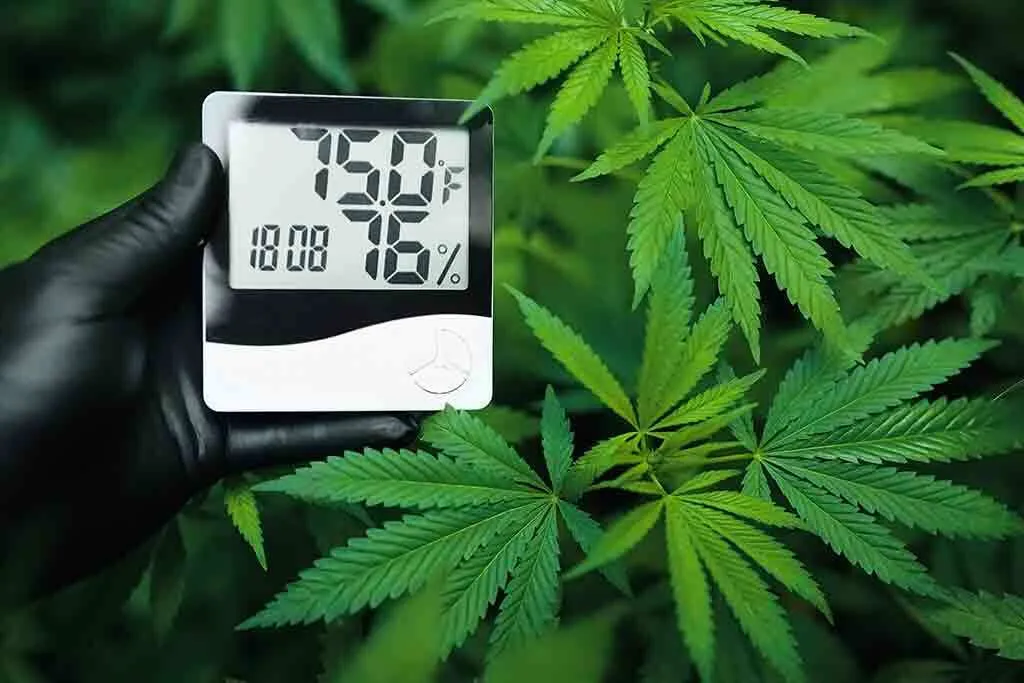
- How to Measure Grow Tent Temperature and Humidity
- How to Lower Grow Room Temperature
- How to Raise Grow Room Temperature
- How to Lower Humidity in a Grow Room
- How to Increase Grow Room Humidity
- Common Grow Room Temperature and Humidity Problems
- Conclusion
- Frequently Asked Questions
- References
Grow Room Temp and Humidity Chart (Fahrenheit and Celsius)
This grow room temperature chart provides starting ranges for each stage of cannabis growth.
| Growth stage | Lights-on temperature | Lights-off temperature | Relative humidity |
| Seedlings and clones | 20–25°C / 68–77°F | 18–22°C / 64–72°F | 65–75% |
| Vegetative growth | 22–27°C / 72–81°F | 18–23°C / 64–73°F | 55–65% |
| Early flowering | 20–26°C / 68–79°F | 18–22°C / 64–72°F | 45–55% |
| Late flowering | 20–25°C / 68–77°F | 18–21°C / 64–70°F | 40–50% |
These are general starting ranges, not universal requirements. Suitable conditions depend on cultivar, lighting intensity, leaf temperature and airflow.
For example, 25°C with 60% humidity creates different evaporative conditions from 25°C with 40% humidity. Use temperature and RH together rather than selecting the extremes of each range independently.
What Temperature Should a Grow Room Be?
Temperature influences photosynthesis, respiration and transpiration.
Chandra et al. (2011) studied seven cannabis varieties and found different temperature responses during photosynthesis. This demonstrates why one temperature setting cannot be considered ideal for every cultivar.
With lights on, measure temperature at canopy height after the room has settled. Lighting increases heat around plants, and leaf temperatures may differ from surrounding air.
With lights off, check the overnight minimum. Cooling can increase RH even when no additional moisture enters the room.
The objective is to maintain suitable conditions across both periods without excessive fluctuations.
Humidity Levels for Each Stage of Cannabis Growth
Cannabis plants generally require less humidity as they mature. Seedlings benefit from higher moisture levels while their roots develop, whereas flowering plants need drier conditions to reduce the risk of fungal disease.
The following cannabis humidity chart provides starting ranges for each growth stage. Adjust these according to temperature, airflow and cultivar requirements.
| Growth stage | Recommended humidity | Why it matters |
| Seedlings and clones | 65–75% RH | Reduces excessive water loss while young roots develop. |
| Vegetative growth | 55–65% RH | Supports transpiration as roots and foliage develop. |
| Early flowering | 45–55% RH | Helps manage moisture as flowers begin forming. |
| Late flowering | 40–50% RH | Reduces moisture buildup around dense flowers and the risk of fungal disease. |
Seedlings and Clones
Higher humidity reduces water loss while young plants establish their root systems. During the cannabis seedling stage, maintain consistent humidity without allowing condensation to collect on leaves or inside propagation domes.
Vegetative Growth
As roots and foliage develop, plants can tolerate lower humidity. During the vegetative stage, gradually reduce RH and maintain airflow between plants to prevent moisture buildup.
Early Flowering
As flowers begin developing, gradually lower humidity to manage excess moisture. Keep air moving through the canopy, particularly around crowded branches and foliage.
Late Flowering
Dense flowers can trap moisture, increasing the risk of fungal disease. Buirs and Punja (2024) identify Botrytis bud rot and powdery mildew among important cannabis pathogens.
Maintaining lower humidity during the later flowering stage helps reduce these risks, although humidity control alone cannot prevent infection.
These ranges are general recommendations rather than fixed requirements. Always consider temperature alongside humidity, as both influence plant water loss.
How Temperature, Humidity and VPD Work Together
Relative humidity (RH) measures how close air is to moisture saturation at a given temperature.
Heating air without adding moisture generally lowers RH. Cooling the same air increases RH.
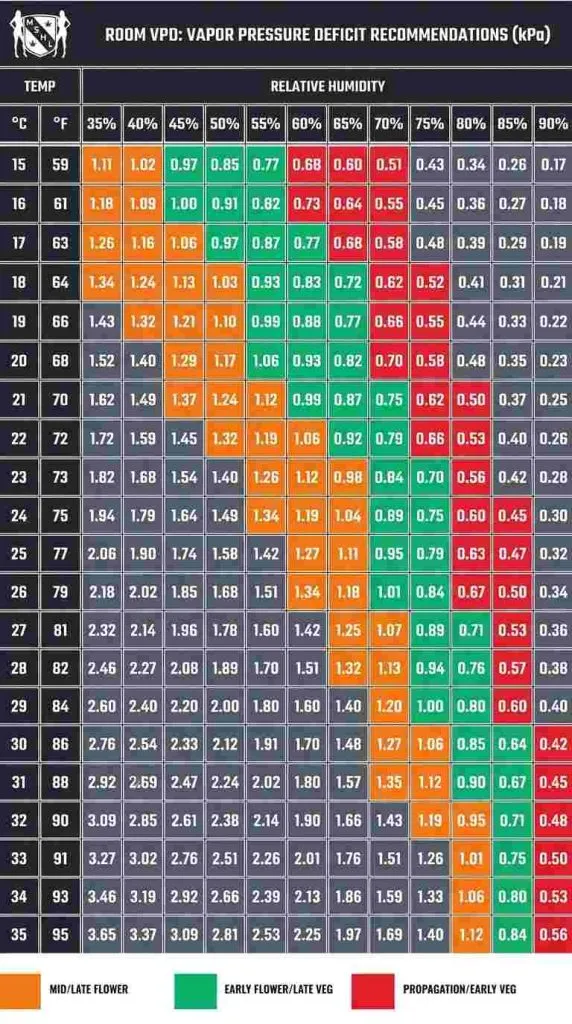
VPD measures the difference between saturation moisture pressure and actual moisture pressure, expressed in kilopascals (kPa). It helps describe the air's potential to draw water from leaves.
At 25°C, the approximate air VPD is:
| Relative humidity | Air VPD |
| 60% | 1.27 kPa |
| 40% | 1.90 kPa |
Lower humidity creates greater evaporative demand at the same temperature. These figures assume leaf and air temperatures are equal.
A cannabis VPD chart helps interpret these combined measurements.
Corredor-Perilla et al. (2025) compared two humidity environments in a CBD-dominant cannabis cultivar. Extremely high humidity reduced biomass and delayed flowering, although the results do not establish universal targets for all cultivars.
How to Measure Grow Tent Temperature and Humidity
Accurate measurements help prevent unnecessary equipment adjustments.
Step 1: Position the sensor correctly
Place a thermometer-hygrometer near canopy height, away from direct lighting, humidifier mist and ventilation outlets.
A sensor beside a light may record higher temperatures than the surrounding canopy.
Step 2: Measure during both light periods
Record temperature and humidity after lights have been operating and during darkness.
Use a sensor with minimum and maximum memory to identify overnight changes.
Step 3: Compare different areas
In larger rooms, use additional sensors to identify uneven conditions. If one area is warmer, inspect lighting and airflow before adjusting the entire room.
Step 4: Record the results
Record readings before changing settings, then check again after conditions settle. This helps determine whether the adjustment worked.
Grower Tip: Keep the main sensor level with the upper canopy as plants develop. Readings near the floor may not represent conditions around the leaves.
How to Lower Grow Room Temperature
When your grow tent temp becomes too high, identify where the heat originates before increasing extraction.
Step 1: Compare indoor and incoming air
Measure the temperature inside the tent and in the surrounding room.
If incoming air is cooler, increasing extraction may help. If both areas are equally warm, additional ventilation alone is unlikely to correct the problem.
Step 2: Inspect ventilation
Check for blocked filters, restricted ducting and exhaust air returning towards the intake.
A properly planned grow tent setup provides a clear route for fresh air to enter and warm air to leave.
Increase fan speed gradually and check the canopy temperature again.
Step 3: Check lighting
Confirm that your cannabis grow lights are positioned and operated according to the manufacturer's recommendations.
Excessive light intensity may increase leaf temperatures.
Step 4: Cool incoming air
If the surrounding room remains warm, air conditioning may be necessary. Check temperature again during the warmest part of the light cycle.
Inspect plants for signs of heat stress rather than assuming unusual leaf curling is caused by feeding.
How to Raise Grow Room Temperature
Cold conditions often result from unheated rooms, cold floors or excessive heat loss.
- Measure incoming air. Check whether cold air enters through ventilation or gaps.
- Reduce heat loss. Improve insulation where practical and raise pots away from cold surfaces.
- Use controlled heating. Set a thermostat-controlled heater to a temperature within your intended range. Use equipment suitable for the location and follow electrical safety instructions.
- Check overnight readings. If temperatures remain too low, inspect heat loss and heater capacity before increasing the thermostat further.
Maintain adequate ventilation. Heating may lower RH, so confirm both readings after making changes.
How to Lower Humidity in a Grow Room
High humidity may result from transpiration, standing water, insufficient moisture removal or overnight cooling.
Step 1: Identify when humidity increases
Compare daytime and nighttime readings.
For example, air at 25°C and 50% RH can reach approximately 68% RH if it cools to 20°C without losing moisture.
If RH rises mainly after lights-off, investigate nighttime temperature first.
Step 2: Remove excess moisture
Empty runoff trays, check for leaks and avoid permanently saturated growing media. Appropriate watering practices help prevent unnecessary moisture buildup.
Step 3: Check ventilation
Compare incoming and indoor air conditions. Ventilation helps when incoming air contains less moisture, but may worsen humidity when outside air is damp.
Remember that RH alone does not show total moisture content. Cooler air can have higher RH while containing less water than warmer air.
Step 4: Use a dehumidifier
Set a humidistat near the intended RH target. Allow conditions to settle, then verify the reading using a separate sensor at canopy height.
Use circulation fans to prevent stagnant air, but remember that airflow alone does not remove moisture.
Step 5: Inspect plants
Check leaves for powdery mildew and dense flowers for bud rot. Correcting humidity reduces environmental risk but does not cure an existing infection.
Grower Tip: Check maximum humidity immediately before lights switch on. Overnight cooling can reveal problems that are not apparent during the day.

How to Increase Grow Room Humidity
Low humidity increases evaporative demand, particularly when temperatures are elevated.
Step 1: Confirm the reading
Check sensor placement and temperature. Excessive heating may be contributing to low RH.
Step 2: Set up a humidifier
Connect a humidifier to a humidistat and select a target within the appropriate growth-stage range.
Keep mist away from leaves, electrical equipment and sensors.
Step 3: Review extraction
If ventilation continually replaces humid indoor air with dry incoming air, reduce fan speed cautiously while maintaining adequate air exchange.
Step 4: Check the response
Allow humidity to settle, then check the canopy reading. If RH remains low, review humidifier capacity, incoming air and room size.
Grower Tip: Avoid wet towels or constantly damp growing media as primary humidity controls. Their moisture output is unpredictable and may create local damp areas.
Common Grow Room Temperature and Humidity Problems
| Problem | Likely cause | What to check first |
| High temperature | Lighting or warm incoming air | Light settings and intake temperature |
| Low temperature | Heat loss or cold intake | Overnight minimum and insulation |
| High humidity | Excess moisture or cooling | Runoff, ventilation and nighttime RH |
| Low humidity | Dry incoming air or heating | Humidifier and incoming air |
| Uneven conditions | Poor air distribution | Sensor positions and circulation |
Conclusion
Maintaining suitable grow room temperature and humidity starts with understanding how both conditions affect plant development. Use the grow room temp and humidity chart as a starting point, then adjust your environment according to growth stage, cultivar and actual measurements.
Check conditions regularly, identify the cause of any changes and make gradual adjustments. Consistent monitoring is more reliable than trying to maintain one exact temperature or humidity level.
Frequently Asked Questions
Why do two hygrometers show different humidity readings?
Sensors may differ because of calibration, accuracy or placement. Position them together for comparison, away from direct heat and moisture. Small differences are normal, but consistently large variations may indicate that one sensor needs calibration or replacement.
Does condensation inside a grow tent mean humidity is too high?
Condensation forms when moist air meets a surface cold enough for water to collect. It can occur even when the main humidity reading appears acceptable. Check surface temperatures, ventilation and overnight conditions if water regularly forms on tent walls.
Can grow room temperature and humidity be correct while plants still show stress?
Yes. Incorrect watering, excessive light intensity, nutrient problems or root damage can cause stress even when environmental readings fall within recommended ranges. Inspect the plants and growing medium before adjusting temperature or humidity.
Does growing in soil or hydroponics change humidity requirements?
The plant's basic environmental needs remain similar, but moisture entering the room can differ. Open hydroponic reservoirs and wet growing media may contribute additional evaporation, depending on their exposed surface area and surrounding conditions.
Does the type of water used in a humidifier matter?
Yes. Hard water can leave mineral deposits, particularly when ultrasonic humidifiers release dissolved minerals into the air. Follow manufacturer guidance, use suitable water and clean the reservoir regularly to reduce mineral buildup and microbial contamination.
References
- Chandra, S., Lata, H., Khan, I. A., & ElSohly, M. A. (2011). Temperature response of photosynthesis in different drug and fiber varieties of Cannabis sativa L.. Physiology and Molecular Biology of Plants, 17(3), 297–303.
- Buirs, L., & Punja, Z. K. (2024). Integrated Management of Pathogens and Microbes in Cannabis sativa L. (Cannabis) under Greenhouse Conditions. Plants, 13(6), 786.
- Corredor-Perilla, I. C., Kwon, T.-H., & Park, S.-H. (2025). Elevated relative humidity significantly decreases cannabinoid concentrations while delaying flowering development in Cannabis sativa L.. Frontiers in Plant Science, 16, 1678142.

