




If you want more control over your grow-room environment, understanding cannabis VPD is a great place to start. Vapor pressure deficit shows how temperature, humidity, and leaf temperature work together, helping you fine-tune conditions for steady transpiration and healthy plant development.
I have found VPD especially useful when dialing in indoor grows because it gives you more information than temperature or humidity alone. In this guide, I'll explain how to measure VPD, the ideal ranges for each growth stage, what happens when VPD is too high or low, the tools you need, and how saturation vapor pressure (SVP) relates to VPD.
Key Takeaways
- VPD combines temperature, relative humidity, and leaf temperature to show how strongly the grow-room environment is driving transpiration.
- Ideal cannabis VPD changes by growth stage, from around 0.4–0.8 kPa for seedlings and clones up to 1.2–1.6 kPa during mid to late flowering.
- VPD that is too high can increase water loss, while VPD that is too low can slow transpiration and create more humid conditions around developing flowers.
- A digital thermo-hygrometer, infrared thermometer, and VPD calculator are the main tools needed to monitor VPD accurately.
- VPD should be used as a guide rather than a strict rule, alongside good lighting, airflow, irrigation, nutrition, and regular plant checks.
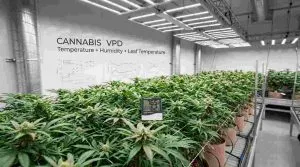
What is VPD?
Vapor pressure deficit (VPD) measures the difference between the moisture pressure at a cannabis leaf surface and the surrounding air. Measured in kilopascals (kPa), it helps growers understand how strongly the environment is driving transpiration.
Cannabis VPD combines temperature, relative humidity, and leaf temperature to give a clearer picture of plant conditions. Keeping VPD within a suitable range supports water movement, nutrient transport, stomatal function, and photosynthesis.
How do you measure VPD?
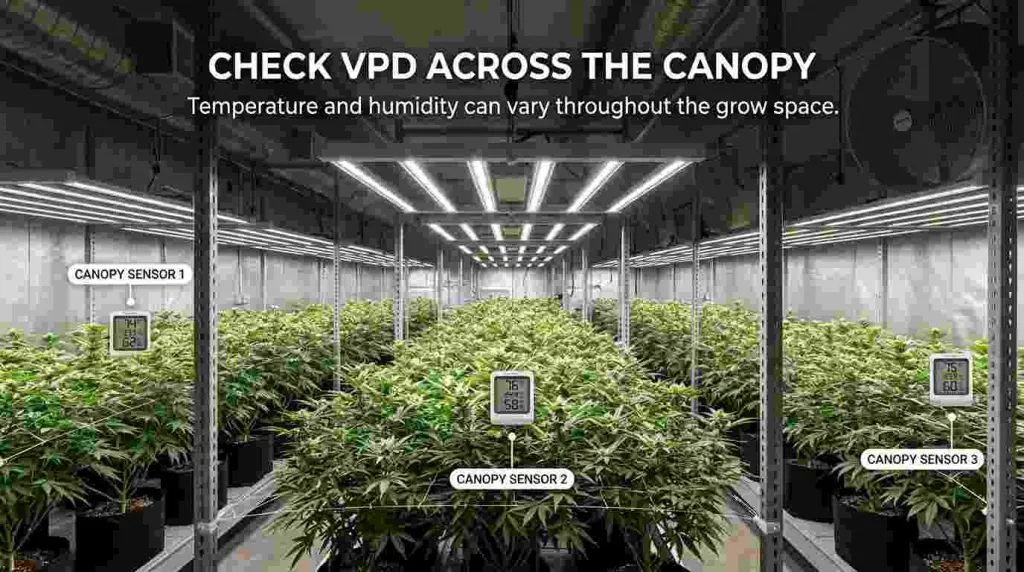
For an accurate reading, measure conditions around the canopy rather than elsewhere in the grow room.
| Measurement | Tool | Purpose |
| Air temperature | Digital thermo-hygrometer | Measures canopy temperature |
| Relative humidity | Digital thermo-hygrometer | Measures moisture in the air |
| Leaf temperature | Infrared thermometer | Measures the temperature of the leaf surface |
Place the thermo-hygrometer at canopy height and use an infrared thermometer to check several healthy fan leaves. Enter these readings into a VPD calculator or cannabis VPD chart to calculate the result in kPa.
Grower tip: Take readings from several areas of the canopy, particularly in larger grow spaces, as temperature and humidity can vary between different locations.
Why is VPD important for cannabis plants?
VPD affects how quickly cannabis plants lose water through their stomata. Keeping it within an appropriate range can help:
- Support consistent transpiration and nutrient movement.
- Maintain efficient stomatal function and CO₂ uptake.
- Reduce excessive water loss in hot or dry conditions.
- Prevent transpiration from slowing when humidity is too high.
- Reduce environmental conditions that favor mold and mildew.
- Maintain more consistent growth throughout the plant lifecycle.
VPD does not prevent heat stress, deficiencies, or mold on its own. Instead, it helps growers understand how temperature and humidity work together so they can make more precise environmental adjustments.
The ideal VPD measurements for each growth stage
Cannabis plants need different environmental conditions as they mature, so your VPD target should change throughout the grow. Young plants prefer lower VPD, while established plants can handle a greater level of transpiration as they move through vegetative growth and flowering.
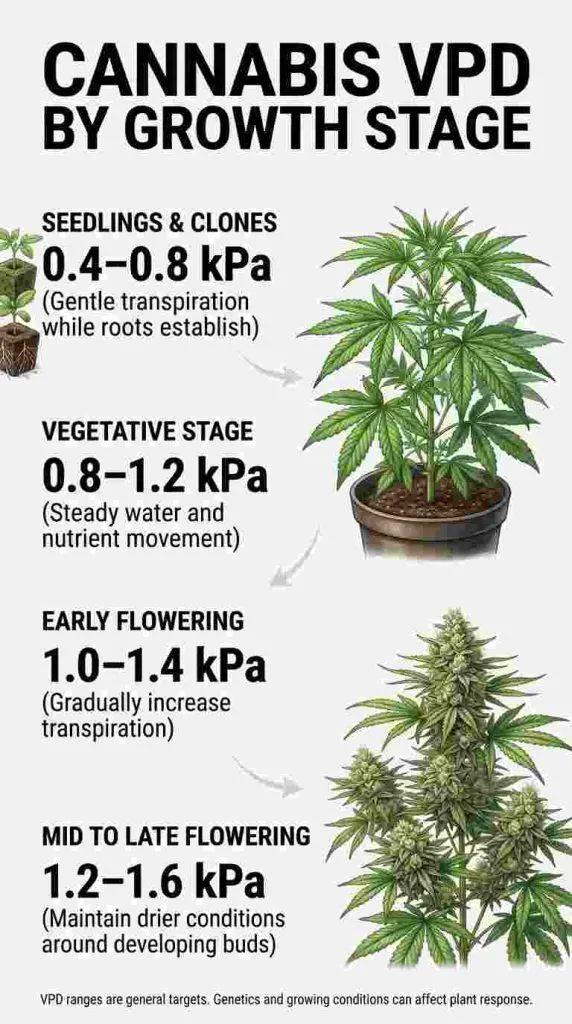
Here are the VPD ranges I recommend using as a starting point:
| Growth stage | Recommended VPD | What to aim for |
| Seedlings and clones | 0.4–0.8 kPa | Gentle transpiration while roots establish |
| Vegetative stage | 0.8–1.2 kPa | Steady water and nutrient movement |
| Early flowering | 1.0–1.4 kPa | Gradually increase transpiration as flowers develop |
| Mid to late flowering | 1.2–1.6 kPa | Maintain drier conditions around developing buds |
- Seedlings and clones – 0.4–0.8 kPa: Young plants have small root systems, so I prefer keeping VPD low while they establish themselves. Avoid excessive light, heat, or nutrients during this stage, as seedlings and fresh clones are far less forgiving than established plants.
- Vegetative stage – 0.8–1.2 kPa: Once your plants have developed a healthy root system and are producing new foliage, you can gradually raise VPD. I normally work toward the upper end of the range as plants mature and prepare to enter flowering.
- Early flowering – 1.0–1.4 kPa: As plants transition into flower, gradually increase VPD rather than making a sudden environmental change. This helps maintain steady transpiration while the plants stretch and begin producing flowers.
- Mid to late flowering – 1.2–1.6 kPa: Once flowers are well established, I prefer slightly drier conditions. This keeps transpiration moving while reducing excess humidity around dense buds, particularly during the final weeks.
Grower tip: Treat these cannabis VPD ranges as targets rather than strict rules. Genetics, light intensity, airflow, irrigation, and leaf temperature can all affect how a plant responds.
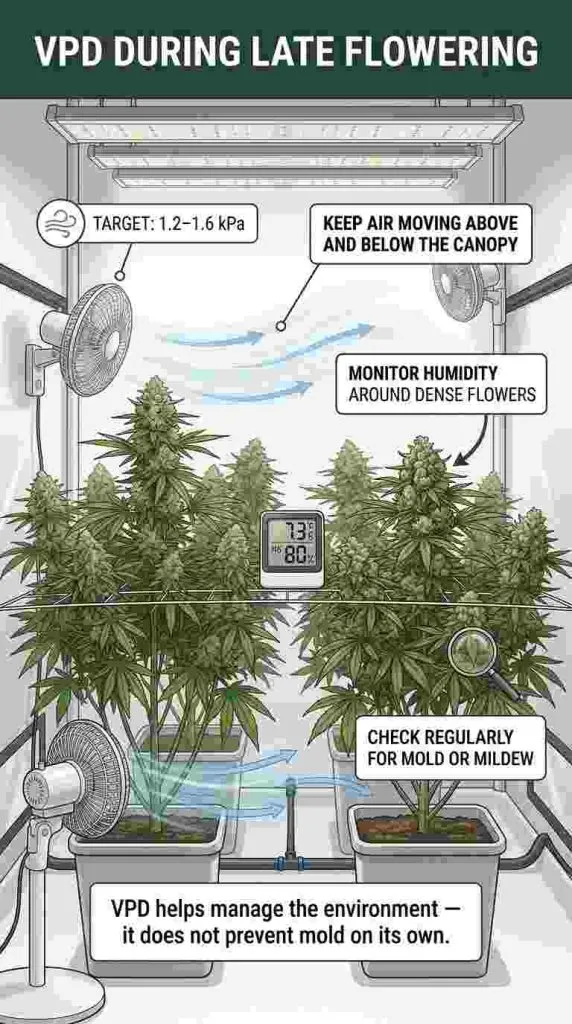
During the final weeks of flowering, airflow becomes especially important. Keep air moving above and below the canopy and regularly inspect dense flowers for mold or mildew. If you find infected material, remove it carefully and take it out of the grow room immediately.
What happens when VPD is too high or too low?
Cannabis plants perform best when the rate of water loss from their leaves is balanced with what the roots can replace. If VPD moves too far in either direction, that balance can be disrupted.
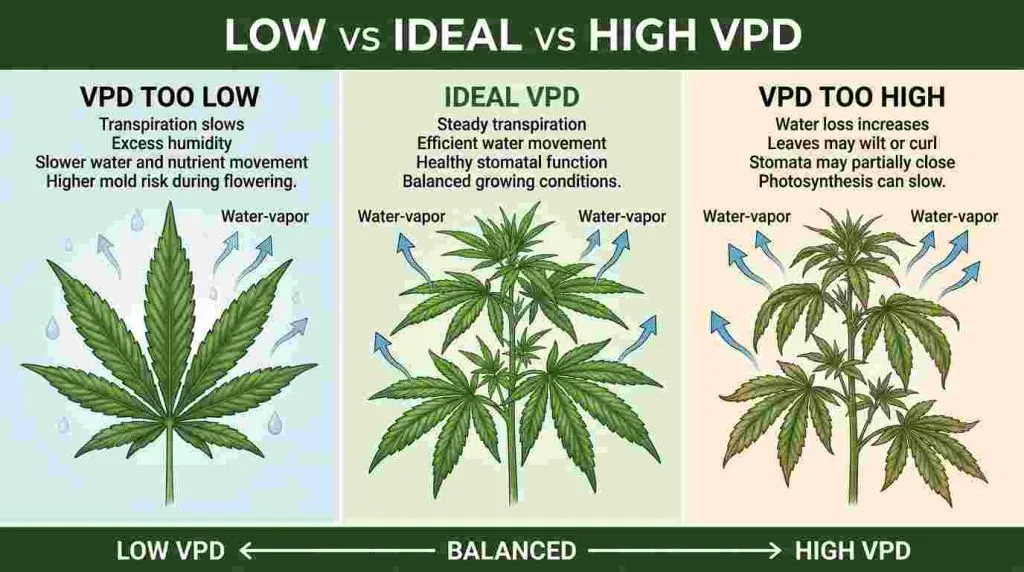
| VPD problem | What happens | Common signs |
| VPD too high | Plants lose water too quickly | Wilting, dry leaf edges, curling, slower growth |
| VPD too low | Transpiration becomes too slow | Sluggish growth, excess moisture, higher mold risk |
When VPD is too high, the air is pulling moisture from the leaves faster than the roots can always replace it. Plants may respond by partially closing their stomata to conserve water, which can reduce CO₂ uptake and slow photosynthesis.
If conditions remain too dry, leaves may begin to curl, wilt, or develop dry edges and tips. I usually take this as a sign to check temperature and humidity before assuming there is a nutrient problem.
When VPD is too low, the surrounding air contains more moisture and transpiration slows. Water and nutrient movement through the plant can become less efficient, which may result in slower growth.
Low VPD becomes particularly important during flowering. Dense buds combined with high humidity and poor airflow can create conditions where mold and mildew are more likely to develop.
Grower tip: Don't diagnose a cannabis plant from VPD alone. Symptoms such as curling, slow growth, or damaged leaf tips can have several causes, so always check irrigation, nutrients, root health, temperature, and humidity together.
Why temperature and humidity matter
Temperature and relative humidity work together to determine VPD, which is why I prefer looking at them as a pair rather than chasing individual numbers.
Maintaining the right balance can help:
- Support steady transpiration and nutrient movement.
- Keep stomata functioning efficiently for CO₂ uptake.
- Prevent plants from losing water too quickly in hot, dry conditions.
- Avoid excessively humid conditions that slow transpiration.
- Reduce conditions that favor mold and mildew during flowering.
- Maintain a more consistent grow environment from the canopy down.
Temperature, humidity, and leaf surface temperature all contribute to your VPD reading. Once you start monitoring them together, it becomes much easier to understand what your plants are experiencing and make the right environmental adjustments.
What tools do I need to measure VPD?
I am a big fan of grow-room tech when it gives me useful data, and measuring VPD only requires a few basic tools. You need a digital thermo-hygrometer for air temperature and relative humidity, an infrared thermometer for leaf temperature, and a VPD chart or calculator to bring those readings together.
| Tool | What it measures | How to use it |
| Digital thermo-hygrometer | Air temperature and relative humidity | Position at canopy height |
| Infrared thermometer | Leaf surface temperature | Check several healthy fan leaves |
| VPD chart or calculator | VPD in kPa | Enter your temperature, humidity, and leaf-temperature readings |
Digital thermo-hygrometer
A digital thermo-hygrometer measures the temperature and relative humidity inside your grow space. I recommend positioning the sensor around canopy height, where conditions are most relevant to your plants.
In larger grow rooms, using more than one sensor can help identify warmer, cooler, or more humid areas that a single reading may miss.
Infrared (IR) thermometer
An infrared thermometer measures leaf surface temperature without touching the plant. Point it at several healthy fan leaves across the canopy and use the readings to get a representative leaf temperature.
Grower tip: Don't rely on the hottest or coolest leaf you find. Checking several leaves gives you a much better idea of the conditions across the canopy.
VPD charts and calculators
Once you have your temperature, relative humidity, and leaf-temperature readings, a cannabis VPD chart or calculator does the hard work for you. Enter the measurements and it will give you a VPD reading in kilopascals (kPa).
I prefer using a calculator because it is quick and removes the need to work through the formula manually. You can then compare your result with the recommended VPD range for your plant's current growth stage.
How does saturation vapor pressure (SVP) relate to VPD?
Saturation vapor pressure (SVP) is the maximum vapor pressure possible when air is fully saturated with water vapor at a given temperature. As temperature rises, SVP increases because warmer air can support a higher concentration of water vapor.
Actual vapor pressure (AVP) represents the water vapor currently present in the air. VPD is calculated from the difference between saturation vapor pressure and actual vapor pressure, giving you an indication of how strongly the environment is pulling moisture from your plants.
For cannabis cultivation, leaf temperature can also be included to give a more accurate picture of the conditions at the leaf surface.
- VPD: Vapor pressure deficit
- SVP: Saturation vapor pressure
- AVP: Actual vapor pressure
You don't need to calculate these values manually. I prefer using a VPD calculator, which uses your temperature, relative humidity, and leaf-temperature readings to give you the result in kPa.
Conclusion
Plenty of growers produce excellent cannabis without ever looking at a VPD chart. However, if you want more control over your indoor environment, monitoring VPD can help you understand how temperature, humidity, and leaf temperature are affecting your plants.
Keeping cannabis VPD within a suitable range supports steady transpiration, nutrient movement, stomatal function, and CO₂ uptake. It can also help you spot environmental problems before they begin affecting growth or creating excess humidity around developing flowers.
I recommend using a VPD chart or calculator if you enjoy taking a more technical approach to growing, particularly in larger or tightly controlled grow rooms. I am a big fan of grow-room gadgets and data, and VPD gives me another useful measurement to work with rather than relying on temperature and humidity alone.
Just remember that VPD is one part of the growing environment. Combine it with good airflow, irrigation, lighting, nutrition, and regular plant checks to create stable conditions throughout the grow.
Frequently Asked Questions
What is the ideal VPD for cannabis?
The ideal VPD depends on the growth stage. I recommend around 0.4–0.8 kPa for seedlings and clones, 0.8–1.2 kPa during vegetative growth, 1.0–1.4 kPa in early flowering, and 1.2–1.6 kPa during mid to late flowering. Treat these as starting points rather than strict rules, as genetics and grow-room conditions can affect how plants respond.
What happens if cannabis VPD is too high?
When VPD is too high, cannabis plants can lose water faster than their roots can replace it. Leaves may wilt, curl, or develop dry edges, while stomata can partially close to conserve moisture, potentially slowing photosynthesis and growth.
What happens if cannabis VPD is too low?
Low VPD means transpiration is occurring too slowly, which can reduce water and nutrient movement through the plant. High humidity associated with low VPD can also create conditions that favor mold and mildew, especially around dense flowers.
How do I calculate VPD for cannabis plants?
Measure air temperature and relative humidity at canopy height with a digital thermo-hygrometer, then check leaf surface temperature with an infrared thermometer. Enter these readings into a cannabis VPD calculator to receive a result in kilopascals (kPa).
Is leaf temperature important when calculating VPD?
Yes. Leaf temperature can differ from the surrounding air temperature, particularly under powerful grow lights. Including leaf surface temperature gives you a more accurate idea of the conditions experienced by the plant rather than relying on room temperature and humidity alone.


