




Defoliating autoflowers involves removing selected fan leaves to improve light distribution and airflow around the plant. Many growers use this technique to manage dense foliage, but knowing when to defoliate autoflowers is important because excessive leaf removal can slow growth and reduce photosynthesis.
Timing, plant health and the number of leaves removed all influence the outcome. This guide explains how to defoliate autoflowers safely, which fan leaves to remove, when to avoid cutting and how to manage the canopy with less stress.
Key Takeaways
- Best timing: Light defoliation is commonly considered during late vegetative growth or early flowering.
- Leaf removal: Only remove fan leaves causing significant shading or crowding.
- Plant health: Avoid defoliating stressed, stunted or unhealthy autoflowers.
- Yield impact: Removing more leaves does not guarantee larger harvests.
- Alternatives: Leaf tucking and low-stress training can improve light access without removing healthy foliage.
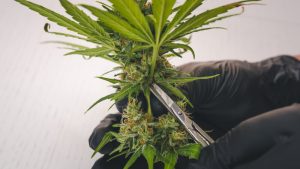
Should You Defoliate Autoflowers?
Yes, you can defoliate autoflowers, but first check whether the canopy needs attention. Some plants grown from autoflowering cannabis seeds develop short spaces between branches and overlapping fan leaves. Others naturally grow with enough room for light and air to pass through.
Selective removal may expose shaded flowers and open crowded areas. But fan leaves also produce sugars through photosynthesis. A leaf that looks large or untidy is not necessarily wasting energy.
Danziger and Bernstein (2022) tested different planting densities and canopy treatments, including defoliation, in cannabis. Plant spacing and canopy treatments affected yield and cannabinoid distribution, but defoliation did not consistently increase flower yield. The study did not establish an autoflower-specific method.
Grower Tip: Look at your plant from above and from both sides. If developing flower sites are visible and the branches are not packed tightly together, keep the healthy leaves in place.
When Is the Best Time to Defoliate Autoflowers?
Growers commonly consider light autoflower defoliation during established vegetative growth or the transition into early flowering. This often falls around weeks three to five from sprouting, although genetics and growing conditions can change the schedule.
Leckie et al. (2024) identified a genetic change linked to flowering without a required short-day trigger. The study does not establish when leaves should be removed. Judge the plant's actual development instead.
| Growth stage | Approximate timing | What to do |
| Seedling | Weeks 1-2 | Leave healthy leaves while roots and early growth develop. |
| Established vegetative growth | Often weeks 3-4 | Check for crowded foliage; consider limited removal only if necessary. |
| Early flowering | Often weeks 4-5 | Be selective while branches and flower sites are developing. |
| Established flowering | Varies by strain | Avoid routine stripping; address only a clear problem. |
| Late flowering | Final maturation | Avoid unnecessary cutting around developing flowers. |
These weeks are guides, not fixed rules. The autoflower week-by-week guide shows how the stages can differ.
Can You Defoliate Autoflowers During Flowering?
Limited removal may be reasonable during early flowering if a healthy plant is crowded. Once flowers develop, healthy leaves remain useful and handling can cause damage.
During the autoflower flowering stretch, branches may separate naturally as they grow. Reassess before cutting.
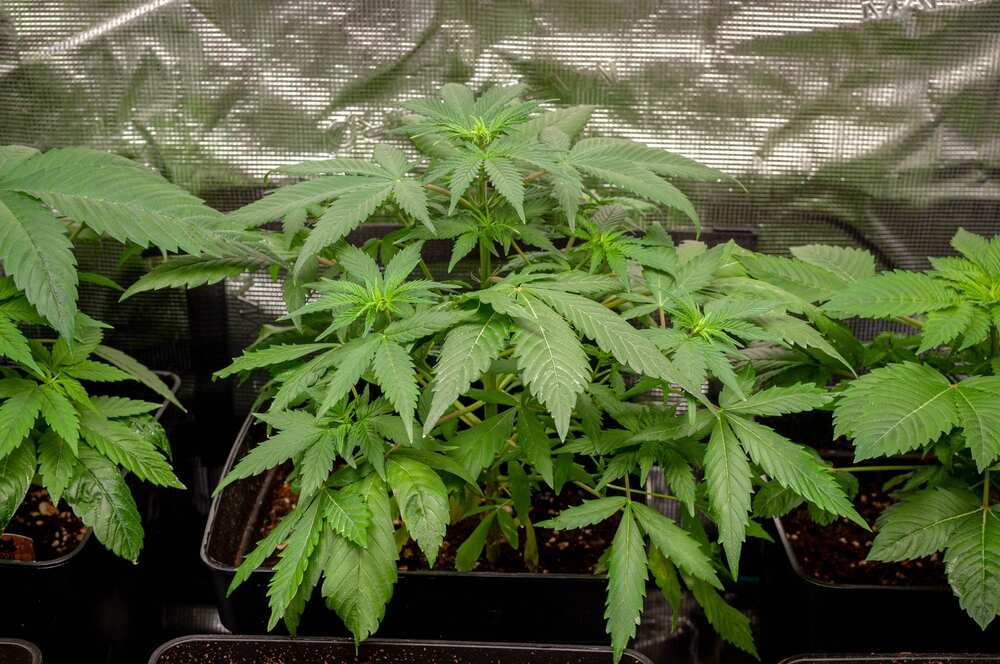
How to Tell if Your Autoflower Needs Defoliation
Do not judge a plant only by how bushy it looks. Check the following:
- Inspect the new growth. Leaves should be developing normally, without widespread drooping or damage. If the plant is struggling, investigate the problem first.
- Look between branches. Identify a large leaf that repeatedly covers several developing flower sites, or a group of leaves pressed together with little space between them.
- Move one leaf aside gently. If this opens the area without bending the stalk sharply, you may be able to tuck it rather than cut it.
- Check the growing space. Poor airflow can result from crowded pots or inadequate ventilation, not just too many leaves.
For indoor autoflower seeds, check spacing and ventilation before trimming. A naturally compact plant is not necessarily a stunted autoflower.
How to Defoliate Autoflowers Safely
For beginners, I recommend removing only leaves causing a specific problem. Stop once the canopy is open enough.
Step 1: Choose the Leaves Carefully
Inspect the upper and middle canopy. Find leaves shading flower sites or pressing into other foliage. Keep other healthy leaves.
A fan leaf grows from a stem or branch on its own stalk. Sugar leaves are the smaller leaves growing directly from flowers. Keep sugar leaves intact.
| Leaf condition | Recommended action |
| Healthy fan leaf with clear space around it | Keep it. |
| Large fan leaf covering several flower sites | Try tucking first; cut only if the obstruction remains. |
| Several leaves pressed together inside the canopy | Assess airflow and remove only what is necessary. |
| Sugar leaf growing from a flower | Leave it in place. |
| Yellow or spotted leaf | Identify the cause before deciding to remove it. |
| Mostly dead or decaying leaf | Remove carefully if it can be reached without damaging healthy growth. |
Yellowing can result from natural changes as a plant matures, watering or nutrient problems. Check the causes of yellowing autoflower leaves rather than using defoliation to hide a developing issue.
Step 2: Prepare the Cutting Tools
Use small, sharp pruning scissors. Clean the blades before starting and between plants. Hold the leaf where its stalk is visible and support the branch with your other hand.
Step 3: Remove One Leaf at a Time
Cut through the leaf stalk near its attachment point without cutting into the main stem or branch. Lift the detached leaf away gently. Do not pull, twist or tear leaves off, especially near developing flowers.
Inspect the area again and stop if it is open. Avoid removing extra leaves simply to make the canopy look even.
Grower Tip: After each cut, look into the area you were trying to open. One carefully selected leaf may be all you need to remove.
Step 4: Check the Plant Afterwards
Maintain appropriate light, watering and feeding. Do not increase nutrient strength merely because leaves were removed. Look for firm leaves and normal new growth.
If the plant starts drooping or growing slowly, check moisture levels, temperature and light exposure. Use the autoflower watering guide to assess watering rather than adding extra water to force recovery.
How Many Fan Leaves Should You Remove?
There is no scientifically established safe percentage for every autoflower. The often-repeated advice to remove 20-30% of foliage is a grower rule of thumb, not a proven threshold. A small plant with few branches has less healthy foliage to spare than a larger plant.
Phillips et al. (2025) tested defoliation in two low-THC cannabis cultivars. Flower biomass decreased, while cannabinoid responses varied. This does not establish an autoflower cutting limit or a yield benefit.
Even high-yielding autoflowers depend on healthy leaves and suitable growing conditions. Remove only the leaves that are clearly obstructing the canopy, then reassess.
When Should You Avoid Defoliating Autoflowers?
Keep healthy foliage when a plant is under stress. Check the cause before adding another change.
| What you notice | What to check first |
| Slow or stunted growth | Roots, watering and recent development. |
| Drooping leaves | Moisture levels, drainage and temperature. |
| Yellowing or spotting | Whether the pattern indicates a nutrient, watering or pest problem. |
| Dense, humid canopy | Plant spacing, air extraction and circulation. |
| Mature flowers | Whether a leaf is actually dead or causing a clear problem. |
When the inner canopy feels persistently damp, assess temperature and humidity for autoflowers as well as leaf position. Removing foliage alone will not correct poor ventilation.
What to Do if You Over-Defoliate an Autoflower
Stop cutting and leave the remaining healthy leaves attached. Avoid further aggressive training or abrupt environmental changes. Continue appropriate care and watch for new growth over the following days. Extra feeding or watering cannot replace the lost leaves.
Alternatives to Defoliating Autoflowers
You can often open a canopy without cutting.
How to Tuck Fan Leaves
Find the leaf blocking a developing flower site. Hold its stalk gently near the base and guide the leaf behind or beneath a nearby branch. Keep the stalk in a natural curve rather than folding it sharply. Release the leaf and check that it stays in place without crushing nearby growth. If it springs back or feels stiff, do not force it. Check its position again as the plant develops.
How to Use Low-Stress Training
During early growth, choose a flexible branch and place a soft plant tie loosely around it. Secure the other end to the pot rim, drawing the branch slightly outward to increase space between stems. Make small adjustments instead of bending a stiff branch in one movement. Check that the tie is not tightening as the stem grows. The autoflower low-stress training guide provides a fuller explanation.
Lollipopping is different: it removes lower branches and growth rather than selected obstructive leaves. It should not be confused with light defoliation. See the autoflower lollipopping method for that separate technique.
Grower Tip: Try moving the obstructive fan leaf before cutting it. If tucking creates enough space, the plant keeps another healthy leaf for photosynthesis.
Conclusion
Defoliating autoflowers can help manage dense foliage, but it is not necessary for every plant. The key is knowing when to remove fan leaves and when to leave healthy growth untouched.
Light defoliation during established vegetative growth or early flowering may improve light distribution and airflow. However, removing too many leaves can reduce photosynthesis and affect plant development.
For beginners, I recommend checking the canopy before making any cuts. Try leaf tucking first, remove only leaves causing a clear problem and monitor the plant afterwards. If your autoflower is healthy, with adequate light and airflow between its branches, there may be no reason to defoliate.
Frequently Asked Questions
Does Defoliating Autoflowers Increase Yields?
Not necessarily. Defoliation may help light reach shaded flower sites, but removing healthy leaves also reduces the plant's ability to produce energy through photosynthesis. Research shows that results vary between cannabis cultivars, so higher yields are not guaranteed.
Can You Defoliate Autoflowers in Week 5 or 6?
Yes, but it depends on the plant's development. Many autoflowers are already flowering by weeks five or six. If a healthy plant has a fan leaf causing significant crowding, limited removal may be reasonable. Avoid heavy defoliation once flowers are well established.
Should You Remove Yellow Fan Leaves From Autoflowers?
Not automatically. Yellow leaves can indicate natural ageing, nutrient deficiencies or watering problems. Check whether yellowing affects older leaves or is spreading to new growth. Identify the cause before removing foliage, and only remove mostly dead or decaying leaves when necessary.
How Often Should You Defoliate Autoflowers?
There is no fixed schedule. Some autoflowers may benefit from one selective session, while others need no defoliation. After removing obstructive leaves, monitor new growth and only consider another session if significant crowding develops. Avoid repeatedly removing healthy foliage.
Is Leaf Tucking Better Than Defoliating Autoflowers?
Leaf tucking is often the lower-risk option because it keeps healthy leaves attached. Gently move the obstructive fan leaf behind or beneath a nearby branch without sharply bending its stalk. If this exposes the shaded flower site, cutting may be unnecessary.
References
- Leckie, K. M., et al. (2024). Loss of daylength sensitivity by splice site mutation in Cannabis pseudo-response regulator. The Plant Journal, 118(6), 2020–2036. https://doi.org/10.1111/tpj.16726
- Danziger, N., & Bernstein, N. (2022). Too Dense or Not Too Dense: Higher Planting Density Reduces Cannabinoid Uniformity but Increases Yield/Area in Drug-Type Medical Cannabis. Frontiers in Plant Science, 13, 713481. https://doi.org/10.3389/fpls.2022.713481
- Phillips, A. L., Gill, A., McGorm, B., & Burton, R. A. (2025). LED spectra and defoliation independently shape canopy architecture and cannabinoid yield in indoor Cannabis cultivation. Industrial Crops and Products, 236, 121918. https://doi.org/10.1016/j.indcrop.2025.121918


