




Iron deficiency in cannabis usually appears as pale or yellow new growth while the older leaves remain relatively green. The most recognizable symptom is interveinal chlorosis, where the tissue between the veins turns yellow but the veins stay darker. Because iron is poorly mobile within the plant, cannabis iron deficiency symptoms normally begin on the youngest leaves and active growing tips.
Although these yellow leaves can make it look as though the plant simply needs more nutrients, a true lack of iron is not always the cause. High root-zone pH, overwatering, poor drainage, salt buildup and unhealthy roots can all lead to iron lockout, preventing the plant from absorbing iron that is already present in the growing medium or fertiliser.
In this guide, I’ll explain how to identify iron deficiency in cannabis during the seedling, vegetative and flowering stages, distinguish it from similar nutrient problems and correct the underlying cause safely. You’ll also learn when chelated iron may be useful and why checking pH, EC and root health should come before adding supplements.
Key Takeaways
- Iron deficiency normally affects the newest upper leaves and growing tips before older foliage.
- Yellow leaves with green veins are a common sign of interveinal chlorosis caused by restricted iron uptake.
- High root-zone pH is one of the most common causes of iron lockout in cannabis.
- Overwatering, salt buildup and damaged roots can cause symptoms even when the nutrient program contains iron.
- To fix iron deficiency in cannabis, correct pH and root conditions first, then supplement iron only when necessary.
What is Iron Deficiency in Cannabis?
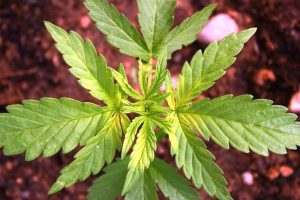
Iron deficiency in cannabis occurs when a plant cannot access enough usable iron to support healthy new growth. Iron is one of several micronutrients involved in common cannabis nutrient deficiencies. Although plants only require it in small amounts, it remains essential for chlorophyll production, photosynthesis, respiration and several enzyme processes. Without enough available iron, developing leaves cannot produce chlorophyll normally and begin to lose their green colour.
A cannabis iron deficiency usually appears as interveinal chlorosis on the youngest leaves. The tissue between the veins turns pale green or yellow while the veins remain darker. Iron is poorly mobile within the plant, so it cannot be moved efficiently from older foliage into new growth. For this reason, symptoms normally begin around the upper leaves and shoot tips rather than at the bottom of the plant.
In most grows, the growing medium is not completely lacking iron. The more common issue is nutrient lockout, where iron is present but the roots cannot absorb it properly. A high root-zone pH can make existing iron less soluble and harder for the roots to absorb. Overwatering, poor drainage, salt buildup and unhealthy roots can also interfere with uptake.
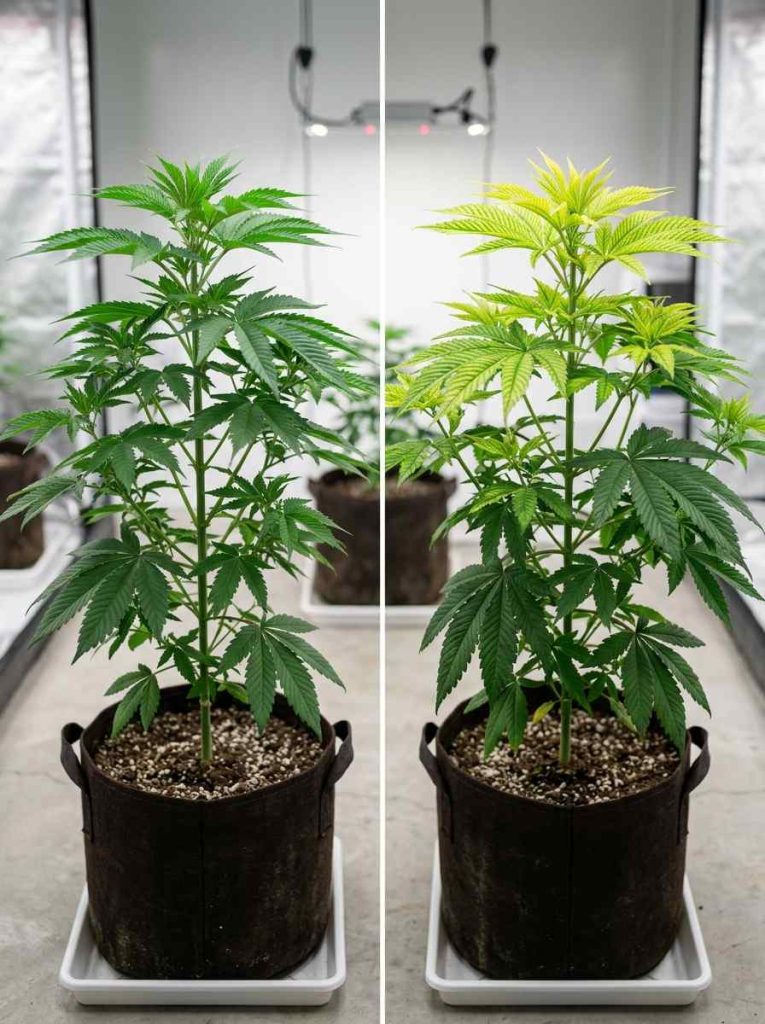
Grower tip: Before adding an iron supplement, confirm that the yellowing started on new growth and test the root-zone pH. Correcting poor uptake is usually more effective than simply adding more iron.
How to Identify Iron Deficiency in Cannabis
Iron deficiency in cannabis is usually recognized by two clues: where the yellowing starts and the pattern it creates. Because iron is poorly mobile within the plant, symptoms normally appear first on the youngest leaves and active growing tips. Older fan leaves usually remain green during the early stages.
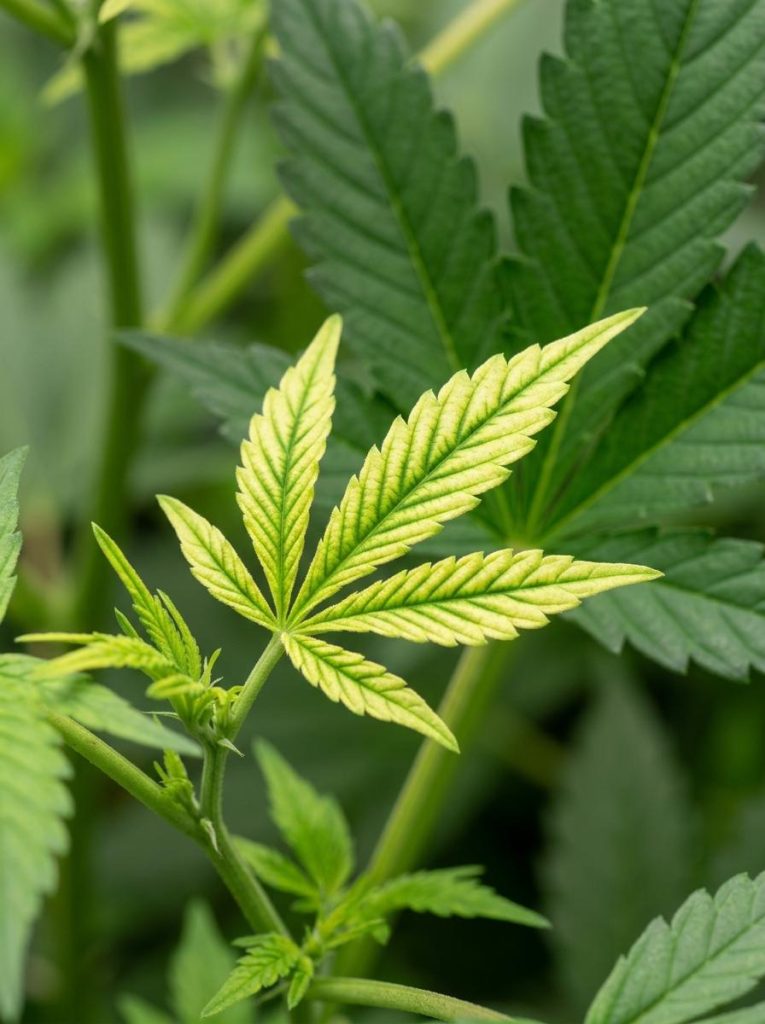
The characteristic symptom is interveinal chlorosis. This means the tissue between the veins turns pale green or yellow while the main veins remain darker. Several problems can cause yellow leaves on cannabis, so colour alone is not enough. Always check the age and position of the affected foliage.
Early Signs and Leaf Patterns
| Symptom | What it looks like | Where to check |
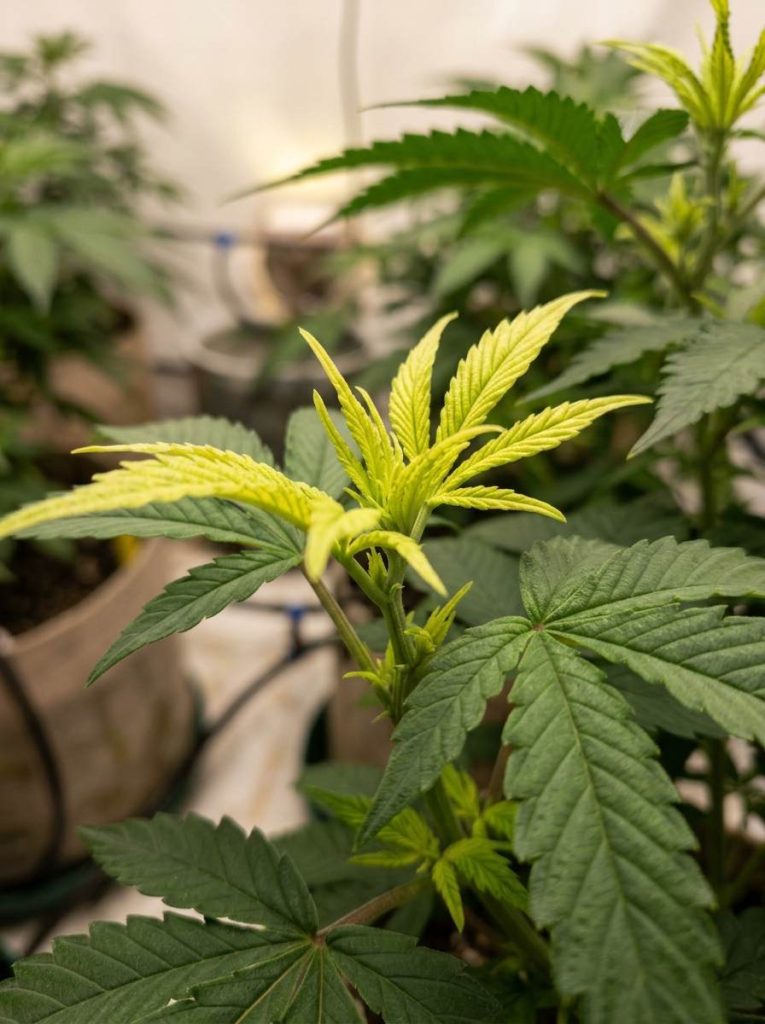
| Pale new growth | New leaves emerge lime green, pale yellow or lighter than the foliage below | Main shoot tip and newest side branches |
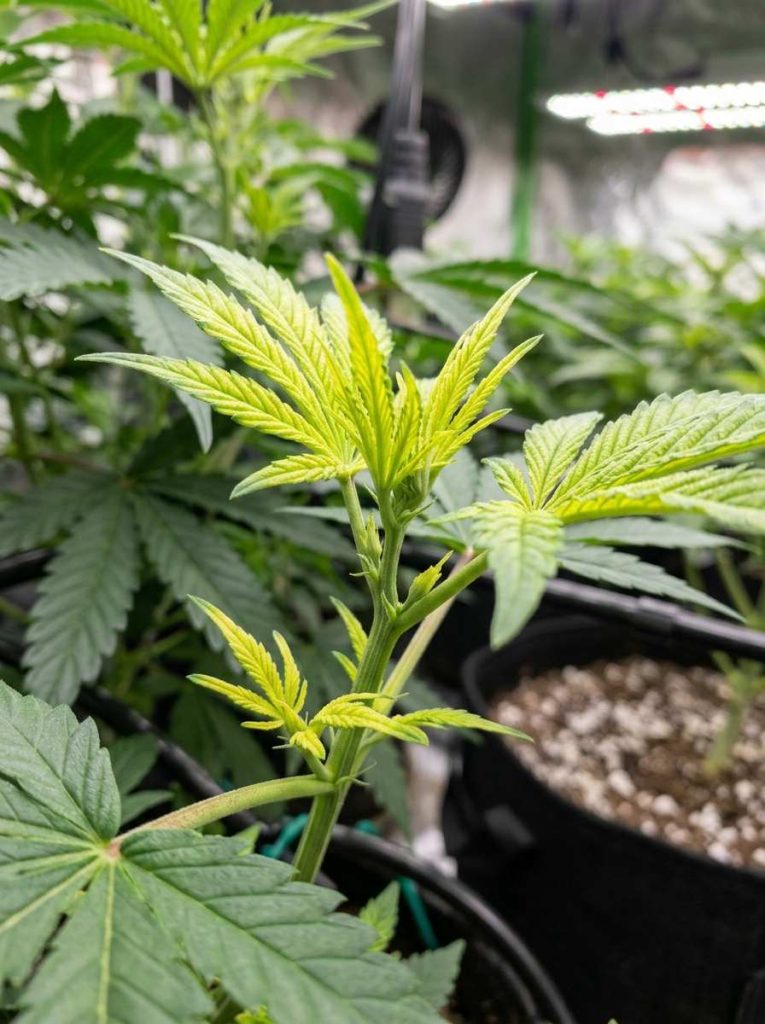
| Interveinal chlorosis | Tissue between the veins turns yellow while the main veins remain greener | Recently opened young leaves |
| Upper growth affected first | The top becomes pale while established lower leaves remain green | Compare new leaves with mature leaves below |
| Slow development | Young leaves open slowly or remain smaller than expected | Growing tips and fresh lateral shoots |
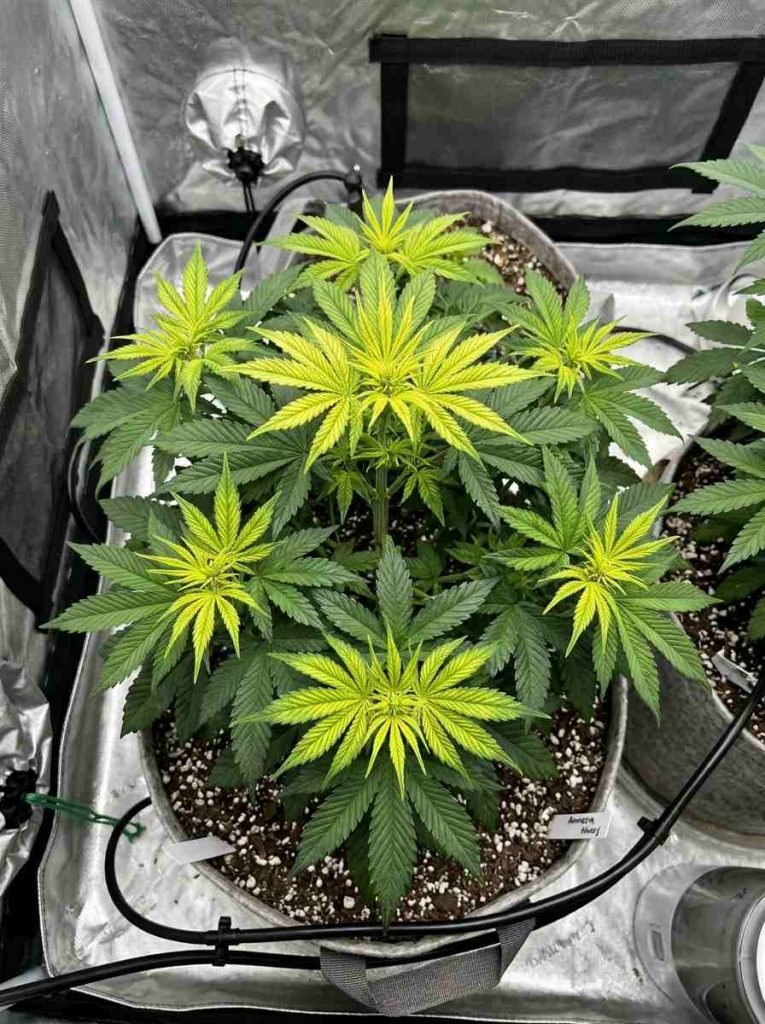
| Several pale shoot tips | The same yellow pattern appears across multiple growing points | Upper canopy |
A newly opened leaf can be slightly lighter before it develops its full green colour. With iron deficiency, the pale appearance persists, becomes clearer as the leaf expands or begins appearing on additional growing tips.
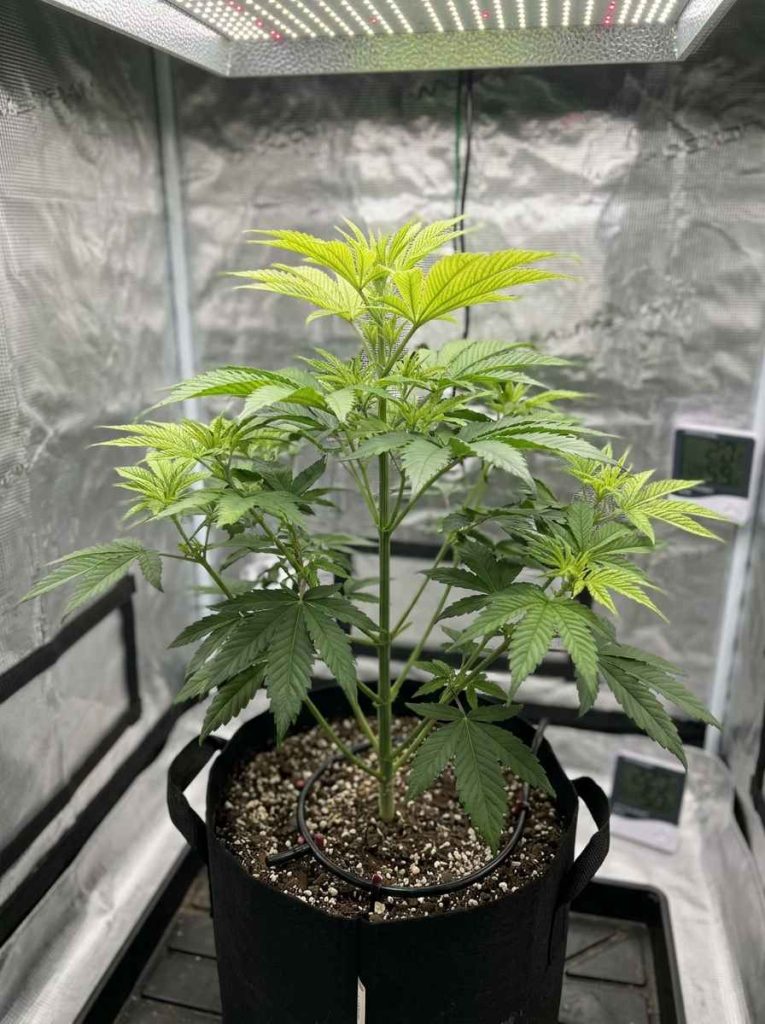
Pale New Growth
Interveinal Chlorosis
Upper Growth affected first
Slow Development
Several pale shoot tips
The basic symptom pattern remains the same across different seed types. Plants grown from autoflowering cannabis seeds and feminized cannabis seeds can both develop pale new growth and interveinal chlorosis when iron uptake is restricted. However, the symptoms may be easier to recognize at some growth stages than others.
| Growth stage | What to look for | Do not confuse it with |
| Seedling | First true leaves or newest growth emerge pale yellow with greener veins while older leaves remain darker | Naturally fading cotyledons, overwatering, overly rich soil or excessive light |
| Vegetative growth | Fresh leaves on the main stem and side branches become pale above an otherwise green canopy | Nitrogen or magnesium deficiency, which usually starts on older lower leaves |
| Flowering | Young leaves around stretching tops and developing flower sites yellow between greener veins | Natural late-flower fading, lower-leaf nitrogen deficiency or light bleaching |
During the seedling stage, do not diagnose iron deficiency from yellow cotyledons alone. These first rounded leaves naturally fade as their stored energy is used. Inspect the newest true leaves for persistent interveinal yellowing instead.
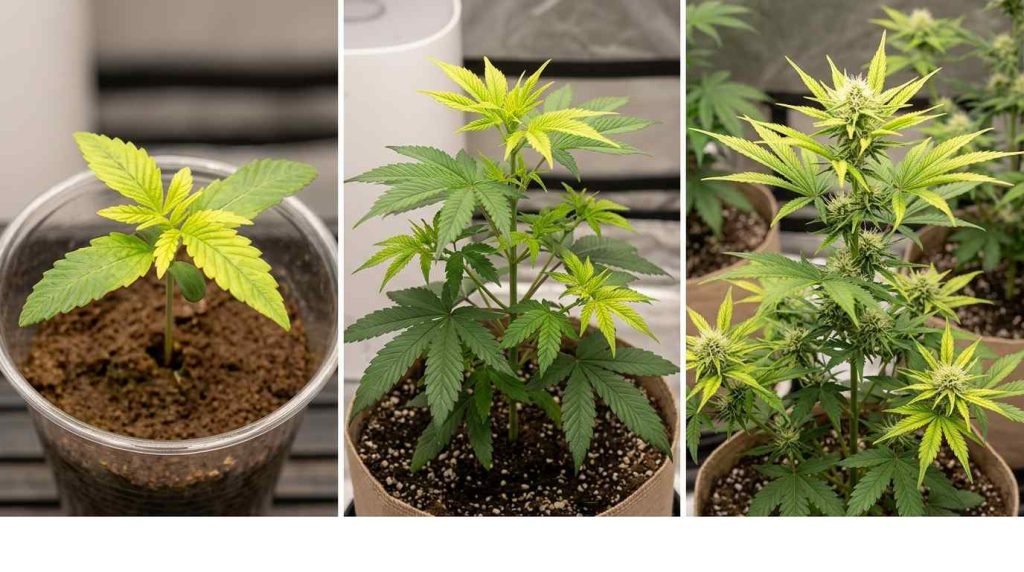
Iron deficiency is often easiest to recognize during vegetative growth because the plant is producing leaves and branches quickly. Pale upper growth above healthy fan leaves is a stronger clue than yellowing across the whole plant.
During flowering, focus on the youngest leaves around the tops. Older fan leaves may naturally lose colour later in bloom, but iron deficiency continues to affect fresh growth first. If only the leaves closest to the grow light are pale, check for light bleaching before changing the nutrient program.
Grower tip: Compare a newly opened leaf with a mature leaf directly below it. This quickly shows whether the yellowing is beginning in developing growth.
How the Symptoms Progress
If iron uptake remains restricted, the newest leaves become progressively lighter, changing from pale green to bright yellow, cream or almost white. The contrast between the greener veins and yellow tissue may become less obvious as the entire young leaf loses chlorophyll.
Fresh leaves may remain small, open slowly or develop an uneven shape. New shoot and branch development can also slow. In advanced cases, affected leaves may develop scorched edges, brown patches or areas of dead tissue.
The symptoms should remain most obvious on fresh upper growth. Iron deficiency does not normally begin as uniform yellowing across the whole plant. If young and old leaves decline together, yellowing starts at the bottom or damage is limited to the canopy nearest the light, another nutrient problem or environmental stress may be responsible.
Use these visual signs as the first stage of diagnosis rather than final proof. Before treating the plant, confirm the pattern by checking root-zone pH, recent feeding, watering practices and root health.
How to Confirm Iron Deficiency
Yellow leaves do not automatically mean iron deficiency in cannabis. Several nutrient problems, root issues and environmental stresses can produce similar symptoms. The strongest sign is interveinal chlorosis on the newest leaves, where the tissue turns yellow while the veins remain greener.
Diagnose the Problem in the Correct Order
- Check where the yellowing started. Iron deficiency normally begins on the youngest upper leaves and active growing tips. Yellowing that starts on older lower leaves is more likely to involve nitrogen or magnesium.
- Examine the leaf pattern. Look for pale or yellow tissue between greener veins. Uniform yellowing is less typical of iron deficiency.
- Inspect the canopy position. Confirm that symptoms affect new growth across the plant rather than only the tops closest to the grow light.
- Test root-zone pH. Measure the growing medium, runoff or reservoir with a calibrated meter. High root-zone pH can make iron unavailable even when it is present.
- Review feeding and EC. Check for recent nutrient changes, excessive feeding, salt buildup or an incomplete nutrient program.
- Inspect watering and root health. Overwatering, poor drainage, low oxygen and damaged roots can all restrict iron uptake.
Grower tip: Change one factor at a time. Correcting pH, flushing and adding supplements together makes it difficult to identify what caused the problem.
Iron Deficiency vs Similar Cannabis Problems
| Problem | Where it starts | Typical pattern | Main clue |
| Iron deficiency | Newest upper leaves | Yellow tissue between greener veins | Older leaves stay greener at first |
| Magnesium deficiency | Older lower leaves | Interveinal yellowing | May develop rusty spots |
| Manganese deficiency | Young or middle leaves | Mottled yellowing | Small brown specks are more common |
| Sulfur deficiency | Young growth | More uniform yellowing | Veins usually pale with the leaf |
| Nitrogen deficiency | Older lower leaves | Uniform yellowing | Progresses upward |
| Zinc deficiency | New growth | Pale, small or distorted leaves | Short internodes and clustered growth |
| Light bleaching | Canopy nearest the light | Pale exposed tissue | Follows light position and intensity |
The most useful comparison is leaf age. Iron deficiency affects new growth, while magnesium deficiencies and nitrogen deficiencies usually begin lower on the plant. Manganese deficiency can look similar, but it is more likely to produce small necrotic specks. Light bleaching is generally limited to the highest areas of the canopy.
What Causes Iron Deficiency in Cannabis?
Iron deficiency in cannabis is usually caused by poor uptake rather than a complete lack of iron. In simple terms, the iron may already be present in the pot or nutrient solution, but the roots cannot absorb it properly.
Several problems can cause this. High root-zone pH may make iron unavailable, while overwatering, salt buildup and damaged roots can reduce the plant’s ability to take nutrients in. More than one cause may also be present at the same time, so check the root zone before adding a separate iron supplement.
High Root-Zone pH and Alkaline Inputs
High root-zone pH is one of the most common causes of iron deficiency. As the growing medium becomes more alkaline, iron changes into forms that are harder for cannabis roots to absorb.
Hard tap water may contain bicarbonates, which are alkaline compounds that can gradually raise the pH of soil and coco growing media. Excess lime, wood ash and repeated watering with a high-pH solution can have a similar effect. Excess lime, wood ash and repeated watering with a high-pH solution can have a similar effect.
The water going into the pot may test within range while the root zone remains too alkaline. Check the growing medium, runoff or reservoir rather than relying only on the input solution.
What to look for: Root-zone pH that repeatedly rises above the intended range, even after the nutrient solution has been adjusted.
Overwatering, Poor Drainage and Root Damage
Cannabis roots need oxygen to absorb water and nutrients efficiently. Overwatering cannabis plants keeps the growing medium saturated, pushes air out of the root zone and slows nutrient uptake.
Compacted soil, blocked drainage holes, standing runoff and root disease can cause similar problems. Cold root conditions may also reduce nutrient uptake.
What to look for: Pots that stay heavy for several days, slow-drying media and persistent drooping all point toward excess moisture. Brown, soft or foul-smelling roots may indicate root rot in cannabis plants.
Grower tip: Allow the growing medium to dry appropriately before watering again. Adding more nutrients will not help if the roots are waterlogged.
Salt Buildup and Nutrient Imbalances
Repeated overfeeding can cause nutrient burn in cannabis and leave fertiliser salts concentrated around the roots. This raises EC, which measures the concentration of dissolved salts within the root zone. This raises EC, which measures the amount of dissolved salts in the root zone. When EC becomes too high, roots struggle to absorb water and nutrients normally.
An unbalanced feeding program may also interfere with iron availability. Beginners do not need to identify every individual nutrient interaction. The important point is that stronger feeding does not always solve pale growth and may make the problem worse.
What to look for: High runoff EC, white fertiliser residue on the medium or pot, burned leaf tips, repeated heavy feeding or a recent increase in nutrient strength.
Flushing cannabis plants should only be considered when EC readings or feeding history indicate excess salts. It is not an automatic treatment for every plant showing yellow new growth. It is not an automatic treatment for every plant showing yellow new growth.
Incomplete Feeding or Low Iron Availability
A genuine iron shortage is less common, but it can occur in depleted soil, reused growing media or nutrient programs that do not provide a complete range of micronutrients.
Reverse-osmosis water contains very few background minerals, so plants grown with it depend almost entirely on the fertiliser. However, this does not mean iron must always be added separately. Many complete cannabis nutrients for soil, coco and hydro already contain iron, as do some Cal-Mag products. Check the label before adding another source.
What to look for: A nutrient label that does not list iron or a micronutrient blend, depleted media, very light feeding or RO water used with an incomplete nutrient program.
Always correct pH, watering and root problems first. A separate iron supplement is only useful when the plant is genuinely receiving too little available iron.
How to Fix Iron Deficiency in Cannabis
The best way to fix iron deficiency in cannabis is to restore normal nutrient uptake rather than immediately adding more iron. In most cases, the nutrient is already present, but high root-zone pH, excess salts, overwatering or unhealthy roots are preventing the plant from absorbing it.
Work through the following steps in order and make one main adjustment at a time. This makes it easier to identify the real cause and judge whether the plant is recovering.
| Problem found | Corrective action |
| Root-zone pH is too high | Return it gradually to the correct range |
| Growing medium stays saturated | Allow it to dry and improve drainage |
| Runoff or reservoir EC is excessive | Reduce feeding strength and address salt buildup |
| Roots are brown, soft or unhealthy | Correct the root problem before increasing nutrients |
| Nutrient program does not contain iron | Resume complete feeding or use a suitable supplement |
Step 1: Correct Root-Zone pH
Begin by testing the conditions around the roots. Measuring only the water or nutrient solution going into the container may not show what is happening inside the growing medium.
As a general guide, cannabis grown in soil is commonly maintained around pH 6.0–6.5. Coco and hydroponic systems are usually managed around pH 5.5–6.2. The ideal range can vary slightly with the medium and nutrient formulation, so check the manufacturer’s recommendations.
If the root-zone pH is too high, bring it back into range gradually with correctly adjusted water or nutrient solution. Avoid trying to force a large correction in a single watering, as a sudden pH change can place additional stress on the roots.
Runoff readings can help identify pH drift, but they should be treated as an indicator rather than a perfect measurement of the entire root zone. In soil, a substrate or slurry test may provide a clearer picture when pH problems persist.
Grower tip: Calibrate your pH meter before making any correction. An inaccurate meter can lead you to treat a problem that is not actually present.
Step 2: Improve Root Conditions and Address Salt Buildup
Next, decide whether the roots are being affected by too much water, poor drainage or excess fertiliser salts.
If the container stays heavy for several days, the medium dries very slowly or the plant remains droopy, allow the root zone to dry appropriately before watering again. Empty standing runoff and make sure the drainage holes are not blocked.
If the roots are visible, healthy roots should generally appear pale and firm. Brown, soft or unpleasant-smelling roots may indicate damage or disease. Correcting root health takes priority because damaged roots cannot absorb iron efficiently, even when pH and feeding are otherwise suitable.
Salt buildup is more likely when the plant has received repeated strong feeds, runoff EC is unusually high, white fertiliser residue is visible or the leaf tips are burned. EC measures the concentration of dissolved fertiliser salts in the root zone.
Flushing can help when testing or feeding history confirms excessive salts. It should not be the automatic response to yellow leaves. Unnecessary flushing can leave the medium waterlogged and remove nutrients the plant still needs.
In hydroponics, replace a badly imbalanced reservoir, remove accumulated deposits and maintain good aeration around the roots.
Step 3: Resume Balanced Feeding
Once root-zone pH, moisture and salt levels are under control, resume a complete cannabis nutrient program at an appropriate strength.
Check the label for iron and other micronutrients. Many base nutrients and some Cal-Mag products already contain iron, so combining several products may result in unnecessary overlap.
If the plant has been overfed, restart at a lower concentration. If it has been underfed, increase the feed gradually rather than moving straight to full strength. Stressed roots may need time before they can handle a stronger nutrient solution.
Growers using reverse-osmosis water should make sure their base feed replaces the minerals removed during filtration. RO water does not automatically require a separate iron product when the main nutrient already supplies it.
In our experience, pale new growth often causes growers to increase feeding too quickly. Checking pH, moisture and root health first usually gives a much clearer indication of what the plant actually needs.
Step 4: Supplement Iron Only if Necessary
Use a separate iron supplement only when the root zone is stable and the nutrient program does not provide enough available iron.
Chelated iron is commonly used because the chelate helps keep iron available for absorption. Different chelates remain stable at different pH levels, so select a product intended for your growing medium and follow the manufacturer’s instructions.
Do not exceed the recommended dose in an attempt to speed up recovery. More iron will not correct lockout caused by high pH, salt stress or damaged roots, and excessive supplementation may disturb the balance of other micronutrients.
Recovery Timeline and What to Expect
Iron deficiency recovery should be judged by the newest leaves. If the cause has been corrected, healthier colour may begin appearing in fresh growth over the following several days to around one week.
Mildly affected young leaves may regain some green colour. Leaves that have become almost white, scorched or necrotic are less likely to recover completely. Do not continue adding iron simply because earlier damage remains visible.
Recovery may take longer when roots have been waterlogged, diseased or exposed to high salt levels. Remove affected leaves only when they are mostly dead, diseased or restricting airflow. Partially green leaves can still contribute to photosynthesis.
Grower tip: Photograph the same growing tip every two or three days under similar lighting. Comparing the images is often more reliable than trying to remember small colour changes.
How to Prevent Iron Deficiency
Preventing iron deficiency in cannabis is mainly about maintaining a stable root zone. This is particularly useful for new growers working with beginner cannabis seeds, as consistent pH, watering and feeding make plant responses easier to understand.
Regularly check pH and calibrate meters before use. Growers using hard tap water should also consider water alkalinity, especially when the root-zone pH repeatedly rises after irrigation.
Use a complete nutrient program that contains iron and other micronutrients. Check labels before combining base nutrients, Cal-Mag and trace-element supplements.
Water according to the moisture level of the growing medium rather than following a rigid schedule. Containers should drain freely, and roots should not remain saturated for long periods.
Monitor EC where possible and avoid increasing fertiliser strength whenever growth appears pale. Keep simple records of pH, EC, feeding, watering and plant response. These notes can help you identify gradual changes before yellow leaves and iron lockout become severe.
Conclusion
Iron deficiency in cannabis is most easily recognized by pale or yellow new growth with veins that remain greener. Because iron is poorly mobile within the plant, the youngest leaves and active shoot tips are affected before the older foliage.
In most grows, the problem is not a complete lack of iron. High root-zone pH, overwatering, salt buildup or damaged roots are more likely to prevent the plant from absorbing iron that is already present. This is why checking pH, EC, watering habits and root health should always come before adding another supplement.
Once the underlying cause has been corrected, judge recovery by the colour and development of new leaves. Earlier damage may remain visible, but healthy green growth at the tips shows that iron uptake has improved. Taking a measured, step-by-step approach will usually correct the problem more safely than flushing or increasing nutrients without a clear diagnosis.
Frequently Asked Questions
What does iron deficiency look like in cannabis?
Iron deficiency usually causes interveinal chlorosis on the youngest leaves. The tissue between the veins becomes pale green or yellow while the main veins remain darker. In severe cases, new growth may turn cream-coloured or nearly white, develop slowly and eventually show scorched or dead areas.
Which leaves are affected first by iron deficiency?
The newest upper leaves and active growing tips are affected first because iron cannot be moved efficiently from older foliage into developing tissue. If yellowing begins on the lower fan leaves, nitrogen or magnesium deficiency is more likely than iron deficiency.
What pH causes iron lockout in cannabis?
Iron availability generally declines as the root zone becomes too alkaline. Soil is commonly managed around pH 6.0–6.5, while coco and hydroponic systems are often maintained around pH 5.5–6.2. These are practical ranges rather than absolute limits, so always consider the growing medium and nutrient manufacturer’s guidance.
Should I flush a cannabis plant with iron deficiency?
Do not flush automatically. Flushing may help when high EC, visible fertiliser buildup or a history of heavy feeding confirms excess salts around the roots. It will not correct every case of iron deficiency and may worsen overwatering by leaving the medium saturated.
How long does iron deficiency take to correct?
Healthier colour may begin appearing in new growth within several days to around one week after the cause has been corrected. Plants with damaged or waterlogged roots may take longer. Severely yellow, bleached or necrotic leaves may not recover fully, so focus on the condition of newly emerging growth.


