




Growing cannabis hydroponically is increasingly popular among home growers and commercial cultivators seeking faster growth, larger yields, and healthier root systems. By delivering water, oxygen, and nutrients directly to the roots, hydroponic systems offer precise control over the growing environment while using less water than traditional soil methods.
Not all hydroponic systems are the same. Some are ideal for beginners looking for simple, low-maintenance setups, while others suit experienced growers aiming for maximum yields and full environmental control. Choosing the right system can significantly impact plant growth, root development, and overall harvest quality.
In this guide, we’ll explain how hydroponics works, explore the most popular systems for growing cannabis, and compare their pros and cons. Whether you're considering Deep Water Culture (DWC), Drip Irrigation, Aeroponics, or another method, you'll learn which system best fits your experience level, budget, and goals helping you grow healthy, high-yielding cannabis plants.
Key Takeaways
- Hydroponic systems can produce faster growth and larger cannabis yields by delivering water, oxygen, and nutrients directly to the root zone, giving growers greater control over plant health and development.
- Deep Water Culture (DWC) is the best hydroponic system for most beginners, offering an affordable, easy-to-maintain setup that consistently produces healthy, high-yielding cannabis plants.
- Every hydroponic system has its strengths. Drip Irrigation is the best all-around choice for scalability, Aeroponics delivers maximum performance for experienced growers, while Wick Systems provide a simple, budget-friendly introduction to hydroponic growing.
- Successful hydroponic cannabis cultivation depends on consistency. Regularly monitoring pH, EC, reservoir temperature, and dissolved oxygen levels is essential for maintaining healthy roots and preventing common problems such as nutrient lockout and root rot.
- The best hydroponic system is the one that matches your experience level, budget, and growing goals. Choosing the right setup and maintaining it properly will help you produce healthier cannabis plants, faster growth, and consistently impressive harvests.
What is Hydroponics and How Does It Work?
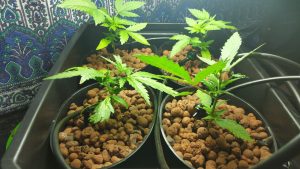
Hydroponics is a method of growing cannabis plants without soil, supplying the roots with a carefully balanced nutrient solution instead of relying on nutrients found in the ground. Rather than planting directly into soil, growers use an inert growing medium such as rockwool, clay pebbles (expanded clay), or coco coir to support the plant while allowing the roots to access water, oxygen, and nutrients efficiently.
In a hydroponic cannabis system, the nutrient-rich water is stored in a reservoir and delivered to the root zone using pumps, drip emitters, or other irrigation methods, depending on the type of hydroponic setup. Most systems continuously or periodically recirculate the nutrient solution, helping maintain consistent moisture and nutrient availability while reducing water waste.
Unlike soil-grown cannabis, where roots must spread through the growing medium to search for nutrients, hydroponic roots have immediate access to everything they need. This allows the plant to direct more energy toward vigorous vegetative growth and flower production rather than root expansion. When environmental conditions such as pH, nutrient strength (EC), water temperature, and oxygen levels are properly managed, hydroponic cannabis plants often grow faster, produce larger yields, and develop more consistent, high-quality buds than plants grown in soil.
Grow Tip: Healthy roots are the foundation of every successful hydroponic grow. Keep your nutrient solution between 65–70°F (18–21°C) and maintain plenty of dissolved oxygen using an air stone or circulation pump to help prevent root rot and encourage explosive root development.
Why Grow Cannabis Hydroponically?
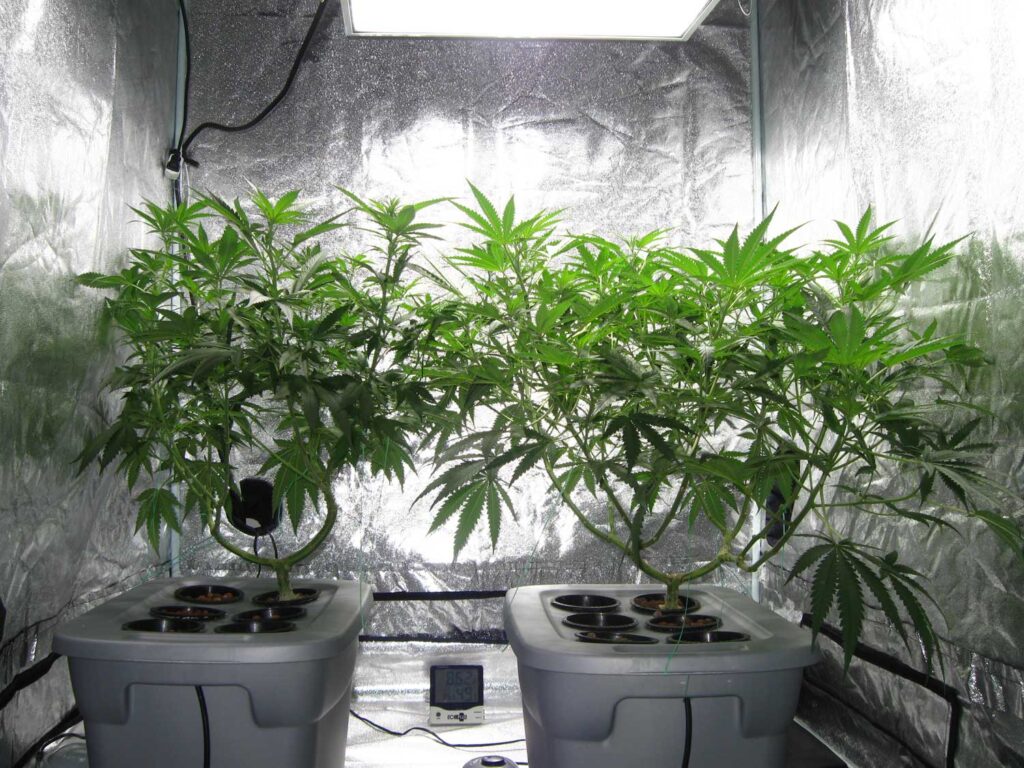
If your goal is to grow faster, healthier cannabis plants while maximising yields, hydroponics is one of the most effective cultivation methods available. Unlike traditional soil growing, hydroponic systems deliver water, oxygen, and nutrients directly to the root zone, allowing cannabis plants to absorb everything they need with minimal effort. This efficient nutrient uptake often results in faster vegetative growth, improved plant vigor, and larger, higher-quality harvests. If you're still deciding between growing methods, read our guide comparing hydroponics vs. soil for cannabis to understand the advantages and disadvantages of each approach.
Hydroponics also gives growers complete control over the growing environment. Instead of relying on the quality of your soil, you can precisely manage nutrient strength (EC), pH, water temperature, and dissolved oxygen levels throughout every stage of your cannabis plant's life cycle. For indoor growers looking to optimise plant health and production, that level of control is one of hydroponics' greatest advantages.
Of course, hydroponics isn't the right choice for everyone. While it can produce exceptional results, it also requires regular monitoring and a greater understanding of plant nutrition than traditional soil growing. If you're willing to spend a few minutes each day checking your system, the rewards can be well worth the extra effort.
Is Hydroponics Right for You?
Hydroponics is an excellent choice if you:
- Want faster-growing cannabis plants.
- Want to maximise yields in an indoor grow space.
- Enjoy monitoring and optimising your grow.
- Prefer precise control over nutrients and plant health.
- Plan to grow cannabis indoors year-round.
Soil may be a better option if you:
- Prefer a more forgiving growing method.
- Don't have time for regular system maintenance.
- Want a simpler, lower-maintenance grow.
- Prefer organic living soil cultivation.
Hydroponics vs. Soil for Cannabis
| Feature | Hydroponics | Soil |
| Growth Rate | Faster due to direct nutrient uptake | Slower as roots search for nutrients |
| Yield Potential | High when properly managed | Moderate to high depending on soil quality |
| Nutrient Control | Complete control over pH and EC | Depends on soil composition |
| Water Efficiency | Excellent with recirculating systems | Higher overall water consumption |
| Pest & Disease Risk | Lower risk of soil-borne pests and pathogens | Greater risk of soil-related issues |
| Maintenance | Requires regular monitoring | More forgiving and beginner-friendly |
| Best For | Indoor growers seeking maximum performance | Growers looking for simplicity |
Why Growers Choose Hydroponics
Faster Growth
Cannabis plants grown hydroponically have immediate access to water, oxygen, and nutrients, allowing them to focus their energy on vigorous growth rather than developing extensive root systems. Many growers find that hydroponic plants reach the flowering stage sooner than those grown in soil.
Bigger Harvests
Healthy roots absorb nutrients more efficiently, helping cannabis plants produce larger, denser buds. When environmental conditions are properly maintained, hydroponic systems can consistently deliver higher yields while making better use of available grow space.
Complete Control Over Plant Health
Hydroponics allows you to fine-tune every aspect of your feeding program. By monitoring pH and nutrient strength (EC), you can quickly identify deficiencies, avoid nutrient lockout, and adjust feeding schedules as your plants transition from seedlings to flowering.
Improved Water Efficiency
Although hydroponic systems continuously circulate water, most recirculating setups reuse their nutrient solution, making them significantly more water-efficient than traditional soil cultivation while reducing nutrient waste.
Cleaner Indoor Growing
Growing without soil means fewer fungus gnats, weeds, and soil-borne diseases. Hydroponic grow rooms are typically cleaner, easier to maintain, and less likely to introduce unwanted pests into your indoor environment.
Are There Any Downsides?
Hydroponics rewards attentive growers, but it is less forgiving than soil. Because cannabis plants depend entirely on the nutrient solution, problems such as incorrect pH, unstable EC, warm reservoir temperatures, or poor oxygenation can affect plant health quickly. Pumps, air stones, and reservoirs also require regular maintenance to keep the system operating efficiently.
The good news is that beginners don't need to start with complex equipment. Systems such as Deep Water Culture (DWC) and Wick systems are relatively simple to set up and provide an excellent introduction to hydroponic growing. As your confidence grows, more advanced systems like Drip Irrigation and Aeroponics offer even greater control and the potential for exceptional yields.
Recommendation: If you're growing cannabis hydroponically for the first time, we recommend starting with a Deep Water Culture (DWC) system. It's affordable, relatively simple to maintain, and offers an excellent balance of fast growth, healthy root development, and consistently impressive yields.
Grow Tip: Consistency is the key to successful hydroponic growing. Checking your reservoir's pH, EC, and water temperature for just a few minutes each day will have a far greater impact on your harvest than constantly changing nutrients or adding unnecessary supplements.
What are the main types of hydroponic systems?
There are several different types of hydroponic systems used to grow cannabis plants, each offering its own advantages depending on your experience level, budget, available grow space, and cultivation goals. While the variety of systems may seem overwhelming at first, they all share the same objective: delivering water, oxygen, and nutrients directly to the root zone to promote healthy growth and maximise yields.
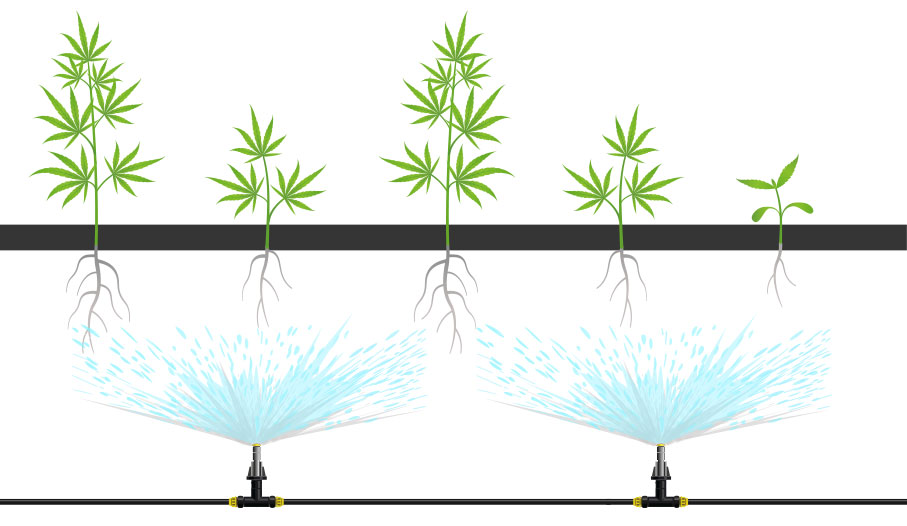
How Aeroponics Works
Aeroponics is one of the most advanced hydroponic systems for growing cannabis plants. Instead of suspending the roots in water or growing media, the roots hang freely inside an enclosed chamber where they are continuously sprayed with a fine mist of oxygen-rich nutrient solution. Cannabis plants are typically supported in net pots using a small amount of rockwool, neoprene collars, or expanded clay pebbles, while the exposed roots receive everything they need from the nutrient mist.
Because the roots are surrounded by air between each misting cycle, they receive exceptional levels of oxygen, allowing the plant to absorb water and nutrients extremely efficiently. This combination of high oxygen availability and precise nutrient delivery is what makes aeroponics one of the fastest-growing hydroponic methods available.
Why Cannabis Growers Choose Aeroponics
Aeroponics is designed for growers who want to maximise plant performance. When properly managed, it can produce explosive vegetative growth, vigorous root development, and impressive yields. It's also a popular choice for propagating cannabis clones, as the constant oxygen supply encourages rapid root formation.
However, aeroponics is generally best suited to experienced growers. Maintaining consistent pH, nutrient strength (EC), and reliable misting intervals is essential, as cannabis plants can become stressed quickly if the system stops operating.
Advantages of Aeroponics
- Exceptional root oxygenation encourages rapid vegetative growth and healthy root development.
- Efficient nutrient delivery allows cannabis plants to absorb water and minerals with minimal waste.
- Produces fast-growing plants with the potential for large, high-quality harvests.
- Uses less water than many other hydroponic systems because the nutrient solution is continuously recirculated.
- Excellent choice for rooting cannabis clones and maintaining healthy root systems.
Disadvantages of Aeroponics
- One of the most expensive hydroponic systems to purchase and maintain.
- Relies on pumps and misting nozzles that require regular cleaning and maintenance.
- Power failures or clogged spray nozzles can cause roots to dry out quickly, potentially damaging plants.
- Requires careful monitoring of pH, EC, and reservoir conditions to achieve consistent results.
- Better suited to experienced growers than complete beginners.
Deep Water Culture (DWC)
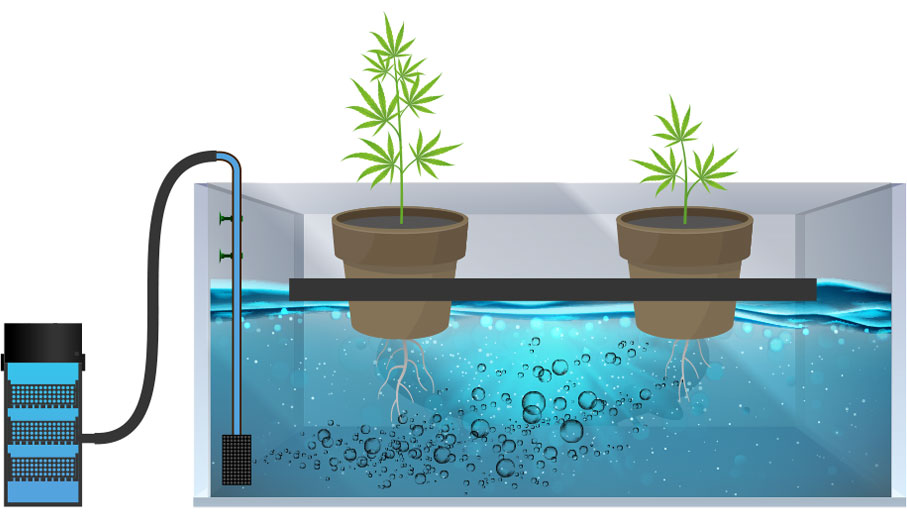
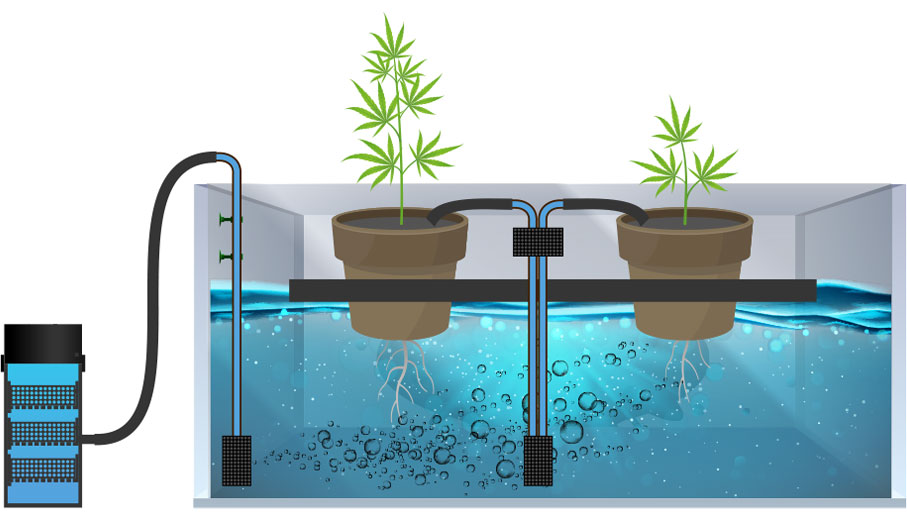
Deep Water Culture (DWC) is one of the simplest and most popular hydroponic systems for growing cannabis plants, making it an excellent choice for beginners and experienced growers alike. In a DWC system, cannabis plants are suspended above a reservoir filled with a nutrient-rich solution, while their roots remain fully submerged in highly oxygenated water. Air pumps and air stones continuously supply dissolved oxygen, ensuring the roots receive the oxygen they need to absorb nutrients efficiently and remain healthy.
Because cannabis roots have constant access to water, nutrients, and oxygen, DWC plants can grow rapidly throughout the vegetative stage and continue producing vigorous growth during flowering. The straightforward design also makes DWC one of the easiest hydroponic systems to build and maintain at home.
Why Cannabis Growers Choose DWC
Deep Water Culture has earned a reputation as one of the best hydroponic systems for indoor cannabis cultivation because it combines simplicity with outstanding performance. It's relatively inexpensive to set up, requires fewer components than many other hydroponic systems, and consistently delivers fast growth and impressive yields when properly maintained.
Many first-time hydroponic growers choose DWC because it provides an excellent introduction to hydroponics without the complexity of more advanced systems. If you're setting up your first hydroponic grow, our Beginner's Guide to Growing Weed Hydroponically walks you through everything you need to get started.
Advantages of Deep Water Culture
- One of the easiest hydroponic systems to set up and maintain.
- Constant access to oxygen, water, and nutrients encourages rapid vegetative growth.
- Capable of producing large, high-quality cannabis yields when properly managed.
- Uses water efficiently through a recirculating nutrient reservoir.
- No soil means fewer soil-borne pests, diseases, and weeds.
- Simple design makes it easy to monitor nutrient strength (EC), pH, and water temperature.
Disadvantages of Deep Water Culture
- Air pumps must run continuously, making the system vulnerable to power outages.
- Warm reservoir temperatures can reduce dissolved oxygen levels and increase the risk of root rot.
- Regular monitoring of pH, EC, and nutrient levels is essential for healthy plant growth.
- Large cannabis plants may require additional support as heavy flowers develop.
- Reservoirs should be cleaned and nutrient solutions replaced regularly to maintain healthy root conditions.
Bubbleponics
Bubbleponics is an enhanced version of Deep Water Culture (DWC) that combines the benefits of constant root oxygenation with a top-feeding irrigation system. Like DWC, cannabis plants are suspended above a reservoir filled with oxygen-rich nutrient solution. However, during the early stages of growth, a small pump delivers nutrient solution directly to the base of the plant, encouraging the roots to establish quickly before they reach the reservoir below.
Once the roots are fully developed, the system functions much like a traditional DWC setup, with air stones continuously oxygenating the nutrient solution. This combination of top feeding and deep water culture helps cannabis plants develop strong root systems and promotes vigorous early growth.
Why Cannabis Growers Choose Bubbleponics
Bubbleponics is popular with growers who want to accelerate the early vegetative stage without adding too much complexity to their hydroponic setup. The top-feeding system helps young cannabis plants establish faster, reducing transplant stress and encouraging rapid root development.
For growers looking to shorten vegetative growth while maintaining the simplicity of a DWC system, Bubbleponics offers an excellent balance between performance and ease of use. It is particularly effective for growers aiming to maximise growth before switching their plants into the flowering stage.
Advantages of Bubbleponics
- Top feeding encourages faster root development during the seedling and vegetative stages.
- Combines the simplicity of DWC with enhanced early plant growth.
- Constant oxygenation promotes healthy roots and efficient nutrient uptake.
- Produces vigorous vegetative growth and the potential for high-yielding cannabis plants.
- Recirculating nutrient solution reduces water waste and improves nutrient efficiency.
Disadvantages of Bubbleponics
- Requires an additional water pump and feed lines compared to a standard DWC system.
- Pump failures can slow early plant development if the top-feed system stops working.
- Regular monitoring of pH, EC, and reservoir temperature is still essential.
- Slightly more maintenance than a standard DWC setup due to the additional components.
Drip Irrigation System
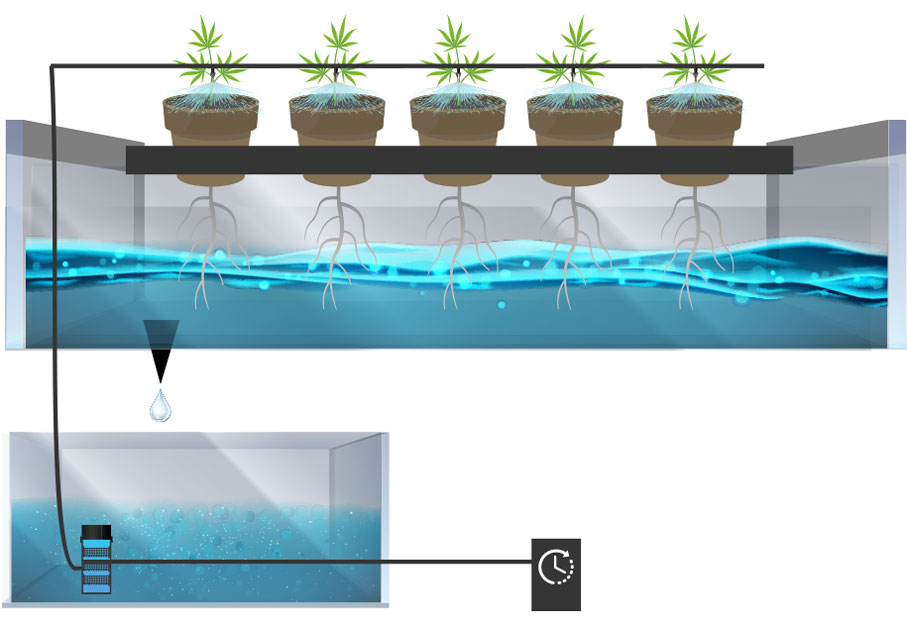
A Drip Irrigation system delivers a controlled amount of nutrient solution directly to the base of each cannabis plant through a network of tubing and drip emitters. A pump moves nutrient-rich water from a central reservoir through the main supply line before distributing it evenly to every plant. The nutrient solution slowly drips into the growing medium typically coco coir, rockwool, expanded clay pebbles (LECA), or a combination of inert media—allowing the roots to absorb water and nutrients efficiently.
Depending on the setup, excess nutrient solution can either drain away (run-to-waste) or be collected and recirculated back into the reservoir. This flexibility makes drip irrigation one of the most versatile hydroponic systems, capable of supporting anything from a single cannabis plant in a grow tent to large-scale commercial cultivation.
Why Cannabis Growers Choose Drip Irrigation
Drip Irrigation is widely regarded as one of the best hydroponic systems for growing cannabis because it combines precision, flexibility, and scalability. Every plant receives a consistent supply of water and nutrients, making it easier to maintain healthy growth throughout both the vegetative and flowering stages.
Unlike some hydroponic systems that are better suited to small plants or experienced growers, drip systems work exceptionally well for large photoperiod cannabis plants, high-yield cultivars, and gardens containing multiple plants. They're also easy to automate using timers, making them a popular choice for growers who want consistent results with less daily manual watering.
Advantages of a Drip Irrigation System
- Delivers precise amounts of water and nutrients directly to each cannabis plant.
- Suitable for both small home grows and large commercial cultivation facilities.
- Easily automated using timers for consistent irrigation schedules.
- Supports large cannabis plants with extensive root systems.
- Compatible with a wide range of hydroponic growing media.
- Can be configured as either a recirculating or run-to-waste system depending on the grower's preference.
Disadvantages of a Drip Irrigation System
- Initial setup is more complex than simpler systems such as DWC or Wick systems.
- Drip emitters and tubing can become blocked by mineral deposits, algae, or nutrient buildup if not cleaned regularly.
- Requires careful monitoring of irrigation frequency to prevent overwatering or underwatering.
- Pumps, tubing, and timers need periodic maintenance to ensure reliable operation.
Ebb and Flow (Flood and Drain)
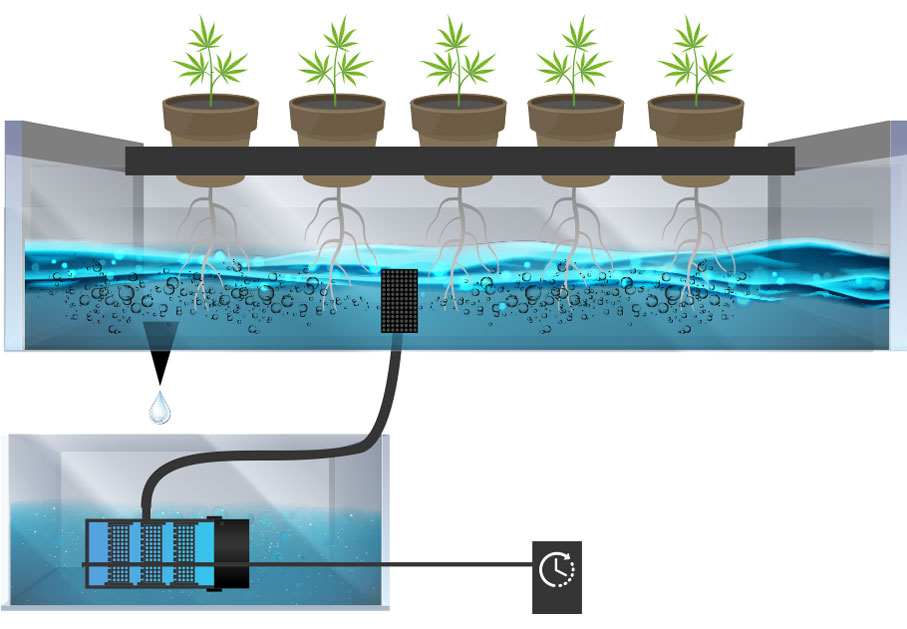
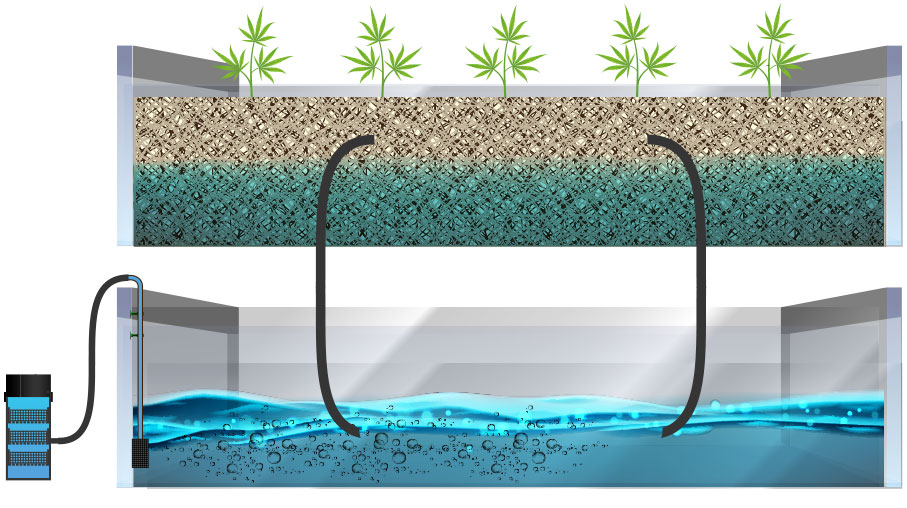
Ebb and Flow, also known as Flood and Drain, is one of the most versatile hydroponic systems for growing cannabis plants. The system works by periodically flooding a grow tray with nutrient-rich water from a reservoir before draining it back once the roots have absorbed the moisture and nutrients they need. This cycle repeats throughout the day using a timer, ensuring cannabis plants receive a consistent supply of water, nutrients, and fresh oxygen.
Cannabis plants are typically grown in inert media such as expanded clay pebbles (LECA), coco coir, perlite, or rockwool, which provide support while allowing the nutrient solution to flow freely around the roots. As the tray drains, fresh air is drawn back into the growing medium, helping maintain healthy, oxygen-rich root systems.
Why Cannabis Growers Choose Ebb and Flow
Ebb and Flow is popular because it offers an excellent balance between automation, flexibility, and plant performance. Unlike Deep Water Culture, which keeps roots permanently submerged, the regular flood-and-drain cycle naturally oxygenates the root zone, encouraging healthy root development while reducing the risk of waterlogged roots.
The system is well suited to growers cultivating multiple cannabis plants, making it a popular choice for larger indoor grow rooms and Sea of Green (SOG) setups. Because irrigation is fully automated, growers can maintain consistent feeding schedules while spending less time hand-watering individual plants.
Advantages of an Ebb and Flow System
- Flood-and-drain cycles provide an ideal balance of nutrients, moisture, and oxygen.
- Suitable for growing multiple cannabis plants in a single system.
- Compatible with a wide range of hydroponic growing media, including rockwool, coco coir, perlite, and expanded clay pebbles.
- Automated irrigation reduces daily maintenance and provides consistent feeding.
- Produces healthy root systems capable of supporting vigorous growth and impressive yields.
- Easily adapted to different grow room sizes and cultivation styles.
Disadvantages of an Ebb and Flow System
- Not as beginner-friendly as simpler systems such as DWC or Wick systems due to the need for careful timer management.
- Relies on pumps and timers, making it vulnerable to power outages or equipment failure.
- Incorrect flooding schedules can lead to overwatering, underwatering, or nutrient imbalances.
- Reservoirs, pumps, and grow trays require regular cleaning to prevent algae and salt buildup.
Nutrient Film Technique (NFT)
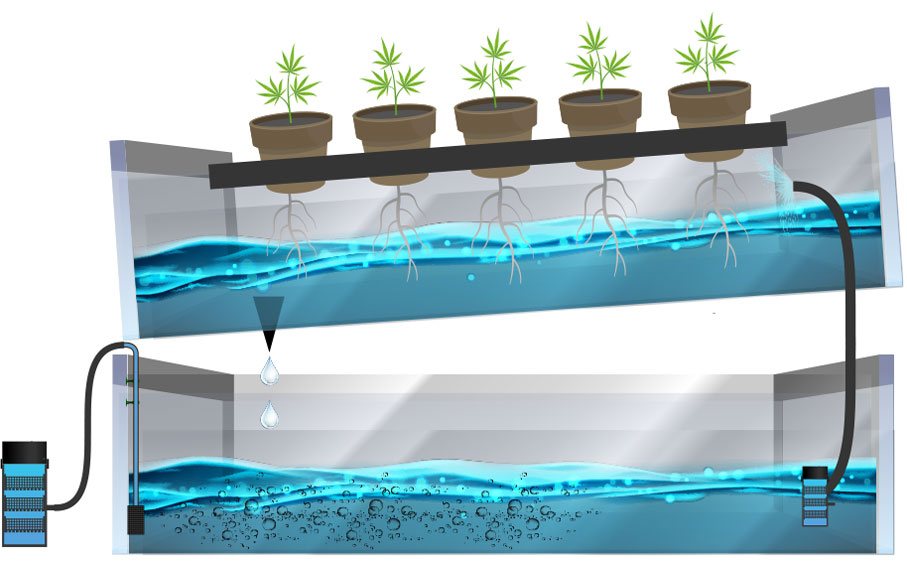
The Nutrient Film Technique (NFT) is a recirculating hydroponic system that continuously flows a shallow stream of nutrient-rich water through narrow channels or PVC pipes. Cannabis plants are supported in net pots, while their roots extend into the channel below, where they absorb water, nutrients, and oxygen from the constantly moving nutrient solution.
Unlike Deep Water Culture, the roots are not fully submerged. Instead, only the lower portion of the root system comes into contact with the nutrient film, while the upper roots remain exposed to air. This constant combination of oxygen and nutrients can promote rapid plant growth when the system is properly maintained.
Why Cannabis Growers Choose NFT
NFT is popular because it is extremely water-efficient and requires very little growing medium. However, while it performs exceptionally well with leafy greens and smaller crops, it is generally less suitable for large cannabis plants with extensive root systems.
Some experienced cannabis growers use NFT successfully for smaller cultivars or compact grow spaces, but larger photoperiod plants can quickly fill the channels with roots, restricting water flow and increasing the risk of system failures. For this reason, NFT is usually considered a specialist hydroponic system rather than the best all-around choice for cannabis cultivation.
Advantages of the Nutrient Film Technique
- Continuously recirculates water and nutrients with very little waste.
- Requires minimal growing medium, reducing setup costs.
- Provides excellent root oxygenation through constant nutrient flow.
- Suitable for smaller cannabis plants and compact indoor growing systems.
- Lightweight design makes it easy to expand or modify.
Disadvantages of the Nutrient Film Technique
- Not the ideal choice for large, high-yield photoperiod cannabis plants.
- Large cannabis root systems can block nutrient channels and restrict water flow.
- Highly dependent on pumps, making power outages a significant risk.
- Requires frequent monitoring of pH, EC, and nutrient flow.
- Less forgiving than systems such as DWC or Drip Irrigation.
Wick system
The Wick System is the simplest and most passive hydroponic system for growing cannabis plants. Unlike other hydroponic methods, it doesn't require pumps, timers, or electricity to deliver water to the roots. Instead, absorbent wicks draw nutrient solution from a reservoir into the growing medium through capillary action, keeping the root zone consistently moist.
Cannabis plants are typically grown in media such as coco coir, perlite, vermiculite, or expanded clay pebbles, while the wick continuously supplies water and nutrients as the growing medium begins to dry. Its simple design makes it inexpensive to build and easy to maintain, making it an attractive option for first-time hydroponic growers.
Why Cannabis Growers Choose the Wick System
The Wick System is ideal for growers who want to learn the basics of hydroponics without investing in expensive equipment. Because there are no pumps or moving parts, there's very little that can go wrong, making it one of the most reliable and beginner-friendly hydroponic systems available.
While it can successfully grow cannabis, the Wick System is best suited to small plants, seedlings, clones, and autoflowering strains with relatively modest nutrient requirements. Larger photoperiod cannabis plants often outgrow the system's ability to deliver enough water and nutrients during late vegetative growth and flowering.
Advantages of the Wick System
- One of the cheapest hydroponic systems to build and operate.
- No pumps, electricity, or complex equipment required.
- Easy to set up and maintain, making it ideal for beginners.
- Quiet operation with very little ongoing maintenance.
- Excellent for seedlings, clones, and smaller cannabis plants.
Disadvantages of the Wick System
- Nutrient uptake is slower than active hydroponic systems, resulting in slower plant growth.
- Not suitable for large, high-yield photoperiod cannabis plants with high water demands.
- Offers limited control over nutrient delivery, pH, and moisture levels.
- Growing media can become overly saturated if the system isn't properly designed, increasing the risk of root problems.
- Lower yield potential compared to DWC, Drip Irrigation, or Aeroponics.
Which Hydroponic System Is Best for Growing Cannabis?
There isn't a single hydroponic system that's perfect for every cannabis grower. The best choice depends on your experience level, budget, available grow space, and cultivation goals. Some systems prioritize simplicity, while others are designed to maximise yields or support larger, more demanding cannabis plants.
The table below summarizes which hydroponic system is best suited to different growing styles.
| Hydroponic System | Difficulty (1–10) | Yield Potential | Best For |
| Wick System | 1/10 | Moderate | Beginners, autoflowers, small grows, low budgets |
| Deep Water Culture (DWC) | 2/10 | High | First-time hydroponic growers, home growers, indoor grow tents |
| Bubbleponics | 3/10 | High | Faster vegetative growth and stronger root development |
| Drip Irrigation | 5/10 | Very High | Large cannabis plants, automated grows, home and commercial cultivation |
| Ebb and Flow | 5/10 | High | Multi-plant gardens, Sea of Green (SOG), automated irrigation |
| Nutrient Film Technique (NFT) | 7/10 | Moderate–High | Experienced growers with smaller cannabis plants |
| Aeroponics | 9/10 | Excellent | Maximum yields, clone production, experienced growers |
Our Recommendations
Every hydroponic system has its strengths, but some are better suited to cannabis cultivation than others.
- Best for Beginners: Deep Water Culture (DWC) offers the ideal balance of affordability, simplicity, and impressive yields, making it our top recommendation for first-time hydroponic growers.
- Best Overall: Drip Irrigation is the most versatile hydroponic system, combining excellent yields, automation, and the ability to grow anything from a single cannabis plant to a large indoor garden.
- Best for Maximum Yields: Aeroponics provides exceptional root oxygenation and nutrient uptake, making it one of the highest-performing systems available for experienced growers.
- Best Budget Option: Wick Systems are inexpensive, simple to build, and ideal for learning the basics of hydroponic cannabis cultivation.
- Best for Multi-Plant Grows: Ebb and Flow systems are well suited to growers running larger gardens or Sea of Green setups with automated irrigation.
Ultimately, choosing the right hydroponic system comes down to your growing style. If you're new to hydroponics, start with a system that's easy to learn and maintain. As your confidence and experience grow, you can move on to more advanced methods that offer greater control and higher production.
Conclusion
Choosing the right hydroponic system is key to successfully growing cannabis plants indoors. While all hydroponic methods deliver water and nutrients more efficiently than soil, each system suits different experience levels, budgets, and grow setups.
Beginners often find Deep Water Culture (DWC) ideal due to its simplicity and reliable results. Growers seeking automation and scalability may prefer Drip Irrigation or Ebb and Flow, while experienced cultivators aiming for maximum performance often turn to Aeroponics for faster growth and higher yields.
Success in hydroponics depends less on the system itself and more on proper management. Maintaining healthy roots, stable pH and EC levels, correct reservoir temperatures, and consistent feeding schedules is essential.
Whether you're growing a single autoflower or managing a larger indoor garden, hydroponics offers precise control and the potential for strong, high-yielding plants. With the right setup and care, you can achieve faster growth and consistently impressive harvests.
Frequently Asked Questions
What is the best hydroponic system for growing cannabis?
The best hydroponic system depends on your experience level and growing goals. For most home growers, Deep Water Culture (DWC) offers the best combination of simplicity, affordability, and high yields. If you're looking to automate your grow or cultivate multiple cannabis plants, Drip Irrigation is an excellent all-around choice. Experienced growers aiming for maximum performance may prefer Aeroponics, which provides exceptional root oxygenation and rapid plant growth.
Is hydroponics better than soil for cannabis?
Hydroponics can produce faster growth and larger yields than soil because cannabis plants receive direct access to water, oxygen, and nutrients. However, hydroponic systems require closer monitoring of pH, nutrient strength (EC), and reservoir conditions. Soil remains a more forgiving option for beginners, while hydroponics offers greater control for growers willing to invest more time in managing their plants.
Which hydroponic system is best for beginners?
Deep Water Culture (DWC) is widely considered the best hydroponic system for beginners. It has a simple design, requires relatively little equipment, and consistently produces healthy cannabis plants with excellent yields. Growers looking for an even lower-cost introduction to hydroponics may also consider the Wick System, although plant growth and yields are generally more modest.
Can you grow autoflowering cannabis in hydroponic systems?
Yes. Autoflowering cannabis performs very well in hydroponic systems thanks to the rapid nutrient uptake and accelerated growth that hydroponics provides. Systems such as DWC, Bubbleponics, and Drip Irrigation are particularly well suited to autoflowers, while a Wick System can also be a good option for smaller plants and budget-friendly grows.
What is the biggest challenge when growing cannabis hydroponically?
The biggest challenge is maintaining a stable growing environment. Cannabis plants grown hydroponically rely entirely on the nutrient solution, so regularly monitoring pH, EC, reservoir temperature, and dissolved oxygen levels is essential. Keeping your equipment clean, maintaining healthy roots, and checking your system daily will help prevent common problems such as nutrient lockout, algae growth, and root rot.


