




Thrips on cannabis plants can become a serious problem for indoor and outdoor growers. These tiny, sap-feeding insects scrape plant tissue, leaving silvery streaks, bronze patches, black specks, curled leaves, and stunted growth. Since thrips often hide beneath leaves, around new growth, and in other protected areas, infestations may spread before visible damage appears.
Early identification is essential for protecting cannabis plants. Inspect leaves regularly, especially their undersides and growing tips, and use sticky traps or a magnifying glass to monitor activity. Catching thrips before populations increase makes control much easier.
Effective management may include beneficial insects, organic treatments, sanitation, and other integrated pest-management practices. Removing heavily damaged foliage, cleaning the growing area, and isolating affected plants can also help limit their spread. Prevention is equally important: inspect new clones and seedlings, maintain a clean environment, and continue monitoring throughout the growing cycle.
This guide explains how to identify thrips on cannabis, recognise their damage, eliminate infestations, and prevent future problems.
Key Takeaways
- Thrips can cause significant damage to cannabis plants by feeding on leaf tissue, which may result in silvery or bronze markings, black fecal spots, curling leaves, brittle tissue, and reduced plant vigor.
- Early detection is essential for controlling thrips on cannabis. Check the undersides of leaves and new growth regularly, and use sticky traps and magnification to monitor pest activity.
- Thrips can spread quickly when conditions are favorable, so dealing with an infestation early can help prevent larger populations from developing throughout an indoor grow room, greenhouse, or outdoor crop.
- Several pest-control methods can help manage thrips, including beneficial insects, microbial treatments, horticultural products, sanitation, and other integrated pest management techniques appropriate to the plant’s growth stage.
- Preventing thrips is often easier than eliminating an established infestation. Inspect new clones and seedlings, keep growing areas clean, remove damaged plant material, monitor plants routinely, and avoid conditions that encourage pest problems.
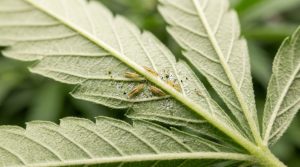
Understanding thrips and their impact on cannabis
Thrips are one of the most common insect infestations that a cannabis grower will experience during their lifetime. These tiny sap sucking bugs are hard to spot with the naked eye, and can quickly infest your crop, leaving behind a world of damage that weakens and seriously affects a cannabis plant's health and development. Below is a breakdown of what they are and the damage they can cause to your plants.
What are thrips — appearance, life cycle, and behaviour
- There are thousands of different species of thrips.
- Hot and dry conditions are their preferred environment
- Thrips are also known as thunder flies.
- Thrips can transmit viruses to cannabis plants.
- They grow as large as 0.5-2.5 millimetres in size, making them difficult to spot.
- Thrips are found in large groups on the undersides of cannabis leaves.
- Appear either brown, black, orange, pale yellow or a white colour.
- They typically have small wings and a slim, soft body.
- Thrips can also live in the soil of a cannabis plant.
- Eggs are laid and deposited in the cannabis leaf tissue.
- The larvae are wingless and transparent in appearance.
- Thrips feed on plant tissue and suck the sap out of cannabis plants.
- Their lifespan will range between 2 and 6 weeks, depending on the species.
| Life Stage | Duration | Activity |
| Egg | 2–7 days | Hidden in leaf tissue |
| Larvae | 4–10 days | Feeds on leaves |
| Pupa | 2–5 days | Often in soil |
| Adult | Up to 30 days | Reproduces rapidly |
Common signs of thrip damage on cannabis
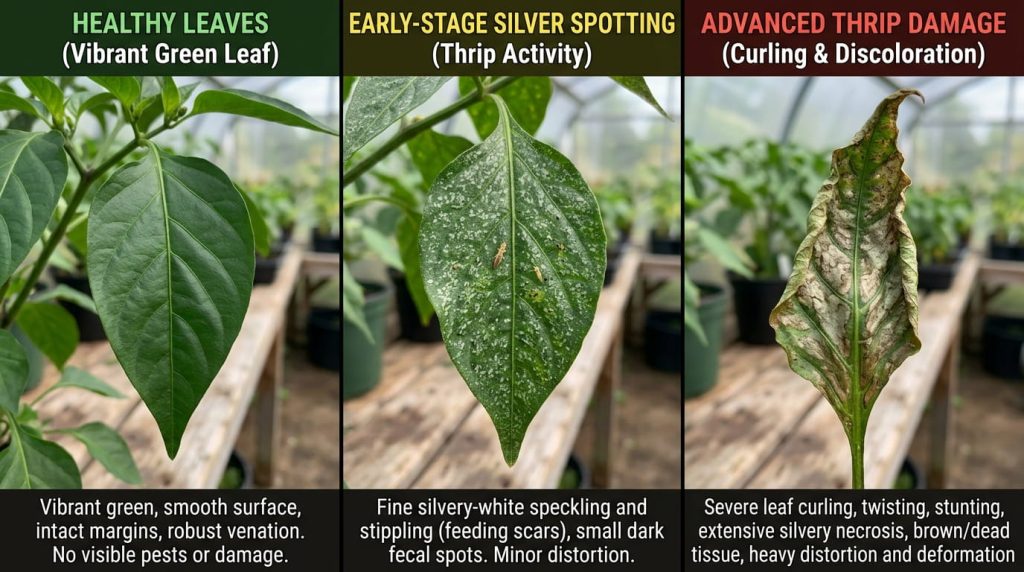
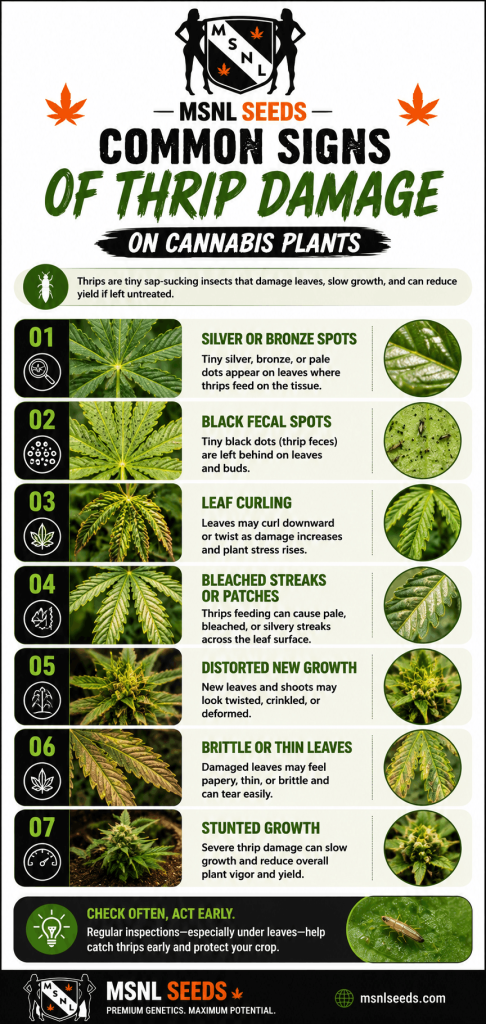
Even though thrips can be so small, making it difficult to know if you even have them, the trail of damage they leave behind can be easier to spot. Below is a short list of common signs to look out for when monitoring your cannabis plant for a potential thrip infestation.
- Tiny black faecal spots will be left on the surface of the leaves.
- The leaf tissue may appear thin and brittle to the touch.
- Plant growth can become stunted and slow down.
- There will be pale yellow, bronze or silver dots on parts of the leaves.
- Bleached patches and streaks on the leaf.
- Distorted growth patterns on new shoots.
- Leaf curling and shrivelling may occur.
| Symptom | Appearance | Severity |
| Silver spots | Shiny leaf marks | Early stage |
| Black dots | Thrip feces | Active infestation |
| Curling leaves | Twisted growth | Moderate damage |
| Brittle leaves | Dry texture | Advanced damage |
| Slow growth | Stunted plants | Long-term stress |
Why cannabis growers should act early
The sooner you can act once you have an awareness of a thrip infestation, the better, especially when it comes to thrips. One of the reasons is that their lifespan can be as short as 2-6 weeks, meaning they will multiply and lay new eggs within a very short time frame. A thrip infestation can be devastating during the seedling stage and early vegetation stages, meaning a grower has a brief window to eliminate the threat before flowering commences.
Healthy plants are generally better able to recover from environmental stress and pest pressure during the vegetative stage. Many growers prioritize stable cannabis genetics and vigorous growth traits when selecting seeds for indoor or outdoor cultivation. Choosing reliable feminised cannabis seeds or fast-growing strains can help simplify plant management and improve consistency throughout the grow cycle.
Diagnosing an infestation

To confirm your fears that your plants are riddled with sap sucking thrips, you will need to be able to diagnose a thrip problem. Only then can you act accordingly. Below is an explanation of how to detect thrips and distinguish between nutrient deficiency in cannabis plants and insect damage.
How to detect thrips
In the event you need to check for any insect infestation, it is time to get up close and personal with your cannabis plants. Suppose you are checking seedlings, plants in vegetation, or mature flowering crops. In that case, the following is a guide on how to detect thrips.
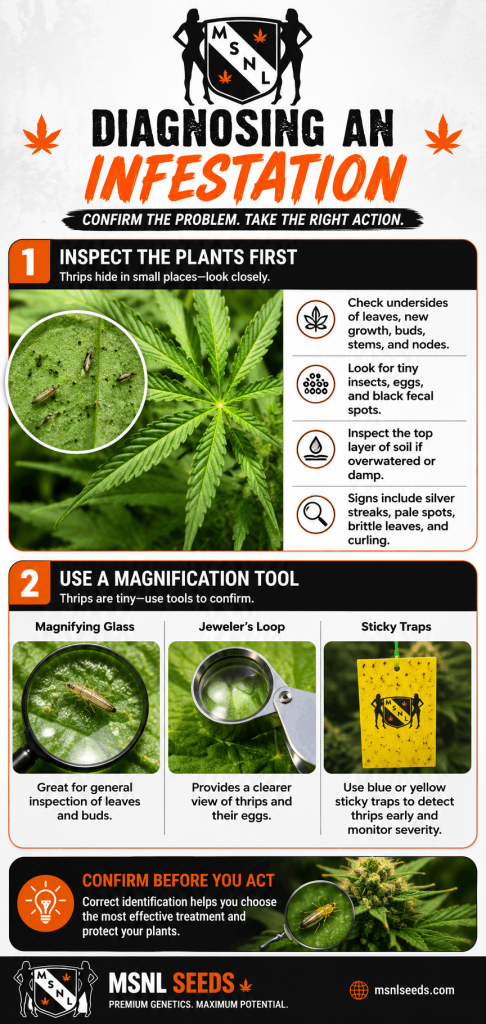
Inspect the leaves first
Because thrips are so tiny and difficult to see with the naked eye, you will first need to inspect your cannabis plants thoroughly. Thrips typically congregate on the undersides of vegetating cannabis plants, as well as inside the buds of plants that are flowering.
When checking for eggs, examine the surface of the plant tissue, as well as the stem and internodal sites, closely. In some cases, thrips can live freely in damp and overwatered soil. Inspect the leaves and the rest of the plant for black faecal spots, brittle and paper-thin leaf tissue, pale yellow, bronze, or silver dots, silver streaks, or bleached patches, and potential leaf curling.
Use a magnification tool
Once you have identified the symptoms and signs mentioned above, the next step is to use a magnification tool. We recommend using a magnifying glass or a jeweller's loop. Carefully check for the signs mentioned above to confirm you have a thrip infestation before acting accordingly using biological or chemical solutions. Using sticky traps is an accurate and safe way to check if you do have thrips. It will provide a clear indication of how severe the situation has become.
Differentiating thrip symptoms from nutrient deficiencies or other pests
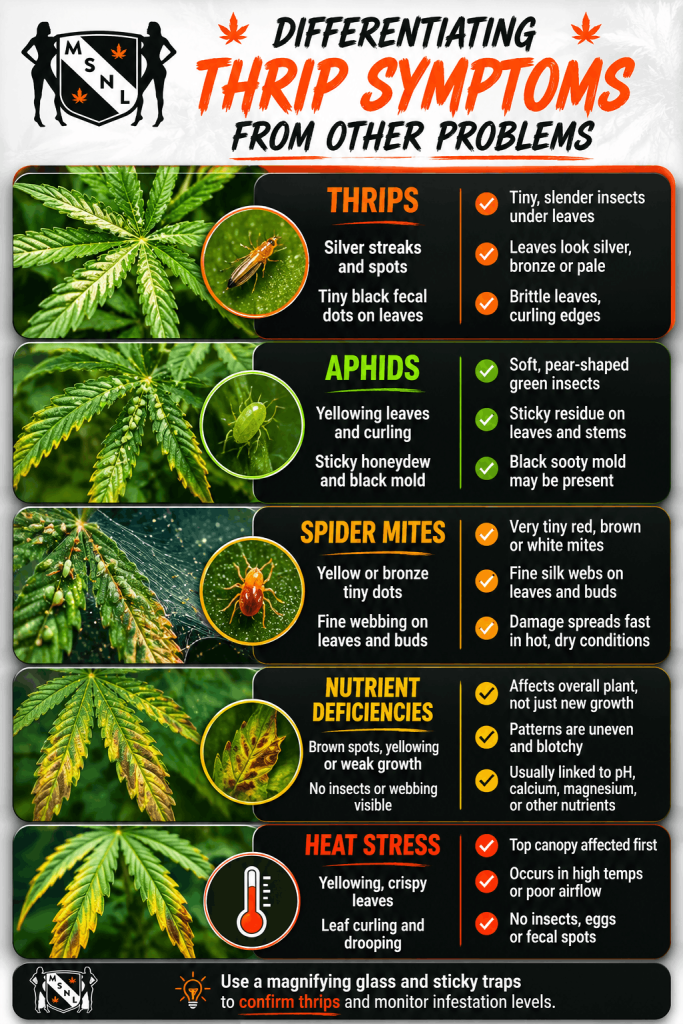
It can be challenging to know the difference between other pests and diseases and thrips on cannabis plants, especially if you are a beginner grower or have never experienced a potential pest problem before.
Oftentimes, pests are transmitted when exchanging clones with another grower, and before you know it, time is against you. Below is a checklist of what to look for to help you rule out other pests, such as aphids and spider mites.
Thrip damage
- Yellow or pale spots on the leaf surface.
- Brittle and paper-thin leaf texture.
- Tiny black traces of faeces.
- Silver or bronze dots on the leaf.
Aphid damage
- Yellow and wilting leaves.
- Honey dew deposits from feeding.
- Black fungal mould growing on the honey dew deposits.
- Leaves will begin to curl.
Spider mite damage
- Yellow or bronze coloured leaves.
- Silk web formation on the stems and leaves.
- Visible webs on the tops of the buds.
- Tiny white or yellow dots on the leaf surface.
Nutrient deficiencies
- Calcium and Magnesium deficiencies can cause brown spots.
- Nutrient deficiencies can produce Septoria or Bipolaris leaf spots.
- Heat stress can cause yellowing leaves.
- Over or underwatering can cause leaves to wilt and curl.
| Problem | Main Sign | Quick Identifier |
| Thrips | Silver spots | Black fecal dots |
| Aphids | Yellow curling | Sticky residue |
| Spider mites | Yellow dots | Fine webbing |
| Calcium deficiency | Brown spots | No insects visible |
| Heat stress | Yellow leaves | Top canopy affected |
Integrated pest management (IPM) strategies for thrips control
| Prevention Step | Purpose |
| Inspect new clones | Avoid introducing pests |
| Use sticky traps | Detect thrips early |
| Clean grow space | Reduce breeding areas |
| Avoid overwatering | Limit soil activity |
| Monitor plants weekly | Catch infestations fast |
IPM should be at the top of your priority list as an indoor grower, especially if you are running a large-scale commercial operation. Integrated Pest Management is a strategy to combat thrips and other unwanted insects that have invaded your garden, as explained below.
Quarantine and sanitation
The last thing you want as a home grower is to infect new plants with thrips or any other insect, for that matter, so quarantining your new clones or seedlings means temporarily separating them. During this separation period, you will need to sanitise the grow space.
- Using biological sprays, or chemical and organic approved applications.
- Remove the top layer of soil and add a layer of Diatomaceous earth.
- Introduce predatory insects onto the plants.
- Use soap or neem oil sprays.
Mechanical methods
The next step in your IPM plan is to implement mechanical methods, as outlined below.
- Using sticky traps.
- Install insect netting to act as a physical barrier.
- Using silver coloured plastic mulches.
Cultural prevention
Cultural prevention means taking every possible step to act as both a preventive measure and a cure simultaneously. When referring to pruning infected plant leaves, using reflective mulch, installing netting or row covers as a physical barrier, introducing predatory insects, applying biological sprays, using sticky traps, and frequently monitoring the plants for signs of thrip damage.
Alongside sanitation and environmental control, many growers also focus on cultivating resilient plants that perform consistently under indoor conditions. Choosing dependable indoor cannabis seeds, beginner-friendly strains, or mould-resistant cannabis seeds is commonly part of a long-term pest prevention strategy, especially in controlled grow spaces where airflow and humidity management are critical.
Biological and organic controls
Suppose there is a way to solve an insect-related problem. In that case, home growers will always choose an organic and biological solution over a chemical-based one. The reason is that chemicals can be harmful to both the plants and the grower, and potentially detrimental to the buds and trim when harvesting.
Below is a breakdown of the best way to deal with a thrip infestation using beneficial predators, natural microbial or fungal agents, and homemade organic sprays.
| Method | Type | Best Use |
| Neem oil | Organic spray | Early veg |
| Sticky traps | Monitoring | All stages |
| Beauveria bassiana | Fungal agent | Veg and flower |
| Predatory mites | Biological control | Prevention |
| Diatomaceous earth | Soil treatment | Soil pests |
Beneficial predators
Beneficial predators are insects that utilise thrips as a food source. Imagine a battlefield where tiny insects fight on your behalf to balance out and eliminate the threat posed by the thrip population.
These predators can be sourced online with specialised companies, and below is a short list of the different thrip predators you can purchase and introduce into your garden and onto your cannabis plants.
- Neoseiulus cucumeris
- Amblyseius swirskii
- Amblyseius andersoni
- Amblydromalus limonicus
- Transeius montdorensis
- Orius spp.
- Franklinothrips vespiformis
- Mallada signata
- Dalotia coriaria
- Hypoaspis miles
Natural microbial or fungal agents
Microbial or fungal agents work by infecting and attacking the thrips' immune system. A completely organic solution that must be applied to the plant, causing the thrips to become compromised and die.
These agents do not harm the plants in any way and do not leave any potentially harmful residue on the leaves or buds. Below is a list of your options if natural microbial and fungal treatments are your preferred biological weapons of choice for combating thrips.
- Beauveria bassiana
- Metarhizium anisopliae
- Akanthomyces muscarius (formerly Lecanicillium muscarium),
- Steinernema feltiae
Organic sprays
Organic spray is easy to source online and works incredibly well to eliminate an out-of-control thrip problem. One of the most popular sprays on the market is called Trifecta Crop Control, which can be applied as follows:
- 5oz per gallon applied once per week during 18/6
- 1oz per gallon applied once per week during 12/12 (until the last 2 weeks)
Chemical and organic-approved applications
Suppose biological bacteria and fungal sprays are not for you. In that case, there are still plenty of options that you can use to prevent the spread of thrips on your cannabis plants, as explained below.
Neem oil best practices
Neem oil is a natural pesticide and fungicide produced when the seeds and fruits of the neem tree, known as Azadirachta Indica, are pressed. The byproduct is a pungent and potent insecticidal oil known as Azadirachtin.
Neem oil has a viscous and gooey consistency that can be mixed with water or applied directly onto the surface of cannabis leaves and stems. You mustn't spray a neem oil-based solution directly onto your developing or mature buds. Below is a guide on how to make a neem oil solution for treating thrips on cannabis plants.
Step 1: Dilute the neem oil with water and a mild soap.
Step 2: Spray the solution on the undersides of leaves, stems and soil.
Step 3: Respray the plant a week later or every other week as a preventive measure.
Spinosad products
Spinosad is a natural insecticide derived from soil bacteria. This natural insecticide, Saccharopolyspora, can be used to kill not only thrips but also flies, beetles, caterpillars, and aphids. The mechanism of action is similar to that of other microbial or fungal agents, which target the insect's nervous system. Once the insect has ingested Saccharopolyspora, it stops feeding, resulting in a rapid death and preventing the growth of the insect population.
Pyrethrins and their constraints
Pyrethrins are naturally produced when the chrysanthemum flowers are extracted. They act as a powerful insecticide that directly targets the insect's nervous system, inducing paralysis and ultimately leading to death. Pyrethroids are a synthetic version of these chemicals. They are just as effective at preventing the spread and infestation of thrips on cannabis plants.
However, there are several downsides to using this product compared to the other biological controls and sprays mentioned in this article. The adverse effects associated with human health using Pyrethetins and Pyrethroids are skin irritation, neurological symptoms and allergic reactions.
Diatomaceous earth usage
Diatomaceous earth is a white powdery substance that can be bought online or found in your local grow shop. It is made from fossilised skeletons of diatoms and acts as a non-toxic insecticide that attacks the insect's exoskeleton.
Diatomaceous earth causes the insect's body to dry out. It can be used for both smaller-sized insects, such as thrips, aphids, and flies, as well as larger-sized insects, including ants and cockroaches. Diatomaceous earth can be sprayed onto plants in a dust form or applied directly to the soil surface.
Managing thrips successfully often comes down to early detection, consistent monitoring, and maintaining healthy plant development throughout the grow cycle. While environmental conditions play a major role, many growers also report that strong cannabis genetics contribute to more stable growth and easier crop management overall. Growers looking for dependable indoor performance often explore our collection of High THC Seeds bred for consistency and vigorous growth. If you are planning your next grow, our range of high-yield cannabis seeds includes genetics suited to a wide variety of indoor and outdoor cultivation setups.
Frequently asked questions
What are thrips on cannabis plants?
Thrips are tiny sap-sucking insects that feed on cannabis leaves and plant tissue. They are commonly found on the undersides of leaves and can quickly spread through an indoor or outdoor grow space if left untreated.
What do thrips look like?
Thrips are slender insects that typically measure between 0.5–2.5 mm long. Depending on the species and life stage, they may appear pale yellow, white, brown, black, or orange. Larvae are usually transparent and wingless.
How do I know if my cannabis plants have thrips?
Common signs of thrip damage include silver or bronze spots on leaves, pale streaks, black fecal marks, curling leaves, brittle leaf texture, and slowed plant growth. Sticky traps and magnifying tools can help confirm their presence.
Are thrips harmful to cannabis plants?
Yes. Thrips damage plant tissue by feeding on sap, which can weaken plants, slow growth, and reduce overall plant vigor. Severe infestations may also increase plant stress during the vegetative and flowering stages.
Where do thrips usually hide on cannabis plants?
Thrips are most commonly found on the undersides of leaves, inside new growth, and sometimes within developing buds during flowering. Eggs are often laid directly inside leaf tissue.
Can thrips live in soil?
Yes. Some stages of the thrip life cycle can occur in damp or overly wet soil, which is why overwatering may contribute to recurring infestations.
What is the fastest way to get rid of thrips on cannabis?
A combination of methods is usually the most effective approach. Growers commonly use sticky traps, neem oil, beneficial insects, microbial sprays, and improved sanitation practices to reduce thrip populations quickly.
Are neem oil sprays safe for cannabis plants?
Neem oil is commonly used as an organic pest control option during the vegetative stage. However, growers generally avoid spraying neem oil directly onto developing buds during flowering due to residue and aroma concerns.
What beneficial insects eat thrips?
Predatory mites such as Neoseiulus cucumeris and Amblyseius swirskii are commonly introduced to control thrips naturally. Other beneficial insects like Orius species may also help reduce infestations.
Can thrips spread from one plant to another?
Yes. Thrips spread easily between nearby plants and are often introduced through infected clones, seedlings, tools, or contaminated grow environments.
How can I prevent thrips from returning?
Regular plant inspections, quarantining new plants, maintaining a clean grow area, using sticky traps, and avoiding excess humidity or overwatering can all help reduce the risk of future infestations.
Do thrips affect cannabis during flowering?
Yes. Thrips can remain active during flowering and may hide inside buds, making infestations harder to manage later in the grow cycle. Early prevention and monitoring are important before flowering begins.


