




High stress training autoflower plants can be an effective way to improve canopy structure, maximise light exposure and increase the yield potential of healthy cannabis plants. However, unlike photoperiod varieties, autoflowers have a fixed life cycle, meaning there is far less time to recover from topping, supercropping or other high stress training techniques. If performed too late or too aggressively, HST can slow growth and reduce your final harvest.
In this guide, we'll explain everything you need to know about high stress training cannabis plants when growing autoflowers. You'll learn which HST techniques are suitable, the best time to train your plants, when to avoid high stress training during flowering, and how to help your autoflowers recover after training.
Whether you're growing your first autoflower or looking to maximise yields from your next crop, this guide will help you use high stress training safely and effectively while avoiding the common mistakes that can reduce plant performance.
Key Takeaways
- High stress training (HST) can improve canopy structure and potentially increase autoflower yields when performed correctly.
- Only train healthy autoflowers during early vegetative growth, ideally once they have developed four to five established nodes.
- Avoid high stress training during flowering, as autoflowers have limited time to recover and late training can reduce yields.
- Topping, FIMming and supercropping are all forms of HST, but each carries different levels of risk and recovery time.
- Selective defoliation and light lollipopping are generally safer than aggressive pruning for autoflowers.
- Mainlining is not recommended for most autoflowers because it requires repeated topping and an extended recovery period.
- Combining a single topping with low stress training (LST) is often the most effective approach for creating an even canopy while minimizing stress.
- Monitor plant health rather than following a strict timeline, as different autoflower cultivars develop at different rates.
- What Is High-Stress Training (HST) for Autoflowers?
- Best High-Stress Training Techniques for Autoflowers
- When Should You Perform High-Stress Training on Your Autoflowers?
- How to High-Stress Train Autoflowers: Step-by-Step
- Can I Perform Low Stress Training with High-Stress Training on Autoflowers?
- How to Get My Autoflowers to Recover After High-Stress Training
- Will My Autoflowers Yield More After High-Stress Training?
- Conclusion
- Frequently Asked Questions
What Is High-Stress Training (HST) for Autoflowers?
High stress training (HST) is a collection of cultivation techniques used to improve the structure and productivity of healthy autoflower seeds, helping growers create a more even canopy and improve light distribution. Unlike low stress training (LST), which gently bends stems without damaging the plant, HST involves techniques such as topping, FIMming and supercropping. When used correctly on healthy autoflowers during early vegetative growth, these techniques can improve canopy structure, light distribution and the number of productive flowering sites.
While SCROG is more commonly associated with photoperiod plants, SCROG autoflowers can also be effective when combined with gentle low stress training rather than aggressive HST.
| Feature | High Stress Training | Low Stress Training |
| Method | Yes | No |
| Recovery required | Yes | Minimal |
| Best for beginners | No | Yes |
| Risk level | Medium–High | Low |
| Suitable for autoflowers | Only selected techniques | Highly recommended |
| Can increase yield | Yes, if done correctly | Yes |
Is High-Stress Training Beneficial to Autoflowers?
High-stress training can benefit healthy autoflowers when it is performed during early vegetative growth. Unlike photoperiod plants, autoflowers have a fixed life cycle, so there is less time to recover from stress. Choosing the right technique and applying it at the correct stage is essential to avoid reducing plant growth or final yield.
Potential benefits of high-stress training on autoflowers include:
- Improved canopy structure, allowing more even light distribution across developing bud sites.
- The potential for higher yields when healthy plants recover quickly from training.
- Stronger branch development, particularly after techniques such as supercropping, which can improve support for heavier flowers.
- Better airflow and light penetration when combined with careful pruning or lollipopping.
- More even bud development across the canopy, helping reduce small, shaded flowers lower on the plant.
What Are the Risks of Using High-Stress Training on Autoflowers?
High-stress training carries greater risks for autoflowers than photoperiod cannabis because their vegetative stage cannot be extended. Every cut, bend or pruning session requires recovery time, and if the plant is stressed for too long, it has less opportunity to regain vigorous growth before flowering begins. For this reason, HST should only be performed on healthy, fast-growing autoflowers during early vegetative growth.
Potential risks include:
- Stunted growth if the plant is trained too early, too aggressively or while it is already under environmental stress.
- Reduced yields if the plant spends too much of its short vegetative stage recovering instead of producing new growth.
- Stem damage or snapped branches, particularly during topping or supercropping if excessive force is applied.
- Slower recovery in weaker plants, as not all autoflower cultivars respond to HST in the same way. Plant vigour, genetics and growing conditions all influence recovery.
- Poor timing, as applying HST once pre-flowers have appeared can interrupt the plant's transition into flowering and reduce its overall performance.
Best High-Stress Training Techniques for Autoflowers
High-stress training techniques vary considerably in risk, recovery time and suitability for autoflowers. Topping, FIMming and supercropping may be effective on healthy, vigorous plants, while aggressive defoliation and mainlining are generally less suitable because autoflowers have limited time to recover. The following sections explain how each technique works and when it may be appropriate.
| Technique | Recommended for Autoflowers? | Difficulty | Recovery Time | Risk |
| Topping | Yes (once only) | Medium | 5–7 days | Medium |
| FIM | Yes (experienced growers) | Medium | 5–7 days | Medium |
| Supercropping | Only experienced growers | Hard | 7–10 days | High |
| Selective Defoliation | Yes | Easy | 1–3 days | Low |
| Lollipopping | Light pruning only | Medium | 3–5 days | Medium |
| Mainlining | No | Expert | Long | Very High |
Selective Defoliation for Autoflowers
Unlike photoperiod cannabis, autoflowers generally respond better to light, selective defoliation. If you're unsure when to defoliate autoflowers, timing is just as important as the amount of foliage you remove. Because autoflowers have a limited vegetative stage, removing too many leaves at once can slow growth and reduce the plant's ability to recover before flowering begins. Instead, focus on removing only large fan leaves that block light or restrict airflow.
Best practice:
- Remove only leaves that heavily shade developing bud sites.
- Use clean, sharp scissors or pruning snips to minimize plant stress.
- Remove as little healthy foliage as possible in each session, focusing only on leaves that significantly restrict light or airflow.
- Improved airflow and better light penetration can encourage more even bud development across the canopy.
Topping Autoflowers
Topping autoflowers is one of the most common high-stress training techniques for cannabis, but it should be approached carefully with autoflowers. By removing the plant's main growing tip, apical dominance is reduced, allowing two new main stems to develop. Because autoflowers have limited time to recover, topping is generally recommended only once and only on healthy, vigorous plants with at least four to five established nodes.
Best practice:
- Use sterilised scissors or pruning snips to remove the main growing tip.
- Top only healthy plants that are growing vigorously during early vegetative growth.
- Avoid topping slow-growing or stressed autoflowers.
- Topping can create a flatter canopy, improving light distribution and potentially increasing the number of productive flowering sites.
FIMming Autoflowers
FIMming ("F**k, I Missed") is similar to topping but involves removing around 75% of the newest growth instead of the entire growing tip. The aim is to encourage several new shoots rather than just two. While some growers successfully FIM autoflowers, results are often less predictable than topping, making it better suited to experienced growers.
Best practice:
- Remove approximately 75% of the newest growth using clean scissors.
- Perform FIMming only during early vegetative growth.
- Allow the plant sufficient recovery time before carrying out any further training.
- Successful FIMming can produce multiple new growing tips and a bushier canopy, although results vary between cultivars.
Supercropping Autoflowers
Supercropping is one of the most advanced high-stress training techniques and should only be attempted on healthy, vigorous autoflowers. The technique involves gently crushing the inner tissue of a stem before bending it into position. As the stem heals, it develops a hardened "knuckle" that can provide additional structural support.
Because autoflowers have limited recovery time, supercropping carries a higher risk than other training methods and is generally recommended only for experienced growers.
Best practice:
- Perform supercropping only during early vegetative growth.
- Bend stems slowly to avoid snapping the outer skin.
- Support damaged branches if necessary while they heal.
- Successfully healed branches often become stronger and better able to support developing flowers.
Lollipopping Autoflowers
Lollipopping autoflowers involves removing lower branches and small growth that are unlikely to receive enough light to produce quality flowers. When performed carefully, this can improve airflow beneath the canopy and help the plant direct resources towards its upper flowering sites.
Unlike photoperiod cannabis, autoflowers should only be lollipopped lightly. Removing too much growth can reduce the plant's ability to recover before flowering.
Best practice:
- Remove only weak lower growth that receives little direct light.
- Carry out light pruning before flowering begins.
- Avoid removing large amounts of healthy foliage in one session.
- Improved airflow beneath the canopy may help reduce humidity around lower growth.
Should You Mainline Autoflowers?
Although it is technically possible to mainline an autoflower, it is generally not recommended. Mainlining requires repeated topping, extensive pruning and a long recovery period, conditions that suit photoperiod cannabis far better than autoflowers.
Because autoflowers flower according to age rather than changes in the light cycle, they rarely have enough time to recover from the repeated stress required to build a true mainline. Most growers achieve better results by combining low stress training (LST) with a single topping, if appropriate.
Why it isn't recommended:
- Requires repeated topping and extended recovery time.
- Can significantly reduce vegetative growth in autoflowers.
- Better suited to photoperiod cannabis with a longer vegetative stage.
- LST or a single topping usually provides a better balance between plant health and yield.
When Should You Perform High-Stress Training on Your Autoflowers?
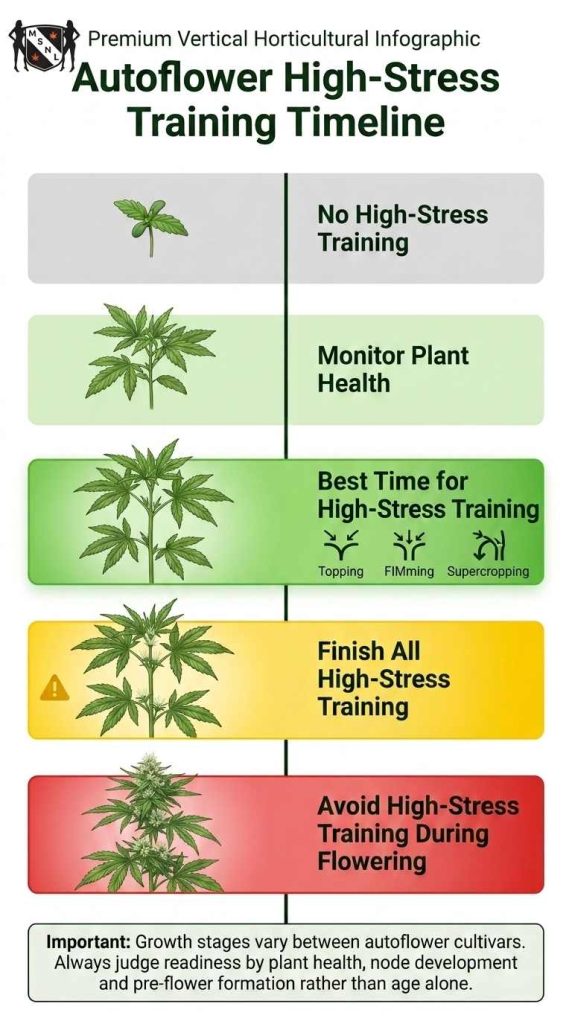
All high-stress training should be completed during vegetative growth, before the autoflower begins producing pre-flowers. Because cultivars develop at different rates, it is more reliable to judge the plant by its health, growth stage and number of established nodes rather than its age alone.
| Growth Stage | Approx. Week* | Recommended Action |
| Seedling | Weeks 1–2 | No HST |
| Early Vegetative | Week 2–3 | Begin only if plant is healthy |
| Vegetative | Weeks 3–4 | Best time for topping, FIM or light defoliation |
| Pre-flowering | Around Week 4–5 | Finish all HST |
| Flowering | After pre-flowers appear | Avoid high stress training |
The Ideal Time to High-Stress Train Autoflowers
The best time to perform high-stress training on autoflowers is during early vegetative growth, once the plant has developed a healthy root system and at least four to five established nodes. At this stage, vigorous plants are better able to recover from topping, FIMming or other high-stress techniques before they begin flowering.
Unlike photoperiod cannabis, autoflowers have a fixed life cycle and cannot remain in the vegetative stage for longer to recover from stress. For this reason, timing is far more important when performing high-stress training.
Best practice:
- Avoid high-stress training during the seedling stage while the plant is establishing its roots.
- Perform HST only on healthy, fast-growing autoflowers with at least four to five established nodes.
- Complete all high-stress training before pre-flowers appear and the plant begins transitioning into flowering.
- Remember that flowering time varies between cultivars, so monitor the plant's development rather than relying on a fixed timeline.
When Should You Avoid High-Stress Training?
High-stress training should be avoided whenever an autoflower is already under stress or has entered its flowering stage. Because autoflowers have limited recovery time, additional stress at the wrong point in their life cycle can reduce plant vigor and affect final yields.
Avoid HST if:
- The plant is still in the seedling stage.
- Growth is slow or the plant is showing signs of nutrient deficiencies, pests or environmental stress.
- Pre-flowers have appeared and flowering has begun.
- The plant has not fully recovered from previous training.
When Is It Too Late to High-Stress Train an Autoflower?
Once an autoflower begins producing pre-flowers and transitions into flowering, it is generally too late to perform high-stress training. At this stage, the plant shifts its energy from vegetative growth to flower production, leaving little time to recover from topping, supercropping or heavy pruning.
Applying HST during flowering can slow development, reduce yields and place unnecessary stress on the plant. In rare cases, severe environmental or physical stress may increase the likelihood of hermaphroditism in genetically susceptible plants, although genetics remain the primary factor.
If canopy management is still needed during flowering, gentle low stress training (LST) is usually a safer option than additional high-stress techniques.
How to High-Stress Train Autoflowers: Step-by-Step
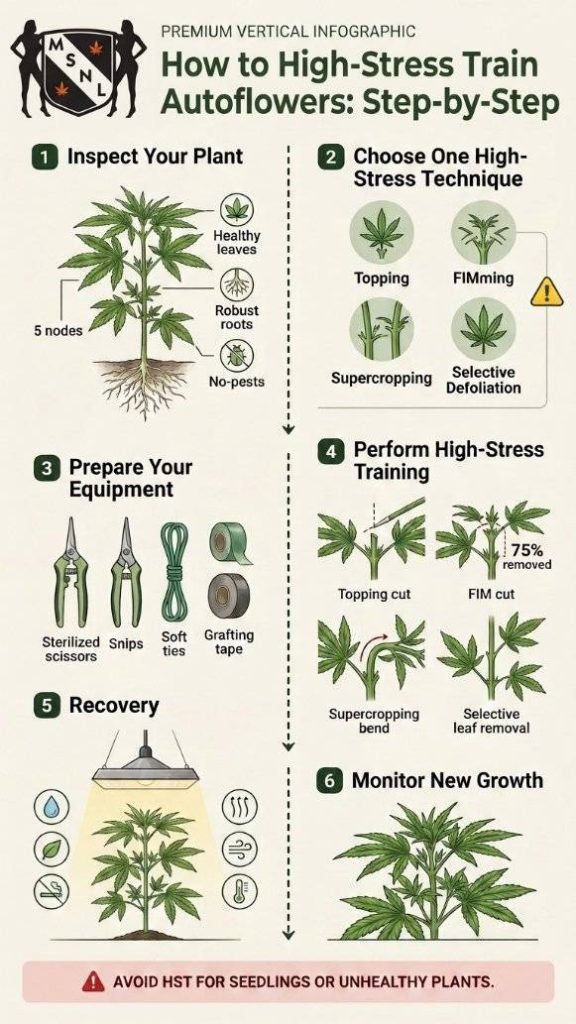
High-stress training should only be carried out on healthy autoflowers during early vegetative growth. Before you begin, inspect your plant for vigorous growth, ensure it has developed at least four to five established nodes, and sterilise your scissors or pruning snips to reduce the risk of introducing disease.
Step 1: Inspect Your Plant
Choose an autoflower that is healthy, growing vigorously and free from nutrient deficiencies, pests or signs of environmental stress. Avoid training seedlings or slow-growing plants, as they have less capacity to recover.
Step 2: Choose Your Training Method
Select the most appropriate HST technique based on your experience and the plant's growth stage.
- Topping: Remove the main growing tip just above the fourth or fifth node using sterilised scissors. This encourages two new main shoots to develop.
FIMming: Remove approximately 75% of the newest growth tip rather than the entire shoot. This may produce several new growing tips but is generally less predictable than topping. - Supercropping: Gently squeeze the stem between your thumb and forefinger until the inner tissue softens, then slowly bend it over without breaking the outer skin. If the stem splits slightly, support it with grafting tape or soft plant ties while it heals.
Selective defoliation: Remove only large fan leaves that block light from developing bud sites or significantly restrict airflow. Avoid removing excessive healthy foliage in a single session.
Step 3: Avoid Overtraining
Only perform one high-stress technique at a time. Combining topping, FIMming, supercropping and heavy pruning in the same session can place too much stress on an autoflower and reduce its ability to recover before flowering.
Step 4: Support Recovery
After training, return the plant to stable growing conditions. Maintain consistent watering, appropriate nutrition and adequate light, but avoid making additional changes while the plant is recovering.
Step 5: Monitor New Growth
Over the next several days, watch for healthy new shoots, upright leaves and continued vegetative growth. These are good signs that your autoflower has recovered successfully. If growth stalls or the plant appears stressed, avoid further high-stress training and allow additional recovery time before making any further adjustments.
Can I Perform Low Stress Training with High-Stress Training on Autoflowers?
Yes, low stress training can be combined with a carefully selected high-stress technique. A common approach is to top a healthy autoflower once and then use LST to spread the new branches and create a more even canopy.
This combination may improve light distribution while avoiding the repeated damage caused by multiple high-stress techniques. However, additional training should only be performed after the plant has recovered and resumed vigorous growth.
For beginners, LST alone is generally the safer option because it requires less recovery time and carries a lower risk of stunting the plant.
How to Get My Autoflowers to Recover After High-Stress Training
Recovery is one of the most important factors when using high stress training on autoflowers. Because autoflowers have a limited vegetative stage, they need time to recover before they begin flowering. Performing multiple high-stress techniques too close together or training an unhealthy plant can reduce vigour and negatively affect final yields.
After topping, FIMming, supercropping or selective pruning, avoid additional training until your plant shows clear signs of recovery, such as healthy new growth, upright leaves and steady vegetative development. Continue providing stable environmental conditions, consistent watering and balanced nutrition to minimize further stress.
If you're using techniques such as supercropping, inspect bent stems over the following few days. It's normal for a hardened "knuckle" to develop as the plant heals. However, if a branch wilts completely and fails to recover after being supported with soft plant ties or grafting tape, the damage may be too severe for the plant to repair. In this case, remove the affected branch using clean, sterilised pruning snips to prevent unnecessary stress on the rest of the plant.
The table below outlines the typical recovery times for each high stress training technique and the signs that indicate your autoflower is ready for further growth.
| Training Method | Typical Recovery Time | What to Look For |
| Topping | 5–7 days | Two new shoots form |
| FIM | 5–7 days | Multiple new growing tips |
| Supercropping | 7–10 days | Knuckle forms at the bend |
| Selective Defoliation | 1–3 days | Leaves regain turgor and vigorous growth resumes |
Timings are approximate. Some autoflowers enter pre-flowering earlier or later depending on genetics and growing conditions. Always prioritise plant development over age.
Will My Autoflowers Yield More After High-Stress Training?
High-stress training may increase autoflower yields by creating a flatter canopy, improving light distribution and encouraging several productive flowering sites. However, higher yields are not guaranteed.
High-stress training may help maximise yields from high yield autoflower seeds by creating a flatter canopy, improving light distribution and encouraging several productive flowering sites.
Results depend on the cultivar, plant health, lighting, nutrition, environmental conditions and how quickly the autoflower recovers after training. Poorly timed or overly aggressive HST can reduce growth and produce a smaller harvest.
For many growers, a single topping followed by gentle low stress training offers a practical balance between canopy control and recovery. Autoflowers that are small, slow-growing or already stressed are usually better left untopped.
Conclusion
High stress training can be an effective way to improve canopy structure and maximise the yield potential of healthy autoflowers, but success depends on choosing the right technique and applying it at the correct stage of growth. Because autoflowers have limited recovery time, methods such as topping, FIMming and supercropping should only be used on vigorous plants during early vegetative growth.
For most growers, combining a single high-stress technique with low stress training (LST) provides the best balance between plant health, canopy management and yield potential. By monitoring your plant's development rather than following a strict timeline, you'll be better equipped to decide when HST is appropriate and when it's best avoided.
Frequently Asked Questions
Can You High-Stress Train Autoflowers?
Yes, healthy autoflowers can be high-stress trained during early vegetative growth. However, because autoflowers have a fixed life cycle, they have less time to recover than photoperiod plants. Techniques such as topping, FIMming or supercropping should only be used on vigorous plants before pre-flowering begins.
Is High-Stress Training Better Than Low Stress Training for Autoflowers?
Not necessarily. Low stress training (LST) is generally the safest and most beginner-friendly option because it causes minimal damage and requires little recovery time. High-stress training can improve canopy structure and potentially increase yields, but it also carries a greater risk of slowing growth if performed incorrectly.
Can You Perform High-Stress Training During Flowering?
No. High-stress training should be completed before an autoflower enters its flowering stage. Once pre-flowers appear, the plant begins focusing its energy on bud development rather than vegetative growth. Applying HST during flowering can slow development, reduce yields and increase plant stress.
Does Topping Increase Autoflower Yields?
Topping can increase the number of productive flowering sites by encouraging a more even canopy. However, it should only be performed once on healthy autoflowers with at least four to five established nodes. Poor timing or topping stressed plants can reduce final yields instead.
Is Supercropping Safe for Autoflowers?
Supercropping can be effective, but it is one of the most advanced high-stress training techniques. It should only be attempted on healthy, vigorous autoflowers during early vegetative growth. Beginners are usually better off using low stress training before attempting supercropping.
Should Beginners Use High-Stress Training on Autoflowers?
If you're new to growing autoflowers, it's usually best to start with low stress training (LST). Once you're confident managing healthy plants and understanding their growth stages, you can experiment with techniques such as topping or FIMming on vigorous cultivars.
What Is the Best High-Stress Training Technique for Autoflowers?
For most growers, topping is the most commonly used high-stress training technique because it creates a flatter canopy and encourages multiple main flowering sites. More advanced techniques, such as supercropping, are best suited to experienced growers, while mainlining is generally not recommended for autoflowers due to their short vegetative stage.
Can You Combine Low Stress Training with High-Stress Training?
Yes. Many experienced growers combine a single topping with low stress training (LST) to create an even canopy while minimizing stress. This approach often provides a better balance between plant health, light distribution and yield potential than relying on multiple high-stress techniques alone.


