




Cannabis plant training is a practical way to control plant height, shape the canopy, and help more growth sites receive useful light. By bending, tying, pruning, or supporting branches, growers can influence how a plant develops instead of allowing one main stem to dominate.
There are several approaches to weed plant training, including low-stress training (LST), ScrOG, topping, FIMing, super cropping, and manifolding. The right method depends on the plant type, available space, and the level of stress the plant can handle.
If you want to learn how to train cannabis plants, this guide covers when to begin, how the main techniques work, and how to choose the right method for your setup. It also explains how to train weed plants step by step while avoiding common mistakes. When done carefully, training cannabis plants can improve canopy control and light distribution, although final yield still depends on genetics, lighting, environment, nutrition, and overall plant health.
Key Takeaways
- Start with healthy plants: Training weak, damaged, or stressed cannabis plants can slow growth and increase the risk of problems.
- Choose the right level of stress: LST and ScrOG reshape growth gently, while topping, FIMing, super cropping, and manifolding involve more plant stress.
- Match training to your grow: Plant type, available height, canopy space, and grower experience should determine which method you use.
- Make gradual adjustments: When learning how to train weed plants, avoid forcing branches or combining several stressful techniques at once.
- Training supports rather than guarantees yield: A well-managed canopy can improve light distribution and use of space, but genetics, lighting, nutrition, environment, and plant health still determine final performance.
- What is Cannabis Plant Training and How Does It Affect Yield?
- When Should You Start Training Cannabis Plants?
- How to Train Cannabis Plants With Low-Stress Training Methods
- How to Train Weed Plants With High-Stress and Pruning Techniques
- How to Choose the Right Weed Plant Training Method
- Conclusion
- Frequently Asked Questions
What is Cannabis Plant Training and How Does It Affect Yield?
Cannabis plant training is the process of deliberately shaping plant growth through bending, tying, pruning, or supporting branches. Instead of allowing a plant to develop naturally around one dominant central stem, growers use training to create a wider, more even canopy.
For indoor growers, this can help more flowering sites receive useful light while controlling plant height and making better use of limited space. If harvest size is a priority, starting with high-yield cannabis seeds gives you genetics selected for stronger yield potential, while training helps you manage how that growth is distributed. Genetics, light intensity, nutrition, environment, plant health, and recovery time all influence the final harvest.
How Training Changes Cannabis Plant Growth and Apical Dominance
Cannabis naturally displays apical dominance, where the main growing tip develops more strongly than many of the lower branches. Training cannabis plants can reduce this dominance and encourage lateral branches to compete more evenly for space and light.
Methods such as topping remove the leading growth tip, while LST bends taller stems downward without cutting them. Both approaches can help create a flatter canopy with several well-positioned flowering sites rather than one dominant top.
Low-Stress Training vs High-Stress Training
| Training type | How it works | Recovery |
| LST | Gently bends and secures stems | Usually minimal |
| HST | Cuts, pinches, or damages plant tissue | Requires more recovery |
Low-stress weed plant training is generally more forgiving, while high-stress methods such as topping and super cropping require healthier plants and better timing.
Benefits and Limitations of Training Cannabis Plants
Effective training can improve canopy control, light distribution, airflow, and height management. Research into cannabis plant architecture also shows that changing canopy structure can affect light penetration, biomass, and cannabinoid distribution, although results vary between techniques.
The trade-off is stress. Excessive pruning or repeated high-stress work can slow growth or reduce yield instead of improving it.
Grower Tip: When learning how to train cannabis plants, start with healthy plants and make one controlled change at a time. Allow the plant to recover before adding further stress.
When Should You Start Training Cannabis Plants?
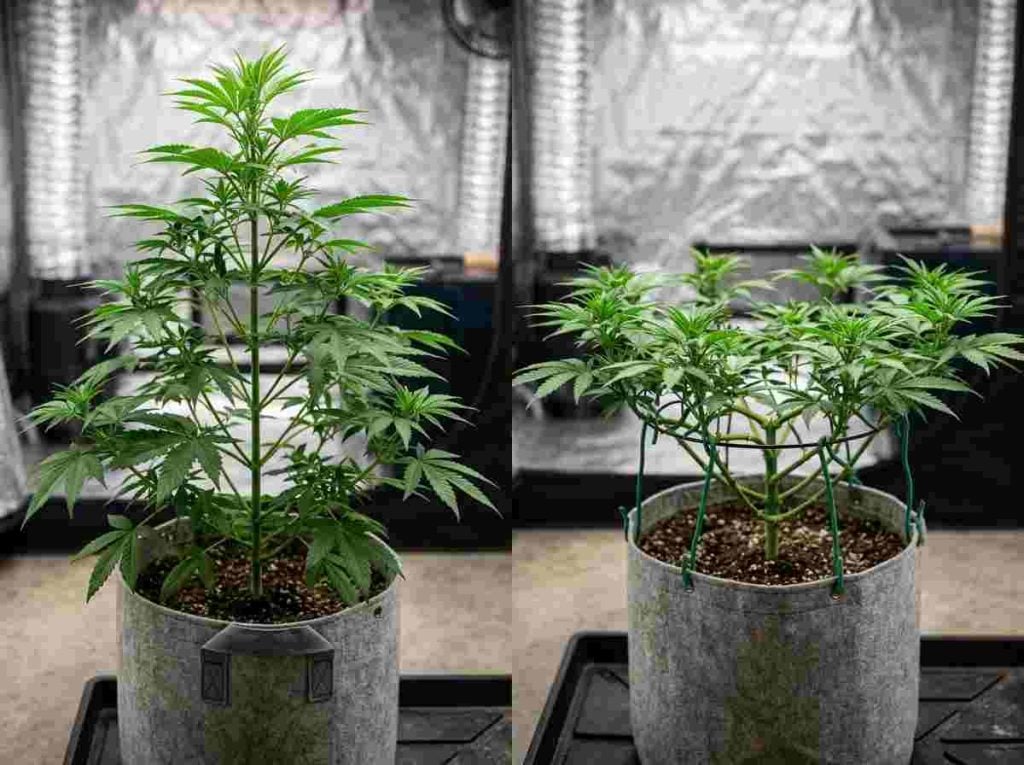
The best time to begin cannabis plant training is during vegetative growth, once the plant has established a healthy root system, several nodes, and stems that are strong but still flexible. Starting too early can damage a young plant, while waiting too long can make branches harder to bend and leave less time for recovery.
Plant health matters more than following an exact day or week. Avoid training plants that are showing signs of nutrient problems, pests, heat stress, or slow growth.
Best Time to Start Cannabis Plant Training During Veg
For most photoperiod plants, training can begin once they have developed around 4–6 nodes and are growing steadily. Gentle bending can usually begin earlier than techniques involving cutting because it causes less disruption.
As the plant develops, adjust ties and branch positions gradually rather than trying to create the final canopy in one session.
Grower Tip: Check plant ties regularly. Stems thicken quickly during veg, and ties that are too tight can cut into the branch as it grows.
When Should You Stop Training Cannabis Plants?
Most structural training should be completed before or during the early flowering stretch. Once flowering is established, avoid major topping, aggressive bending, or other high-stress work because the plant has less time to replace damaged growth.
Minor canopy adjustments and branch support can still be made when needed.
Training Autoflower vs Photoperiod Cannabis Plants
| Plant type | Training approach | Main consideration |
| Photoperiod | LST and HST can both be used | Growers can extend veg to allow recovery |
| Autoflower | Gentle LST is generally lower risk | The fixed life cycle leaves less recovery time |
When training plants grown from autoflowering cannabis seeds, timing is especially important because their vegetative stage cannot be extended to allow extra recovery time. Autoflowers move into flowering according to age, so heavy pruning or repeated stress can use up valuable growth time.
Indoor photoperiod plants give growers more flexibility because the vegetative stage can be extended by maintaining a long-day light schedule until the plant has recovered.
How to Train Cannabis Plants With Low-Stress Training Methods
Low-stress methods reshape the canopy without cutting major growth points or deliberately damaging stems. The two most common approaches are low-stress training (LST) and the Screen of Green (ScrOG) method. Both aim to spread growth horizontally, but they use different levels of structure and equipment.
Low-Stress Training (LST): Bending and Tying Down Branches
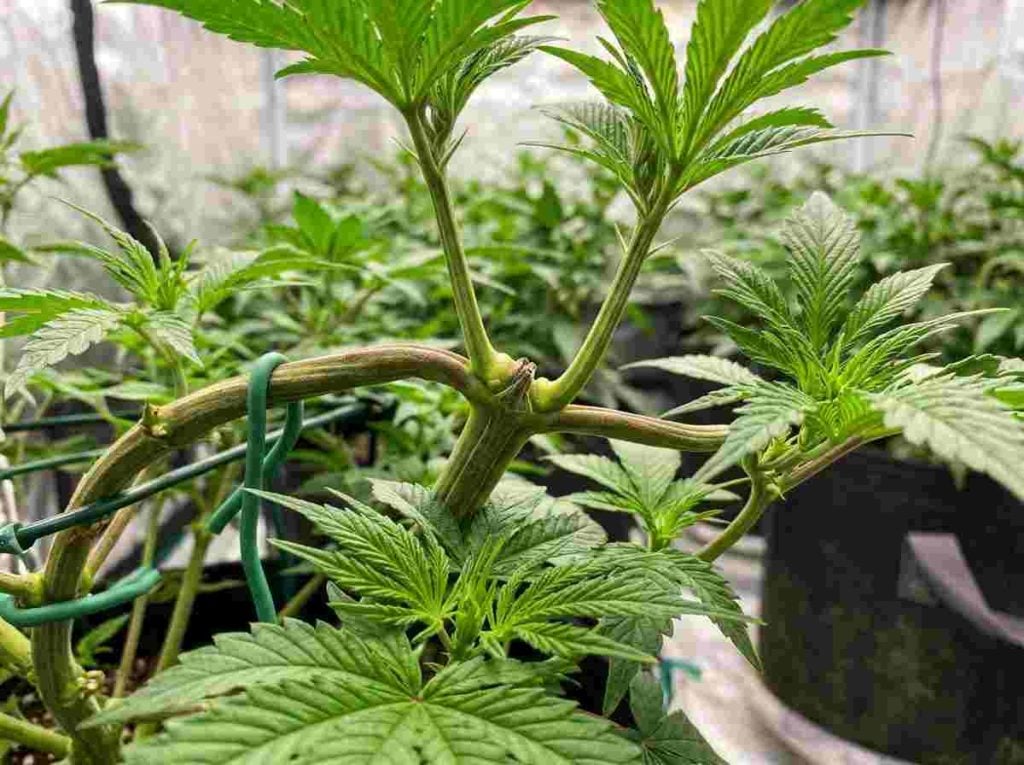
Low-stress training cannabis plants involves gradually bending taller stems away from the center and securing them in position to guide growth outward. This redirects growth outward and prevents one branch from dominating the canopy.
To use LST, gently bend the main stem or tallest branch sideways and attach it to the edge of the container using soft plant ties. As new shoots grow upward, continue repositioning the tallest branches to keep the canopy relatively level.
Avoid making sharp bends or forcing stiff stems into position. If a branch resists, move it gradually over several adjustments rather than trying to reshape it in one session.
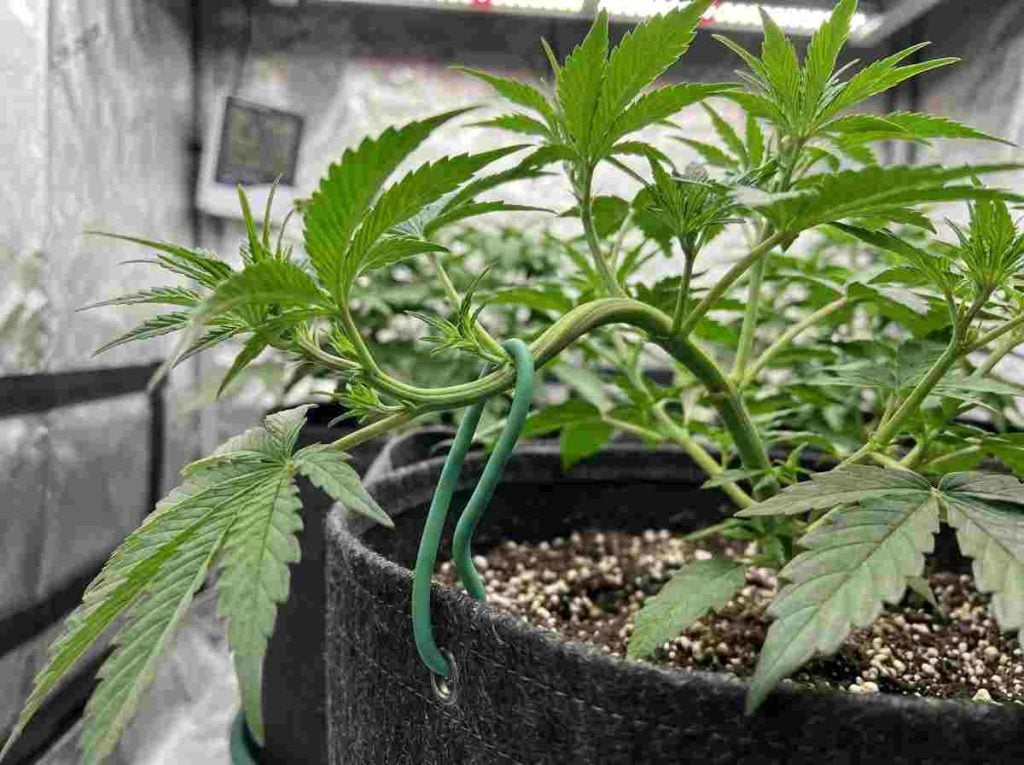
Grower Tip: Use soft-coated wire, garden ties, or another material that will not cut into expanding stems. Leave enough slack for the branch to thicken.
Screen of Green (ScrOG): Building an Even Canopy
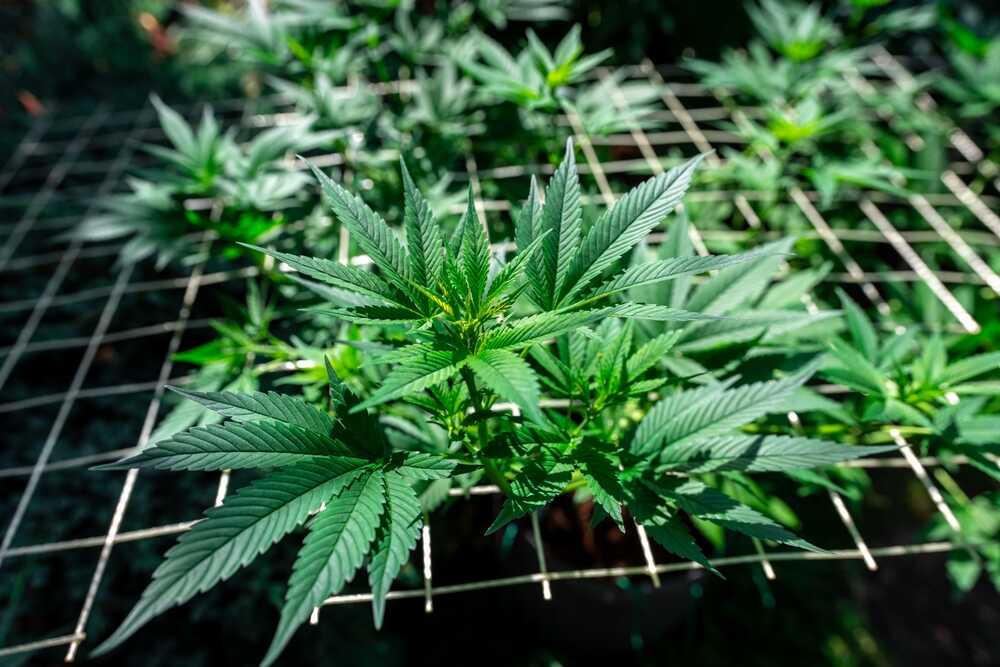
ScrOG training cannabis plants takes the same horizontal-growth principle further by using a mesh or trellis to spread branches across the available canopy.
As branches reach the screen, guide them underneath and into open sections rather than allowing them to grow directly upward. Continue spreading growth across empty areas until the available screen is evenly occupied.
The goal is not to force every branch through the first opening it reaches. Direct stronger branches toward unused areas so weaker shoots have room to develop without being shaded.
A ScrOG setup works particularly well when growers want to manage a broad indoor canopy, but the fixed screen makes individual plants harder to move once training is established.
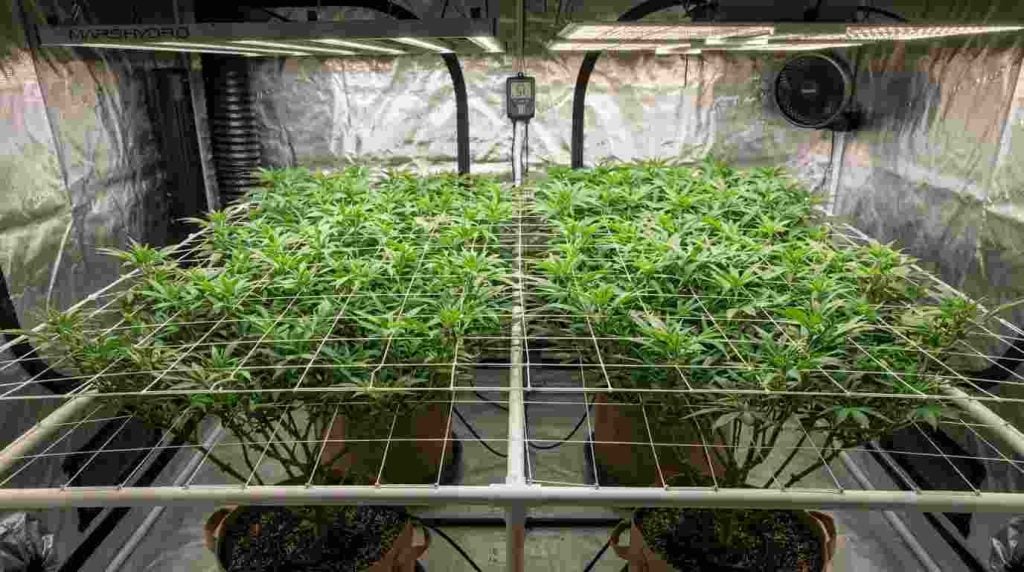
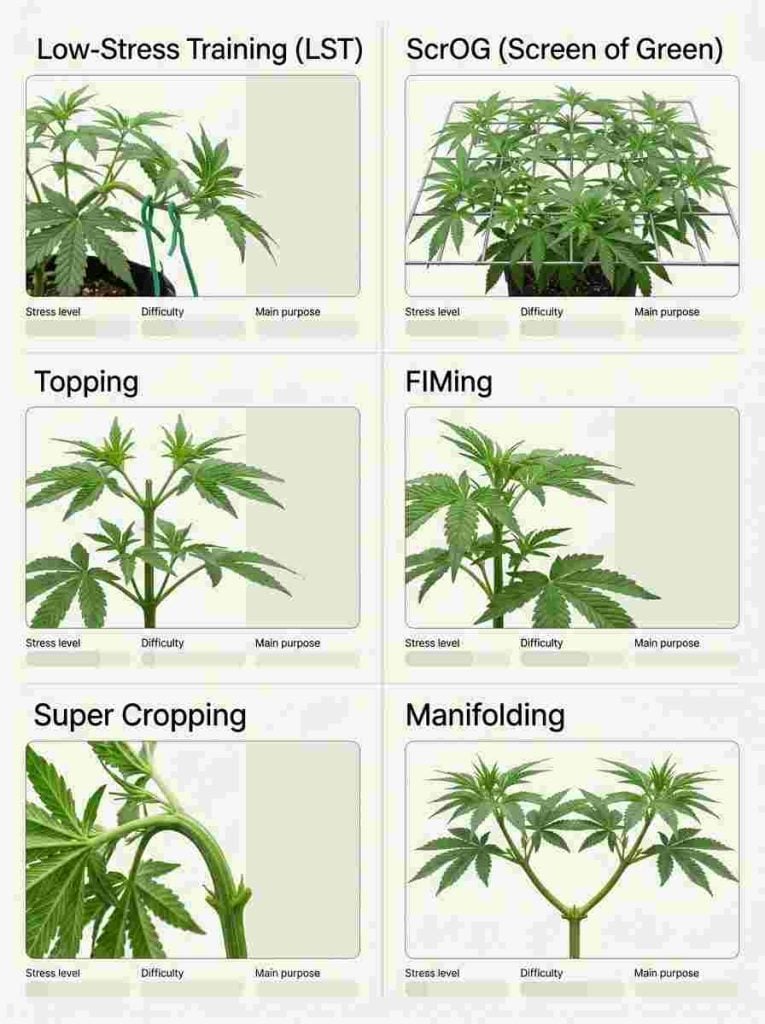
LST vs ScrOG: Which Training Method Fits Your Grow?
Neither method is automatically better. The right choice depends on how much flexibility and structure you want from your weed plant training setup.
| Factor | LST | ScrOG |
| Equipment | Plant ties and anchor points | Trellis or mesh screen |
| Plant movement | Easy to move individually | Limited once branches fill the screen |
| Canopy control | Branch-by-branch | Whole-canopy management |
| Setup | Simple and flexible | Requires more planning |
| Best suited to | Smaller or adaptable grows | Wider, fixed indoor canopies |
LST is usually easier for growers learning how to train cannabis plants because individual branches can be adjusted independently. ScrOG offers more structured canopy control but requires regular attention as shoots fill the screen.
Grower Tip: Whichever method you choose, reposition growth gradually. A balanced canopy is built through repeated small adjustments rather than aggressive bending in a single session.
How to Train Weed Plants With High-Stress and Pruning Techniques
High-stress training gives you more direct control over plant structure by cutting, pruning, or manipulating selected growth. For new growers, the key is to use each technique for a specific purpose rather than combining several methods at once.
Always start with a healthy plant and use clean, sterilized tools when making cuts.
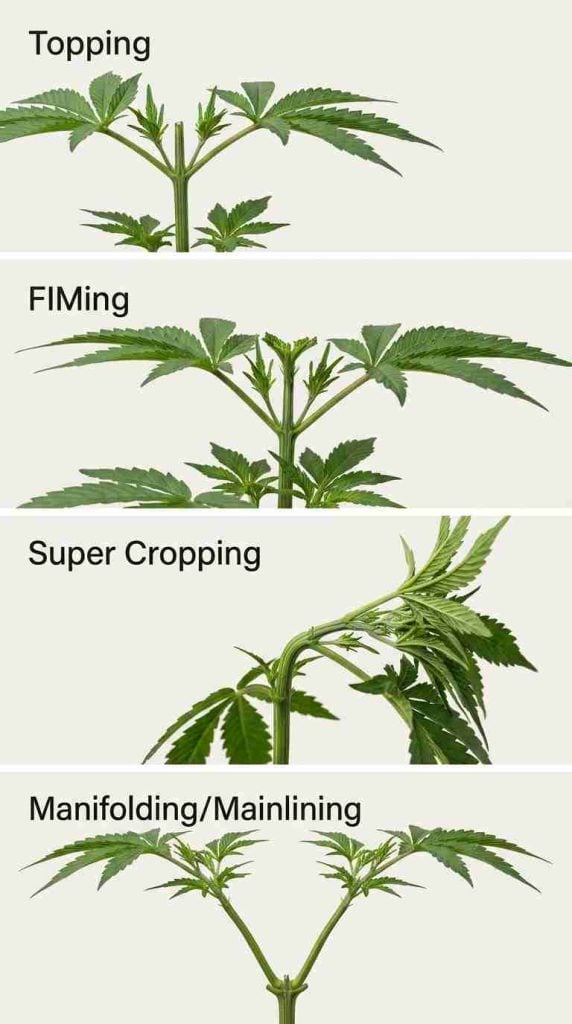
Topping vs FIMing: Creating Multiple Main Colas
Topping cannabis plants and FIMing cannabis plants both target the main growing tip, but they use different cuts and create different branching patterns.
| Method | What You Remove | Typical Result | Beginner Difficulty |
| Topping | Entire growing tip | Two main shoots | Easier |
| FIMing | Part of the growing tip | Several possible shoots | Less predictable |
How to top a cannabis plant:
Step 1: Find the main growing tip at the top of the plant.
Step 2: Identify the node immediately below the section you want to remove.
Step 3: Use sterilized scissors to make a clean cut above that node.
Step 4: Leave the two shoots below the cut intact. These can develop into two dominant branches.
Step 5: Allow fresh growth to establish before deciding whether further topping is necessary.
FIMing follows a similar process, except only part of the newest growing tip is removed rather than cutting it off completely.
Grower Tip: Topping is usually easier when learning how to train weed plants because the resulting structure is more predictable.
Super Cropping: Controlling Height and Uneven Growth
Super cropping cannabis plants can bring an unusually tall branch back into line with the surrounding canopy without removing the branch completely.
Step 1: Choose a green, flexible section of the branch. Avoid hard, woody stems.
Step 2: Hold the stem between your thumb and finger.
Step 3: Gently squeeze and roll the stem until the inner tissue begins to soften.
Step 4: Slowly bend the softened section sideways. Do not force it sharply.
Step 5: Support the branch if necessary so it stays in its new position.
The outside of the stem should ideally remain intact. If it splits, support the damaged area with plant tape rather than continuing to manipulate it.
Grower Tip: Work gradually. If the stem does not bend easily after gentle pressure, choose a younger section rather than forcing it.
Manifolding and Mainlining: Building a Symmetrical Canopy
Manifolding, also commonly called mainlining, uses repeated topping and branch selection to create an organized set of main branches.
Step 1: Top the main stem to create two primary branches.
Step 2: Remove unwanted growth below these branches so both sides develop from the same central area.
Step 3: Guide the two branches outward to keep the structure balanced.
Step 4: Once both sides have developed enough new growth, top them again to create additional main branches.
Step 5: Continue shaping the selected branches so each has adequate space.
This method requires more planning than simple topping, so beginners should decide on the intended number of main branches before making additional cuts.
Defoliation and Pruning: Improving Light Exposure and Airflow
Defoliating cannabis plants removes selected fan leaves, while pruning cannabis plants can also remove weak, shaded, or unwanted shoots to improve canopy management.
Step 1: Inspect the canopy before cutting anything.
Step 2: Remove damaged or unhealthy leaves first.
Step 3: Identify foliage that heavily blocks important growth or creates a crowded interior.
Step 4: Remove selected leaves individually with clean scissors rather than stripping large sections at once.
Step 5: Reassess the canopy before making additional cuts.
There is no universal percentage of foliage that every cannabis plant should lose. Cultivars and growing conditions differ, so selective pruning is safer than following a fixed number.
Grower Tip: When training cannabis plants, every cut should have a purpose. If a healthy leaf or branch is not causing a problem, there is usually no reason to remove it.
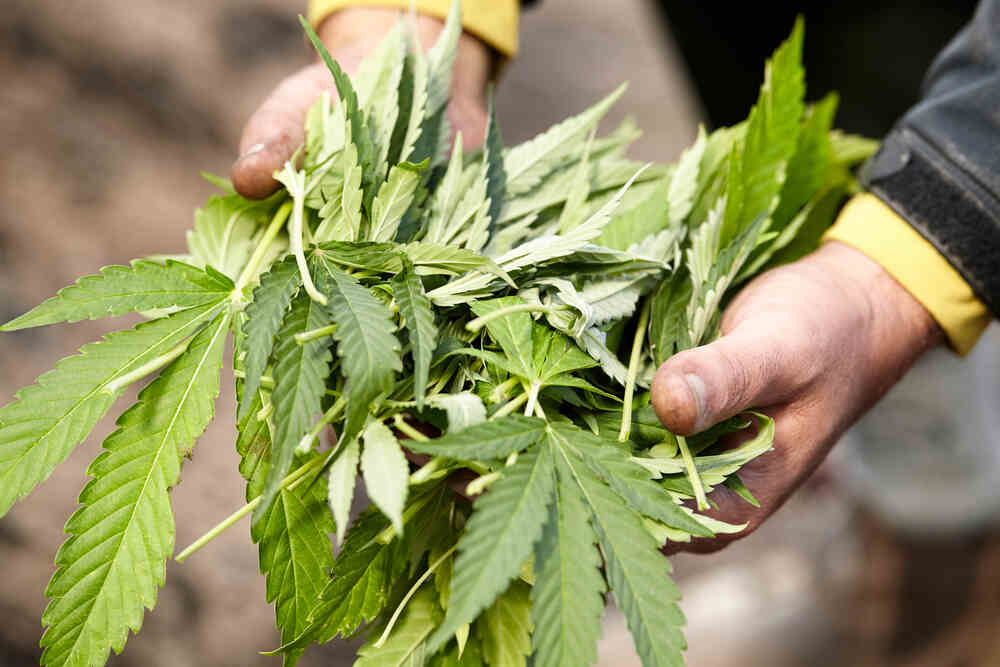
How to Choose the Right Weed Plant Training Method
Choose your weed plant training method based on plant type, grow space, and experience rather than using the most aggressive option.
Match the Method to Plant Type, Grow Space and Experience
Step 1: Check your plant type.
Photoperiod plants give you more flexibility for topping, FIMing, ScrOG, and manifolding. For autoflowers, gentle LST is usually the lower-risk option.
Step 2: Look at your available space.
Use LST or super cropping to control height. ScrOG works well when you want to spread growth across a wider fixed area.
Step 3: Match the method to your experience.
Beginners should start with LST or simple topping before moving on to techniques such as manifolding or super cropping.
| Goal | Suitable method |
| Control height | LST or super cropping |
| Fill a wide canopy | ScrOG |
| Create multiple main shoots | Topping or FIMing |
| Build a symmetrical structure | Manifolding |
Can You Combine Cannabis Plant Training Techniques?
Yes, but combine methods gradually.
Step 1: Use one main technique, such as topping.
Step 2: Allow healthy new growth to develop.
Step 3: Add LST or ScrOG if more canopy control is needed.
Avoid performing several high-stress techniques at the same time.
Common Cannabis Plant Training Mistakes
Avoid:
- training unhealthy plants;
- forcing stiff branches;
- over-tightening ties;
- removing too much foliage;
- making unnecessary cuts;
- adding more stress before the plant has recovered.
Post-Training Care and Recovery
After training cannabis plants, check stems, ties, and new growth regularly.
Support damaged branches if needed, loosen ties as stems thicken, and wait for steady new growth before making another major adjustment.
Grower Tip: When learning how to train cannabis plants, make one change at a time. This makes it easier to see how the plant responds and reduces the risk of overtraining.
Conclusion
Cannabis plant training gives growers more control over plant shape, height, and canopy development. Methods such as LST and ScrOG offer lower-stress ways to guide growth, while topping, FIMing, super cropping, and manifolding provide more aggressive options for changing plant structure.
The best approach depends on the plant, available space, and grower experience. Start with healthy growth, choose a method that suits your goal, and avoid adding unnecessary stress. When done carefully, training cannabis plants can help improve light distribution and make better use of the available grow space, although final yield still depends on genetics, lighting, environment, and plant health.
Frequently Asked Questions
What Is the Easiest Cannabis Plant Training Method for Beginners?
LST is usually one of the easiest techniques for beginners because it involves gently bending and securing branches rather than cutting the plant. It also allows adjustments to be made gradually as the canopy develops.
Does Cannabis Plant Training Increase Yield?
Cannabis plant training can help create a more even canopy and improve how light reaches flowering sites, which may support better yields. However, training alone does not guarantee a larger harvest. Genetics, lighting, nutrition, environment, and plant health also affect yield.
How Do You Train Weed Plants Without Damaging Them?
When learning how to train weed plants, work with flexible stems, make gradual adjustments, and use soft plant ties that will not cut into branches. Avoid forcing stiff growth or performing several stressful techniques at once.
Can You Train Cannabis Plants During Flowering?
Minor adjustments and branch support can continue during flowering, but most major structural training should already be complete. Heavy pruning, topping, or aggressive bending during established flowering can cause unnecessary stress.
Can You Use More Than One Weed Plant Training Method?
Yes. Techniques such as topping followed by LST or ScrOG are commonly combined. Introduce each method gradually and allow healthy new growth to develop before adding further stress. The goal of weed plant training is controlled plant shaping, not using as many techniques as possible.


