




Kush Mints is a balanced hybrid cannabis strain known for its refreshing mint aroma, earthy Kush taste and high THC potential. Created by crossing Animal Mints with Bubba Kush, this strain combines sweet, herbal notes with dense, resin-covered flowers. With THC levels advertised at up to 24% and a flowering period of 8–10 weeks, Kush Mints appeals to those interested in potent cannabis and distinctive genetics.
In this Kush Mints strain review, you'll learn about its genetics, reported effects, terpene profile and appearance, along with the growing characteristics that matter when deciding if this strain is right for you.
Key Takeaways
- Genetics: Kush Mints is a balanced hybrid created by crossing Animal Mints with Bubba Kush.
- Potency: THC levels are advertised at up to 24%, making it a high-potency strain.
- Taste and aroma: Expect mint, pine, earthy Kush and sweet cookie notes, with some variation between plants.
- Plant characteristics: Kush Mints develops substantial side branches and dense flowers covered in resin-producing trichomes.
- Growing suitability: Its advertised flowering time is 8–10 weeks, but its potential height of 180–220 cm makes available space an important consideration.
- What is the Kush Mints Strain?
- How Strong Is Kush Mints? THC and Potency
- What Does Kush Mints Smell and Taste Like?
- What Terpenes Are Found in Kush Mints?
- What Are the Effects of Kush Mints?
- What Does Kush Mints Look Like?
- How to Grow Kush Mints: Step-by-Step Guide
- Is Kush Mints a Good Strain for Beginners?
- Conclusion
- Frequently Asked Questions About Kush Mints
- References
What is the Kush Mints Strain?
Kush Mints is a hybrid cannabis strain originally developed from Animal Mints and Bubba Kush. Its parentage combines the sweet, mint-forward characteristics of Animal Mints with the earthy, rich aroma associated with traditional Kush varieties.
The strain is known for producing compact, resin-rich flowers with a distinctive smell. Its high THC potential and complex taste have made it a popular choice among people interested in modern hybrid cannabis.
You can find this variety as Kush Mints Feminized Seeds, with growing specifications provided.
| Characteristic | Kush Mints strain information |
| Genetics | Animal Mints × Bubba Kush |
| Indica/Sativa | 50% / 50% |
| THC | Up to 24% |
| CBD | Below 1% |
| Flowering time | 8–10 weeks |
| Height | 180–220 cm |
| Indoor yield potential | 500–600 g/m² |
| Growing difficulty | Advertised as easy |
| Climate | Warm, temperate, Mediterranean |
| Main terpenes | Limonene, caryophyllene, linalool |
These figures describe the advertised MSNL selection. Actual plant characteristics and chemical composition can vary.
Is Kush Mints Indica or Sativa?
Kush Mints is commonly classified as a 50% indica and 50% sativa hybrid.
Its two parents contribute different characteristics. Animal Mints is associated with sweet, minty aromas, while Bubba Kush is known for its earthy profile and compact flowers.
However, indica and sativa percentages do not reliably predict how cannabis will affect you.
Research published in Nature Plants found that commercial indica and sativa labels poorly reflect the overall genetic and chemical differences between cannabis samples.
Kush Mints is therefore best understood through its parentage, cannabinoid content and terpene profile rather than its hybrid classification alone.
{{block class="FishPigExtend\Wordpress\Block\Product\Related" sku="KM-F005"}}
How Strong Is Kush Mints? THC and Potency
Kush Mints is a high-THC cannabis strain, with advertised levels of up to 24%. Its Animal Mints and Bubba Kush genetics are associated with dense flowers and substantial resin production.
One of its most noticeable characteristics is the layer of trichomes covering the mature flowers. These small glands produce cannabinoids, including THC, and contribute to the plant's resin-rich appearance.
Potency can differ between individual plants. Some phenotypes may develop higher cannabinoid concentrations than others, even when they share the same parentage.
Research comparing cannabis grown in different environments found differences in cannabinoid and terpene composition. Advertised THC levels should therefore be treated as potential rather than guaranteed results.
What Does Kush Mints Smell and Taste Like?
Kush Mints has a distinctive aroma combining fresh mint, pine, sweet cookie notes and earthy Kush.
Its Animal Mints parentage is associated with mint and sweetness, while Bubba Kush contributes to its reputation for deeper earthy and coffee-like notes.
The reported taste begins with fresh mint, followed by sweet, creamy and herbal characteristics. Some selections also display hints of spice or fuel.
The balance of these aromas differs between plants. Some have a sharper mint character, while others display stronger earthy or sweet notes.
What Terpenes Are Found in Kush Mints?
Kush Mints is commonly associated with three terpenes that contribute to its aroma.
| Terpene | Common aroma | Characteristic |
| Limonene | Citrus, lemon | Fresh citrus notes |
| Caryophyllene | Pepper, spice | Spicy, earthy notes |
| Linalool | Floral, herbal | Softer herbal notes |
Terpenes are naturally occurring compounds responsible for many of the aromas found in cannabis and other plants.
Their concentrations can vary between individual Kush Mints plants, which helps explain differences in smell.
Research into terpene diversity in cannabis supports the importance of chemical variation between plants.
What Are the Effects of Kush Mints?
Kush Mints is commonly associated with uplifting effects followed by physical relaxation.
Consumers frequently report changes in mood and sensory perception, along with increased appetite.
The most commonly reported effects include:
- Relaxation: A calming physical sensation.
- Euphoria: An uplifting change in mood.
- Increased appetite: A greater interest in food.
- Sensory changes: Differences in how sounds, tastes and other sensations are experienced.
As a high-THC strain, Kush Mints may also cause dry mouth, dizziness or anxiety, particularly in people with low THC tolerance.
Individual experiences depend on cannabinoid content, sensitivity and the amount consumed. Its balanced hybrid classification does not guarantee a particular effect.
What Does Kush Mints Look Like?
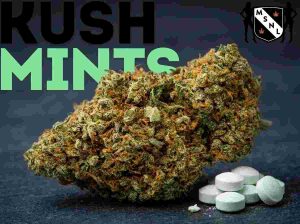
Kush Mints is known for its compact, resin-covered flowers and thick trichome coating.
The flowers commonly develop medium to dark green tones, with some phenotypes displaying purple areas. Orange pistils appear between the tightly packed bracts, while trichomes give the surface a frosted appearance.
| Flower characteristic | Typical appearance |
| Bud structure | Dense, compact flowers |
| Main appearance | Medium to dark green |
| Purple tones | Possible in some phenotypes |
| Trichomes | Thick resin coating |
| Pistils | Orange to amber |
| Flower shape | Rounded or slightly elongated |
Flower density: Kush Mints typically develops closely packed bracts, creating firm flowers. This structure can retain moisture in damp environments.
Resin coverage: Mature flowers often display a thick layer of trichomes. Although this contributes to their frosted appearance, laboratory testing is needed to confirm THC concentrations.
Pigmentation: Some plants develop purple tones through anthocyanins, while others remain green. The final appearance depends on the phenotype and growing conditions.


| THC % | Up to 24% |
|---|---|
| Flowering Time | 8–10 Weeks |
| Outdoor harvest | End Of September |
| Yield | 500–600 g/m² |
| Indica/Sativa | 50/50 |
| Height | Tall: 180–220 cm |
| Difficulty | Easy |
| CBD Content | Less than 1% |
| Climate | Mediterranean, Temperate, Warm |
| Seed Type | Feminized |
| Genetics | Animal Mints x Bubba Kush |
| Effects | Arousing, Relaxing, Uplifting |
| Taste | Mint, Pine, Coffee |
| Terpene | Limonene, Caryophyllene, Linalool |
How to Grow Kush Mints: Step-by-Step Guide
Kush Mints is a photoperiod cannabis strain known for its tall structure, substantial side branches and resin-rich flowers. Although rated as easy to grow, its advertised height of 180–220 cm makes available space an important consideration.
Understanding how Kush Mints develops will help you assess its suitability for indoor or outdoor cultivation where permitted.
Step 1: Understand the Growing Environment
Kush Mints is associated with warm, temperate and Mediterranean-style climates.
Indoor environments provide greater control over temperature and moisture, while outdoor plants experience seasonal weather changes.
The following ranges are general cannabis cultivation guidelines rather than confirmed requirements specific to Kush Mints.
| Growth stage | Temperature | Relative humidity |
| Seedling | 21–26°C | 60–70% |
| Vegetative | 21–26°C | 55–65% |
| Flowering | 20–26°C | 40–50% |
| Late flowering | 20–25°C | 40–45% |
Stable environmental conditions support healthy plant development. Damp conditions deserve particular attention because this strain can produce compact flowers.
Step 2: Understand Seedling Development
Kush Mints begins by developing a primary root, followed by its first leaves and central stem.
During this early stage, the plant establishes the root system needed to support further growth.
Healthy seedlings generally display upright stems, fresh leaves and steady development.
Individual seedlings may grow at different rates, even when they come from the same seed selection.
Step 3: Plan for Height and Vegetative Growth
Kush Mints typically develops a prominent central stem with several side branches.
During the vegetative stage, these branches extend outwards as the plant establishes its mature structure.
Its advertised height of 180–220 cm makes it more suitable for spaces that can accommodate substantial vertical growth.
Some plants also stretch during the transition into flowering, so their final height can exceed their size at the end of the vegetative stage.
Step 4: Understand Plant Training
Kush Mints has a branching structure that may suit several common plant training techniques.
These methods influence how the plant develops rather than changing its underlying genetics.
| Training technique | Purpose |
| Low-stress training (LST) | Encourages a wider plant structure by repositioning flexible branches |
| Topping | Promotes additional leading branches |
| SCROG | Uses a screen to support and organise the canopy |
Plant responses vary according to phenotype and overall health. Training does not guarantee increased flower production.
Step 5: Understand the Flowering Stage
Kush Mints has an advertised flowering period of 8–10 weeks.
Its flowers develop along the main stem and side branches, gradually forming dense clusters covered in trichomes.
| Flowering stage | What to expect |
| Early flowering | Initial flower sites appear and vertical growth may continue |
| Mid flowering | Buds become fuller and resin production becomes more visible |
| Late flowering | Flowers become compact and aromatic characteristics develop further |
The cannabis flowering stage guide explains the general changes that occur as cannabis flowers mature.
Step 6: Check Flower Health
Kush Mints commonly produces tightly packed flowers, which can retain moisture during prolonged humid conditions.
When assessing flower health, look for:
- Brown or grey patches within developing flowers.
- Unexpected wilting around individual buds.
- Decaying plant material.
- Unusual fungal growth or a musty smell.
These symptoms can indicate plant health problems and should not be mistaken for normal flower development.
Step 7: Assess Plant Maturity
As Kush Mints approaches maturity, its flowers typically become firmer and develop a visible resin coating.
Trichome appearance, pistil development and flower density can differ between phenotypes.
Some plants also display purple pigmentation, while others remain predominantly green.
The advertised flowering period provides a general estimate, but actual maturity depends on the individual plant.
Is Kush Mints a Good Strain for Beginners?
Kush Mints can appeal to beginners because of its advertised easy difficulty rating and relatively straightforward hybrid growth characteristics.
However, it is better suited to growers who have enough space for its mature structure.
| Advantages | Considerations |
| Advertised easy difficulty | May become too tall for restricted spaces |
| Substantial side branching | Different phenotypes can develop different structures |
| 8–10 week flowering period | Actual flowering duration can vary |
| Resin-rich flowers | Compact buds can be vulnerable to moisture-related problems |
| Indoor and outdoor suitability | Outdoor conditions are less predictable |
For beginners comparing feminized cannabis seeds, Kush Mints offers an example of a taller photoperiod variety with substantial branching.
Among hybrid cannabis seeds, its main characteristics are its potential height, compact flowers and distinctive mint-forward aroma.
Conclusion
Kush Mints is a balanced hybrid that combines the sweet, minty characteristics of Animal Mints with the earthy depth of Bubba Kush. Its high THC potential, distinctive aroma and resin-rich flowers make it an interesting choice for those exploring modern Kush genetics.
For growers, Kush Mints offers substantial branching, an advertised flowering period of 8–10 weeks and good flower production potential. Its tall structure makes available space an important consideration, while its compact buds deserve attention in humid conditions.
Overall, Kush Mints is worth considering if you want a photoperiod strain with a distinctive terpene profile and well-established Kush heritage.
Frequently Asked Questions About Kush Mints
Is Kush Mints the Same as Kush Mints #11?
Kush Mints #11 is a selected phenotype from the original Kush Mints genetic line. The number identifies a particular selection rather than a separate cross. Seeds sold under the broader Kush Mints name may display different characteristics from this selected plant.
Can Kush Mints Be Grown From Clones?
Yes. Kush Mints can be propagated through cloning because it is a photoperiod cannabis variety. A clone is produced from an existing plant and retains its genetic makeup. This allows growers to preserve the characteristics of a particular selection, although growing conditions can still influence its development.
Does a Strong Mint Smell Mean Kush Mints Has More THC?
No. Aroma strength does not provide a reliable measurement of THC concentration. Terpenes and other aromatic compounds contribute to the smell, while cannabinoids determine potency. Laboratory analysis is needed to establish actual THC levels.
What Is the Difference Between Kush Mints and Thin Mint Cookies?
Kush Mints comes from Animal Mints and Bubba Kush, while Thin Mint Cookies belongs to the Girl Scout Cookies genetic family. Both are associated with mint-like aromas, but they have different parentage and may display different plant structures, cannabinoid profiles and aromatic characteristics.
Can Kush Mints Seeds Produce Male Plants?
Regular Kush Mints seeds can produce male or female plants. Feminized seeds are bred to produce predominantly female plants, although occasional male or intersex development remains possible. The seed type matters when choosing between varieties for different cultivation purposes.
References
- Watts, S., McElroy, M., Migicovsky, Z., et al. (2021). Cannabis labelling is associated with genetic variation in terpene synthase genes. Nature Plants, 7, 1330–1334. Research examining the relationship between genetic differences, terpene profiles and indica/sativa classifications.
- Zandkarimi, F., Decatur, J., Casali, J., et al. (2023). Comparison of the Cannabinoid and Terpene Profiles in Commercial Cannabis from Natural and Artificial Cultivation. Molecules, 28(2), 833. Research comparing cannabinoid and terpene composition in genetically identical cannabis plants grown under different conditions.
- Booth, J. K., Yuen, M. M. S., Jancsik, S., et al. (2020). Terpene Synthases and Terpene Variation in Cannabis sativa. Plant Physiology, 184(1), 130–147. Research investigating terpene production and chemical differences between cannabis cultivars.

