




F1 cannabis seeds are often described as more consistent and vigorous than other seed types, but what does that actually mean for growers? This article explains what F1 seeds are, how they are created, and why they tend to behave differently from F2 and S1 generations.
Understanding these differences matters because seed generation can influence plant uniformity, growth patterns, and overall predictability in the grow space. By breaking down key breeding terms and genetic concepts in simple language, this guide helps growers make more informed choices when selecting seeds, while also offering useful context for anyone interested in how modern cannabis breeding works.
Key Takeaways
- F1 cannabis seeds are the first generation created by crossing two genetically distinct parent (P1) plants.
- They typically show more uniform growth patterns, including similar height, structure, and flowering time.
- Hybrid vigor in F1 plants often leads to faster early growth and more consistent development.
- F2 seeds introduce more variation, with noticeable differences in traits between individual plants.
- S1 seeds are produced from a single plant and tend to reflect the mother’s traits but may expose recessive characteristics.
- Results from any seed type can vary depending on genetics, environment, and overall growing conditions.
- Key Takeaways
- What are F1 seeds?
- What are F2 cannabis seeds (and how do they differ from F1)?
- What are S1 cannabis seeds?
- F1 vs F2 vs S1: Key differences at a glance
- How F1 hybrid seeds are created
- Why genetics matter: homozygosity and heterozygosity explained
- F1 hybrid seeds compared to traditional cannabis strains
- Frequently asked questions about F1 seeds
What are F1 seeds?
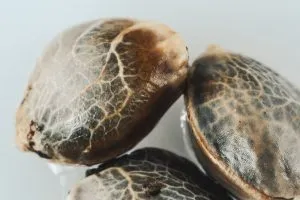
F1 cannabis seeds are first-generation hybrid seeds produced by crossing two genetically distinct parent plants known as P1. Each parent is selected for specific traits—such as plant structure, flowering speed, or aroma—so the resulting seeds inherit a defined mix of characteristics and traits from both parent plants.
Because F1 seeds are the direct result of this first P1 cross, they often display strong hybrid vigor, meaning plants tend to establish quickly and grow in a more uniform and stable way than later generations. While no seed-grown plant is ever identical, F1s commonly show tighter ranges in height, growth pattern, and flowering time compared to F2 or feminized seeds.
It’s important to note that F1 does not automatically mean superior quality. Instead, it describes how the seeds were made and what generation of lineage they represent. The performance of F1 seeds depends heavily on the genetic stability and selection of the parent plants used in the cross.
For growers, F1 seeds are typically chosen for their balance of consistency and genetic diversity and their tendency to display hybrid vigour and enhanced parental traits. This makes F1 generation seeds well suited to grows where predictability and even plant development are priorities.
What are F2 cannabis seeds (and how do they differ from F1)?
F2 cannabis seeds are produced by crossing two plants grown from the original F1 generation. While F1 seeds are the direct result of combining two different parent lines, F2 seeds represent the second generation, where those combined genetics begin to separate and express themselves in different ways. Imagine F2 genetics as the grandchildren of the P1 parents.
This is where variability becomes much more noticeable and you open the window to a greater range of phenotypes and traits. In an F2 population, plants can differ significantly in height, leaf shape, growth structure, flowering time, bud structure, resin production, aroma, and overall vigor.
Some may closely resemble one of the original parent plants, others may lean toward the opposite parent, and some may show a mix of both. This genetic “reshuffling” is normal and expected at the F2 stage.
For breeders, F2 seeds are valuable because they reveal hidden traits and allow for phenotype selection. This is often the generation where breeders start identifying standout plants to stabilize or refine a future strain.
For growers who prefer uniform results, however, F2 seeds can feel less predictable than F1s. It is worth remembering that pheno hunting using F2 will express the most desirable phenotypes as well as the worst of the bunch.
In short, the key difference is consistency:
- F1 seeds tend to grow more evenly due to hybrid vigor.
- F2 seeds offer more variation, making them better suited to selection and experimentation rather than uniform grows.
What are S1 cannabis seeds?
S1 cannabis seeds are produced through a process known as selfing or reversing, where a single female plant is sprayed with Silver thiosulfate to create both pollen and seeds. Instead of crossing two separate plants, a female plant is chemically or environmentally induced to produce pollen, which is then used to pollinate a genetically identical clone.
Because S1 seeds come from one genetic source, they tend to strongly reflect the traits of the mother plant. This makes S1 seeds particularly useful for preserving a specific phenotype that a grower or breeder wants to keep in seed form. However, this doesn’t mean all S1 plants will be identical. Genetic variation can still appear, especially in traits controlled by recessive genes.
Compared to F1 seeds, S1s usually show less hybrid vigor and can sometimes expose weaknesses that weren’t obvious in the original plant. For this reason, S1 seeds are typically used by experienced growers who already understand the traits—and limitations—of the plant they are working with.
In the context of this article, S1 seeds are best viewed as a specialized tool, while F1 seeds remain the most common choice for growers looking for consistency and balanced performance, or are planning a breeding project to create seeds.
F1 vs F2 vs S1: Key differences at a glance
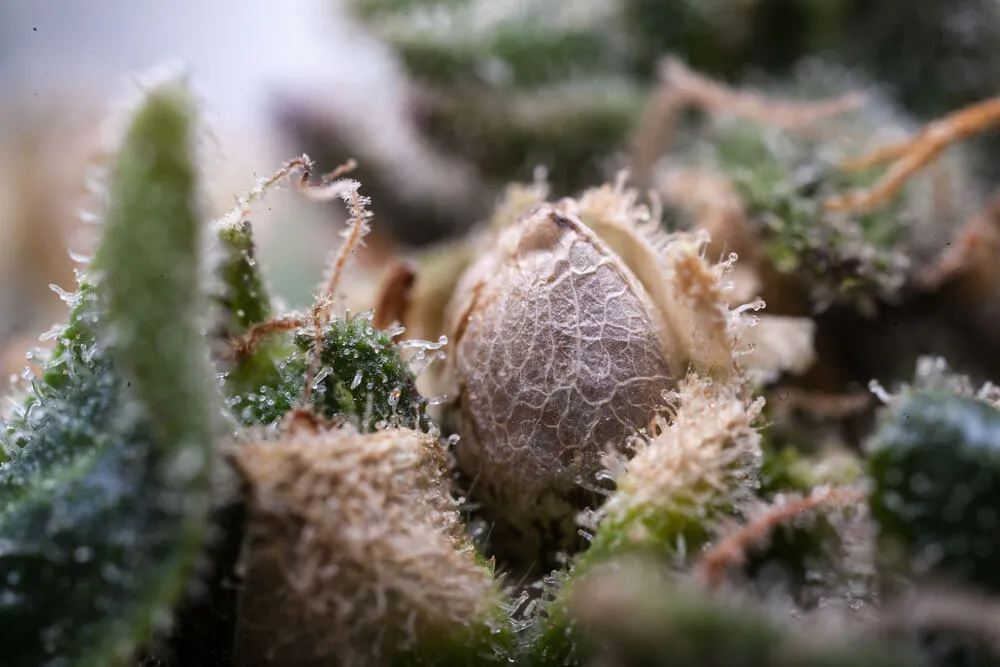
While F1 seeds are the main focus of this article, it helps to see how they compare to F2 and S1 seeds side by side. The differences come down to how the seeds are made, how consistent the plants tend to be, and what each type is best used for.
F1 seeds
Created by crossing two genetically distinct parent plants. These seeds are known for stronger hybrid vigor and more uniform growth, making them a popular choice for growers who value consistency, predictable structure, and even flowering times.
F2 seeds
Produced by crossing two F1 plants. This generation shows much more variation, with traits splitting and expressing differently across plants. F2 seeds are useful for breeders who want to explore genetic diversity and select standout phenotypes, but they are less predictable for straightforward grows.
S1 seeds
Made by self-pollinating a single plant. These seeds tend to mirror the mother plant closely but can still show variation, especially in recessive traits. S1s are often used to preserve a specific phenotype rather than to maximize uniformity or vigor.
In simple terms:
- F1 = consistency and vigor
- F2 = variation and selection
- S1 = preservation of a known plant
How F1 hybrid seeds are created
First-generation cannabis seeds can only be created by using a male and female plant. These will be the parent plants and will contain XY chromosomes meaning the offspring will be either male or female sex.
To produce F1 seeds, pollen from a selected male plant is used to fertilize a selected female plant during the first 3-4 weeks of the flowering period The key detail here is that both parents are chosen for their genetic reliability, not just for a single standout trait. When done properly, this controlled cross produces seeds that share a predictable mix of characteristics from both parents.
F1 seeds show stronger uniformity and vigor compared to later generations such as F3, F3, F4 and F5 which tend to express a much wider range of phenotypes and traits.
When breeding and making your own seeds at home, F1 seeds are not accidental hybrids—they are the result of carefully selecting the best parents and controlled breeding techniques designed to produce consistent results.
Why genetics matter: homozygosity and heterozygosity explained

To understand why F1 seeds behave differently from F2 or S1 seeds, it helps to know the basics of homozygosity and heterozygosity—without getting too technical.
Homozygous plants carry matching gene pairs for certain traits. In practical terms, this means they tend to express those traits consistently from plant to plant. Well-worked breeding lines often become more homozygous over time.
Heterozygous plants carry different versions of genes for the same traits. This genetic diversity is what gives rise to variation, but it can also contribute to stronger growth and resilience.
F1 hybrid seeds are created by crossing two parent plants that are genetically different. This results in offspring that are highly heterozygous, which is a major reason F1 plants often show strong hybrid vigor. The combination of different gene sets can lead to faster early growth, better structure, and more uniform performance.
As seeds move into later generations—such as F2-F5, the level of heterozygosity begins to break down. Traits start to separate and express differently across plants, which is why variation increases and consistency decreases.
In simple terms, F1 seeds benefit from genetic diversity working in harmony, while later generations reveal how those genetics split apart and produce the best and worst traits and phenotypes.
F1 hybrid seeds compared to traditional cannabis strains
Traditional cannabis strains also referred to as landrace varieties are typically the result of many generations of selection, where breeders stabilize traits over time by repeatedly breeding plants that show similar characteristics. Well stabilized line breeding projects are referred to as inter-bred lines (IBL) and mean the genetic is crossed over 5 generations.
These strains often offer a recognizable look, flavor profile, and growth pattern, but they can still vary depending on how stable the line truly is.
F1 hybrid seeds differ because they are created by crossing two distinct parent lines rather than continuing an established line. Instead of focusing on long-term stabilization, F1 hybrids prioritize performance and uniformity in the first generation. This is why F1 plants often grow more evenly and show stronger early vigor than many traditional strains that were developed to lock in specific traits and characteristics.
That doesn’t mean one approach is better than the other. Traditional stable IBL strains are often valued for their history, uniqueness, and long-established traits, while F1 hybrids appeal to growers who want predictable results and consistent plant behavior. In many cases, modern breeding programs use both approaches—developing stable lines first, then crossing them to create F1 hybrids with improved growth characteristics.
For growers, the key takeaway is that F1 hybrid seeds are designed to deliver reliability and balance, whereas IBL strains may offer more individuality but less uniformity across plants.
Frequently asked questions about F1 seeds
What does F1 mean in cannabis seeds?
F1 stands for “first filial generation.” It refers to seeds created by crossing two genetically different parent plants (P1). These seeds are the first generation of that specific cross.
Are F1 cannabis seeds more consistent than F2 seeds?
Yes, in most cases. F1 seeds tend to grow more uniformly because they benefit from hybrid vigor. F2 seeds show more variation as traits begin to separate in later generations.
Does F1 always mean better quality?
Not automatically. F1 describes how the seeds were made, not their overall quality. The results depend heavily on the genetics and stability of the parent plants used in the cross.
Are F1 seeds good for beginner growers?
They can be. Because F1 plants often grow more evenly and predictably, they can be easier to manage than seeds that show wide variation. However, good growing conditions still matter.
What is the difference between F1 and S1 seeds?
F1 seeds come from crossing two different plants (male and female), while S1 seeds come from self-pollinating a single female plant. F1s usually show more vigor, while S1s tend to reflect the traits of the original plant more closely.
Can F1 seeds be used to create new strains?
Yes. Many breeders start with F1 plants and then work into F2 and later generations to explore variation and select plants for stabilization.


