




A cannabis caterpillar infestation may start with a few irregular holes in the leaves, then progress to damaged stems, chewed sugar leaves, and larvae hiding inside developing buds. Outdoor cannabis plants face the greatest risk because moths and butterflies can lay eggs directly on foliage. Once hatched, young caterpillars may begin feeding before growers notice them.
Recognizing caterpillar damage in cannabis early can prevent a minor problem from becoming serious cannabis bud damage. Watch for jagged holes, missing leaf edges, black droppings called frass, chewed flower tissue, and unexplained browning. Caterpillars in buds are especially dangerous because they can remain hidden inside dense flowers while increasing the risk of rot.
This guide explains how to identify caterpillars on cannabis plants, recognize common symptoms, remove active infestations, and protect developing flowers. It also covers practical prevention methods, including regular inspections, egg removal, and suitable biological controls for outdoor gardens.
Key Takeaways
- Irregular holes in cannabis leaves are an early warning sign. Caterpillar feeding commonly leaves jagged holes, missing leaf edges, or translucent window-like patches rather than the fine spotting associated with many smaller cannabis pests.
- Frass is one of the strongest signs of a cannabis caterpillar infestation. Small black or dark brown droppings on leaves, stems, sugar leaves, or buds indicate that a caterpillar has probably been feeding nearby.
- Caterpillars in buds require immediate attention. Look for damaged sugar leaves, frass between flowers, small feeding tunnels, localized browning, and chewed flower tissue as cannabis enters flowering.
- Minor caterpillar damage is easiest to fix when larvae are young. Hand removal, checking for eggs, and appropriately labeled Bt/Btk treatments can help control actively feeding caterpillars before they become hidden inside mature flowers.
- Prevention is particularly important for outdoor cannabis. Regular inspections, removing eggs, using fine insect mesh where practical, and monitoring for fresh feeding can reduce the chance of caterpillars reaching developing buds.
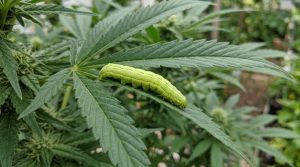
Outdoor cannabis plants are more exposed to caterpillars because moths and butterflies can land directly on the foliage and lay their eggs. This makes regular pest checks especially important when growing cannabis outdoors, particularly during warmer periods when flying insects are more active.
Choosing well-adapted outdoor cannabis strains can help plants cope with changing temperatures, humidity, and other environmental pressures, but no strain is protected from caterpillar feeding.
Understanding caterpillars on cannabis plants
Caterpillars are the larval stage of moths and butterflies. After an adult moth or butterfly lays eggs on or near a cannabis plant, the eggs hatch into small larvae that need to feed continuously as they develop.
Cannabis is not their only food source, but several caterpillar species will feed on its leaves, stems, and flowers when plants are available outdoors. The caterpillar stage is the part of their lifecycle that matters most to growers because this is when feeding damage occurs.
Their lifecycle follows four basic stages:
| Stage | What happens |
| Egg | A moth or butterfly lays eggs on or close to plant material |
| Larva | The caterpillar hatches and begins feeding as it grows |
| Pupa | Feeding stops while the insect develops into its adult form |
| Adult | The moth or butterfly emerges and can reproduce and lay more eggs |
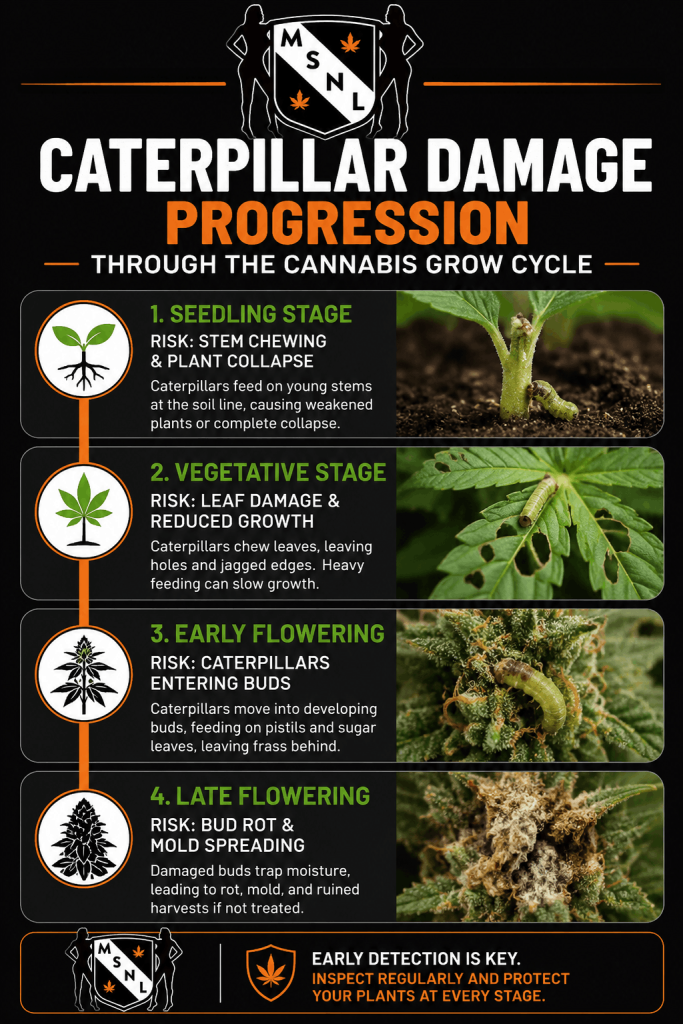
Different caterpillar species behave differently, but minor infestations usually begin with small areas of chewing damage rather than immediately causing serious plant loss. What that early damage looks like depends heavily on the stage of cannabis growth.
Minor caterpillar damage during each cannabis growth stage
| Cannabis stage | Minor damage you may notice | Where to check |
| Seedling | Small bites from young leaves or light chewing around soft stems | Cotyledons, first true leaves, and the base of the stem |
| Vegetative | Irregular holes, notched leaf edges, or small sections of missing foliage | Fan leaves, new growth, and leaf undersides |
| Early flowering | Chewed sugar leaves, small holes around flowers, or frass near developing buds | Bud sites, sugar leaves, and branch junctions |
| Late flowering | Small areas of damaged flower tissue or signs of feeding between tightly packed buds | Inside and around dense flowers and upper colas |
Seedling stage
Young cannabis plants have relatively little foliage, so even minor caterpillar feeding can be easy to notice. Small larvae may chew the edges of the first leaves or create tiny holes through soft leaf tissue.
Some caterpillars, particularly cutworm-type larvae, may also feed close to the base of young stems. At this stage, growers should take even light damage seriously because seedlings have less plant material available to lose.
Grower tip: Check around the stem and both sides of the first leaves if a healthy seedling suddenly develops fresh bite marks. Small caterpillars can blend into young green growth surprisingly well.
Vegetative stage
During vegetative growth, caterpillar damage usually becomes most obvious on the foliage. Early signs commonly include irregular holes in cannabis leaves, sections missing from leaf edges, or small patches that appear to have been scraped away.
A healthy vegetative plant can normally tolerate a small amount of leaf loss, so one or two damaged leaves do not necessarily indicate a serious infestation. The important sign is new damage continuing to appear.
Look beneath fan leaves and around new shoots, where smaller larvae can remain hidden while feeding.
Grower tip: Compare damaged leaves from one inspection to the next. If new holes appear overnight or the amount of missing tissue increases quickly, look more closely for caterpillars and frass.
Early flowering stage
Once flowers begin developing, caterpillar activity deserves closer attention. Minor damage may initially appear as chewing on sugar leaves, small bites around developing flowers, or tiny black pellets of frass near bud sites.
Some species remain on the outside of the plant, while others can begin moving between developing flowers where they become harder to see.
This is the stage when growers should begin checking more than just the larger fan leaves.
Grower tip: Gently inspect around bud sites, branch junctions, and sugar leaves without pulling flowers apart unnecessarily. Frass around a flower can be an early clue that a caterpillar is feeding nearby even when the larva itself is hidden.
Late flowering stage
As cannabis flowers become larger and denser, caterpillars can find more protected places to hide. Early or minor caterpillar damage in cannabis buds may appear as a small area of chewed flower tissue, damaged sugar leaves, frass trapped between flowers, or an unexplained opening within a bud.
The amount of visible feeding may initially look insignificant, but caterpillars hiding inside dense flowers are more concerning than those feeding openly on leaves because internal damage can be difficult to monitor.
Grower tip: During late flowering, investigate fresh frass or localized flower damage rather than assuming a small mark is harmless. Check surrounding buds as well because more than one larva or egg may be present.
The appearance of a few chewed leaves does not automatically mean that a cannabis plant is suffering serious damage. The main objective at this stage is to identify minor caterpillar activity early, before feeding spreads or larvae move deeper into developing buds. The next step is knowing the specific signs that separate caterpillar damage from other common cannabis pests.
How to identify caterpillars on cannabis plants
Caterpillars are not always easy to spot because their coloring allows them to blend into cannabis leaves, stems, and flowers. For a new grower, the easiest way to identify an infestation is usually to look for the symptoms of caterpillar feeding first, then inspect the surrounding plant for the larva itself.
The clearest warning signs are irregular holes in cannabis leaves, fresh chewing, black caterpillar droppings known as frass, damaged sugar leaves, and feeding inside developing buds. When several of these symptoms appear together, caterpillars become a much more likely cause.
Use the following step-by-step inspection to work out whether caterpillars are feeding on your plants.
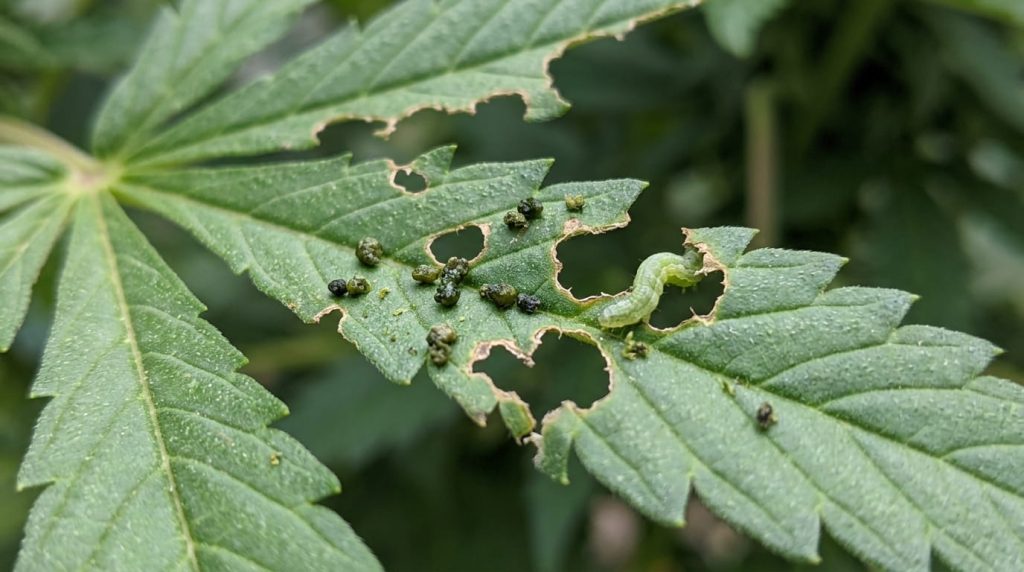
Step 1: Look for fresh holes and missing leaf tissue
Start by examining the fan leaves and newer growth. Caterpillars have chewing mouthparts, so instead of leaving tiny dots or discoloration, they physically remove pieces of leaf tissue.
Typical caterpillar damage on cannabis leaves includes:
- irregular or jagged holes through the leaf
- sections missing from the outer leaf edge
- partially eaten leaf tips
- small patches where the surface has been scraped away
- larger pieces of foliage disappearing as larvae grow
Fresh damage may appear quickly, sometimes between daily inspections.
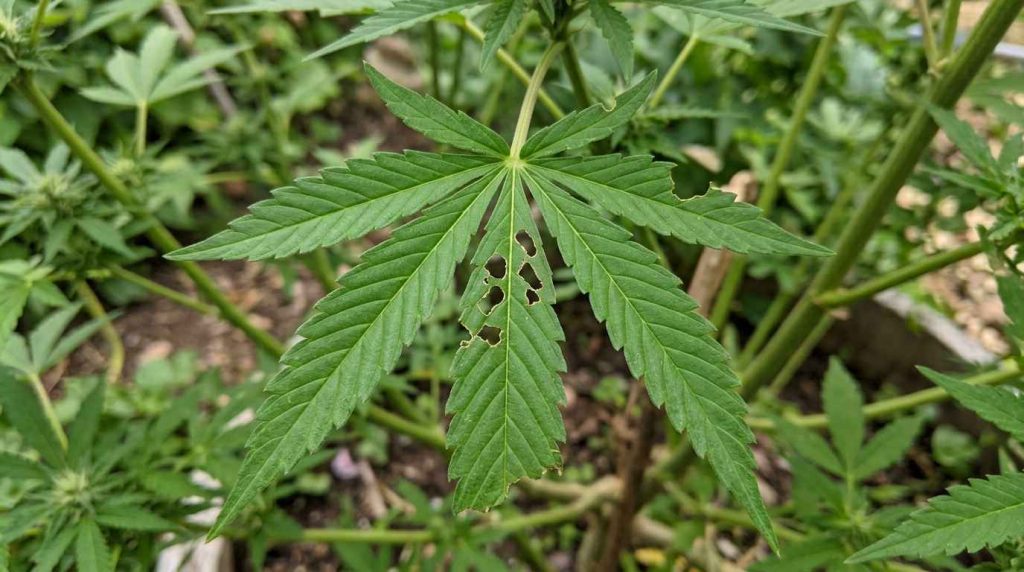
What it looks like: Uneven holes through the center of a leaf or chunks missing from its edges.
What it tells you: Something with chewing mouthparts has been feeding on the plant. Caterpillars should be suspected when the holes appear alongside frass or when fresh damage continues appearing.
Grower tip: Take a photograph when you first notice damaged foliage. Check the same leaf 24 hours later. Existing holes will not heal, so you are looking for new holes or enlarging bite marks that confirm feeding is still active.
Step 2: Check for leaf windowing
Very young caterpillars do not always chew completely through a cannabis leaf. Instead, they may remove only the softer surface tissue.
This can leave behind a thin, pale, or almost transparent patch known as windowing.
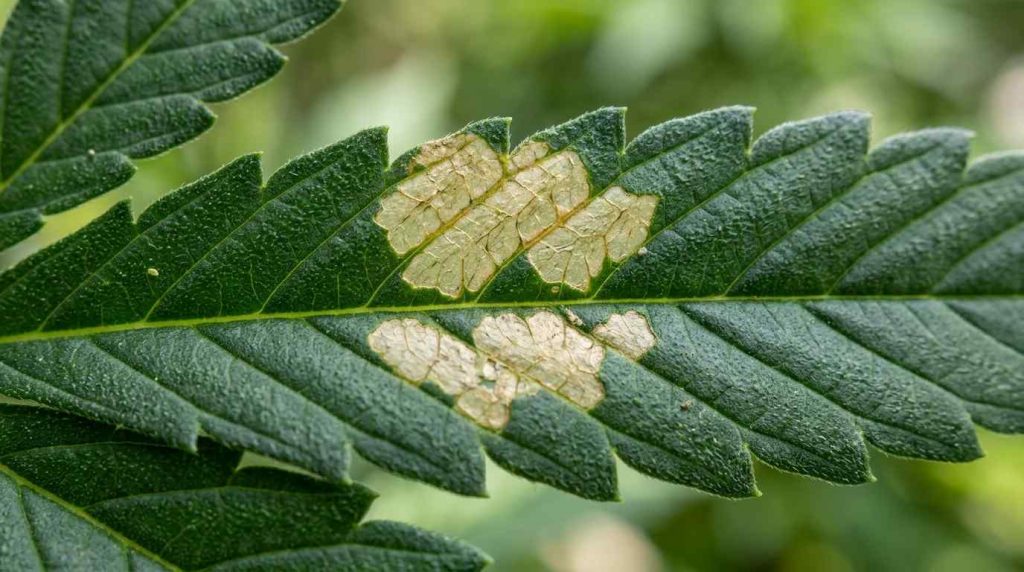
What it looks like: Thin, translucent patches where part of the leaf has been eaten but the entire leaf blade has not been removed.
What it tells you: Small larvae may have recently hatched and started feeding.
Windowing can be especially useful for identifying an infestation early, before caterpillars become large enough to cause obvious holes.
Grower tip: If you find fresh windowing, inspect the underside of that leaf carefully. Small caterpillars and newly hatched larvae are easier to control when they are found before they spread farther across the plant.
Step 3: Search for caterpillar frass
Once you find chewing damage, look directly around and below it for frass.
Frass is caterpillar waste and usually appears as small dark brown or black pellets. It can look like tiny grains of soil, but unlike soil it may appear unexpectedly on upper leaves, sugar leaves, or inside developing flowers.
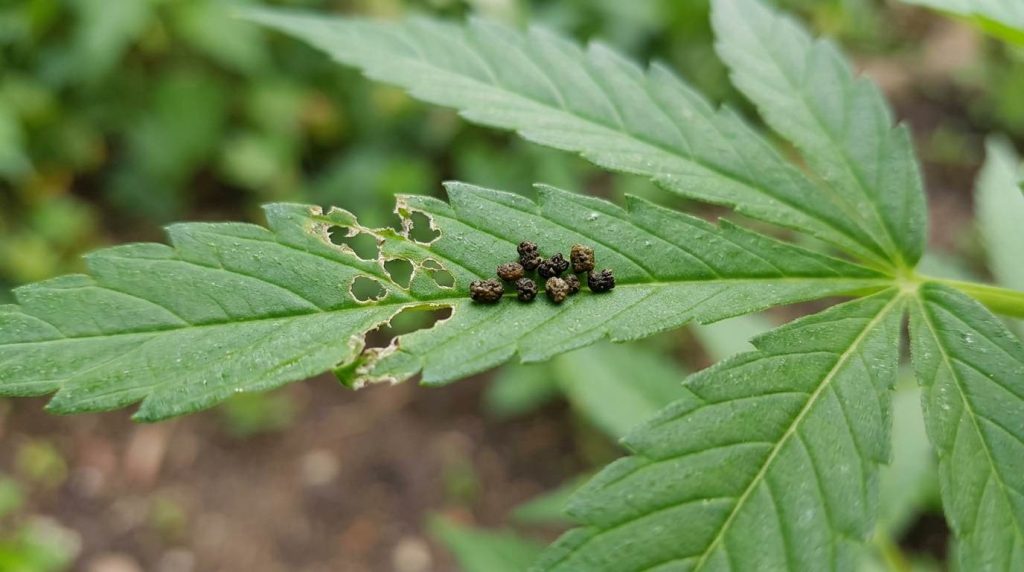
What it looks like: Small black or dark brown pellets scattered across leaves, stems, or buds.
What it tells you: A caterpillar has probably been actively feeding nearby.
Check for frass in:
- damaged fan leaves
- leaf junctions
- branch intersections
- around sugar leaves
- underneath damaged foliage
- between developing buds
Grower tip: When you find frass but cannot see the caterpillar, look above the droppings first. Frass often falls from the area where the larva has been feeding.
Step 4: Inspect the undersides of leaves and stems
If leaf damage and frass suggest caterpillars are present, begin searching for the insects themselves.
Turn damaged leaves over and inspect:
- the underside of the leaf
- the leaf stem
- nearby branches
- new shoots
- areas where leaves meet the main stem
Caterpillars can remain almost motionless while hiding against green plant tissue, so inspect slowly rather than giving the plant a quick glance.
Depending on the species and age, larvae may be green, brown, striped, or patterned.
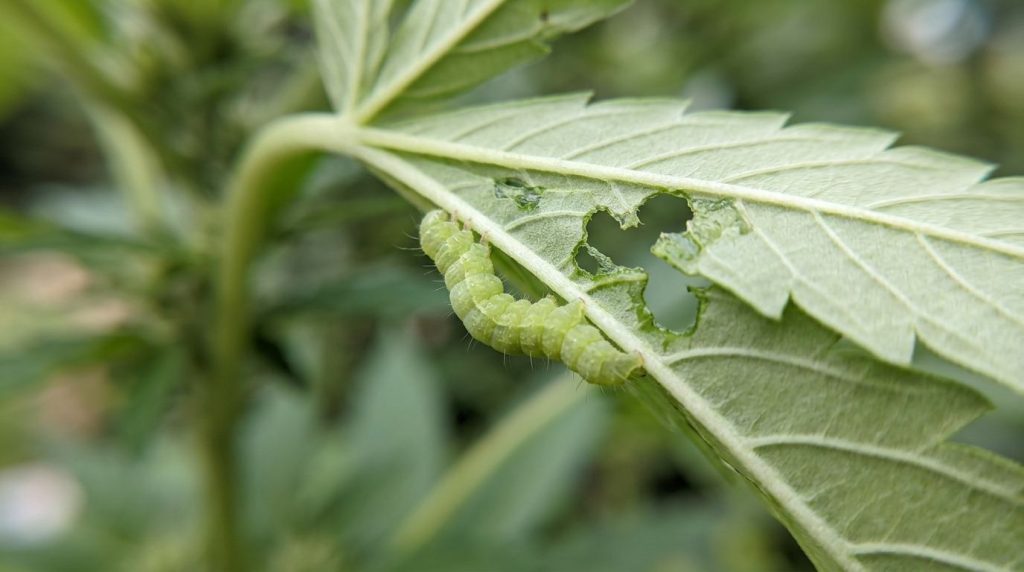
What it looks like: Soft-bodied, segmented larvae resting or moving along leaves, stems, or flowers.
What it tells you: Seeing a caterpillar alongside fresh feeding damage confirms the source of the problem.
Grower tip: Do not stop inspecting the plant after finding one caterpillar. Continue checking nearby leaves and branches because several eggs may have hatched around the same time.
Step 5: Inspect young stems for chewing
Caterpillars are usually associated with leaf damage, but some types can also feed around young stems.
Seedlings and younger cannabis plants are particularly vulnerable because their stems have not yet developed the strength of mature branches.
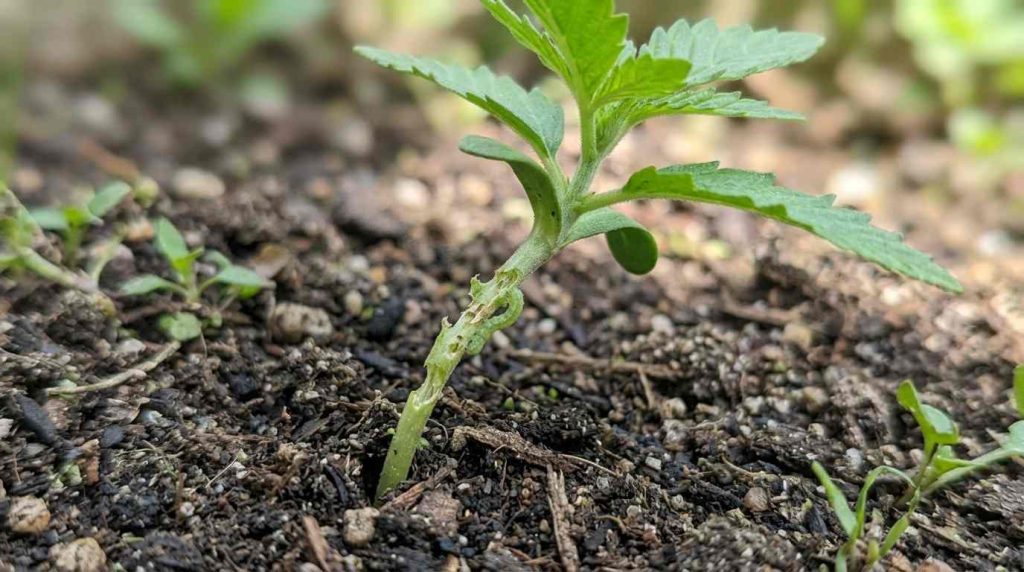
What it looks like: Bite marks, scraped tissue, or sections of stem that appear partially chewed.
What it tells you: A caterpillar may be feeding close to the base of the plant or around soft new growth.
More serious stem feeding can cause seedlings to lean, wilt, or collapse.
Grower tip: If a young plant suddenly begins leaning despite adequate watering, inspect the stem at soil level before assuming there is a root or watering problem.
Step 6: Check sugar leaves and developing buds
Once cannabis begins flowering, your inspection needs to move beyond the large fan leaves.
Look closely around:
- sugar leaves
- developing bud sites
- branch junctions
- the outside of colas
- areas where flowers meet the stem
Caterpillars in buds can be significantly harder to find because flowers give them sheltered areas in which to feed.
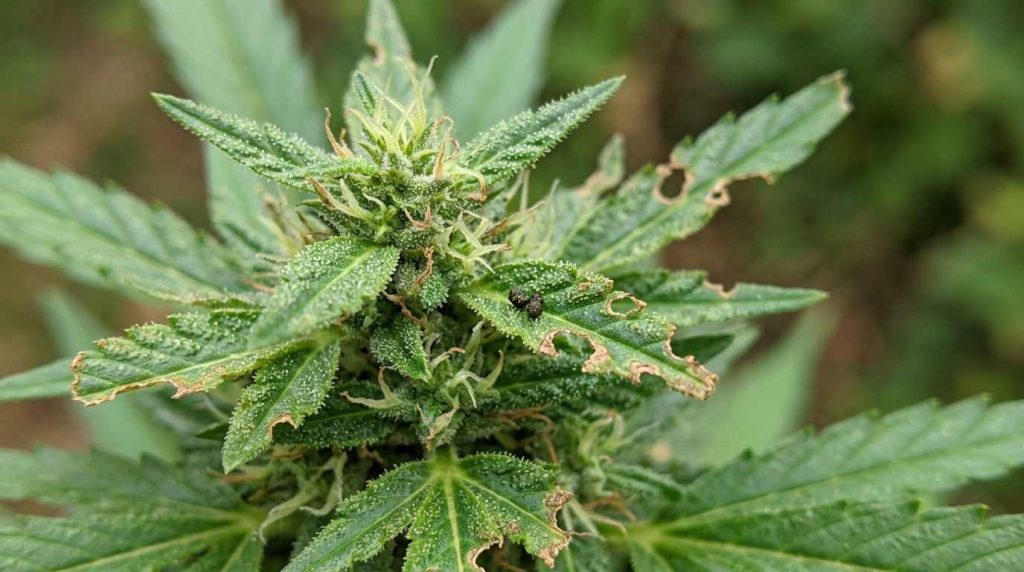
What it looks like: Small bites, irregular holes, or missing sections from the leaves growing directly around the flowers.
What it tells you: Caterpillar feeding may be moving closer to the developing buds.
Sugar-leaf damage becomes particularly important when it appears alongside frass.
Step 7: Look for signs of caterpillars inside buds
During flowering, do not assume that a healthy-looking outer bud means nothing is happening inside.
A caterpillar feeding between flowers may leave only subtle symptoms at first.
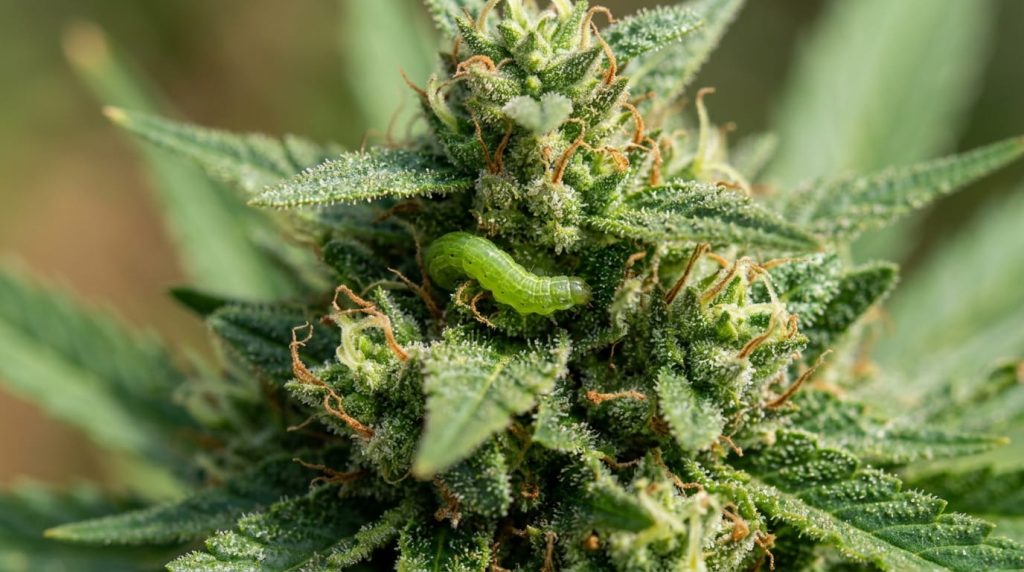
What it looks like: Small dark pellets trapped between flowers or resting on sugar leaves.
What it tells you: A caterpillar may be feeding somewhere inside or directly above the flower.
This is one of the strongest reasons to investigate a bud more closely.
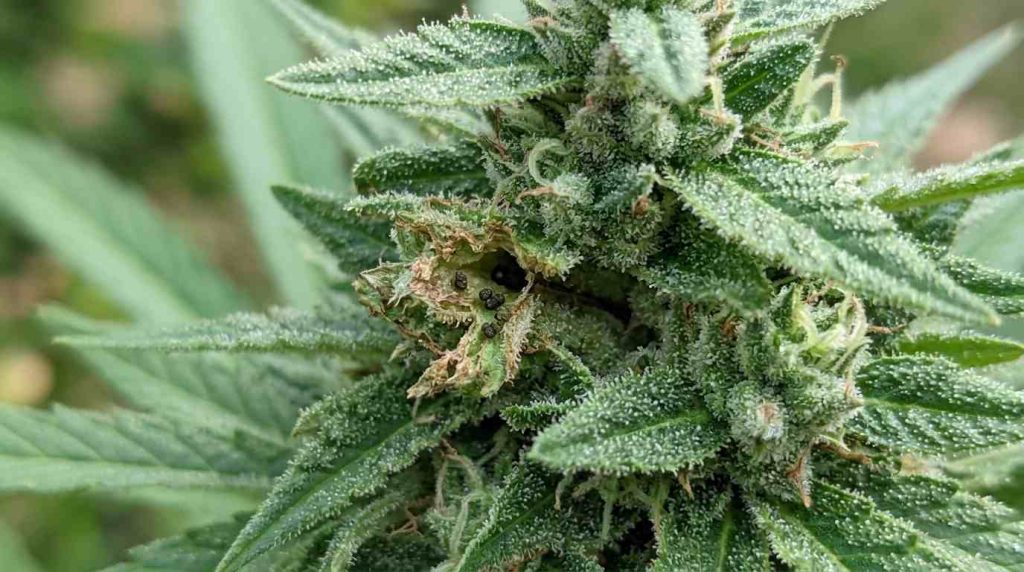
What it looks like: An unusual opening, chewed flower tissue, or a small channel extending farther into the flower.
What it tells you: A larva may have entered the bud and started feeding internally.
Do not unnecessarily pull healthy flowers apart. Concentrate your inspection on buds already displaying frass, chewing, or localized discoloration.
Step 8: Watch for localized browning in flowers
More advanced caterpillar damage in cannabis buds can cause sections of flower tissue to become damaged or die.
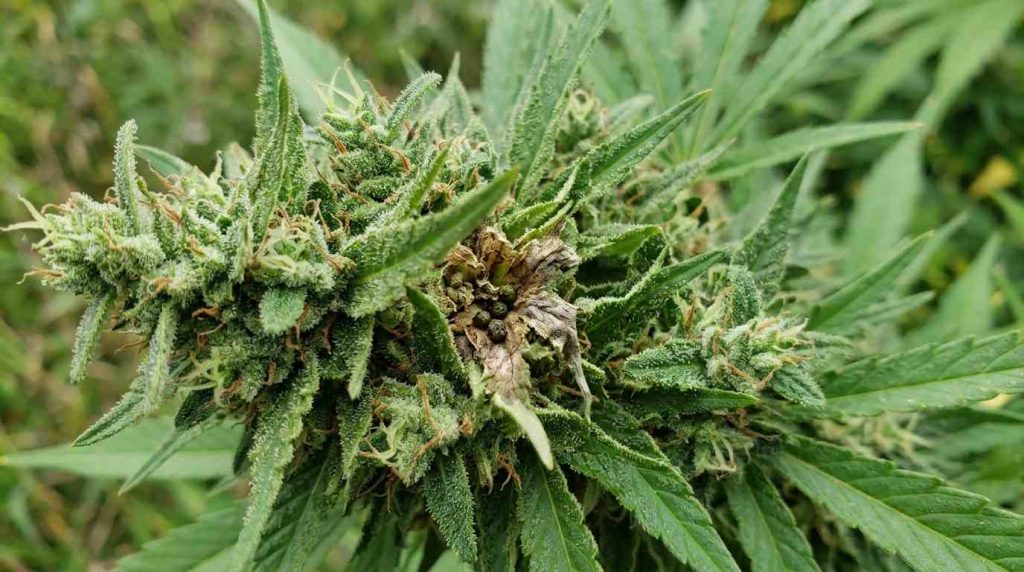
What it looks like: A localized section of a flower turns brown while the surrounding bud remains green and healthy.
What it tells you: There may be damaged or dying tissue inside the flower and the bud should be inspected for caterpillar feeding, frass, and possible mold.
Browning does not prove that caterpillars are responsible by itself. However, browning combined with frass and visible chewing damage is a much stronger warning sign.
Grower tip: If one area of an otherwise healthy cola suddenly turns brown, do not ignore it. Check around that section carefully instead of waiting for the discoloration to spread.
Step 9: Check damaged buds for signs of rot
Caterpillar feeding does not automatically cause bud rot, but feeding wounds and damaged flower tissue can make affected areas more vulnerable to fungal infection, particularly when humidity or moisture remains trapped inside dense flowers.
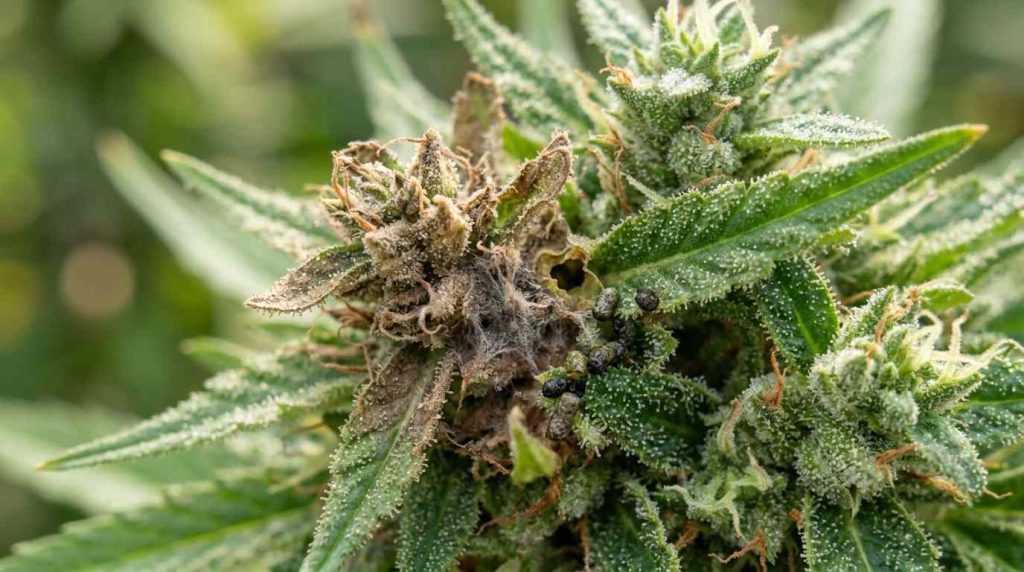
What it looks like: Brown, dying, soft, or moldy material developing around an area that has already been chewed or tunneled through.
What it tells you: Caterpillar feeding may have caused physical damage that has subsequently become affected by rot.
This is a more advanced symptom and needs to be distinguished from the minor leaf damage seen earlier in an infestation.
Grower tip: Frass + internal feeding damage + localized browning is a much stronger indication of a caterpillar-related problem than browning alone.
Quick caterpillar symptom checklist
Use several symptoms together rather than diagnosing caterpillars from a single damaged leaf.
| Caterpillar symptom | Where you will usually see it | How strong is the clue? |
| Irregular leaf holes | Fan leaves and new growth | Moderate |
| Missing leaf edges | Fan leaves | Moderate |
| Windowing | Young leaves and leaf undersides | Moderate |
| Black frass | Leaves, branches, sugar leaves, and buds | Strong |
| Visible caterpillar | Leaves, stems, or flowers | Confirmation |
| Chewed young stems | Seedlings and soft growth | Moderate |
| Damaged sugar leaves | Around flowering sites | Strong when combined with frass |
| Frass inside flowers | Developing and mature buds | Strong |
| Tunnels or chewed flower tissue | Inside buds | Strong |
| Localized brown flower tissue | Flowering plants | Needs further inspection |
| Mold around damaged tissue | Dense flowering buds | Advanced damage |
How to confirm that caterpillars are causing the damage
For a new grower, avoid diagnosing an infestation from holes in cannabis leaves alone. Several insects can damage foliage, and physical damage can occasionally have other causes.
A much more reliable identification is finding several caterpillar-specific clues together.
For example:
Irregular holes + frass + a visible larva = confirmed caterpillar feeding
or during flowering:
Damaged sugar leaves + frass around the bud + internal chewing = strong evidence of caterpillars in buds
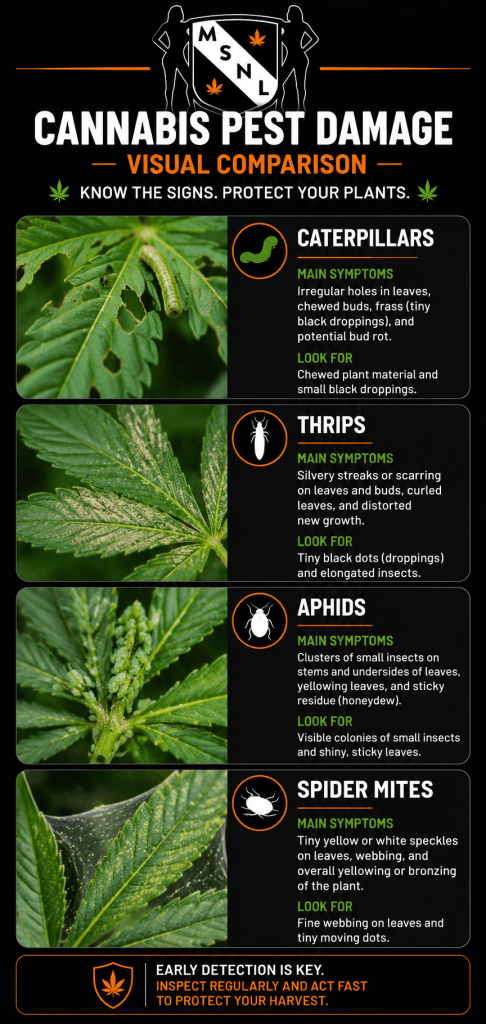
This is also how caterpillar damage can be separated from common pests such as thrips, aphids, and spider mites. These pests are more commonly associated with stippling, silver markings, leaf distortion, sticky residue, or webbing rather than large sections of plant tissue being physically chewed away.
The most common cannabis pests can produce overlapping symptoms, so confirming fresh chewing together with frass or visible caterpillars is the most reliable approach.
Impact on plant health and photosynthesis
Cannabis plants produce green, healthy and vibrant foliage with the goal of capturing as much light energy as possible for photosynthesis. When caterpillars work their way through fresh leaf growth, the amount of leaf tissue significantly reduces over time, thus lowering the amount of potential energy a plant can store when growing indoors or outside.
How caterpillars cause bud damage and rot
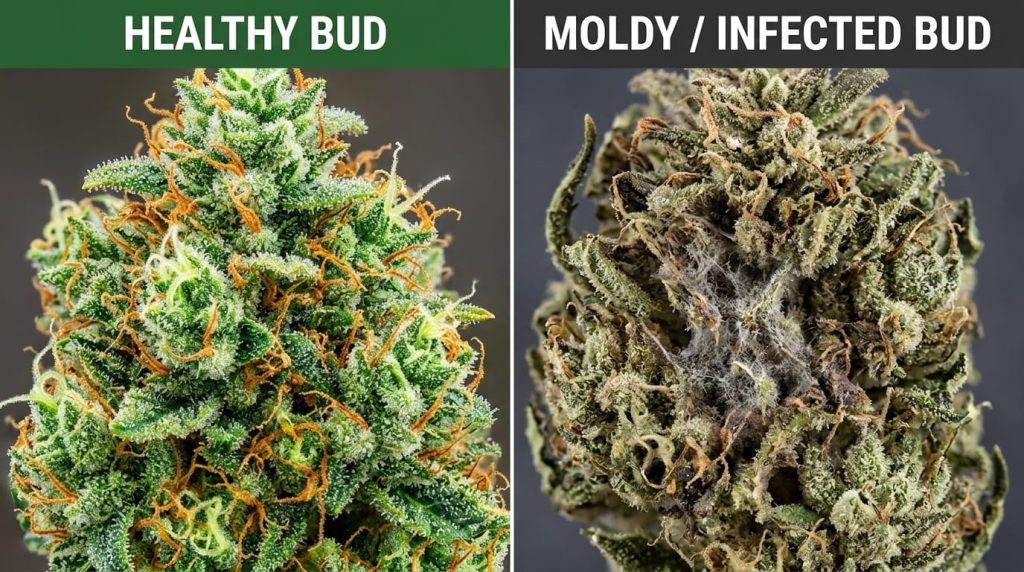
Caterpillars seem to love cannabis buds as much as growers! They will mine their way through your best-looking buds and create small tunnels. At the same time, the caterpillar will produce excrement, which contains pathogens.
Another reason why caterpillars are single handedly responsible for causing infected eaten buds to become moldy, is to the fact the damaged buds are exposed to humidity and heat. This dramatically increases the chances of the buds becoming too wet and damp, especially outdoors.
Bud rot caused by caterpillars is often far more severe in dense flowers where airflow is restricted and excess moisture becomes trapped inside the buds. For this reason, many outdoor growers choose mold-resistant cannabis strains or varieties with slightly looser bud structures, particularly in regions with humid late summers and wet fall conditions.
How to get rid of caterpillars on cannabis plants
Once you have confirmed caterpillars are causing the leaf holes, frass, or bud damage, act as early as possible. Small caterpillars feeding on exposed leaves are much easier to control than larger larvae that have moved into developing flowers.
For beginner growers, the easiest approach is to work through the plant in order: remove visible caterpillars, check for more larvae and eggs, monitor for fresh damage, and use an appropriate biological treatment if feeding continues.
| What you find | What to do first |
| One or two visible caterpillars | Remove them by hand and inspect the whole plant |
| Fresh holes and frass | Search around and above the damaged area |
| Several young caterpillars | Remove them and consider a labeled Bt/Btk treatment |
| Caterpillars around buds | Remove carefully and inspect nearby flowers |
| Brown or moldy flower tissue | Remove affected material and inspect surrounding buds |
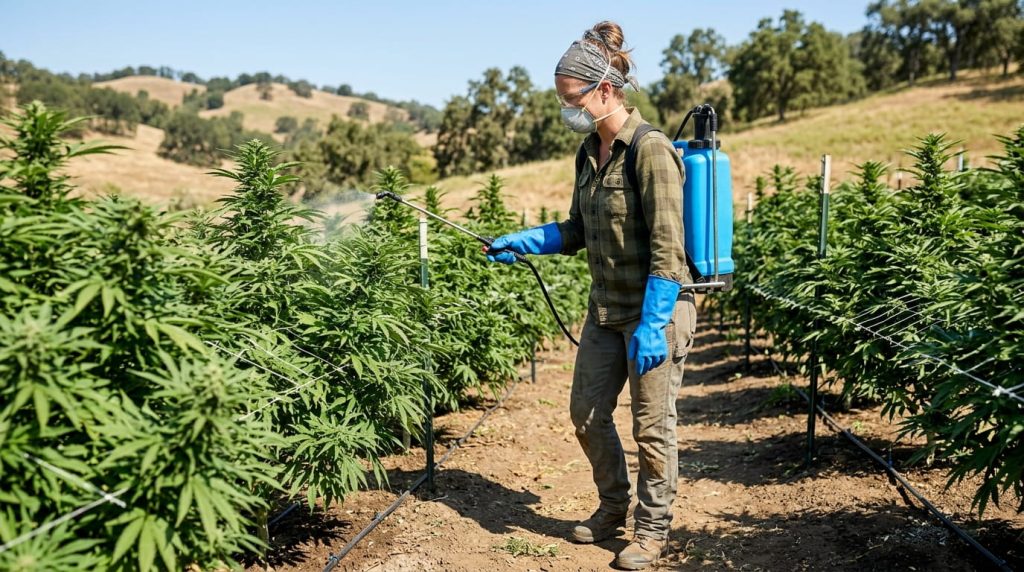
Step 1: Remove caterpillars by hand
Manual removal is the simplest way to deal with a small caterpillar infestation.
Put on clean gloves and inspect the plant from top to bottom. Look underneath leaves, around new shoots, along stems, and around branch junctions. During flowering, also check sugar leaves and the outside of developing buds.
Remove every caterpillar you find and take it completely away from the growing area.
Do not stop after finding the first one. Moths and butterflies can lay multiple eggs on the same plant, so several caterpillars may hatch around the same time.
Grower tip: If you find fresh frass but cannot see the caterpillar, inspect directly above the droppings. Caterpillars often remain close to the area where they have been feeding.
Step 2: Look for eggs and fresh feeding
After removing visible caterpillars, check the undersides of nearby leaves for eggs and very small larvae.
For the next few days, monitor the plant for:
- new holes in leaves
- fresh black frass
- damaged sugar leaves
- newly chewed stems
- additional caterpillars
- fresh damage around buds
Old holes will remain in the leaves, so do not use existing damage alone to decide whether caterpillars are still active.
Grower tip: Photograph damaged leaves when you first find them. Compare them the next day. New or enlarged holes are a simple way for beginner growers to confirm that feeding is continuing.
Step 3: Use Bt/Btk when caterpillars are actively feeding
Bacillus thuringiensis (Bt) is a biological control commonly used against caterpillars. Products containing Bacillus thuringiensis var. kurstaki (Btk) are specifically used for caterpillar larvae.
Bt must be eaten by the caterpillar to work. After a larva consumes treated plant material, feeding is disrupted.
This means Bt generally works best against small, actively feeding caterpillars before they become hidden deep inside flowers.
When using Bt/Btk:
- Choose a product labeled for the intended crop and caterpillar pest in your location.
- Mix and apply it exactly according to the product label.
- Cover areas where caterpillars are actively feeding.
- Inspect the plant afterward for continued chewing and frass.
- Reapply only according to label directions.
Rain and strong sunlight can reduce how long some Bt treatments remain active, so always follow the manufacturer's instructions concerning repeat applications.
Take additional care during the flowering stage. Avoid unnecessarily soaking dense buds, and follow any flowering-stage restrictions or pre-harvest interval on the product label.
Grower tip: Do not wait until large caterpillars are buried inside mature buds before taking action. Catching them while they are small and feeding on exposed leaves gives you far more control options.
Step 4: Use natural predators as additional control
Beneficial predators can help reduce caterpillar numbers outdoors, but they should support regular inspections rather than replace them.
| Natural predator | How it can help |
| Lacewings | May feed on eggs and small larvae |
| Assassin bugs | Attack a range of soft-bodied pests |
| Praying mantises | Can hunt larger insects and caterpillars |
| Birds | Some species naturally feed on outdoor caterpillars |
Beneficial insects are most useful as part of a wider prevention strategy that also includes physical barriers, egg removal, and regular monitoring.
Should you use homemade caterpillar sprays?
Peppermint, vinegar, lavender, garlic, and hot pepper mixtures are sometimes recommended as homemade caterpillar deterrents. However, their effectiveness varies, and concentrated homemade sprays can damage cannabis leaves or leave unwanted residues on flowers.
For this reason, I would not rely on homemade mixtures as the main treatment, particularly once buds are developing.
Manual removal, physical exclusion, regular inspections, and appropriately labeled biological controls provide a more predictable approach.
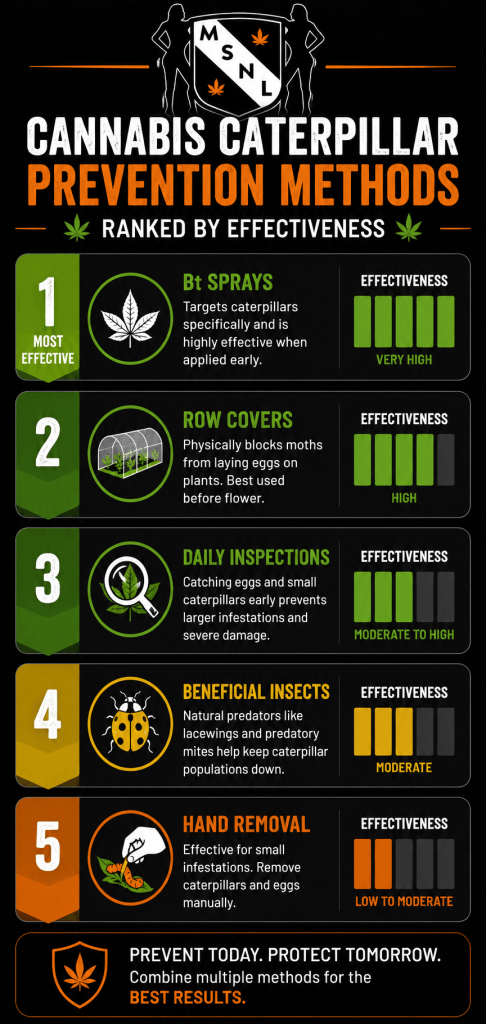
How to prevent caterpillars on cannabis plants
Preventing caterpillars is much easier than trying to remove them once they have entered dense buds. Outdoor plants are most vulnerable because moths and butterflies can land directly on the foliage and lay eggs.
The goal is to stop egg laying where possible and find young caterpillars before they reach the flowers.
Step 1: Inspect outdoor plants regularly
Check outdoor cannabis plants frequently during the warmer months and increase inspections as flowering begins.
Look closely at:
- leaf undersides
- new growth
- stems and branch junctions
- sugar leaves
- developing buds
- areas where previous damage occurred
A small magnifying glass can help identify eggs and newly hatched larvae that may otherwise be missed.
Step 2: Use insect mesh or row covers
Fine insect mesh can stop adult moths and butterflies from reaching cannabis plants and laying eggs.
Install the barrier before an infestation develops and make sure it is secured around the growing area.
The mesh should still allow good airflow and should not sit tightly against foliage or trap excess humidity around the plants.
This becomes particularly important as flowers develop because reduced airflow can increase moisture around the buds.
Step 3: Remove eggs before they hatch
Check the undersides of leaves for small eggs and remove them when found.
If only one or two leaves are affected, removing the individual leaf may sometimes be easier than trying to treat the entire plant.
Finding eggs before they hatch is one of the simplest ways to prevent caterpillar damage because the larvae never get the opportunity to start feeding.
Step 4: Monitor for fresh damage
Regular monitoring should focus on new activity rather than old damage.
| Plant area | What to look for |
| Fan leaves | New holes or missing edges |
| Leaf undersides | Eggs and small caterpillars |
| Stems | Fresh chewing or frass |
| Sugar leaves | New bite marks |
| Buds | Frass, tunnels, or damaged flower tissue |
If new holes or frass appear between inspections, continue searching for active caterpillars.
Managing caterpillars during flowering
Caterpillars become more serious when cannabis moves from the vegetative stage into flowering.
A mature vegetative plant can usually tolerate a small amount of leaf damage. During flowering, however, caterpillars can move between sugar leaves and into the buds where feeding becomes harder to see.
During flowering:
- Inspect sugar leaves and buds as well as fan leaves.
- Look for frass around flower sites.
- Remove visible caterpillars immediately.
- Check neighboring buds after finding one affected area.
- Remove clearly damaged or moldy flower tissue.
- Avoid unnecessarily wetting dense flowers.
Grower tip: If you find frass around a bud but cannot see the caterpillar, inspect the flower carefully. Frass trapped between flowers can be an early warning that a larva is feeding somewhere inside.
Safe caterpillar control near harvest
In the final weeks before harvest, flowers are larger and denser, making hidden caterpillars more difficult to find.
Wear clean gloves and inspect each cola carefully, including lower buds and side branches rather than only checking the top of the plant.
Look for:
- visible caterpillars
- frass between flowers
- damaged sugar leaves
- small feeding tunnels
- localized brown flower tissue
- gray or moldy material
Remove visible caterpillars by hand. If part of a bud is clearly dead, rotten, or moldy, cut away and discard the affected material using clean scissors.
Be particularly cautious about spraying mature flowers. Adding unnecessary moisture to dense buds may increase mold risk. If you are considering a pesticide or biological treatment close to harvest, follow the product label and its stated pre-harvest interval.
Check harvested cannabis for hidden caterpillars
Even careful inspections can miss caterpillars that are concealed deep inside mature flowers. I have found caterpillars myself when trimming outdoor colas into smaller thumb-sized buds, despite checking the plants before harvest.
When trimming, use good lighting and inspect suspicious buds for:
- hidden caterpillars
- frass
- chewed channels
- brown internal tissue
- gray mold or signs of Botrytis
Discard clearly moldy or rotten flower material rather than trying to salvage it. Bud rot can develop inside dense flowers before the full extent of the damage becomes visible from the outside.
Clean trimming scissors after cutting affected material and remove discarded flowers from the trimming area.
There is no need to automatically throw away all growing media or disinfect an entire grow space simply because caterpillars were found on an outdoor plant. Sanitation should match the pest and growing environment involved.
How to reduce caterpillar problems in future outdoor grows
The best long-term defense is a combination of physical exclusion, frequent inspections, egg removal, and early treatment while caterpillars are still small.
Some outdoor growers also choose fast-flowering cannabis strains because an earlier finish can reduce late-season exposure to caterpillar activity, rainfall, and increasing humidity. Shorter flowering periods may also reduce the amount of time buds remain exposed to wet fall conditions.
Likewise, well-adapted outdoor cannabis strains can be better suited to changing temperatures, humidity, and other environmental pressures.
Neither strain choice prevents caterpillars directly. Regular inspection remains the most important habit: find the eggs early, remove young caterpillars quickly, and prevent them from reaching the buds whenever possible.
Conclusion
Caterpillars on cannabis plants may first appear as irregular leaf holes and small amounts of frass, but problems worsen when larvae enter developing flowers. Their feeding can damage buds and increase the risk of browning or bud rot, especially in humid, rainy conditions.
Inspect plants regularly, focusing on fresh damage and frass. Remove visible larvae and eggs promptly. A properly labeled Bt/Btk treatment may help control small, actively feeding caterpillars; always follow the product label.
Prevent infestations with fine insect mesh, frequent inspections, and egg removal. During flowering, monitor buds closely. Continued holes, frass, or flower damage indicate that caterpillar activity remains active.
Frequently asked questions
How do I know if caterpillars are eating my cannabis plant?
The most common signs are irregular holes in cannabis leaves, missing sections around leaf edges, transparent window-like patches, black caterpillar droppings called frass, and visible larvae.
During flowering, also look for chewed sugar leaves, frass around flowers, small feeding tunnels, and localized brown areas inside buds.
A single hole does not confirm caterpillars. Finding fresh chewing together with frass or a visible larva provides much stronger evidence.
Where do caterpillars hide on cannabis plants?
Caterpillars commonly hide on the undersides of leaves, along stems, around branch junctions, and within new growth. Once cannabis starts flowering, some larvae can move between sugar leaves and into developing buds.
If you find frass but cannot see the caterpillar, inspect directly above and around the droppings first. During flowering, carefully check nearby flower sites because the larva may be concealed between buds.
What is the best way to get rid of caterpillars on cannabis?
For a small infestation, start by removing visible caterpillars and eggs by hand. Then inspect the plant over the following days for fresh leaf holes, frass, or additional larvae.
If young caterpillars continue feeding, a properly labeled Bt/Btk product may be an appropriate biological control. Bt must be eaten by the caterpillar, which is why it generally works best while larvae are small and actively feeding on exposed plant tissue. Always follow the product label and any pre-harvest restrictions.
Can caterpillars damage cannabis buds?
Yes. Caterpillars in cannabis buds can chew flower tissue, create feeding tunnels, and leave frass between flowers. The resulting damaged or dying tissue can become more vulnerable to fungal infection, especially when moisture becomes trapped inside dense buds.
Check any flower showing unexplained browning, frass, damaged sugar leaves, or visible chewing. Caterpillar feeding does not automatically mean bud rot will develop, but damaged flowers should be monitored closely.
How can I prevent caterpillars on outdoor cannabis plants?
Start prevention before obvious damage appears. Inspect leaf undersides regularly for eggs, use fine insect mesh or row covers where practical, remove eggs and young larvae immediately, and increase inspections as flowering begins.
During flowering, check sugar leaves and developing buds rather than concentrating only on fan leaves. Finding caterpillars while they are still small and feeding openly is much easier than trying to remove them after they have entered mature flowers.


