




Cannabis growers often use the terms pistils and stigmas interchangeably, but they describe different parts of the female flower. Understanding the difference between a stigma and a pistil can help you identify female plants, recognize pollination, follow flower development, and assess maturity more accurately.
In simple terms, cannabis pistils are the complete female reproductive organs, while cannabis stigmas are the fine, hair-like structures that extend from them and capture pollen. This distinction is important because many of the white, orange, or brown "pistils" growers talk about are technically stigmas.
In this guide, I'll explain the pistil and stigma difference, how both structures function during reproduction, what changes in stigma appearance can tell you during flowering, and how to use these signs alongside other indicators when monitoring your plants.
Key Takeaways
- Pistils and stigmas are not the same: The pistil is the complete female reproductive organ, while the stigma is the hair-like, pollen-receiving part of it.
- White hairs are technically stigmas: The fine white or cream hairs that appear on female cannabis flowers are stigmas, although growers commonly call them pistils.
- Stigmas help identify female plants: Their appearance around developing preflowers is one of the clearest visual signs of female cannabis sex.
- Stigma color changes during flowering: White stigmas often darken to yellow, orange, reddish-brown, or brown as flowers mature, although pollination and environmental conditions can also influence their appearance.
- Do not rely on stigma color alone for harvest timing: Use stigma development alongside trichome maturity, bract swelling, and overall flower development for a more reliable assessment.
- Understanding Cannabis Flower Anatomy
- What is a Pistil on a Cannabis Plant?
- What Are Stigmas on Cannabis Plants?
- Stigmas vs Pistils: Key Differences Explained
- Stigmas and Pistils During the Flowering Cycle
- Stigmas, Pistils, and Cannabis Sex Identification
- How Understanding Stigmas and Pistils Helps Growers
- Frequently Asked Questions
Understanding Cannabis Flower Anatomy
Before comparing cannabis pistils and stigmas, it helps to understand where these reproductive structures fit within the wider anatomy of a cannabis plant. The two sexes develop different structures: male flowers produce and release pollen, while female flowers contain the reproductive organs that receive pollen and can eventually produce seeds.
Male and female cannabis reproductive structures
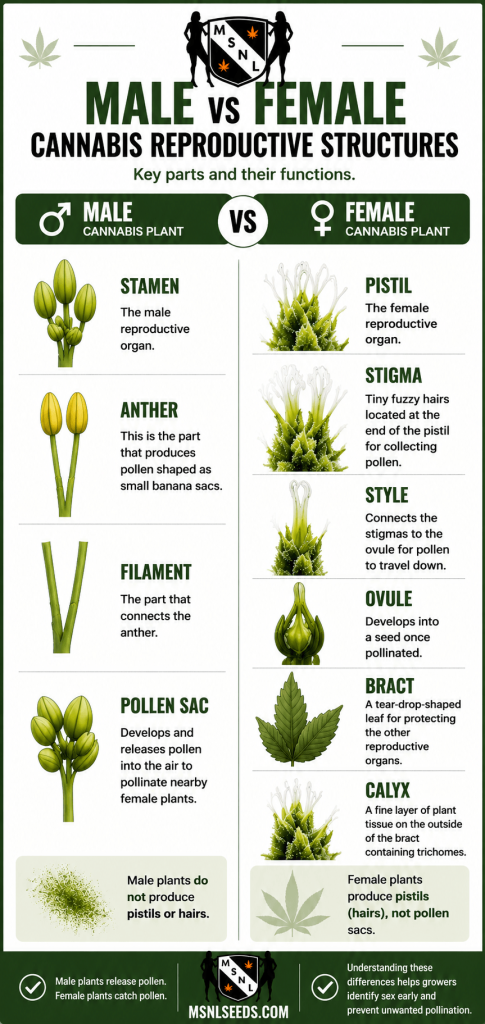
Male cannabis flowers do not produce the white hair-like stigmas associated with female flowers. Instead, they develop stamens made up of anthers supported by filaments. The anthers produce pollen, which can be carried through the air to female flowers.
- Stamen: The male reproductive organ, consisting of an anther and filament.
- Anther: Produces and releases pollen.
- Filament: Supports the anther and positions it for pollen dispersal.
Female cannabis flowers contain a pistil, the complete female reproductive structure. The pistil includes the stigma, style, and ovary. The visible white hairs that growers often call "pistils" are technically stigmas.
- Pistil: The complete female reproductive organ, including the stigma, style, and ovary.
- Stigma: The exposed, hair-like structure that captures airborne pollen.
- Style: Connects the stigma to the ovary and provides a pathway for pollen after successful pollination.
- Ovary: Contains the ovule and forms part of the female reproductive structure.
- Ovule: Develops into a seed following successful fertilization.
- Bract: A small, tear-shaped structure surrounding and protecting the female reproductive organs. It can become heavily covered in trichomes as the flower matures.
Grower tip: If you see pairs of fine white hairs emerging from a female preflower, you are looking at stigmas, not the entire pistil. This distinction is important when assessing sex, pollination, and flower maturity.
| Male cannabis structure | Function | Female cannabis structure | Function |
| Stamen | Complete male reproductive organ | Pistil | Complete female reproductive organ |
| Anther | Produces and releases pollen | Stigma | Captures airborne pollen |
| Filament | Supports the anther | Style | Connects the stigma to the ovary |
| — | — | Ovary | Contains the ovule |
| — | — | Ovule | Develops into a seed after fertilization |
| — | — | Bract | Protects the female reproductive structures |
For growers aiming to produce seedless flowers, preventing pollen from reaching the stigmas is essential. Once pollen lands on a receptive stigma and fertilization occurs, the plant begins directing energy toward seed development.
What is a Pistil on a Cannabis Plant?
A cannabis pistil is the complete female reproductive organ of the flower. It includes the stigma, style, and ovary, which work together during pollination and fertilization.
Growers often call the visible white hairs on female flowers "pistils," but botanically these hairs are stigmas.
Parts of the pistil: stigma, style, and ovary explained
- Stigma: The hair-like structure that captures pollen.
- Style: Connects the stigma to the ovary and provides a pathway for the pollen tube.
- Ovary: Contains the ovule, which can develop into a seed after fertilization.
The role of the pistil in cannabis reproduction
When pollen lands on a receptive stigma, it can germinate and form a pollen tube that travels through the style toward the ovule. Successful fertilization allows the ovule to develop into a seed.
For growers producing seedless flowers, preventing pollen from reaching female stigmas is essential.
Grower tip: Stigma color can provide clues about flower development, but it should not be used alone to judge harvest readiness. Trichome maturity is a more reliable indicator.
What Are Stigmas on Cannabis Plants?
Cannabis stigmas are the fine, hair-like structures that extend from female flowers and capture pollen. They are part of the pistil, not the entire reproductive organ.
This is the main difference between a stigma and a pistil: the pistil is the complete female reproductive structure, while the stigma is its pollen-receiving part.
Physical appearance of cannabis stigmas
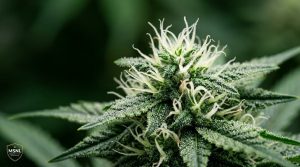
Stigmas usually appear as pairs of fine white or cream-colored hairs emerging from female flowers. As flowering progresses, they may turn yellow, orange, reddish-brown, or brown depending on genetics, maturity, pollination, and growing conditions.
Biological function of stigmas in pollination
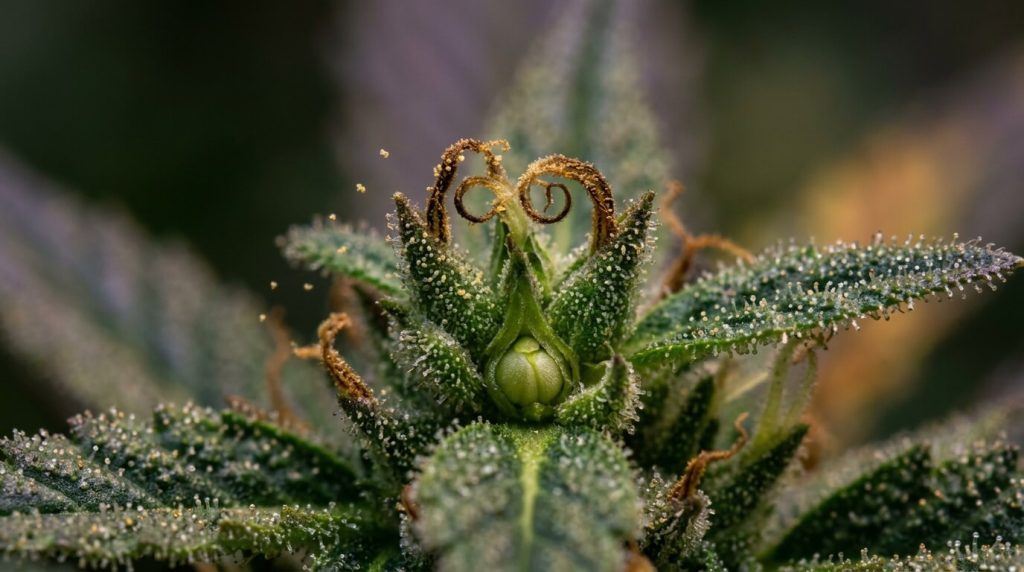
The stigma is the first point of contact for pollen. Once compatible pollen lands on it, a pollen tube can grow through the style toward the ovule, where fertilization may occur.
If the flower remains unpollinated, it does not develop a mature seed.
Why stigmas are often mistaken for pistils
The terms pistil and stigma are often used interchangeably by cannabis growers, which causes confusion.
The easiest way to remember the pistil and stigma difference is:
The stigma is part of the pistil, but it is not the entire pistil.
Stigmas vs Pistils: Key Differences Explained
The main difference between a stigma and a pistil is simple: the pistil is the complete female reproductive organ, while the stigma is the visible, hair-like part that receives pollen.
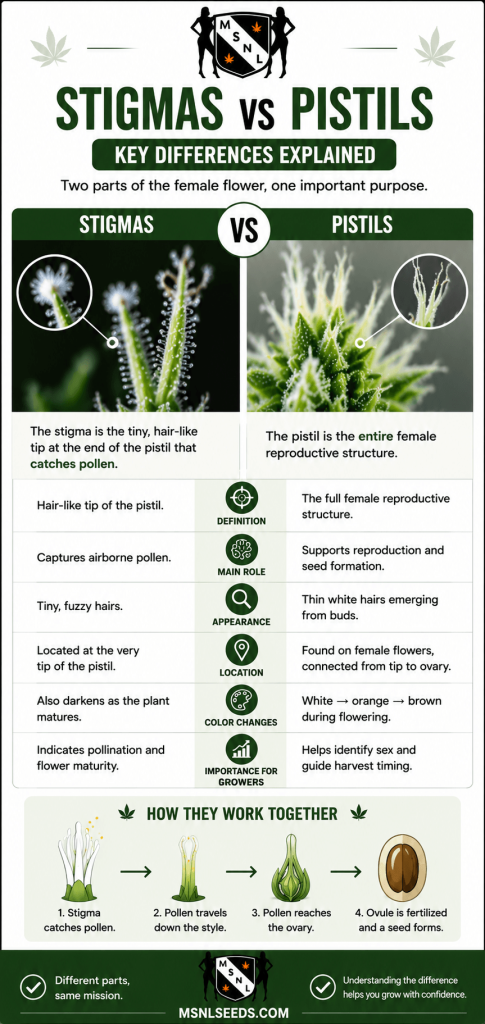
| Feature | Pistil | Stigma |
| Definition | Complete female reproductive organ | Pollen-receiving part of the pistil |
| Structure | Includes the stigma, style, and ovary | Hair-like tissue extending from the flower |
| Main function | Supports fertilization and seed development | Captures pollen |
| Visible to growers | Not as a single external structure | Yes, usually as white or cream-colored hairs |
| Color changes | Does not change color as a whole | Often darkens as the flower matures |
| Grower relevance | Helps explain female flower reproduction | Useful for sex identification and monitoring flower development |
During pollination, pollen lands on a receptive stigma and germinates. A pollen tube then grows through the style toward the ovule, where fertilization can occur.
Grower tip: When growers talk about "pistil color," they are usually referring to stigma color. White, orange, or brown stigmas can provide useful clues about flower development, but they should not be used alone to judge harvest readiness.
Stigmas and Pistils During the Flowering Cycle
As flowering progresses, more female flowers develop and the number of visible stigmas increases. Their appearance and color can provide useful clues about flower maturity, pollination, and plant health.
For growers who want to minimize the likelihood of male plants, feminized cannabis seeds are bred to produce female plants at a very high rate, making sex identification and canopy management more straightforward.
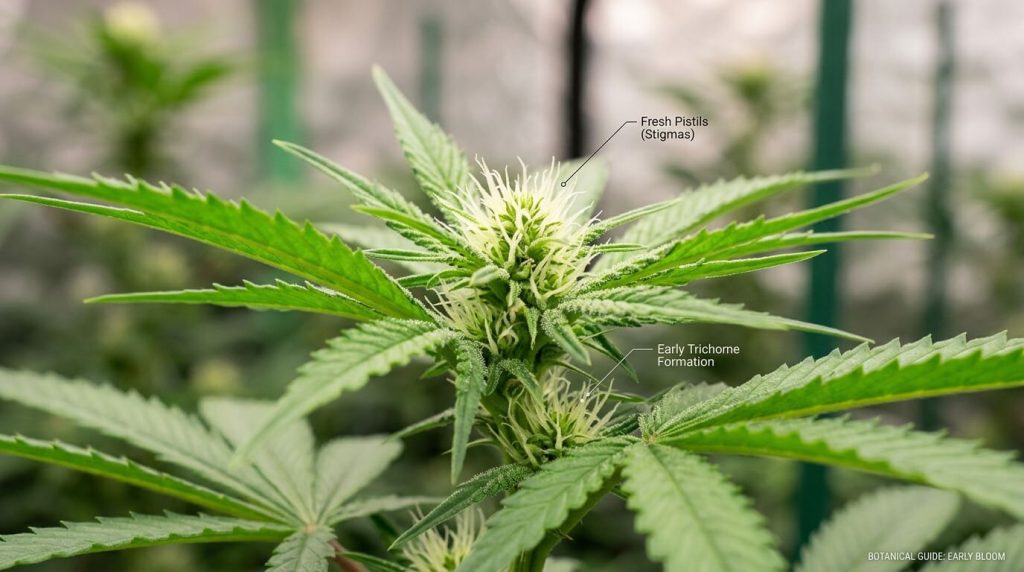
Early flowering stage: stigma emergence
During early flowering, pairs of fine white stigmas begin emerging from female preflowers at the nodes on a cannabis plant. These are often the first clear visual sign that a plant is female.
As flowering progresses, more female flowers form and the number of visible stigmas increases around developing bud sites. The exact timing varies by genetics and growing conditions, so growers should focus on plant development rather than expecting stigmas to appear during a specific week.
Grower tip: Check the nodes where branches meet the main stem when looking for the first signs of female flowering. White stigmas are usually easier to identify here before flower clusters become established.
Late flowering and stigma maturity
During mid to late flowering, the structures that make up a cannabis bud become more pronounced as the bracts swell, trichome coverage increases, and flowers become denser. Fresh stigmas may continue to emerge while older stigmas gradually darken and curl back toward the flower.
White stigmas commonly turn cream, yellow, orange, reddish-brown, or brown as flowers mature. Genetics, pollination, environmental stress, and physical contact can also affect their appearance, so color change should always be interpreted alongside other signs of flower development.
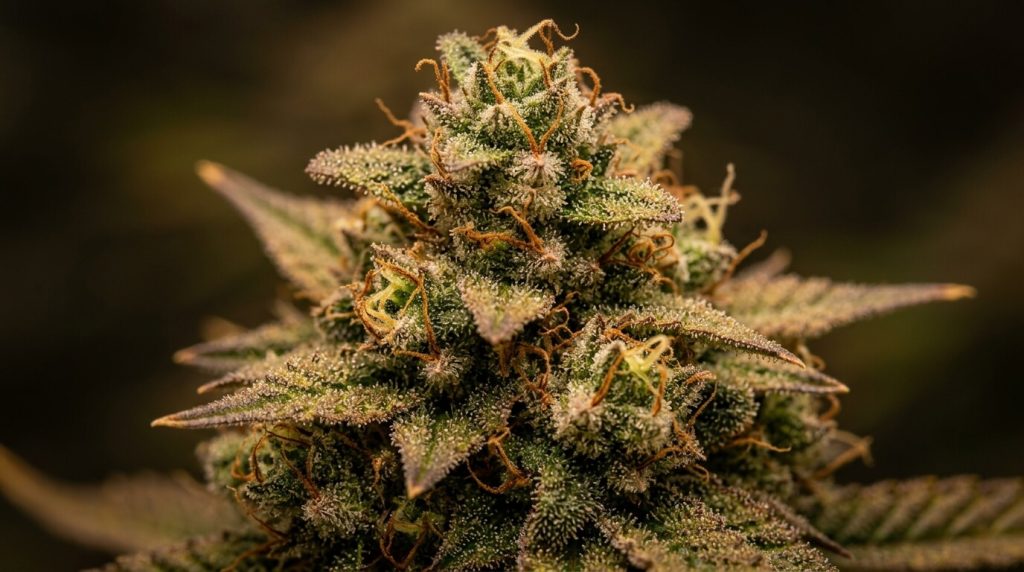
What stigma changes indicate about plant maturity
Stigma color can provide a useful indication of flower maturity, but it should not be used as the sole guide for deciding when to harvest.
A plant covered predominantly in fresh white stigmas is usually still actively developing flowers. As maturity approaches, a greater proportion of the orange hairs on cannabis flowers may darken, curl, and recede while the surrounding bracts become fuller.
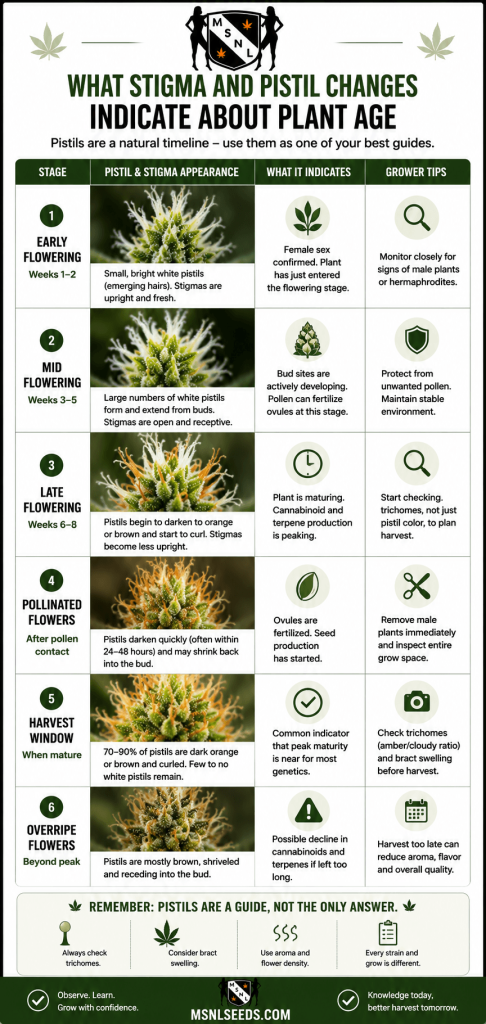
For a more reliable assessment of maturity, growers should consider:
- Trichome color: Cannabis trichome color provides one of the most useful indicators of flower maturity. Examine the gland heads with a jeweler's loupe or microscope for changes from clear to cloudy and amber.
- Bract development: Mature flowers typically have fuller, swollen bracts.
- Stigma appearance: A reduction in fresh white stigmas can indicate that flower development is slowing.
- Overall flower development: Density, resin production, and new growth should be assessed together rather than relying on a single sign.
| Flowering stage | Typical stigma appearance | What it may indicate |
| Early flowering | Fresh white or cream stigmas | Female flowers are developing |
| Mid flowering | Large numbers of fresh stigmas | Bud sites are actively building |
| Late flowering | More stigmas darken and curl inward | Flowers are progressing toward maturity |
| Pollinated flowers | Stigmas may darken and recede earlier | Possible pollination and seed development |
| Harvest window | Fewer new white stigmas and mature flowers | Check trichomes and bract development before harvesting |
Grower tip: Avoid using a fixed percentage of brown or orange stigmas as a harvest rule. Different cultivars mature differently, and trichome development provides a more dependable indicator when combined with stigma and bract changes.
Stigmas, Pistils, and Cannabis Sex Identification
When growing from regular cannabis seeds, identifying male and female plants early helps reduce the risk of unwanted pollination. Female plants typically develop visible stigmas, while males form pollen-producing structures.
Understanding these differences can also help growers recognize plants showing both male and female reproductive traits.
How stigmas help identify female cannabis plants
Pairs of fine white or cream-colored stigmas emerging from female preflowers are one of the clearest visual signs of a female cannabis plant. They usually appear around the nodes as the plant reaches sexual maturity or begins flowering.
Because stigmas are part of the pistil, growers commonly refer to them as "pistils" when identifying female plants, although stigma is the more botanically accurate term.
Grower tip: Check several nodes before confirming sex. Very early preflowers can be small, and relying on a single developing structure can lead to misidentification.
Female stigmas vs male pollen sacs
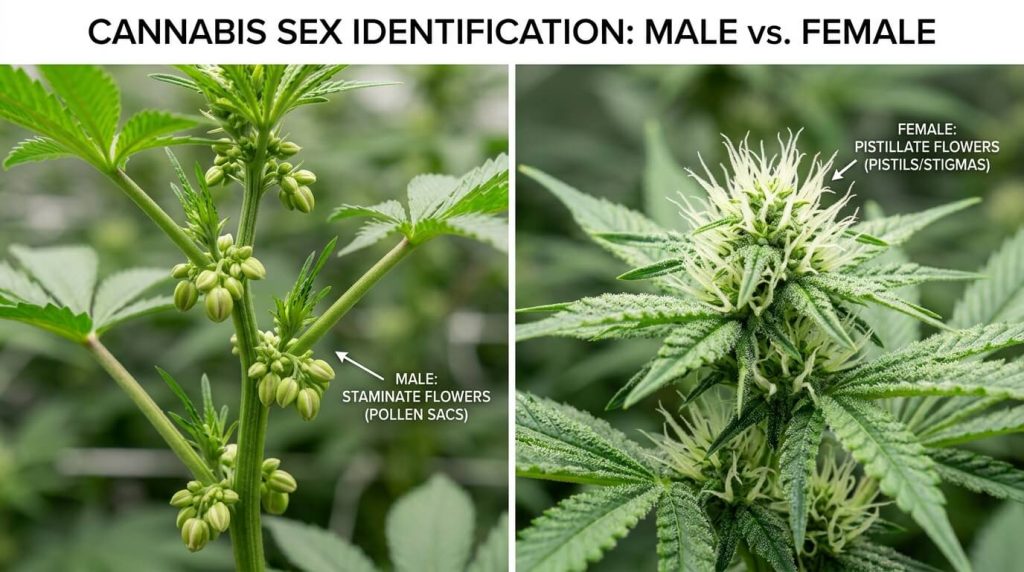
Male and female preflowers develop differently and become easier to distinguish as they mature.
| Feature | Female plant | Male plant |
| Early appearance | Small female preflowers | Small rounded structures |
| Key identifier | White or cream stigmas | Pollen sacs |
| Growth pattern | Stigmas extend outward from the flower | Sacs may develop in clusters |
| Reproductive role | Receives pollen | Produces and releases pollen |
Exact timing varies between cultivars and growing conditions, so structure is more reliable than counting days or weeks.
Hermaphroditic traits and abnormal flower development
Some cannabis plants can develop both male and female reproductive structures. This is commonly described by growers as hermaphroditic or intersex expression and may be influenced by genetics, environmental stress, or a combination of factors.
A female plant showing stigmas alongside pollen-producing structures can potentially pollinate itself or nearby females, resulting in seeded flowers.
Growers should therefore inspect flowering plants regularly, particularly after significant stress or unexpected changes in the grow room.
It is also worth avoiding the assumption that every seed produced by an intersex plant will automatically express the same trait. Genetics can increase susceptibility, but environmental conditions also influence how and whether intersex characteristics appear.
How Understanding Stigmas and Pistils Helps Growers
Understanding cannabis pistils and stigmas helps growers identify female flowers, monitor flowering progress, recognize possible pollination, and assess maturity more accurately. The key is knowing what stigma changes can indicate without relying on them as a single diagnostic tool.
Monitoring flowering progress more accurately
Fresh white stigmas are common while flowers are actively developing. As flowering progresses, older stigmas often darken, curl, and recede while the surrounding bracts swell and trichome coverage increases.
These changes can help track flower development, but genetics and growing conditions affect their timing and appearance.
Grower tip: When planning when to harvest cannabis, use stigma color alongside trichome maturity and bract development rather than following a fixed percentage of orange or brown hairs.
Recognizing pollination and unusual changes
Stigmas can sometimes darken or recede earlier than expected after pollination, but color changes alone do not confirm it. Normal maturation, physical contact, heat, and environmental stress can produce similar changes.
For that reason, growers should assess the whole flower rather than diagnosing maturity, pollination, or plant health from stigma appearance alone.
Frequently Asked Questions
Are pistils and stigmas the same thing?
No. The pistil is the complete female reproductive organ, which includes the stigma, style, and ovary. The stigma is the visible, hair-like part of the pistil that receives pollen. This is the key difference between a stigma and a pistil.
What do cannabis stigmas look like?
Cannabis stigmas usually appear as pairs of fine white or cream-colored hairs extending from female flowers. As flowering progresses, they may turn yellow, orange, reddish-brown, or brown depending on genetics, maturity, pollination, and growing conditions.
When do stigmas first appear on cannabis plants?
Stigmas can begin appearing as a plant reaches sexual maturity or enters early flowering. They usually emerge from female preflowers around the nodes, although the exact timing varies between cultivars and growing conditions.
Can stigmas be used to identify a female cannabis plant?
Yes. Pairs of white or cream stigmas emerging from preflowers are one of the clearest visual signs of a female cannabis plant. Male plants develop pollen-producing structures instead, although growers should inspect several nodes before confirming plant sex.
Do orange or brown stigmas mean cannabis is ready to harvest?
Not necessarily. Stigmas commonly darken and curl as flowers mature, but pollination, physical contact, heat, and environmental stress can also cause color changes. For a more reliable assessment of maturity, consider stigma appearance alongside trichome development and overall flower structure.


