




If you're wondering how to increase autoflower yield, the good news is that producing bigger, healthier harvests is largely within your control. From choosing high-yielding genetics and optimizing your growing environment to applying low-stress training and maintaining a consistent feeding schedule, every decision you make can influence your autoflower yield.
After growing autoflowering cannabis for many years, I've found that the highest-performing plants all have one thing in common: consistency. Strong lighting, healthy root development, proper environmental control, and gentle plant training work together to maximize autoflower yield and improve the overall quality of your harvest.
In this guide, I'll explain the proven techniques I've used to improve autoflowering cannabis yield, including how to create the ideal growing environment, apply the most effective training methods, and choose high-yielding autoflower strains. Whether you're growing indoors or outdoors, these practical tips will help you harvest larger, denser buds while avoiding the common mistakes that limit production.
Key Takeaways
- Maximizing autoflower yield starts with strong fundamentals. High-quality genetics, powerful LED lighting, healthy root development, and stable environmental conditions have the biggest impact on harvest size.
- Low-stress training (LST) is one of the most effective ways to increase autoflower yield. By creating an even canopy and exposing more bud sites to light, LST can significantly improve both yield and flower quality.
- Your growing environment directly affects autoflowering cannabis yield. Maintaining the correct temperature, humidity, pH, airflow, and light schedule helps plants reach their full genetic potential.
- Avoid common mistakes that reduce autoflower yield. Overwatering, poor lighting, incorrect pH, undersized pots, and excessive plant stress can all limit bud development and overall harvest weight.
- Consistency produces the best results. Healthy plants grown under stable conditions with proper nutrition and careful training will consistently deliver larger, denser, and more resinous autoflower harvests.
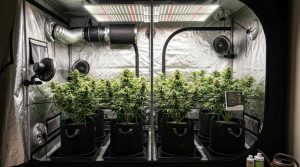
Understanding autoflower yields
It can take months and months of hard work, care and attention to finally harvest your autos. For most growers, whatever your yield is determines how many buds you will have to last until your next crop. The following explains why yields are important, what constitutes a good yield for an auto, and the different factors that affect high auto-flowering yields.
Why yield is important when growing autoflowers
One thing I've noticed over countless autoflower grows is that growers often focus on speed rather than plant health. While autoflowers can be ready in as little as 9–10 weeks, consistently producing large, dense buds comes from maintaining stable growing conditions from seed to harvest. The fact that autos remain short to medium in height is advantageous for indoor growers with limited space, as well as for outdoor growers who want to keep a low profile. However, they can also yield on the low side in a worst-case scenario.
- The yield determines how many buds you will have to smoke
- The size, thickness and weight of the buds make up the yield
What is considered a good autoflower yield?
Autoflowers grown indoors typically yield between 85 and 150 g per plant, depending on factors such as growing environment, lighting, nutrients, light schedule, pot size, and the grower's level of experience. Below are highlights of what is considered a good autoflower harvest.
- The buds are all well developed and of a consistent size
- The buds are dense and covered in resin
- The bracts are fully mature and swollen
- There are no popcorn buds, only big buds
- Growers can harvest 3-6 ounces per plant
Factors that affect yield for autoflowers
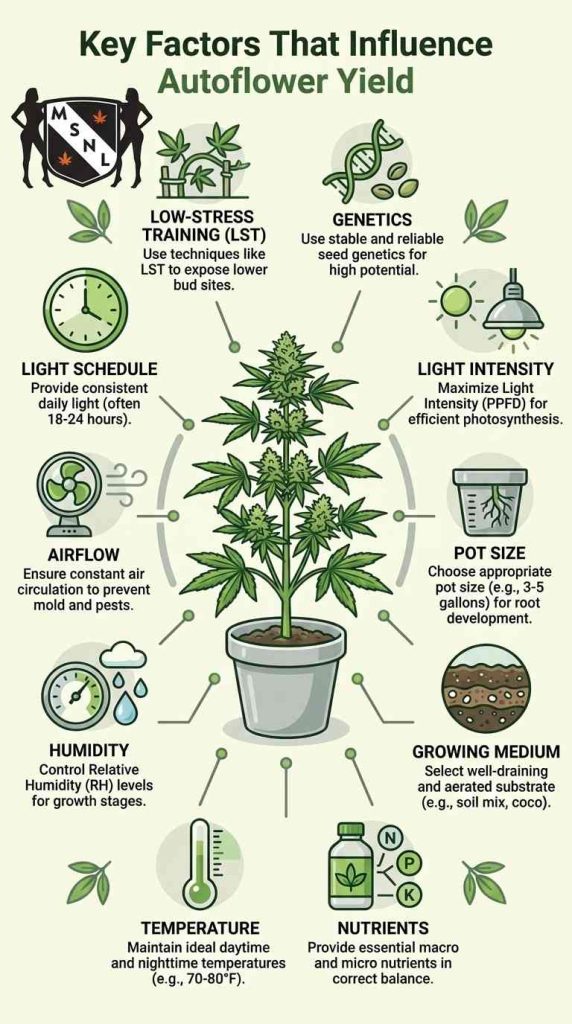
Growing autoflowering cannabis plants is as easy as planting your seeds, setting your grow timer and letting your plants do the rest! There are many factors to consider that affect yield, as listed below.
| Factor | Impact on Yield | Best Practice |
| Light Intensity | Very High | Use high-quality LED grow lights with adequate PPFD. |
| Genetics | Very High | Choose autoflower strains bred for high yields. |
| Pot Size | High | Use 20–30L fabric pots indoors where space allows. |
| Nutrients | High | Feed consistently and maintain the correct pH range. |
| Growing Medium | High | Use a light, well-aerated mix with good drainage. |
| Light Schedule | Medium–High | Run 18/6 or 20/4 indoors for strong growth. |
| Temperature | High | Maintain 22–25°C during lights on. |
| Humidity | Medium | Reduce humidity during flowering to help bud development. |
| Airflow | Medium | Ensure continuous fresh air and good circulation. |
| Plant Training | High | Apply LST early to expose more bud sites. |
Light
In my experience, lighting is the single biggest factor affecting autoflower yield indoors. Even premium genetics can't reach their potential under weak lighting. I've consistently seen plants develop denser flowers and stronger branching when grown under high-quality LED fixtures delivering adequate PPFD throughout the canopy.
Grower's Tip: Don't judge your grow lights by wattage alone. A quality LED with strong PPFD and even canopy coverage will usually outperform a cheaper, higher-wattage fixture and produce denser, more resinous buds.
Nutrients
Autos don't require much nutrition during their lifecycle. Still, nutrients are the best way to keep plant health optimal and fatten the buds. Your nutrient solution should also be within the correct pH range: 6.0 - 7.0 for organics and 5.5 - 6.5 for hydro. A nutrient lockout is usually the main cause of small yields and cannabis deficiencies, and happens if the pH level of your water or nutrients is above or below the optimal range.
Pot Size
I've experimented with everything from 7-litre pots to 50-litre fabric containers, and in my experience, giving autoflowers plenty of root space helps them establish stronger growth before flowering begins. For most indoor grows, I find 20–30L fabric pots provide an excellent balance between plant size and efficient use of space. If you're unsure which container is right for your setup, read our guide on choosing the right pot size for cannabis plants
Growing Medium
Over the years I've found that a light, airy growing medium makes a noticeable difference in root development. A quality soil amended with coco coir and perlite improves drainage while maintaining enough moisture for healthy, vigorous growth throughout the plant's life cycle
Light Schedule
As an indoor grower, you get to choose which light cycle you choose, and some are more favorable over others. If you want the biggest yields, try either 18 hours of light and 6 hours of dark, or 20 hours of light and 4 hours of dark, to avoid small yields.
Temperature
Autos are resilient plants well suited to colder climates, but indoors, they love a consistent temperature and humidity. If you can create a temperature of 22-25 degrees Celsius with the lights on and a slight drop to 18-21 degrees when the lights are off. This will keep yields optimal and produce the best quality buds.
Humidity
During the last 6 weeks of the flowering period, your plants will rely on the correct humidity range. Too dry, and the plants will struggle to develop big buds; too humid, and you run the risk of mold. Using a digital hygrometer, monitor and aim to keep humidity around 50% until harvest.
Airflow and Ventilation
Cannabis plants require fresh air and carbon dioxide to grow and produce those big yields that we all love! Poor airflow and ventilation can result in heat stress or mold. The buds produced will not be as frosty or terpene-rich, and the total yield will be below average.
Environmental Stress
How you set up and maintain your grow room will affect yield and bud quality. Cold or hot grow rooms will negatively affect bud development and flower density. Light burn can also cause plants to become stunted and the top colas to bleach white. Insects can severely damage cannabis plants and harm their yields.
Plant Training
Using techniques such as topping, LST, super cropping, fimming and pruning will increase yields and the number of colas produced. Plant training combined with high-yielding genetics is a sure way to break yield records.
Genetics
Some autoflowering cannabis plants naturally produce bigger harvests. It is always best to research an autoflowering strain and find one known for consistently high yields.
Ensure you have the right growing environment to optimize your autoflowers' yield
Even with the highest-yielding genetics and optimal plant training, without the right environmental factors in place, your autos won’t grow and develop as well as they could. There are several variables to consider, such as pot size, light intensity, ventilation, humidity control, and watering.
| Growing Factor | Recommended Range |
| Temperature (Lights On) | 22–25°C |
| Temperature (Lights Off) | 18–21°C |
| Humidity (Vegetative Growth) | 60–70% |
| Humidity (Flowering) | 40–50% |
| Soil pH | 6.0–7.0 |
| Hydro/Coco pH | 5.5–6.5 |
| Light Schedule | 18/6 or 20/4 |
| Pot Size | 20–30L fabric pots |
| Airflow | Constant fresh air with oscillating fans |
Essentials to factor when thinking about your autoflowers' yield
Growing autos is straightforward, and as long as you have everything in place, you cannot go wrong. Below is a list of the essential factors that significantly influence bud development and yields.
Pot sizes
Autos will have 5 weeks before they transition to flower, so they need to establish a strong, healthy root system before then. Using small pots will only produce small plants.
Grower's Tip: One mistake I see beginners make is starting autoflowers in small pots and transplanting them later. In my experience, planting seeds directly into their final container helps avoid transplant shock and allows the roots to develop without interruption.
Lights
LED and 600-1000w HID grow lights will allow you to grow the biggest plants and yields possible. Avoid using 400W HID models; use only LED lights with a strong PAR rating.
Good ventilation and humidity control
How well your grow space ventilates fresh air also has a major effect on how well your plants perform and yield. Humidity levels should remain consistent and be frequently monitored using a digital hygrometer.
Watering and nutrient schedule
Watering your plants within the correct pH range and making sure your nutrient solution is neither too weak nor too strong are key to large buds. It is always recommended to follow the feeding chart provided by the nutrient company.
Grower's Tip: It's usually easier to recover from slightly underwatering an autoflower than from overwatering it. Let the growing medium dry slightly between waterings to encourage healthy root development and reduce the risk of root problems.
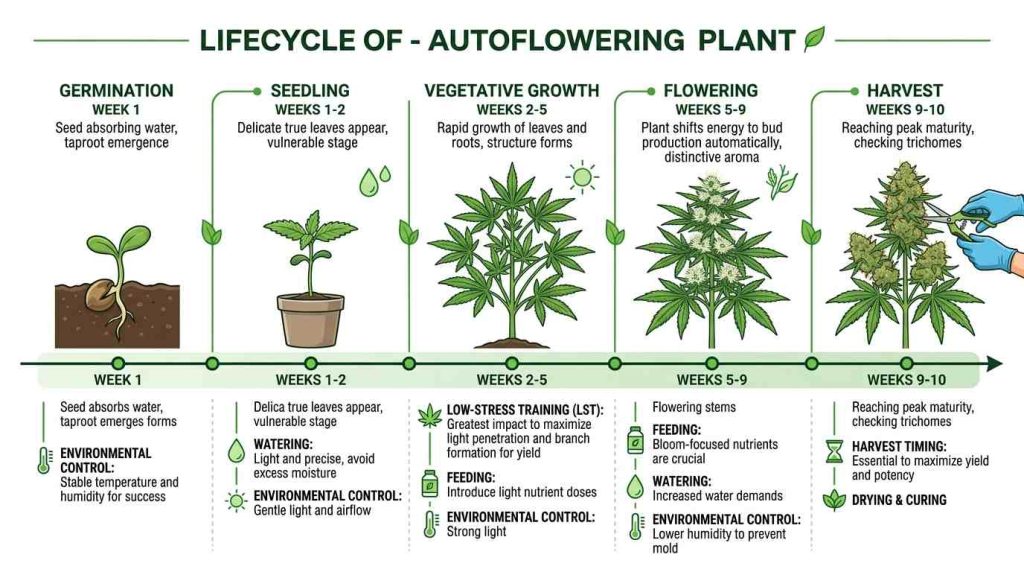
Training methods that will help you maximize your autoflower yield
Cannabis plants have the potential to yield good amounts of frosted buds; however, if you want to produce even more colas and buds, then plant training is the way to boost autoflowering yields. Now you will need to remember that autoflowering cannabis plants have a very short vegetative stage, so all plant training covered below should only be performed during vegetative growth and development.
| Training Method | Difficulty | Stress Level | Yield Potential |
| Low-Stress Training (LST) | Easy | Low | 5/5 |
| ScrOG | Medium | Low | 5/5 |
| Sea of Green (SOG) | Medium | Low | 5/5 |
| Topping | Medium | High | 4/5 |
| FIMing | Medium | High | 4/5 |
| Supercropping | Advanced | High | 4/5 |
| Lollipopping | Easy | Medium | 4/5 |
| Defoliation | Medium | Medium | 3/5 |
LST to help you produce the best yield for your autoflowers
LST, or low-stress training, is a method for tying plants down to create multiple primary colas. Cannabis plants usually grow a central primary cola, surrounded by side branches that form secondary colas. Low-stress training has consistently given me the best results with autoflowers. I begin gently tying branches down once the plants have established several healthy nodes, encouraging an even canopy and allowing more flowering sites to receive direct light.
Grower's Tip: I normally begin low-stress training once the plant has developed 4–5 healthy nodes. Starting too early can slow growth, while waiting too long makes the stems less flexible and harder to train safely.
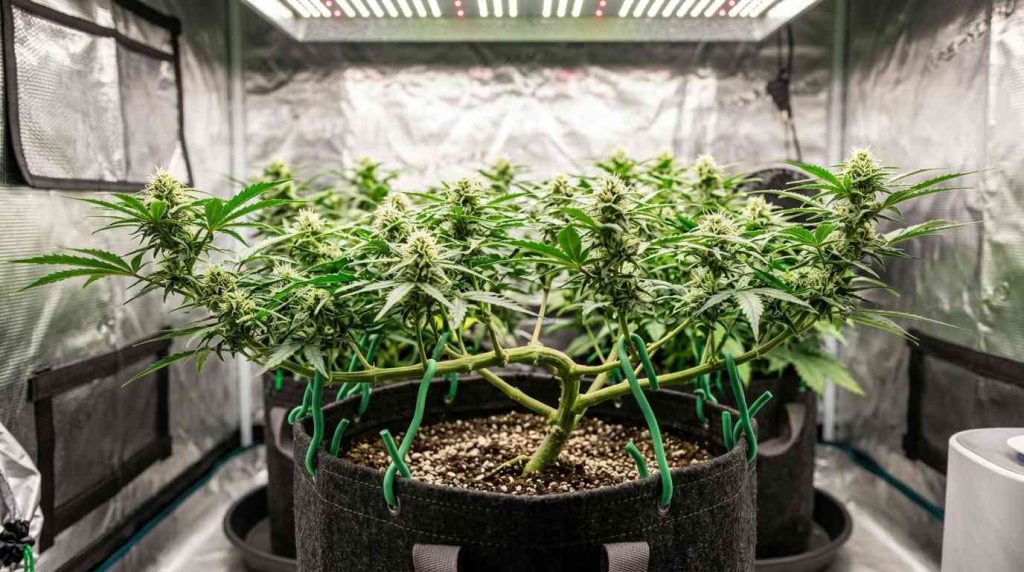
Screen of green (ScrOG)
This is a plant-training method that involves systematically training autoflowering plants using a screen net. When growing multiple autoflowers in a dedicated indoor tent, I've found ScrOG to be an excellent way to maximize every square metre of canopy space. It takes a little more planning, but the increase in light distribution often leads to heavier harvests. Scrog can be done using one plant or several, depending on how much space you have.
Tie-and-bend
Tying down and bending the plants' side branches with thick gardening wire creates strong, durable, resilient plants. They can support more weight when flowering and have greater access to light.
Sea of green (SOG)
In my opinion, the SOG method is the ultimate way to achieve maximum yields with autos. You can plant 9,16, 24 or 36 autos in 7.5-litre pots and produce a healthy and abundant harvest without needing lots of space. The SOG method using autos also works incredibly well outdoors.
Using high-stress training methods to increase yield
Plant training techniques are separated into two categories. Low stress training and high stress. The following explains how high-stress training techniques work.
Topping & FIMing
Topping is a method of removing the top node and allowing the smaller axillary shoots to grow into the primary colas. Topping can rapidly increase the number of colas and increase yields, especially in small grow spaces.
FIM is almost identical to topping; however, instead of cleanly removing the top node, you use a pair of scissors to remove 75% of the top node’s foliage. This will temporarily disrupt top growth and encourage bushy lower growth. This method works well for autos due to their height and structure.
Supercropping
While supercropping can increase yields on vigorous plants, I generally reserve it for healthy, fast-growing autoflowers with enough time to recover. Because autos have a limited vegetative period, any significant stress can reduce final yield if applied too late.
Lollipopping
Nobody wants to grow small, undeveloped and fluffy lower buds, so with the lollipopping technique, you can shape the plant canopy as you wish. Lollipoping is basically the same as pruning, so stripping away all of the lowest growth, leaving only the top foliage. The result is a top-heavy canopy that eliminates small lower buds.
Heavy defoliation
Removing fan leaves, small growth shoots, and weak, flimsy branches with a sharp scalpel shapes the plant to focus all its energy on a top-heavy canopy full of uniform colas. Defoliation of autos is best done a week before they begin to stretch and flower.
Our best high-yielding strains at MSNL
One way to ensure that you are on the right track to maximizing your autoflowering yields, you can try out growing our best yielding varieties, as covered below.
| Strain | THC | Yield | Height | Flowering Time | Best For |
| Bruce Banner Auto | Up to 30% | 500–600 g/m² | Medium | 8–10 weeks | Maximum potency & yield |
| GG4 Auto | High | 500–600 g/m² | 60–100 cm | ~10 weeks | Heavy resin production |
| Do-Si-Dos Auto | High | High | 60–100 cm | 8–10 weeks | Compact indoor grows |
Bruce Banner Auto
- THC Very High - Up to 30%
- Yield - 500-600g/m2
- Sativa Dominant Ruderalis
- Flowering Time - 8-10 Weeks
- Key Trait - High-potency autoflower with strong yield potential
GG4 Auto
- Genetics: Gorilla Glue x Ruderalis
- Life Cycle: Seed to harvest in approximately 10 weeks
- Yield Potential: 500–600 g/m² under stable conditions
- Height: Short plants, typically 60–100 cm
- Primary Terpenes: Caryophyllene, Myrcene, Limonene
- Taste Profile: Pungent, Pine, Earthy
Do-Si-Dos Auto
- Type: Indica-dominant autoflower
- Life Cycle: 6-8 weeks from seed to harvest (autoflowering)
- Height: Short plants typically reach 60-100 cm
- Flavor: Earthy and skunky with sweet pine undertones
- Climate: Performs best in warm and Mediterranean conditions
- Stability: Selected for uniform autoflowering behavior and compact structure
Conclusion
Maximizing autoflowering yields has many benefits and can be easily done using the right growing environment, plant training and large yielding genetics. You would be amazed at how much plant training can impact the structure, shape, and yield capacity of an auto.
Pot size, light intensity and your feeding schedule will also majorly affect how well the plants perform and yield. Autos do not require large amounts of nutrients and adapt much better to low nutrient ratios than photoperiods.
Frequently Asked Questions
How can I maximize autoflower yield?
To maximize autoflower yield, focus on the fundamentals: choose high-yielding genetics, provide strong LED lighting, use a well-aerated growing medium, maintain the correct temperature and humidity, and apply low-stress training (LST) early in the vegetative stage. Healthy plants grown in stable conditions will consistently produce larger, denser buds.
How do you increase autoflower yield indoors?
The best way to increase autoflower yield indoors is by creating an optimal growing environment. Use quality LED grow lights, maintain temperatures between 22–25°C, keep humidity at the appropriate level for each growth stage, provide consistent airflow, and grow your plants in larger fabric pots with a nutrient-rich growing medium. Combining these conditions with proper watering and early plant training can significantly improve harvest size.
What is considered a good autoflower yield?
A good autoflower yield depends on the strain, growing conditions, and the grower's experience. Under optimal indoor conditions, most autoflowering cannabis plants produce 85–150g (3–6 oz) per plant, while experienced growers using high-yielding genetics and advanced techniques may harvest even more.
Does pot size affect autoflower yield?
Yes. Pot size has a direct impact on root development, which influences plant size and final yield. Larger fabric pots generally allow autoflowers to establish a healthier root system before flowering begins, resulting in bigger plants and heavier harvests.
Does low-stress training (LST) increase autoflower yield?
Yes. Low-stress training is one of the safest and most effective ways to increase autoflower yield. By gently bending and tying down branches, more bud sites receive direct light, creating a flatter canopy and encouraging multiple large colas without causing significant stress to the plant.
What is the best light schedule for autoflowering cannabis?
Most indoor growers use either an 18/6 or 20/4 light schedule throughout the entire life cycle. Because autoflowers flower based on age rather than changes in daylight hours, they can benefit from extended periods of light, which helps maximize growth and yield.
Can nutrients improve autoflowering cannabis yield?
Yes, but more nutrients do not always mean bigger yields. Autoflowers typically require lighter feeding than photoperiod plants. Providing a balanced nutrient program while maintaining the correct pH helps prevent nutrient deficiencies or lockout, allowing plants to produce healthy, resinous flowers.
What are the biggest mistakes that reduce autoflower yield?
The most common mistakes include overwatering, using undersized pots, poor-quality lighting, incorrect pH levels, excessive nutrients, and stressing plants too late in their vegetative stage. Maintaining consistent environmental conditions throughout the grow is one of the most effective ways to avoid reduced yields.
Which autoflower strains produce the highest yields?
High-yielding autoflower strains such as Bruce Banner Auto, GG4 Auto, and Do-Si-Dos Auto have been bred to produce large harvests under optimal growing conditions. Choosing stable genetics is one of the most important factors when aiming to maximize autoflower yield.


