




Weed leaves are one of the easiest ways to recognise a cannabis plant, but their appearance can tell growers much more than just what species they are looking at. Cannabis leaf shape, leaflet number, colour, size, and condition all change as the plant develops and can provide useful clues about genetics, growth stage, and plant health.
So, what does a marijuana leaf look like, and why do some plants develop narrow leaves while others grow broad ones? This guide explains the different types of cannabis leaves, how marijuana leaf shape changes from seedling to maturity, what a typical Sativa leaf looks like, and what changes in your weed leaves may indicate during a grow.
Key Takeaways
- Cannabis leaf shape changes as the plant matures, progressing from smooth cotyledons to serrated leaves with multiple leaflets.
- Mature weed leaves commonly develop 5–9 leaflets, although genetics and growth stage can produce fewer or more.
- A traditional Sativa leaf is usually long and narrow, while Indica-type leaves tend to be shorter and broader.
- Fan leaves and sugar leaves serve different roles, with fan leaves providing much of the plant's photosynthetic surface and sugar leaves developing close to the flowers.
- Changes in cannabis leaves, including yellowing, curling, spotting, or wilting, can provide clues about plant health but should not be used alone to diagnose a problem.
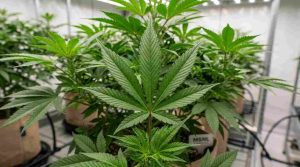
What does a marijuana leaf look like?
A marijuana leaf typically has several long, pointed leaflets with serrated, saw-like edges that spread outward from a central point. This distinctive cannabis leaf shape is one of the most recognisable features of cannabis plant anatomy and is described botanically as palmately compound.
Mature weed leaves commonly develop 5–9 leaflets, although leaves with 3–13 can occur depending on genetics, plant age, and development. The central leaflet is usually the longest, with progressively shorter leaflets positioned toward either side.
The exact marijuana leaf shape can vary considerably. Some plants develop long, narrow leaflets, while others produce shorter, broader leaves. Leaf size, colour, and leaflet number can also change as the plant grows.
Young cannabis plants do not immediately produce the classic multi-fingered weed leaf. Seedlings first develop two smooth, rounded leaves called cotyledons. The first true leaves that follow usually have serrated edges and may consist of a single leaflet. Later leaves commonly develop three, five, seven, or more leaflets as the plant matures.
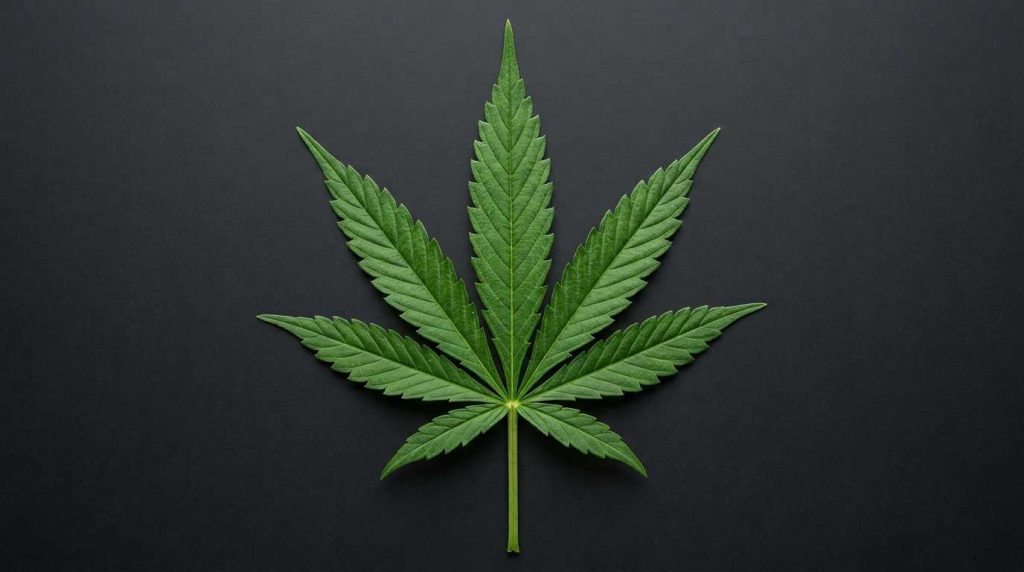
| Cannabis leaf feature | Typical appearance |
| Structure | Multiple leaflets spreading from one central point |
| Leaflet shape | Pointed and usually lance-shaped |
| Leaf edges | Serrated or saw-toothed |
| Mature leaflet number | Commonly 5–9, although 3–13 can occur |
| Color | Usually green, with shade varying by genetics and conditions |
| Leaf stalk | Petiole connecting the leaf to the stem |
A single leaf should not be used to determine a plant's genetics or health. Cannabis leaf appearance varies naturally, so growers should look at several mature leaves and consider the plant's age, growth stage, and environment.
Grower tip: When learning to identify cannabis, look at the entire leaf rather than counting fingers alone. Serrated margins, pointed leaflets, and the characteristic palm-like arrangement provide a more useful picture of typical weed leaf morphology.
What is the purpose of cannabis leaves?
The main purpose of cannabis leaves is photosynthesis. Chlorophyll within the leaves absorbs light energy, which the plant uses to convert carbon dioxide and water into sugars that provide energy and building materials for growth. Oxygen is released during this process.
Leaves also regulate gas exchange and transpiration through microscopic pores known as stomata, found mainly on the underside of the leaf.
Carbon dioxide enters through the stomata for photosynthesis, while water vapor exits during transpiration. This process contributes to leaf cooling and helps drive the movement of water and dissolved mineral nutrients from the roots through the plant.
Healthy leaves therefore support several important functions:
- capturing light for photosynthesis;
- taking in carbon dioxide;
- regulating water loss;
- helping cool the plant;
- supporting the movement of water and nutrients.
Fan leaves provide much of the plant's photosynthetically active surface area, particularly during vegetative growth. If healthy leaves are removed excessively, the plant loses part of its capacity to capture light and produce energy. Heavily shaded leaves may also contribute less photosynthesis than leaves receiving adequate light.
Grower tip: Don't remove large fan leaves simply because they are blocking your view of the buds. Selective defoliation can sometimes improve airflow or light distribution, but removing too much healthy foliage can reduce the leaf area available for photosynthesis.
What are the different types of cannabis leaves?
Growers generally distinguish between two main types of cannabis leaves: fan leaves and sugar leaves.
Both contain chlorophyll and can photosynthesize, but their appearance, location, size, and trichome coverage are very different.
| Feature | Fan leaves | Sugar leaves |
| Size | Large | Small |
| Location | Grow from stems and branches | Develop within and around flowers |
| Shape | Classic multi-leaflet cannabis leaf | Smaller leaves protruding from buds |
| Trichome coverage | Usually relatively low | Usually much higher |
| Main role | Major photosynthetic surface | Photosynthesis close to developing flowers |
| At harvest | Often removed | Commonly trimmed from finished buds |
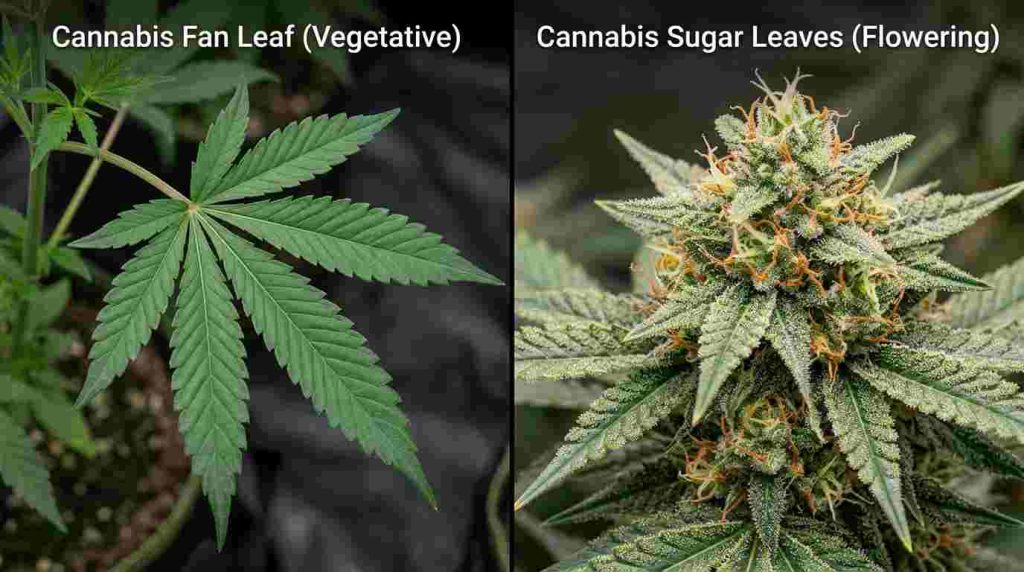
Fan leaves
Cannabis fan leaves are the large, distinctive weed leaves most people associate with a cannabis plant. They become especially prominent during vegetative growth and provide a substantial proportion of the plant's photosynthetic surface area.
A mature fan leaf consists of several serrated leaflets radiating from a common point where they connect to the petiole. Their exact appearance varies between plants. Some develop long, narrow leaflets, while others have noticeably broader leaves.
Fan leaves can also give growers useful clues about changing conditions because alterations in their colour, posture, texture, or edges may indicate that the plant is responding to environmental stress, watering problems, pests, or nutrient availability.
Leaf symptoms are not a diagnosis by themselves, however. Similar-looking symptoms can have several different causes.
Grower tip: When inspecting fan leaves, note where the problem starts. Symptoms appearing first on older lower leaves can have different causes from symptoms affecting young growth near the top of the plant. This is often more useful than looking at colour alone.
Sugar leaves
Sugar leaves are the small leaves that grow within and around developing female cannabis flowers. They get their name from the dense covering of cannabis trichomes that can give them a frosted or sugar-coated appearance as flowering progresses.
Unlike large fan leaves, sugar leaves protrude directly from the flower clusters and remain closely associated with the developing buds.
They still contain chlorophyll and contribute to photosynthesis, but one of their most obvious characteristics is their comparatively heavy trichome coverage. These trichomes can contain cannabinoids, terpenes, and other resin compounds, which is why sugar leaves are often noticeably sticky and aromatic by late flowering.
During harvest, growers commonly trim protruding sugar leaves to improve the appearance of finished buds. Because the trimmed material can contain substantial trichome coverage, it is often retained rather than treated in the same way as ordinary fan leaves.
Grower tip: When checking trichomes to estimate harvest maturity, examine those on the flowers themselves, particularly the calyxes, rather than relying on sugar-leaf trichomes. Trichomes on sugar leaves can mature at a different rate and may make the plant appear further along than the flower actually is.
Cannabis leaf shape by plant type
Cannabis leaf shape varies between plants. The traditional differences between Sativa, Indica, hybrid and Ruderalis cannabis include variations in plant structure and leaf morphology, with narrow-leaf plants commonly described as Sativa-type and broader leaves associated with Indica-type plants.
These terms are useful for describing appearance, but leaf shape alone cannot reliably confirm a plant's ancestry, effects, potency, or flowering behavior.
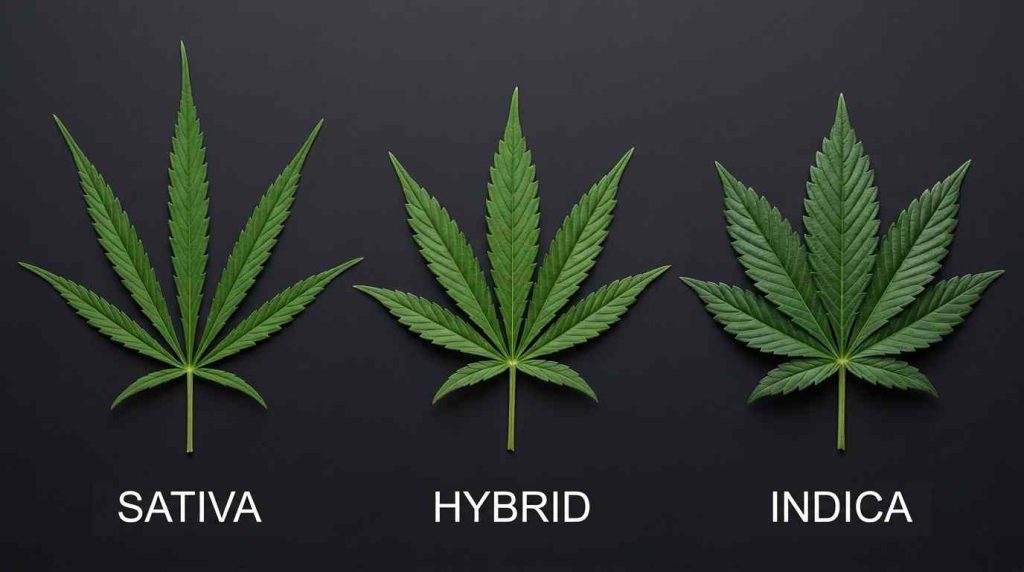
| Plant type | Typical leaf shape | Common appearance |
| Sativa-type | Narrow | Long, slender, serrated leaflets |
| Indica-type | Broad | Shorter, wider, serrated leaflets |
| Hybrid | Variable | Intermediate or similar to either parent type |
| Ruderalis-type | Usually smaller | Smaller overall leaf structure |
| Modern autoflower | Variable | Narrow, broad, or intermediate depending on genetics |
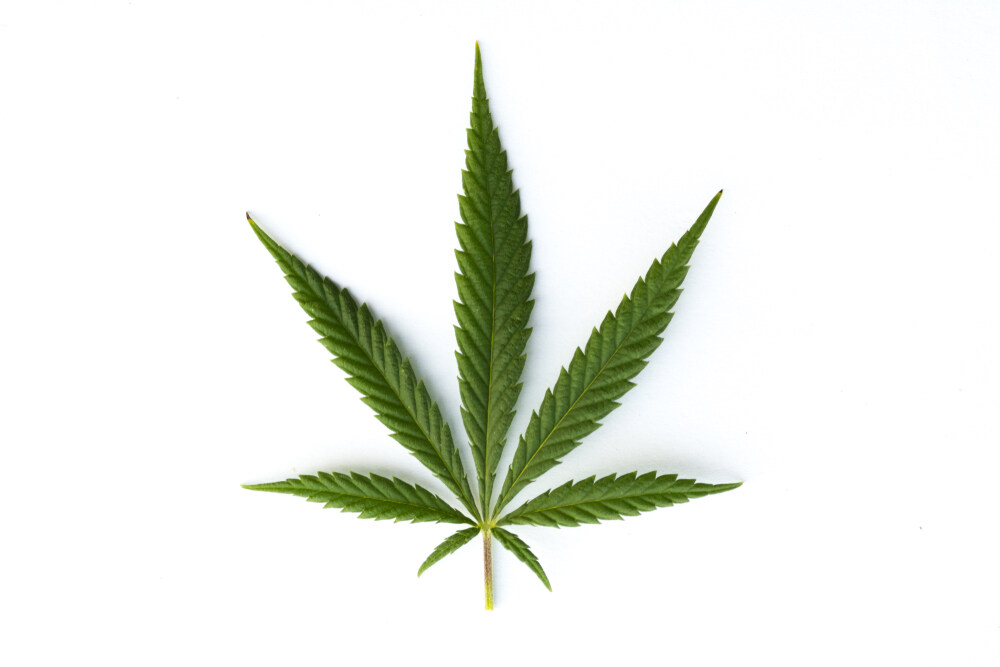
What does a Sativa leaf look like?
A Sativa leaf typically has long, narrow, pointed leaflets with serrated edges. The leaflets often sit farther apart, giving the fan leaf a more open appearance than broad-leaf types.
Leaflet number can vary, so the overall proportions of the leaf are more useful than counting fingers.
Grower tip: Look at leaflet width as well as number. Seven narrow leaflets can look very different from seven broad ones.
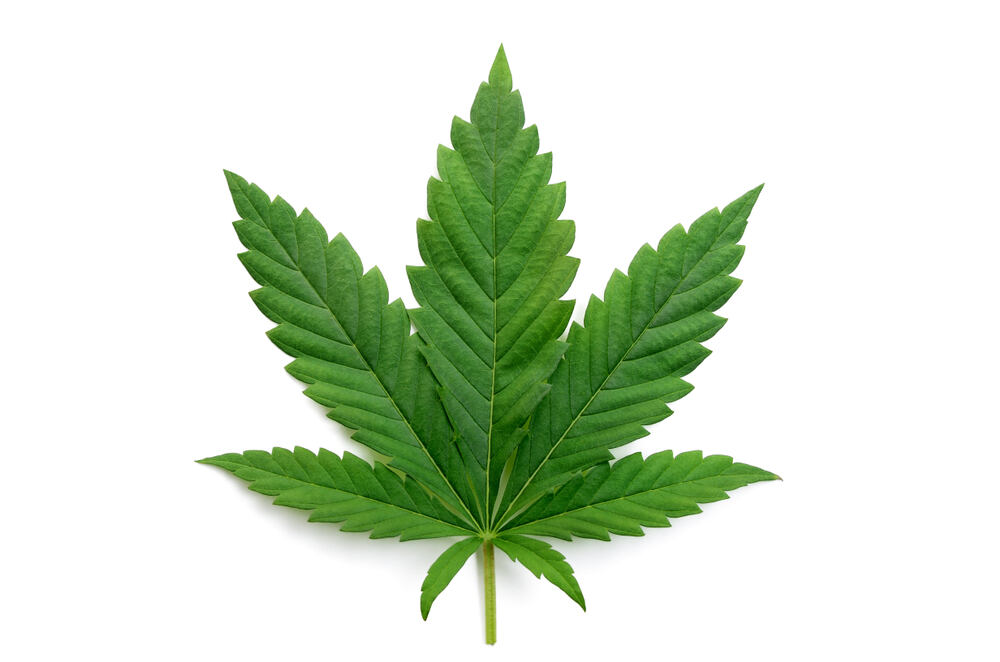
What does an Indica-type leaf look like?
An Indica-type cannabis leaf usually has shorter, broader leaflets that create a fuller, more compact-looking fan leaf. The leaflets remain pointed and serrated but may sit closer together or partially overlap.
Broad-leaf morphology has traditionally been associated with cannabis populations from regions such as Afghanistan and Pakistan, although modern breeding has blurred these distinctions.
Grower tip: Don't use leaf width or colour alone to make feeding decisions. Check the whole plant, root-zone conditions, and recent nutrient history before diagnosing a problem.
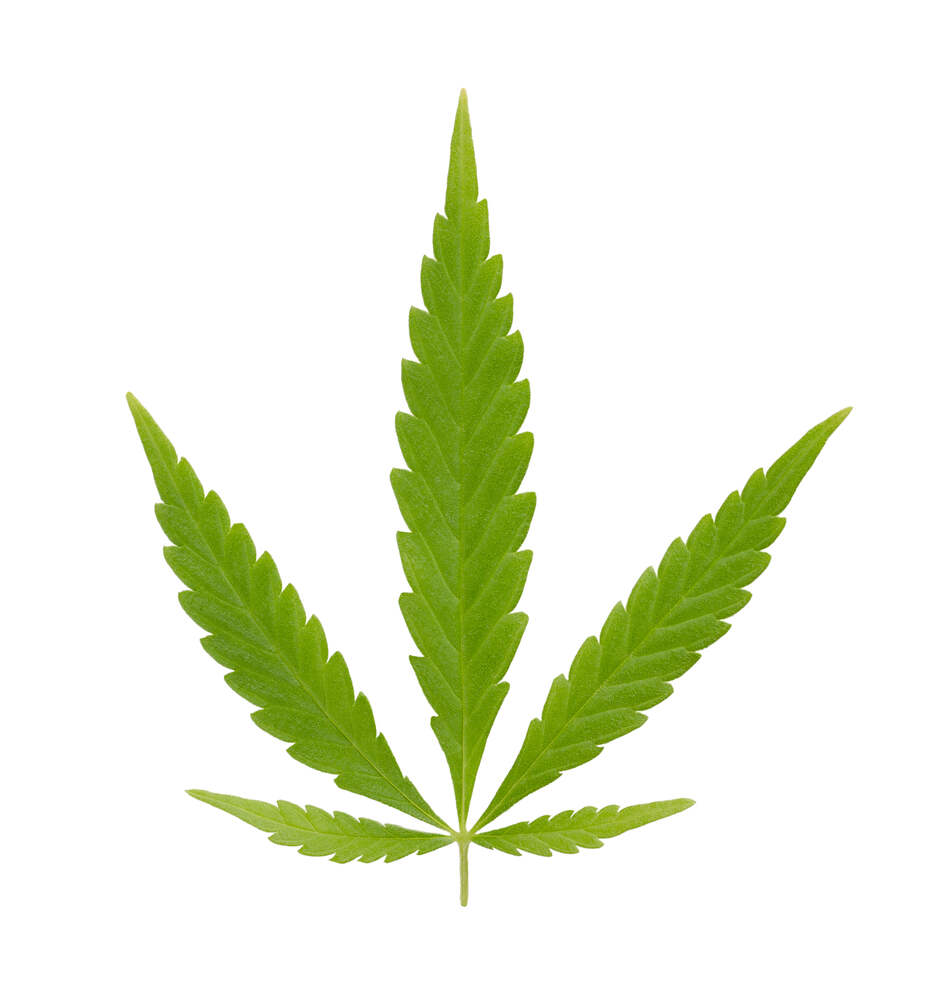
What do hybrid cannabis leaves look like?
Hybrid cannabis leaves can display narrow, broad, or intermediate leaflets depending on the genetics involved.
Some hybrids closely resemble one parent type, while others develop medium-width leaves that sit between traditional Sativa- and Indica-type shapes. Plants grown from seed may also show some natural variation.
For growers, it is more useful to describe the visible characteristics—leaflet width, length, number, and overall fan-leaf shape—than to estimate Sativa or Indica percentages from the leaves.
What do Ruderalis and autoflower leaves look like?
Ruderalis-type cannabis is generally associated with smaller plants and smaller leaves than many cultivated Sativa- and Indica-type plants. However, there is no single leaflet number or leaf shape that reliably identifies Ruderalis.
Modern plants grown from autoflower cannabis seeds can develop narrow, broad, or intermediate weed leaves because today's autoflowers contain a wide range of cultivated cannabis genetics.
Their key defining feature is not leaf shape, but their ability to begin flowering according to plant age rather than requiring a specific change in day length. Grower tip: Don't try to identify an autoflower by counting leaflets. Three- or five-fingered leaves can occur naturally during cannabis development.
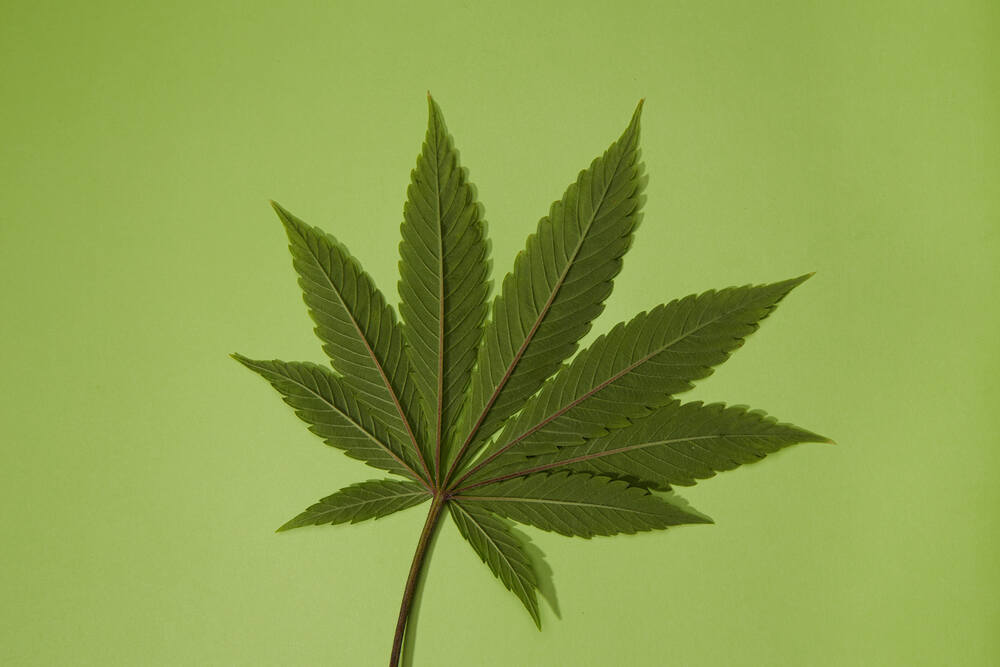
How cannabis leaf shape changes as plants grow
Cannabis leaf shape changes significantly as a plant develops. Seedlings begin with simple seed leaves before gradually producing the familiar multi-leaflet weed leaves associated with mature cannabis plants.
The progression often follows a pattern of increasing leaflet numbers, but genetics and development influence exactly how many leaflets appear at each node.
| Growth stage | Typical leaf appearance |
| Germination | Two smooth cotyledons |
| Early seedling | Single serrated leaves |
| Developing seedling | Three-leaflet leaves |
| Vegetative growth | Commonly five, seven, nine, or more leaflets |
| Flowering transition | Leaflet number may decrease again toward the flowers |
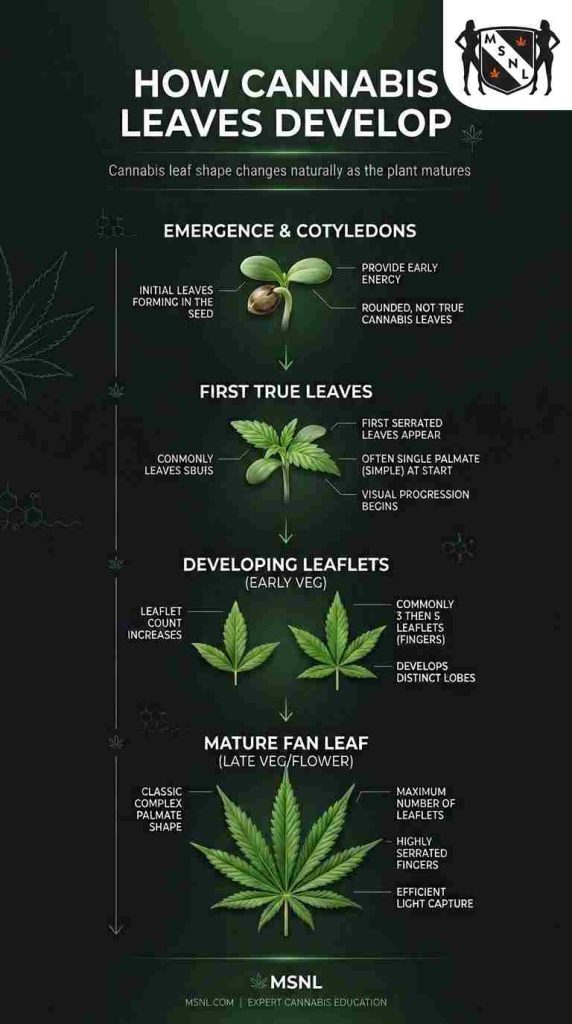
Cotyledons
During the cannabis seedling stage, the first leaves to emerge from the seed are cotyledons. These small, smooth, oval-shaped seed leaves look very different from a mature cannabis leaf because they do not have serrated edges or multiple leaflets.
Cotyledons contain stored nutrients that support the seedling during its earliest development while the first true leaves begin growing. They are temporary and naturally yellow and fall away once the young plant is established.
One-finger leaves
The first true cannabis leaves usually appear above the cotyledons as single, pointed leaves with the serrated edges characteristic of cannabis.
Growers commonly call these one-finger leaves, although botanically they are simple leaves rather than compound leaves made up of several leaflets.
Their appearance is a normal part of early seedling development and should not be confused with the mature marijuana leaf shape.
Three-finger leaves
As the seedling develops new cannabis nodes and internodes, leaves commonly become more complex, with three-leaflet leaves often appearing during early development.
Three-finger leaves are completely normal on young cannabis plants. Their appearance shows the plant progressing from its juvenile simple leaves toward the compound fan leaves produced during vegetative growth.
Leaf development is not identical in every plant, however, so growers should not expect every seedling to move through each leaflet number at exactly the same rate.
Five-, seven-, nine- and higher-leaflet leaves
As cannabis enters stronger vegetative growth, its fan leaves typically become larger and more complex. New leaves often develop five, seven, nine, or more leaflets, depending on genetics and their position on the plant.
Research into cannabis leaf development shows that leaflet number generally increases as leaves form higher along the vegetative stem, although the exact pattern varies between plants. Some cannabis leaves can develop as many as 11 or 13 leaflets.
Higher leaflet counts do not mean that a plant is healthier, more potent, or more mature than one producing fewer. Leaflet number is influenced strongly by genetics and developmental stage.
As the plant transitions toward flowering, the number of leaflets on leaves forming closer to the flowers can decrease again. This means cannabis leaf shape is not fixed; it changes naturally as the plant moves through different stages of growth.
What weed leaves can tell you about plant health
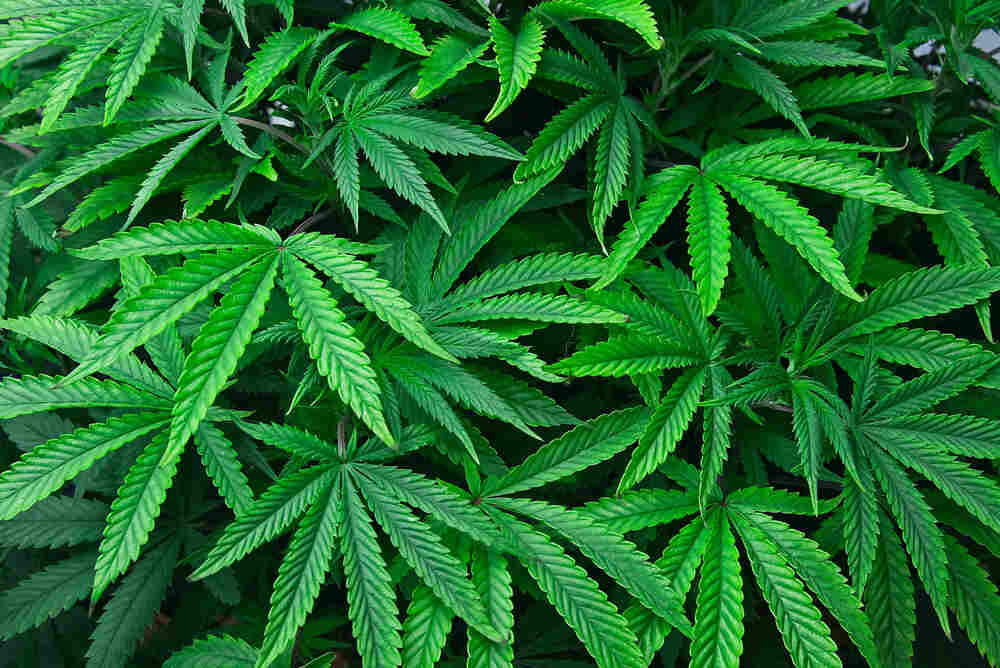
Weed leaves are one of the first places growers may notice that growing conditions have changed. Recognising common cannabis leaf symptoms, including changes in colour, posture, texture, spotting, and damage, can provide useful clues about watering problems, nutrient availability, environmental stress, pests, and disease.
However, a leaf symptom rarely has just one possible cause. If your cannabis leaves are turning yellow, possible causes include nutrient deficiencies, root-zone problems, incorrect pH, overwatering, or natural aging. Always consider where the symptoms started, how quickly they are spreading, and whether old or new leaves are affected before making changes.
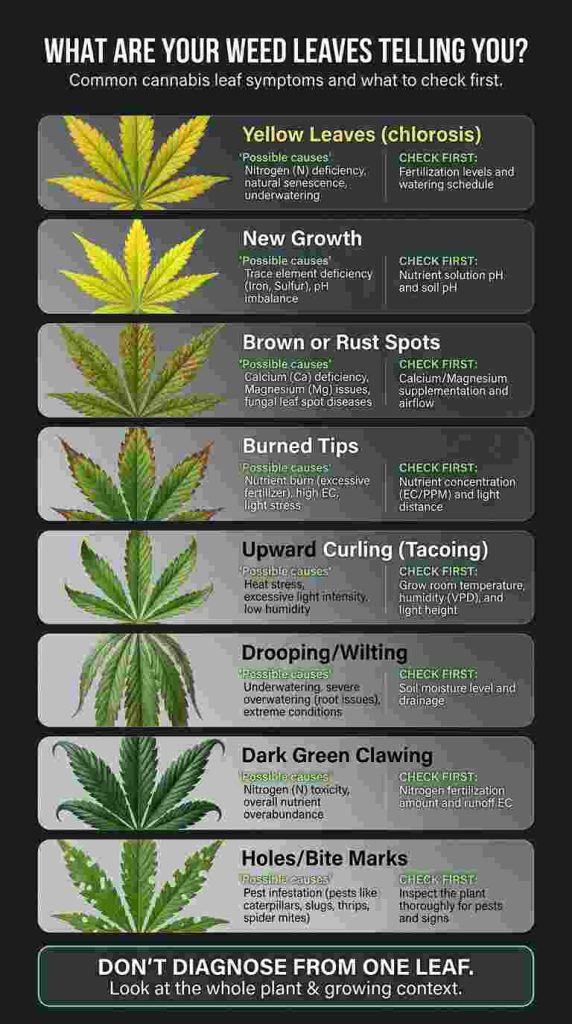
| Leaf symptom | Possible causes | What to check first |
| Yellow older leaves | Nitrogen deficiency, root stress, pH problems, natural senescence | Lower vs. upper growth, root-zone pH, feeding history |
| Yellow new growth | Micronutrient availability, pH or root-zone problems | Newest leaves and root-zone pH |
| Brown or rust-colored spots | Nutrient problems, pests, disease, physical damage | Leaf undersides, symptom pattern, pH |
| Burned tips or edges | Excess nutrients/salts, heat or light stress | Feed strength, EC, canopy conditions |
| Upward curling or “tacoing” | Heat, excessive light, dry air | Canopy temperature, light intensity, humidity |
| Drooping or wilting | Overwatering, underwatering, root problems | Growing-medium moisture and root health |
| Very dark, clawed leaves | Excess nitrogen or other root-zone stress | Nutrient strength and watering |
| Holes or bite marks | Chewing pests | Both sides of the leaves and nearby stems |
Grower tip: Don't treat a symptom before checking the root zone and environment. Adding more nutrients to a plant suffering from incorrect pH or overwatering can make the problem worse.
Persistent cannabis leaves curling up or down can have several causes, including environmental stress, watering problems, and nutrient issues. If brown spots on cannabis leaves continue to spread, check nutrient availability, pH, pests, and disease before treating the plant. If your cannabis leaves are drooping, check the moisture level of the growing medium and root health first, as both overwatering and underwatering can produce similar symptoms.
Purple or red cannabis leaves also aren't automatically a sign of trouble. Anthocyanin pigmentation can be influenced by genetics and environmental conditions, while some nutrient stresses can produce similar colouration. Look for accompanying symptoms before diagnosing a deficiency.
What do healthy cannabis leaves look like?
Healthy cannabis leaves are generally well-developed, firm rather than persistently wilted, and free from spreading discolouration, dead tissue, severe curling, or obvious pest damage.
There is no single perfect shade of green. Leaf colour varies with genetics, age, growing conditions, and position on the plant. New leaves may appear lighter than mature foliage, while some cultivars naturally develop purple or red pigmentation.
Signs of healthy leaf development generally include:
- consistent new growth;
- well-formed leaflets for the plant's genetics and stage;
- no rapidly spreading yellow or brown areas;
- no persistent clawing, curling, or wilting;
- no obvious webbing, feeding damage, or pest colonies.
Some yellowing of older weed leaves can also occur naturally as leaves age, particularly later in the plant's life cycle. This should be distinguished from rapid or widespread yellowing affecting otherwise active growth.
Grower tip: Watch for changes rather than trying to match every leaf to a picture of the “perfect” cannabis plant. A developing pattern across several leaves is usually more informative than one damaged or discoloured leaf.
Can you tell hemp and marijuana leaves apart?
No. You cannot reliably tell hemp and marijuana leaves apart by leaf shape alone.
Both are forms of Cannabis sativa and share the same basic cannabis leaf structure: pointed, serrated leaflets arranged in a palmately compound leaf. Individual plants can develop narrow or broad leaves depending on their genetics and growing conditions.
Hemp bred for fiber production is often tall and relatively narrow with less branching, while drug-type cannabis is commonly bred for greater branching and flower production. These are differences in overall plant architecture, however, not a dependable way to classify an individual cannabis leaf.
The legal and commercial distinction between hemp and marijuana is based primarily on cannabinoid composition rather than the appearance of the leaves.
Grower tip: Don't identify a cannabis plant as hemp or marijuana from a photograph of its leaves. Visual appearance cannot reliably determine its THC content or legal classification.
Are cannabis leaves good for you?
Cannabis leaves contain a range of nutrients and plant compounds, but they should not be treated as a proven “superfood.” Research on hemp leaves has identified fiber, protein, minerals, vitamin E, flavonoids, phenolic compounds, and cannabinoids, although the exact composition varies between cultivars and growing conditions.
Studies have also found antioxidant activity in cannabis leaf extracts. However, this laboratory evidence does not mean that eating weed leaves will prevent cancer, reduce inflammation, or treat medical conditions. Claims like these require much stronger human clinical evidence.
Fresh fan leaves can be used in several ways:
- added in small amounts to salads;
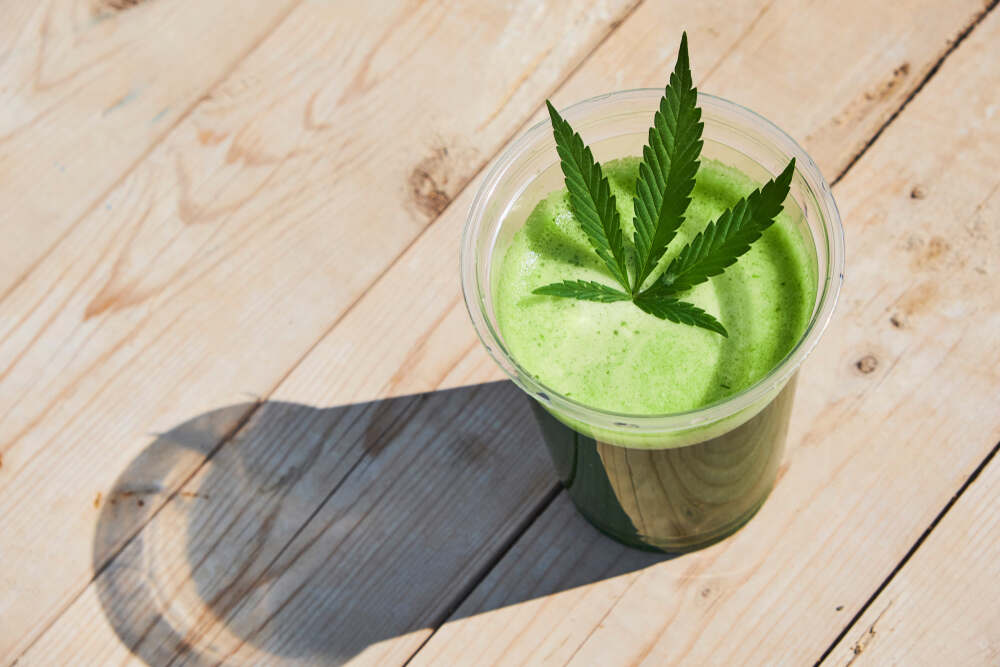
- blended into juices or smoothies;
- dried for herbal tea;
- added to a compost pile after harvest.
If you plan to consume home-grown cannabis leaves, only use clean material that has not been treated with pesticides or foliar products unsuitable for edible crops.
Grower tip: Younger, healthy fan leaves are generally more suitable for culinary uses than old, damaged, yellowing, or pest-affected leaves.
What can I do with leftover fan leaves and sugar leaves?
There is no need to throw away every cannabis leaf after harvest. What you do with leftover leaves depends largely on whether they are fan leaves or resin-covered sugar leaves.
| Leftover material | Common uses |
| Healthy fan leaves | Smoothies, salads, tea, compost |
| Dried fan leaves | Tea or compost |
| Sugar leaf trim | Saved as resin-rich trim for infusions or concentrates where legal |
| Damaged or pest-infested leaves | Dispose of rather than consume |
| Unwanted healthy plant material | Compost where appropriate |
Fan leaves generally contain far fewer glandular trichomes than flowers and sugar leaves, making them better suited to culinary or composting uses than resin collection.
Because of their heavier trichome coverage, there are several useful things you can do with sugar leaves instead of discarding the trim after harvest. Depending on local laws, resin-rich trim may be used for cannabis-infused preparations or concentrate production.
Cannabis leaves also have several traditional uses. For example, fan leaves have historically been incorporated into Thai sticks, while unwanted plant material can be recycled into compost for future grows.
Grower tip: Keep clean sugar-leaf trim separate from ordinary fan leaves during harvest. The higher trichome coverage makes it considerably more useful for resin-based applications.
Conclusion
Weed leaves can reveal a great deal about how a cannabis plant is developing. Cannabis leaf shape changes from simple seedling leaves to larger multi-leaflet fan leaves, while genetics influence whether mature leaves appear narrow, broad, or somewhere between the two. Leaf colour, posture, texture, and condition can also provide early clues about plant health, but no single symptom should be used to diagnose a problem. Check where symptoms appear, along with root-zone conditions, watering, nutrients, and the growing environment. Learning what is normal for each plant makes it easier to recognise meaningful changes early and respond appropriately when needed.
Frequently Asked Questions
Do cannabis leaves contain THC and can they get you high?
Yes, cannabis leaves contain cannabinoids, but the amount varies considerably between leaf types, genetics, and trichome coverage. Cannabinoids are concentrated mainly in glandular trichomes, which is why resin-covered sugar leaves generally contain more cannabinoids than large fan leaves.
Fresh cannabis also contains much of its potential THC as THCA, the non-intoxicating acidic precursor to THC. Heat converts THCA into psychoactive THC through decarboxylation. Fan leaves usually have relatively little resin, while sugar leaves are commonly saved as cannabinoid-rich trim.
Why are my cannabis leaves turning yellow?
Yellow weed leaves can have several causes, including nitrogen deficiency, overwatering, root problems, incorrect pH, or other nutrient issues. Where the yellowing begins can help narrow down the cause; for example, nitrogen deficiency typically affects older, lower leaves first.
Some yellowing of older leaves can also occur naturally as a cannabis plant ages, particularly later in flowering. However, rapid or widespread yellowing should still be investigated rather than automatically dismissed as normal.
Can you smoke weed leaves?
You can smoke weed leaves, but fan leaves are generally a poor substitute for cannabis flowers because they have much lower trichome coverage and usually contain fewer cannabinoids.
Sugar leaves contain more glandular trichomes and cannabinoids, particularly where they grow close to the flowers. They can therefore be more resin-rich than fan leaves, although smoking leafy material typically provides a less desirable experience than properly prepared flower.
For most growers, clean sugar-leaf trim is more useful when kept separate after harvest rather than mixed with ordinary fan leaves.
Can you eat raw cannabis leaves or use them for tea?
Yes. Clean cannabis leaves can be eaten raw in small amounts, added to smoothies or salads, or dried and steeped as an herbal tea. Only use healthy leaves that have not been treated with pesticides or foliar products unsuitable for consumption.
Fresh cannabis contains predominantly acidic cannabinoids such as THCA rather than THC. THCA itself is not intoxicating and is converted into THC mainly through heat and other decarboxylation processes.
Plain cannabis-leaf tea should be viewed primarily as an herbal drink rather than a reliable way to extract substantial amounts of cannabinoids.
How do you tell the difference between Indica and Sativa leaves?
Traditional Sativa leaves generally have long, narrow, serrated leaflets, while Indica-type leaves tend to have shorter, broader leaflets that create a fuller-looking fan leaf.
Leaf width is a more useful visual clue than colour. Although Sativa-type leaves are sometimes described as lighter green and Indica-type leaves as darker, colour varies with genetics, nutrition, environment, and plant age.
Most modern cannabis strains have also been extensively crossbred, so cannabis leaf shape cannot reliably prove that a plant is Sativa or Indica or predict its cannabinoid profile or effects.


