




Growing regular cannabis seeds gives growers access to both male and female plants, making them a strong choice for breeding, plant selection, and anyone who wants to work with traditional photoperiod genetics. The growing process is similar to feminized seeds, but regular seeds require one extra skill: identifying plant sex before unwanted pollination happens.
This guide explains how to grow regular cannabis seeds from germination through harvest, including how many seeds to start, how to care for seedlings, when to check for pre-flowers, how to identify male and female cannabis plants, and what to do with males once they appear.
Key Takeaways
- Once plant sex is managed, regular cannabis plants grow much like comparable feminized photoperiod plants.
- Regular cannabis seeds can produce either male or female plants.
- You should start more seeds than the number of females you ultimately want to keep.
- Male and female plants are identified by checking pre-flowers at the nodes.
- Remove or isolate males before pollen sacs open if you want seedless female flower.
- What Are Regular Cannabis Seeds?
- Why Grow Regular Cannabis Seeds?
- How Many Regular Cannabis Seeds Should You Start?
- How to Grow Regular Cannabis Seeds Step by Step
- How to Germinate Regular Cannabis Seeds
- How to Identify Male and Female Regular Cannabis Plants
- What to Do With Male Cannabis Plants
- How to Prevent Male Plants From Pollinating Females
- Flowering and Harvesting Regular Cannabis Plants
- How to Tell When Female Cannabis Plants Are Ready to Harvest
- Conclusion
- Frequently Asked Questions
What Are Regular Cannabis Seeds?
Regular cannabis seeds can grow into either male or female cannabis plants. Unlike feminized seeds, which are produced to greatly favor female plants, regular seeds give growers access to both sexes. That makes them especially useful for cannabis breeding, selecting parent plants, preserving useful traits through cloning, and producing your own seeds.
Regular seeds do not need a special germination method or growing medium. You can grow them in soil, coco, or hydroponic systems using the same basic approach as other photoperiod cannabis plants. The main difference is that you need to plan for male plants and identify each plant’s sex as it matures.
How Regular Seeds Produce Male and Female Plants
Cannabis is generally a dioecious species, meaning male and female flowers usually develop on separate plants. Regular seeds can therefore produce either sex.
Across a large number of seeds, growers can expect a roughly even male-to-female ratio. However, this is based on probability. A pack of 10 regular seeds will not always produce exactly five males and five females.
Grower Tip: Label each plant from the seedling stage. This makes it much easier to track individual plants once pre-flowers begin to appear.
Regular vs Feminized vs Autoflower Seeds
The main difference between these seed types is how they are produced and, in the case of autoflowers, what triggers flowering.
| Seed type | What to expect | Best suited to |
| Regular | Can produce male or female plants | Breeding and growers who want access to both sexes |
| Feminized | Very high likelihood of female plants | Growers focused on female flower production |
| Autoflower | Flowers according to age rather than a 12/12 light schedule | Faster grows and simpler light schedules |
One important distinction is that regular and autoflower are not complete opposites. Autoflower genetics can also be produced as regular or feminized seeds.
Why Grow Regular Cannabis Seeds?
Regular cannabis seeds are a good choice for growers who want access to both male and female plants. That makes them especially useful for breeding projects, selecting parent plants, preserving traits through cloning, and producing your own seeds.
They also give growers a wider range of plants to evaluate. Instead of growing only females, you can compare structure, growth rate, branching, aroma, flowering behavior, and other traits across a mixed population before deciding which plants are worth keeping.
Benefits for Breeding and Plant Selection
The main advantage of regular seeds is access to male plants. If you want to breed cannabis, collect and store cannabis pollen, or create new crosses, you need suitable male and female parents.
Regular seeds also give you more freedom when selecting plants for future breeding. You can grow several individuals, compare their characteristics, and keep the plants that best match your goals.
Grower Tip: Label every plant clearly from the start and keep notes on growth, structure, and flowering traits. Good records make parent selection much easier later.
When Regular Seeds May Not Be the Best Choice
Regular seeds are less convenient if your main goal is simply to produce female flower.
Because some plants will be male, you need extra space and time to grow them until their sex becomes clear. Growers with limited plant counts, small tents, or restricted space may find feminized seeds more practical because fewer plants need to be removed later.
How Many Regular Cannabis Seeds Should You Start?
Start enough regular seeds to account for the fact that some plants will be male. If your goal is to finish with several female plants, you usually need to start more seeds than the number of females you want to keep.
The exact number depends on your space, legal plant limits, and how much selection you want. Avoid assuming that planting twice as many seeds will always give you the exact number of females you need.
Planning for Male and Female Plants
If you want four female plants, starting six to eight regular seeds gives you more room for variation than starting only four.
Also allow for seeds that fail to germinate or seedlings that do not develop well.
Grower Tip: Do not overcrowd your grow area just to increase the odds of getting females. Start only as many plants as you can manage properly and legally.
Why a 50/50 Chance Does Not Guarantee an Even Split
Regular seeds have roughly equal odds of producing male or female plants across a large population, but small batches can vary.
A pack of 10 seeds might produce five females and five males, but it could also produce seven females and three males, or the reverse. Treat the 50/50 figure as a probability, not a guarantee. You also cannot reliably tell the sex of a cannabis seed from its color, shape, size, or markings, so each plant needs to be grown until its sex becomes identifiable.
How to Grow Regular Cannabis Seeds Step by Step
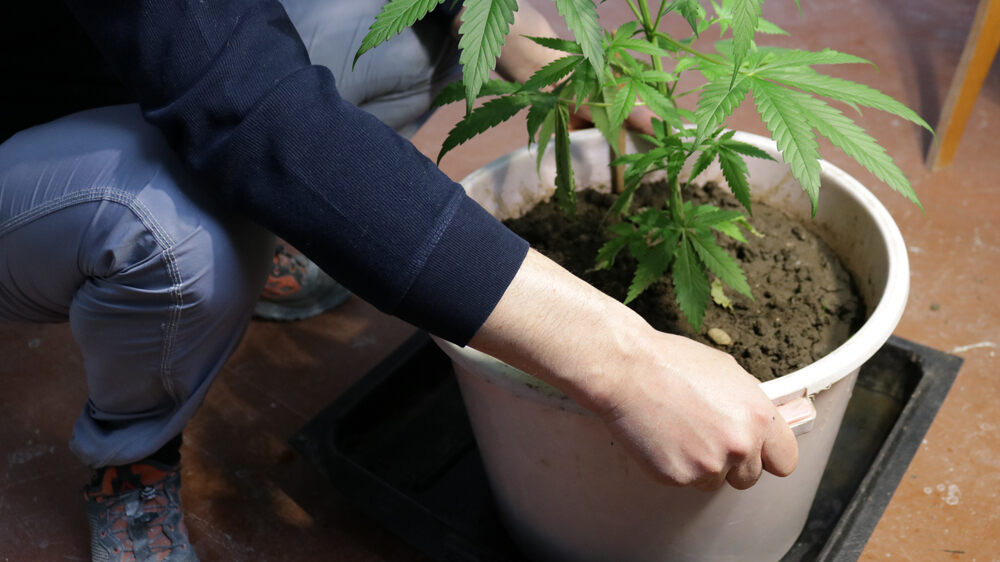
Growing regular cannabis seeds follows the same basic stages as other photoperiod cannabis plants, but there is one extra step to plan for: regular seeds can produce male or female plants. The process below shows what to do at each stage without going into the deeper detail covered later in this guide.
Step 1: Choose and Prepare Your Growing Area
Start with a clean growing space that gives each plant enough room to develop and be inspected.
Indoors, prepare your lighting, ventilation, containers, and growing medium before germination. Outdoors, choose a site with good sunlight, drainage, and protection from severe weather.
Leave enough space to move or separate plants later if needed.
Step 2: Germinate the Regular Cannabis Seeds
Germinate the seeds until they open and produce a small taproot.
Keep the germination medium evenly moist rather than saturated, and handle newly germinated seeds carefully. Once the taproot appears, move the seed into its growing medium.
A full germination method is covered later in this guide.
Step 3: Plant the Germinated Seeds
Place each germinated seed into a small hole in the growing medium and cover it lightly.
Keep the area moist while the seedling emerges, but do not compact the medium or disturb the seed by repeatedly checking underneath the surface.
Label each container from the start so you can track individual plants as they develop.
Step 4: Establish Healthy Seedlings
Give young seedlings suitable light, stable conditions, and careful watering while their roots become established.
Avoid heavy feeding or keeping the growing medium constantly wet. At this stage, the aim is steady early growth rather than trying to push the plant too quickly.
Watch for stretched stems, drooping, discoloration, or stalled growth and correct problems early.
Step 5: Grow the Plants Through the Vegetative Stage
During vegetative growth, focus on developing healthy stems, branches, leaves, and roots.
Indoor photoperiod plants are commonly kept under a long-day light schedule such as 18 hours of light and 6 hours of darkness.
Keep plants labeled and make simple notes if you are interested in breeding or plant selection.
Step 6: Check Each Plant's Sex
As the plants mature, begin checking for pre-flowers at the nodes.
Do not remove a plant based on one unclear structure. Confirm the sex by checking several nodes and waiting for the reproductive structures to become easier to identify if necessary.
The dedicated sexing section later in this guide explains the visual differences between male and female pre-flowers.
Step 7: Decide What to Do With Male Plants
Once a plant is confirmed male, decide whether you need it.
If you are growing for seedless female flower, remove or separate unwanted males before they release pollen. If you are breeding, move selected males to a controlled area away from females you do not want pollinated.
The important point is to make this decision before pollen is released.
Step 8: Move Female Plants Into Flowering
After plant sex has been confirmed and unwanted males have been dealt with, continue the selected females into flowering.
Indoor photoperiod plants are commonly moved to a 12-hour light and 12-hour dark schedule. Outdoor plants flower as seasonal daylight shortens.
Keep conditions consistent and follow the expected flowering time for the strain you are growing.
Step 9: Monitor Flower Development
As flowering progresses, watch how the flowers mature rather than relying only on a calendar date.
Use the breeder's estimated flowering range as a guide, but also assess the plants themselves before deciding they are ready.
The later harvesting section covers the signs of maturity in more detail.
Step 10: Harvest and Handle the Flowers Properly
Once the plants reach the maturity you want, harvest the female flowers and move them into the drying stage.
Drying and curing should be handled slowly and carefully rather than rushed. At this point, plants grown from regular seeds are treated the same way as comparable feminized photoperiod plants.
The main difference with regular seeds happens earlier in the grow: planning for both sexes, identifying them correctly, and managing male plants before pollination occurs.
How to Germinate Regular Cannabis Seeds
Regular cannabis seeds germinate in the same way as other cannabis seeds. The goal is to provide moisture, warmth, and enough oxygen for the seed to open and produce a healthy taproot. The method below is beginner-friendly, while our full guide to how to germinate cannabis seeds covers additional methods and common germination problems. One of the simplest beginner methods is to use a lightly damp paper towel or another clean germination medium.
Step 1: Moisten the Germination Medium
Dampen the paper towel or germination medium with clean water. It should feel moist but not dripping wet. Too much water can reduce oxygen around the seed and increase the risk of rot.
Step 2: Place the Seeds in the Medium
Place the seeds on the damp surface with a little space between each one, then cover them with another moist layer. Handle the seeds gently and avoid squeezing or scraping the shell.
Step 3: Keep the Seeds Warm and Moist
Keep the seeds in a warm, dark place while they germinate. Check the medium regularly and re-moisten it if it begins to dry out.
Avoid soaking the seeds or letting them sit in standing water. Consistent moisture is more important than excessive moisture.
Step 4: Wait for the Taproot to Appear
Check the seeds once or twice a day. Germination time varies, so do not discard a seed simply because it takes longer than the others.
Once the shell opens and a small white taproot becomes visible, the seed is ready for planting.
Step 5: Carefully Plant the Germinated Seed
Make a small hole in your chosen growing medium and place the seed inside with the taproot pointing downward where possible. Cover it lightly and keep the area moist while the seedling emerges.
How to Identify Male and Female Regular Cannabis Plants
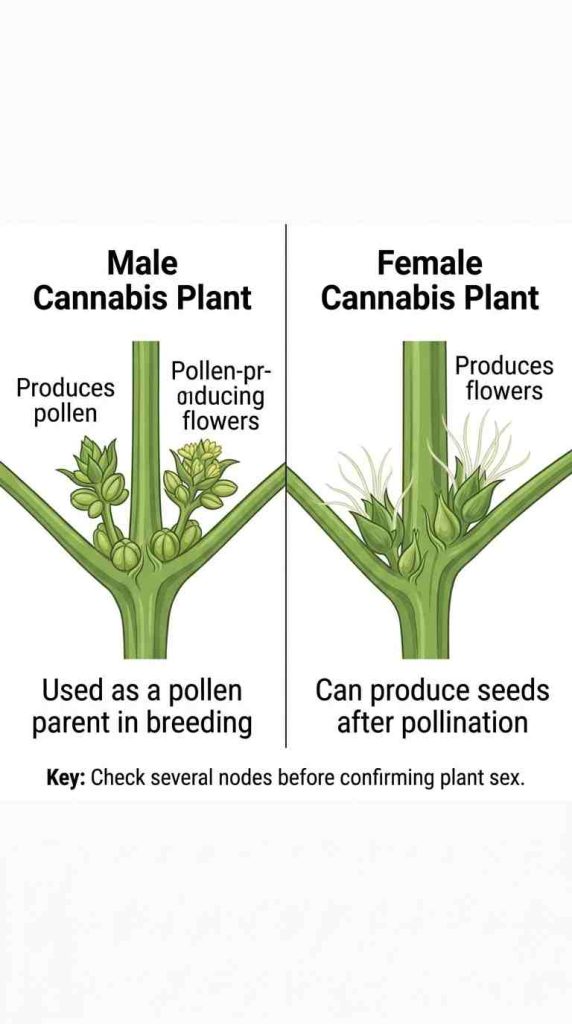
Regular cannabis plants need to be sexed as they mature so you can decide which plants to keep, remove, or isolate. The easiest way is to inspect the developing pre-flowers at the nodes and compare several sites on each plant before making a final call.
Step 1: Wait Until Pre-Flowers Begin to Develop
Do not try to sex plants too early. Pre-flowers usually become easier to identify as plants mature and approach flowering.
Look for small reproductive structures forming at the nodes. If they are still tiny or unclear, give the plant more time rather than guessing.
Step 2: Check the Nodes Where Branches Meet the Main Stem
Inspect the points where side branches meet the main stem. This is where pre-flowers usually appear first.
Use a small magnifier if needed. Check several nodes on the same plant because one early structure may not be clear enough to identify confidently.
Step 3: Look for Female Pre-Flowers and White Stigmas
Female pre-flowers usually develop a small bract with two fine white stigmas emerging from it.
These hair-like stigmas are one of the clearest early signs of a female plant. As flowering progresses, more female flower structures will appear around the nodes.
Do not confuse stipules, which are pointed leaf-like structures found at the nodes, with female pre-flowers.
Grower Tip: Check the upper and middle nodes where new growth is actively developing. Pre-flowers are often easier to see there than at the oldest lower nodes.
Step 4: Look for Rounded Male Pollen Sacs
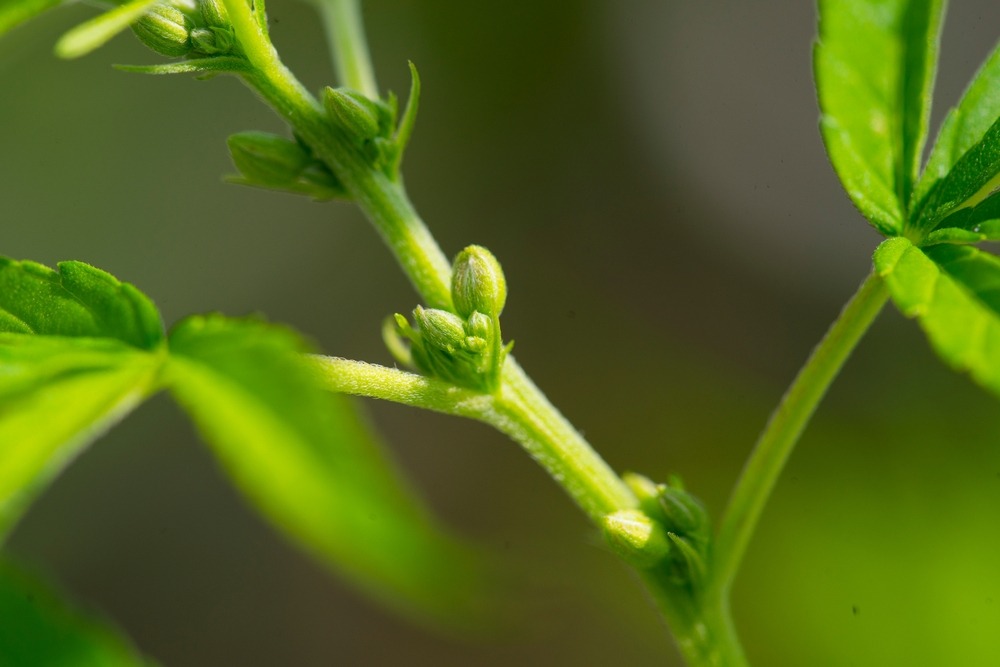
Male plants usually form small, rounded pollen sacs at the nodes instead of white stigmas.
At first, these may appear as single smooth structures. As the plant develops, more sacs can form in clusters and hang slightly away from the stem.
If your goal is seedless female flower, identify males before the sacs mature and open.
Step 5: Recheck Plants if Their Sex Is Not Yet Clear
If you are unsure, wait and inspect the plant again after a few days.
Do not remove a plant based on one ambiguous pre-flower. Compare several nodes and look for repeated male or female features before making a decision.
This reduces the risk of accidentally removing a female plant or leaving a male in the grow too long.
What to Do With Male Cannabis Plants
Male plants are useful if you are breeding, but they need to be managed carefully if your goal is seedless female flower. Once a plant is confirmed male, decide whether it will be removed or kept in a separate breeding area.
| Your goal | What to do with male plants | Why |
| Grow seedless female flower | Remove confirmed males before pollen sacs open | Prevents unwanted pollination |
| Breed cannabis plants | Keep selected males in a separate area | Allows controlled pollen collection and planned crosses |
| Unsure about plant sex | Isolate and recheck the plant | Reduces the risk of removing a female too early or leaving a male too long |
How to Remove Males When Growing Seedless Female Flower
If you are growing for unseeded female flowers, remove confirmed males before their pollen sacs open.
Move them carefully so you do not shake mature sacs over nearby females. If a male is already close to releasing pollen, handle it as little as possible and take it away from the grow area promptly.
Grower Tip: Do not wait for pollen to become visible. Once sacs open, nearby females may already have been exposed.
How to Keep and Isolate Males for Breeding
If you want to breed, keep selected males in a separate space away from females you do not want pollinated.
When selecting males for breeding, compare observable traits such as structure, branching, growth pattern, aroma, and overall health. The resulting offspring should then be evaluated before deciding whether a male is worth using again. Keep clear labels and records so you know which male contributed pollen to each cross.
How to Prevent Male Plants From Pollinating Females
Preventing accidental pollination depends on early identification, separation, and regular checks. Pollen can spread easily, so do not rely on distance alone if male plants are being kept for breeding.
Step 1: Inspect Plants Regularly as Pre-Flowers Develop
Check plants often once pre-flowers begin to form. Focus on the nodes and compare several sites on each plant.
Frequent inspection gives you more time to identify males before pollen sacs mature.
Step 2: Identify Male Plants Before Pollen Sacs Open
Male pollen sacs start as small rounded structures and become more obvious as they mature.
The goal is to act while the sacs are still closed. Once they open, pollen can spread through airflow, clothing, tools, or direct contact.
Step 3: Move or Remove Male Plants From the Female Growing Area
Remove unwanted males completely, or move selected breeding males to a separate, controlled space.
Avoid carrying mature males through areas containing flowering females. If you work with both spaces, change clothes and clean tools before returning to the female grow.
Grower Tip: Work with female plants first and breeding males last. This reduces the chance of carrying pollen back into the main flowering area.
Step 4: Continue Checking Female Plants During Flowering
Do not stop inspecting plants after the males are gone.
Female plants can occasionally develop pollen-producing structures, so continue checking flowers during bloom. If you find any, isolate the affected plant and assess it before pollen is released.
Flowering and Harvesting Regular Cannabis Plants
Once unwanted males have been removed, the remaining female plants can continue through flowering and harvest much like comparable feminized photoperiod plants. From this point, the focus shifts from plant sex to flower development and maturity.
Flowering Regular Plants Indoors vs Outdoors
Indoors, photoperiod plants are commonly moved to a 12-hour light and 12-hour dark schedule to trigger flowering. Keep the dark period uninterrupted and the schedule consistent.
Outdoors, flowering begins naturally as day length shortens. Timing varies by strain, latitude, and season, so outdoor growers should plan around local conditions rather than a fixed date.
How to Tell When Female Cannabis Plants Are Ready to Harvest
Use flower development and trichome maturity as your main guides instead of relying only on the breeder’s estimated finish time.
Check trichomes with a magnifier and compare several flowers on the plant. The plant should show consistent signs of maturity before you harvest.
Drying and Curing After Harvest
After harvest, dry cannabis slowly in a dark area with steady airflow and controlled conditions.
Once properly dried, cure the cannabis in suitable containers so remaining moisture can equalize gradually.
Conclusion
Growing regular cannabis seeds gives you access to both male and female plants, which makes them especially useful for breeding, plant selection, and growers who want more control over future crosses.
The main extra step is sex management. Keep plants labeled, inspect pre-flowers carefully, and remove or isolate males before pollen is released if you want seedless female flower. Once the sexes are managed, the rest of the grow follows the same general process as other photoperiod cannabis plants.
Regular seeds are not harder to grow, but they do require closer observation and a little more planning.
Frequently Asked Questions
Do Regular Cannabis Seeds Need Different Growing Conditions?
No. Regular cannabis seeds need the same basic conditions as comparable photoperiod cannabis plants, including suitable light, water, nutrients, airflow, and root space.
The main difference is that regular seeds can produce male or female plants, so you need to identify and manage plant sex as the grow develops.
How Long Do Regular Cannabis Seeds Take to Grow?
Most regular photoperiod cannabis plants take several months to grow from seed to harvest.
The total time depends on the strain, how long you keep plants in the vegetative stage, and the flowering period. Indoor growers can control when flowering begins, while outdoor growers depend more on seasonal changes in daylight.
How Many Regular Cannabis Seeds Should I Plant to Get Female Plants?
There is no exact number that guarantees a certain number of females.
Regular seeds have roughly equal chances of producing male or female plants across a large population, but small batches can vary. If you want several females, start more seeds than the final number of plants you plan to keep, while staying within your available space and local rules.
When Can You Tell if a Regular Cannabis Plant Is Male or Female?
You can usually identify sex once pre-flowers become visible at the nodes.
Female plants generally develop small pre-flowers with white stigmas, while male plants form rounded pollen sacs. If the structures are still unclear, wait a little longer and check several nodes before deciding.
What Should You Do With Male Plants From Regular Seeds?
If your goal is seedless female flower, remove or isolate confirmed males before their pollen sacs open.
If you are breeding, selected males can be kept in a separate area and used for controlled pollen collection. Keep them away from females you do not want pollinated and label each plant clearly.


