




Cannabis plants naturally gain height as they develop, but there is a difference between healthy growth and excessive stretching. Long internodes, thin stems, an uneven canopy, or plants rapidly reaching toward the grow light can all indicate that something in the growing environment needs attention. The cause can also change depending on whether the plant is a seedling, in vegetative growth, entering flowering, or growing as an autoflower.
In this guide, we explain how to recognize cannabis stretching at each growth stage, what can cause it, and how to work through the problem step by step. You will also learn how lighting, temperature, plant spacing, root space, genetics, and canopy management can influence plant height, along with practical ways to prevent excessive stretch before it becomes difficult to control.
Key Takeaways
- Not all cannabis stretching is a problem. Plants naturally become taller as they grow, particularly during the transition into flowering. Genetics also play a major role, so judge stretching by changes in internodal spacing, stem strength, and canopy balance rather than height alone.
- Start by checking the light. If a plant becomes unusually tall, thin, or widely spaced between nodes, review light position and intensity first. Poor or uneven light coverage can encourage plants to reach upward in search of stronger light.
- The cause can change with the growth stage. A stretched seedling may require a different solution from a plant stretching during vegetation or early flowering. Diagnosing the stage first makes it easier to identify what needs correcting.
- Fix one factor at a time and watch the new growth. Existing stretched stems will not become shorter. After adjusting lighting, temperature, spacing, or another environmental factor, use the newest nodes and branches to judge whether the correction is working.
- Prevention is easier than correcting an overgrown canopy. Good plant spacing, stable environmental conditions, suitable lighting, enough root space, and early canopy management give growers much more control before the natural flowering stretch begins.
- What is cannabis stretching?
- Cannabis seedling stretch: how to identify the early warning signs
- Cannabis stretch during the vegetative stage
- Cannabis stretching during the flowering stage of growth
- How to fix and prevent cannabis stretching during flowering
- How to prevent excessive flowering stretch next time
- How to fix a stretching autoflower step by step
- How to prevent autoflower stretching
- Preventing cannabis stretching throughout each growth stage
- Conclusion
- Frequently Asked Questions
What is cannabis stretching?
As you grow cannabis from seed to harvest, plants naturally become taller and wider as they develop new stems, branches, nodes, and leaves. Stretching is most commonly associated with the transition stage from vegetation into flowering; however, there will be times when genetics, environmental conditions and low light levels can cause plants to stretch.
Cannabis plants can stretch tall, become lanky, and produce a tall, thin structure. Stretching can occur during the seedling, vegetative, and flowering stages and will affect plant height.
- Stretching can cause plants to become tall and grow with a weak stem
- Seedlings that stretch may topple over the side of the pots
- Excessive stretching during bloom will affect light spread
| Growth stage | What stretching can look like | Main warning signs | What to check first |
| Seedling | A tall, thin seedling with an elongated stem | Weak stem, leaning or falling over the side of the pot | Light intensity, temperature, light spectrum and airflow |
| Vegetative | Increasing plant height with wider internodal spacing | Long gaps between nodes and a narrow, upright structure | Light intensity, plant spacing, temperature and pot size |
| Flowering | Rapid vertical growth as plants transition into bloom | Tops outgrowing the usable light area, shading and unstable branches | Light distance, light intensity, temperature and available space |
| Autoflower | Increased height as the plant moves toward flowering | Faster-than-expected vertical growth or reduced canopy control | Temperature, light intensity, light distance, spectrum and spacing |
Cannabis seedling stretch: how to identify the early warning signs
The earlier that you can recognise your seedlings are stretching and becoming tall and lanky, the better! Below covers cannabis seedlings, what may cause them to stretch, and how to identify the early warning signs.
What can cause your cannabis seedling to stretch?
During the cannabis seedling stage, your plants focus on developing roots, anchoring themselves in the growing medium, and building a stem strong enough to support new growth. The better developed the root zone, the easier it will be for the seedlings to support themselves upright and develop a strong and thick stem. Seedlings can end up stretching and becoming too tall and weak, so below are the 5 main causes for stretched seedlings.
| Possible cause | What happens | What the grower may notice |
| Low light intensity | The seedling grows upward in an attempt to receive more usable light | A long stem and increasing height |
| High temperatures | Excessive warmth can encourage elongated growth | A thin, wire-like appearance |
| Outgrowing a starter container | Limited space can make it harder for the young plant to establish itself properly | Weak support and seedlings leaning or falling |
| Unsuitable light spectrum | A red-dominant setup may encourage more elongated growth than a blue-rich vegetative spectrum | Taller growth and wider spacing |
| Lack of airflow | The stem receives little movement to encourage stronger development | A pale, delicate stem with poor stability |
Low Light Intensity
Even though seedlings do not need much light or nutrients when they are so young, you still need to provide enough light so they can grow 3-4 inches with ease and not need support in any way, using a small splint or thin bamboo cane.
Growers who keep their grow light above 12 inches will often find that the seedlings are stretching as tall as they can in an effort to increase light exposure.
High Temperatures
Seedlings enjoy a warm and humid environment that mimics springtime; however, they are particularly sensitive to high temperatures. Exceeding 28 degrees Celsius will cause seedlings to stretch and become long and wire-like. It is best to keep the grow room cooler, stay as close to 24 degrees Celsius as possible, and maintain a high humidity level around 70%.
Seed Starter Kits
Seedlings can very quickly outgrow seed starter kits. Once roots are beginning to fill the starter container, it is worth checking when to transplant cannabis so you can move the seedling before restricted root space becomes a problem. Starter cubes are great for the initial germination phase, but allowing seedlings to stay inside the tiny cubes for more than 10 days will encourage excessive stretching.
This often results in seedlings falling over the side of the pot and causing the stem to kink and become angled.
Red Light Spectrum
Cannabis seedlings require red light to develop roots; however, they also require a large amount of blue light to produce vegetative growth and foliage. If you are using a light that is designed for the flowering period, or was manufactured as a red spectrum-dominant grow light, then this will result in elongated growth and a tall, narrow growth structure.
No Air Flow
Providing seedlings with a gentle breeze can help strengthen the stem, making it more resistant to wind. The more chance your seedlings have to gently sway and lightly blow, the more rigid and tougher the stem becomes. Without a gentle breeze, seedlings will continue to grow tall with a pale and delicate stem.
No Plant Training
Many cannabis plant training techniques are well suited for better canopy control and for manipulating the shape and growth structure of your plants. Sativa strains and sativa-dominant hybrids generally produce more vertical growth than naturally compact genetics, so their expected structure should be considered before assuming extra height is a problem. Without plant training, some genetics can become tall, overgrown, and difficult to maintain and grow.
How to fix cannabis seedling stretching without slowing growth
Your seedlings are still growing just fine; however, it may be inconvenient to have plants that are much taller than anticipated. Below highlights how I have solved cannabis stretching in the past without compromising growth.
Low Light Intensity
When I am starting off my seedlings, I like to use a low-powered LED and keep the LED 8-12 inches above the top of the seedling. I use around 40w of power and maintain a cool, optimal environment that guarantees short intentional spacing. CFL and LED are the best lights in my opinion for seedlings and rooting clones.
High Temperatures
The rule of thumb is to keep the temperature at 24 degrees Celsius when the light is on, and when the light is off, try to keep a temperature between 18-20 degrees Celsius. As long as your grow light is producing enough intensity, then your seedlings will remain short and stocky. I use a digital hygrometer to monitor my propagation station 24/7.
Seed Started Kits
I love using seed starter kits, especially if I am growing a large number of seeds. They are easy to use, and within 2-3 days, all my seedlings are ready to go. You will find that after 7 days, the small plastic moulded trays are full of healthy white roots.
All I do next is prepare the grow medium and a pot to transplant the 7-day-old seedlings in a lightly watered medium. Now the seedlings have plenty of room to spread their roots and properly anchor themselves.
Red Light Spectrum
The ideal spectrum for seedlings and vegetative growth is blue light (6400k). Compact fluorescent lights (CFL) or LED lights are optimal as they have a balanced spectrum, with the ideal levels of blue and white light for the seedling and vegetative period.
You can use a CFL strip light such as the T5 models, which I have used in the past and work incredibly well, produce hardly any heat and use very little power!
No Air Flow
Providing your seedlings with enough airflow is essential to keep the grow room temperature consistent and also promote strong stem development. I find that using a small oscillating fan kept far away from the seedlings works best.
You do not want to give the seeds too much wind and airflow, as they can end up drying out or suffering from windburn. A gentle, soft swaying breeze will help your seedlings love it.
Plant Training
I would recommend applying the topping, LST and super cropping techniques to your vegetative plants once they are 4 weeks old. Tying your plants down will significantly reduce plant height and create a bushy, horizontally dominant canopy that can receive more light.
Plant training is also effective for increasing yields, improving airflow and maximising a grow space. You can also use a thin wooden bamboo cane or a gardening stick to help support the tall and lanky seedling. I find that creating a loop around the seedling stem and the cane allows it to grow upright and develop a thicker and more durable stem.
Cannabis stretch during the vegetative stage
The cannabis vegetative stage is when plants focus on developing roots, stems, branches, and healthy new foliage. At this stage, plants will develop new internodes and become taller, with internodal distance dependent on genetics. Below breaks down what causes cannabis plants to stretch during the vegetative stage, signs of stretching during 18/6 and how to fix the issue.
What causes your cannabis plant to stretch during the vegetative stage?
Low light intensity is the main cause you notice internodal spacing becoming longer every day, and your plants are growing much taller than you would like or originally anticipated. Using a PAR meter, you can check whether you have the optimal PPFD levels for superior growth and development. 400 to 600 µmol/m²/s is the ideal range.
If your grow light does not contain adequate levels of blue light, you will find that the plants focus on apical vertical growth. This is why plants that receive blue light during early growth produce compact and tighter internodal spacing.
Grow lights rich in the red or green spectrum are best suited for the flowering period; however, they can encourage excessive vertical growth during 18/6. The distance of your grow light can also impact how short or tall the plants are. I always find that keeping your grow light 12-18 inches above the canopy provides the perfect light coverage, penetration and PPFD levels.
Small pots and root-bound plants can result in tall, overstretched plants during vegetation. This can be easily resolved by repotting in a wider and deeper pot. Ideally, a fabric pot, as they prune roots and produces a superior root zone compared to plastic pots.
Overcrowded grow space causes your plants to fight for light and, as a result, grow taller in refined spaces. I have seen this trait in many grow rooms that had too many plants inside, and not enough space for plants to become bushy. Evenly space your plants out so they are not touching one another, and ensure each has plenty of light.
High temperatures during the vegetative stage, or cold nighttime temperatures, can cause vegetating plants to stretch. Many growers struggle to control fluctuations between hot and cold. Still, if you can maintain a consistent warm temperature close to 24 degrees Celsius, you will not need to worry about unwanted stretching.
How stretching changes during the vegetative stage
- Cannabis plants are focused on bushy growth and a stocky stature
- Internodal spacing should be compact and range between 2-3 inches
- Sativa-dominant genetics are more prone to focusing on vertical growth
What should you look out for and how should I fix it?
If you notice that the internodal spacing of your plants is becoming too long and exceeding 9 inches, causing the plants to take on a narrow and thin appearance, then you can do several things.
| What you notice | Possible cause discussed in the article | Suggested response |
| Internodal spacing is becoming longer | Insufficient light intensity | Check usable light levels and adjust the lighting setup where necessary |
| Plants are growing strongly upward rather than outward | Light spectrum or genetics | Review the spectrum and account for naturally taller genetics |
| Plants are crowded together | Competition for available light | Increase spacing so each plant has room to develop |
| Growth becomes tall and narrow in a small container | Restricted root space | Move the plant into a wider or deeper container where appropriate |
| Height is becoming difficult to manage | Genetics, environment or insufficient canopy control | Use suitable low-stress training to lower and spread the canopy |
| Stretch coincides with unstable temperatures | Large environmental fluctuations | Aim for a more consistent growing environment |
The first thing I would do is to tie the plants down using gardening wire to immediately lower the height. The next thing I would do is insert 9-12 bamboo canes around the edge of the pot and train the side branches to grow outward.
- LST produces thicker and stronger stems capable of holding more weight
- LST is ideal for growers with limited height and space
- Sativa and sativa-dominant hybrids benefit greatly from LST training
- Plants that have been tied down will produce bigger secondary colas
- LST should be done during vegetation or early flowering if necessary
Cannabis stretching during the flowering stage of growth
The cannabis flowering stage is when you can expect the most noticeable natural stretch, particularly during the first part of the transition from vegetative growth into flower. As a grower, you will welcome an aggressive stretch once your plants receive 12 hours of light and 12 hours of darkness.
Below breaks down the signs that stretching has become a problem during 12/12, nutritional and environmental causes of excessive stretching and how to control stretching without reducing bud development and yields.
On one hand, you want your plants to stretch tall and wide; however, you do not want them to exceed your comfort zone or what is practical for your grow space.
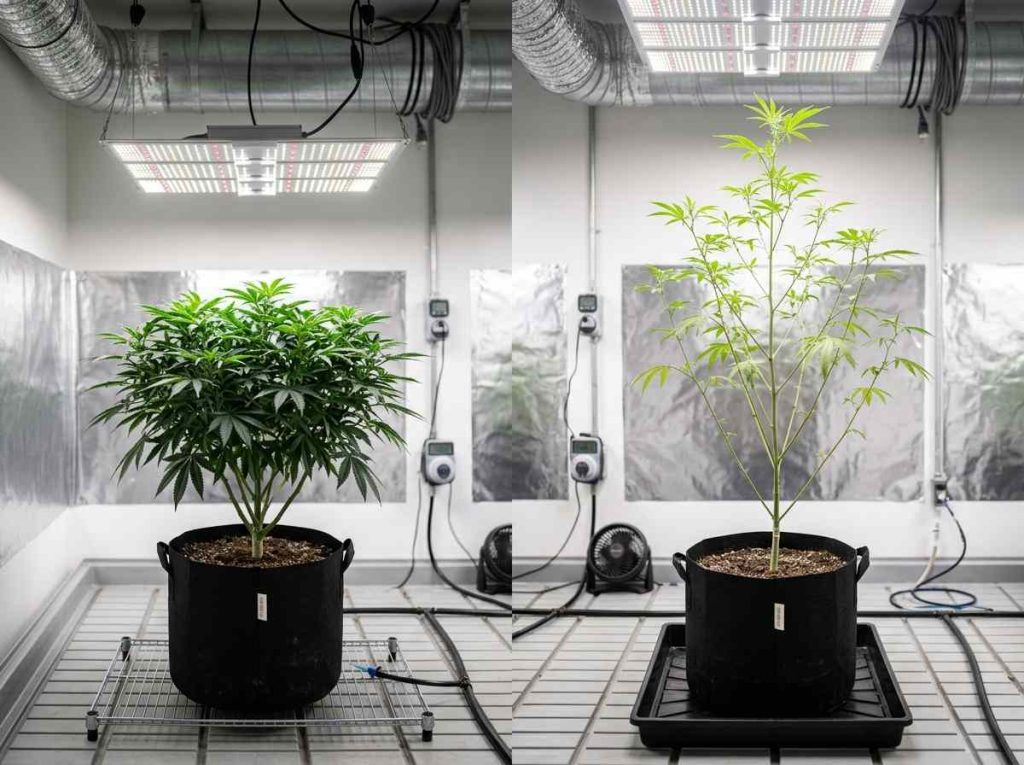
What are the signs that stretching has become a problem?
I have come across many incidents both indoors and outdoors when excessive stretching has become an issue for me. Many issues can arise due to working with tall plants, and they are covered below:
- Tops of plants grow above the grow lights, receiving minimal PPFD levels
- The lower half of the plant produces small and wispy buds due to low light levels
- Surrounding plants can become shaded and not develop buds as well
- The structure of the plants during flowering is not stable and topples over
Causes of excessive stretching in flowering
It is during the flowering period when your plants will grow as big and tall as possible in preparation to focus all their energy on flower production. It is during this time when all systems are gone, and as a grower you must be vigilant for excessive stretching. Below is a breakdown of what can cause unwanted stretching during 12/12 and how to fix it.
Light Distance
If your grow light is not close enough, then your plants will compensate for the distance and stretch as tall as they can. Within weeks, your plants can race to grow toward the light, and those with limited space are often overwhelmed.
Light Intensity
Using a PAR meter, you will want to adjust the light intensity to sit between 800 and 1000 µmol/m²/s. This will be the optimal amount of PAR for flowering cannabis plants and will eliminate the need for your plants to stretch too tall in the first place.
Hot and Cold Temperatures
Grow rooms that experience high temperatures during the lights-on period and cold temperatures during lights-off will suffer from excessively tall plants. I have witnessed this numerous times in other grow rooms during wintertime.
Frequently monitor the temperature of your grow room and do not exceed a temperature deficit of more than 6-8 degrees Celsius during lights on and off.
Small Pots
Once a cannabis plant outgrows a small pot, if it is not repotted into a larger pot, then it will become tall and narrow. This may work well for Sea of Green setups, as plants keep a short vegetative period before flowering. Large-sized plants in small pots will adapt by keeping a narrow growth structure.
How to fix and prevent cannabis stretching during flowering
Some stretching during the first part of flowering is normal. The key is knowing when that stretch becomes a problem. If the tallest branches are getting too close to the grow light, internodal spacing is increasing quickly, or one plant is starting to shade the rest of the canopy, it’s time to figure out what is driving the extra height.
Instead of changing everything at once, work through the steps below in order. This helps you identify the cause and see whether each adjustment is actually improving the situation.
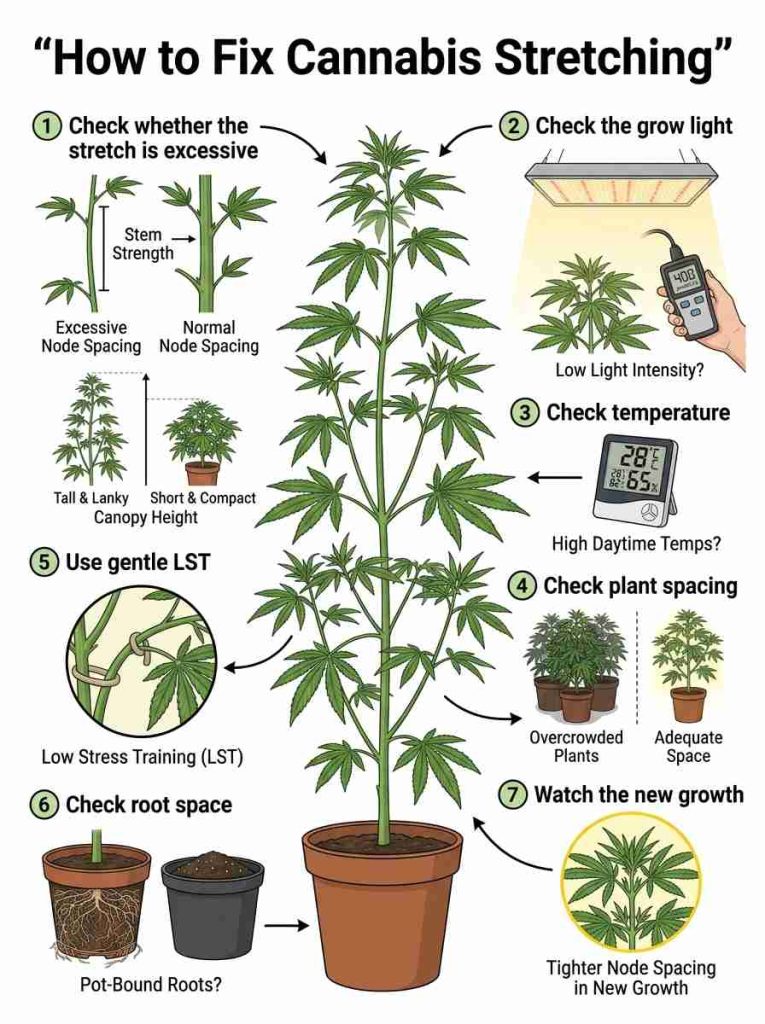
Step 1: Decide whether the stretch is actually a problem
Start by looking at the plant as a whole. A plant getting taller after switching to 12/12 is not automatically stretching excessively.
Look for signs such as:
- noticeably longer gaps between new nodes
- one or two tops growing well above the rest of the canopy
- branches reaching strongly toward the grow light
- neighboring plants becoming shaded
- lower flowering sites receiving noticeably less light
- plants beginning to outgrow the available vertical space
Genetics play a big role here. Some cultivars naturally gain much more height during early flowering than others. Always compare the plant to its own earlier growth rather than judging height alone.
Step 2: Check the grow light
If plants are reaching upward quickly, check the lighting before making major changes to the plant itself.
First, review the manufacturer’s recommended hanging height for your fixture. Different LEDs and other grow lights produce very different intensities, so there is no universal distance that works for every setup.
If you have a PAR meter, take readings at multiple points across the canopy. Do not measure only directly under the center of the light. The outer edges of the grow space often receive significantly less usable light.
If the light is too high or coverage is uneven, make small adjustments rather than lowering the fixture dramatically all at once. Then observe the newest growth to see whether stretching begins to slow.
Step 3: Check the temperature
Once lighting is dialed in, evaluate the growing environment.
Use a thermometer or digital hygrometer to monitor temperatures during both lights-on and lights-off periods. You are looking for unusually high temperatures or large swings between day and night.
If the room becomes much hotter during lights-on and then significantly cooler when lights go off, work on stabilizing conditions. Improving ventilation, air circulation, or temperature control can help create a more consistent environment.
Do not judge results based on already-stretched stems. Those internodes will not shorten. Focus on how new growth develops after adjustments are made.
Step 4: Check the space between plants
Crowded plants can make stretch worse and harder to manage.
Look down at the canopy from above. If plants are heavily overlapping, taller branches may shade smaller ones and reduce light penetration to lower sites.
Where possible, increase spacing between pots and gently spread branches into open areas of the grow space. The goal is to allow each plant access to light without forcing all growth upward into the same limited space.
This is especially important when growing multiple large plants or cultivars known for strong flowering stretch.
Step 5: Lower taller tops with gentle LST
If one or two tops are clearly above the rest of the canopy, gentle low-stress training can help even things out.
Choose a flexible branch and slowly bend it outward rather than forcing it downward. Secure it loosely with soft plant ties so the top sits closer to the height of the surrounding canopy.
Avoid trying to reshape the entire plant in one session. Small, gradual adjustments are safer than forcing stiff flowering branches into position.
Once flowering is well underway and branches have hardened, avoid aggressive training unless absolutely necessary. The easiest time to control height is still during vegetative growth and early flower transition.
Step 6: Check whether the plant has enough root space
Container size is best addressed before flowering begins.
If plants are still in veg and clearly root-bound, transplant them into their final containers before switching to 12/12 and allow time for recovery.
Avoid unnecessary transplants once flowering is underway. At that stage, correcting light, environment, and canopy structure is usually more effective than disturbing the root system.
Step 7: Watch the new growth
After making adjustments, focus on what happens next rather than expecting existing stretch to reverse.
Look for:
- slower vertical growth
- shorter spacing between new nodes
- a more even canopy
- fewer tops racing above the rest of the plant
- more consistent light distribution across flowering sites
If stretching continues, go back through the steps and reassess one factor at a time instead of changing multiple variables at once.
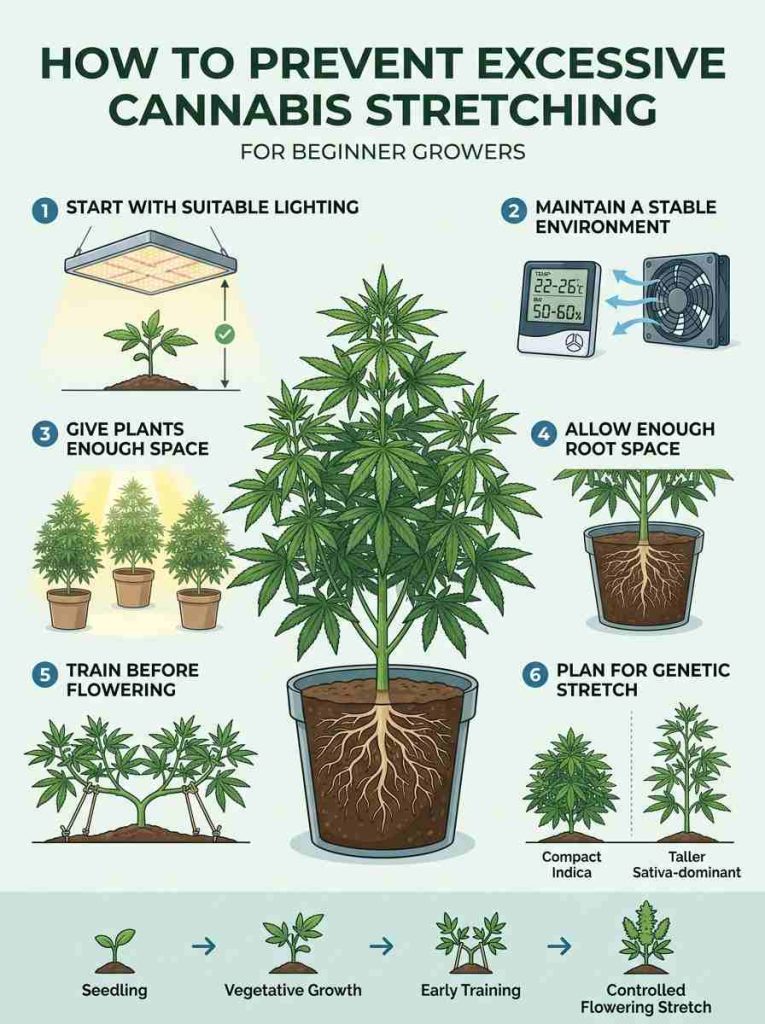
How to prevent excessive flowering stretch next time
Prevention starts before the switch to 12/12.
When growing feminized cannabis seeds indoors, account for the expected stretch before switching photoperiod plants to 12/12 and leave enough vertical space for the plant to develop.
Complete most topping, LST, and canopy shaping during vegetative growth. Space plants properly, establish them in their final containers early, and confirm even light coverage before flowering begins.
This makes stretch much easier to manage because you are guiding normal growth instead of trying to correct an overgrown canopy after the fact.
| Flowering problem | What to check | What to do |
| Tops are reaching toward the light | Light position and intensity | Check manufacturer guidance and adjust gradually |
| One branch is much taller than the canopy | Branch flexibility and space | Gently lower with LST |
| Plants are shading each other | Spacing and canopy overlap | Increase spacing and spread branches |
| Stretch coincides with unstable temperatures | Day/night temperature swings | Stabilize environment and airflow |
| Plants outgrow containers before flowering | Root space | Transplant before 12/12 if needed |
| Stretch continues after adjustments | New growth response | Recheck light, temperature, and spacing one at a time |
What does stretching look like in autoflowers?
Plants grown from autoflowering cannabis seeds can stretch just like photoperiod plants, but the amount of vertical growth varies considerably between cultivars. Some stay naturally compact, while others become significantly taller during early development and the transition into flowering.
Because of this, a tall autoflower is not automatically a sign of a problem.
The key question is whether the plant is showing normal genetic growth or whether environmental factors are causing unusually long internodes and weak structure.
How do you know if an autoflower is stretching too much?
Focus on new growth rather than final height.
Warning signs include:
- rapidly increasing distance between nodes
- thin stems combined with fast vertical growth
- branches strongly reaching toward the light
- plant becoming tall and sparse very quickly
- neighboring plants shading each other
- difficulty achieving even light coverage across the canopy
If the plant is tall but has strong stems, balanced branching, and consistent node spacing, it may simply be expressing its natural structure
How to fix a stretching autoflower step by step
Autoflowers develop quickly, so early identification is important. Understanding how long autoflowers take to grow also helps explain why there is less time to correct stretching once flowering has started.
Work through the following steps in order.
Step 1: Consider genetics first
Before changing anything, consider the expected growth pattern of the cultivar.
Some autoflowers are naturally compact, while others grow taller and more open. If possible, check breeder information for expected height and structure.
Do not try to force a naturally tall plant to stay extremely short. Instead, look for abnormal elongation or unusually weak, thin growth.
Step 2: Check the light
Light is one of the most common causes of stretching in autoflowers.
Make sure the grow light is centered over the plant and positioned within the recommended range for your fixture.
If using a PAR meter, take readings across the canopy to identify uneven coverage.
If adjustments are needed, make them gradually. Avoid moving powerful lights too close too quickly.
Then observe new growth rather than expecting existing stems to change.
Step 3: Check temperature and humidity
Use a digital hygrometer to monitor conditions throughout the day.
Watch for excessive heat under lights or large swings between day and night temperatures.
If conditions are unstable, improve ventilation, airflow, or temperature control before making further plant adjustments.
Maintain appropriate humidity for the plant’s stage of growth, focusing on stability rather than chasing exact numbers.
Step 4: Check plant spacing
Even autoflowers need enough space for light penetration.
If plants are too close together, overlapping leaves can block light and encourage upward stretching.
Increase spacing where possible and ensure each plant has its own clear area of light exposure.
Step 5: Use gentle LST if the plant is still flexible
If the plant is still in early growth or early flower, gentle LST can help manage height.
Slowly bend the tallest flexible stem outward and secure it loosely with a soft tie to lower the main growth point.
Avoid sharp bends or aggressive training, especially once stems begin to harden or flowering is well established.
Autoflowers have limited recovery time, so minimal stress is best.
Step 6: Check the container
It is best to start autoflowers in their final container whenever possible.
Avoid unnecessary transplanting once flowering has begun, even if the plant has stretched.
For future grows, choose container size in advance so the root system can develop without interruption.
Step 7: Watch new growth
Stretched sections will not reverse, so focus on future development.
Look for:
- more controlled vertical growth
- tighter node spacing
- stronger stems
- improved canopy balance
- more even light distribution
If stretching continues, revisit lighting, temperature, and spacing one factor at a time.
How to prevent autoflower stretching
The best prevention is a stable environment from the start.
Set lighting correctly early, provide enough space, maintain consistent temperatures, and avoid crowding plants together.
Plan container size ahead of time, since autoflowers move quickly through their life cycle and leave little room for correction.
Most importantly, understand the natural growth pattern of the cultivar. Some height is normal, and recognizing genetic structure makes it much easier to distinguish healthy growth from true stretching issues.
For growers with limited vertical space, choosing compact autoflower genetics and managing canopy structure early is usually far more effective than trying to correct height after flowering has already begun.
Preventing cannabis stretching throughout each growth stage
When you have your growing environment well dialled in, your light intensity and distance are optimal, you should not need to worry about excessive and unwanted stretching. However, there will be times when it can happen during the seedling, vegetation or flowering stage.
To help prevent overstretching again, below are the ideal lighting conditions, environmental factors to consider, and cannabis plant training techniques that can be used.
Ideal lighting practices for seedlings, vegetative and flowering stages
Regardless of the stage your plants are currently in, as long as you follow these principles, you will be able to eliminate the concern of unwanted and excessive stretching.
- Provide the optimal PPFD levels for each stage of growth
- Make sure the light spectrum contains blue lighting for vegetative growth
- Monitor the temperature and humidity of the grow room using a digital hygrometer
- Repot plants once they have become too big for the current pot
- Do not let the grow room temperature drop below 18 degrees Celsius
- Avoid high temperatures above 28 degrees Celsius when the lights are on
- Apply plant training techniques such as topping, FIM and LST during 18/6
- Space plants evenly apart so they do not fight for light and can grow outward
Environmental factors such as temperature, humidity and airflow
Keeping your grow room consistently ventilated with fresh, carbon dioxide-rich air is essential for large yields of amazing-quality flowers. Temperature, humidity and airflow are all connected and can make or break a harvest.
Take the time and money to invest in tools and equipment such as fan temperature controllers to help control your growing environment. I have found these devices to be lifesavers and do everything for you!
Training techniques that prevent and reduce stretching
Below are my favourite techniques for reducing plant height and unwanted stretching. I recommend that you apply all of these during the vegetative stage between week 4-8, allowing plenty of recovery time.
- LST - Tying down the top of the plant and side branches immediately reduces height
- Pruning - Allows you to strip away lower growth and focus on a top-heavy canopy
- Super Cropping - Creates a hard wooden knuckle and enhanced growth
Conclusion
Cannabis stretching is not always a sign that something has gone wrong. Plants naturally gain height as they develop, particularly during the transition into flowering, and the amount of stretch will depend partly on genetics. Problems begin when stems become weak, internodal spacing increases excessively, or plants grow beyond the available space and light coverage.
The best approach is to identify stretching early and work out what is driving it. Light intensity and distance, temperature, airflow, plant spacing, pot size and genetics can all influence plant height at different stages. Keeping the growing environment consistent and managing the canopy during vegetative growth makes it much easier to prevent excessive stretching before flowering begins.
Frequently Asked Questions
Is it normal for cannabis plants to stretch?
Yes. Cannabis plants naturally become taller as they grow, and stretching is especially noticeable when photoperiod plants transition from vegetative growth into flowering. Genetics have a major influence on how much height a plant gains, so some cultivars will naturally stretch more than others. Stretching becomes a concern when growth is unusually thin, weak or difficult to manage.
Why is my cannabis plant growing tall and skinny?
Tall, narrow growth can be associated with insufficient light, excessive distance between the plant and grow light, high temperatures, overcrowding or naturally tall genetics. Look at the spacing between nodes as well as overall height. If internodal gaps are increasing quickly and stems appear weak, check the growing environment before assuming genetics are responsible.
Can stretched cannabis seedlings recover?
Stretched seedlings can continue developing if the underlying cause is corrected early. Check that they are receiving suitable light, maintain a stable environment and provide gentle airflow to encourage stronger stem development. If a seedling has become unstable, it may also need temporary support while the stem thickens and the root system becomes better established.
When do cannabis plants stretch the most?
The most noticeable stretch usually occurs as photoperiod cannabis moves from vegetative growth into flowering. During this transition, plants can increase considerably in height as new flowering sites develop. How much a plant stretches will vary according to genetics, growing conditions and its size before the change to the flowering light cycle.
How can I reduce excessive cannabis stretching?
Start by identifying the cause rather than relying on one solution. Check light intensity and positioning, temperature, plant spacing and available root space. During vegetative growth, suitable plant-training techniques such as LST can also help keep height under control and create a more even canopy before plants enter flowering.


